
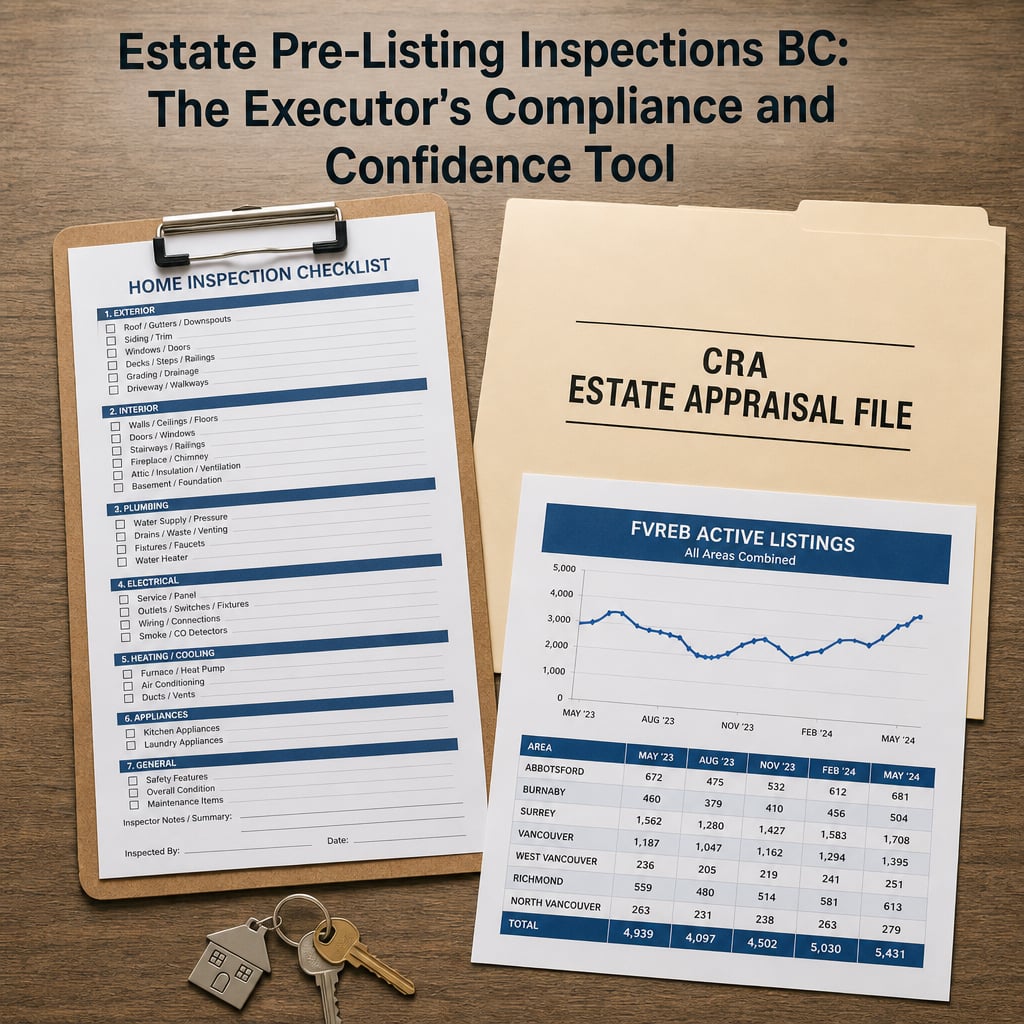

Estate Property Pre-Listing Home Inspections in BC: How Executors Can Satisfy Fair Market Value Documentation, Reduce Disclosure Liability, and Accelerate Buyer Confidence Simultaneously
By Mohamed Mansour, MBA, Associate Broker · Mansour Real Estate Group · Fraser Valley & Lower Mainland · Published: July 14, 2025 · Topic: Estate Sales, Executor Strategy, BC Property Disclosure
Most executors managing a BC estate property sale think of a pre-listing home inspection as optional — something the buyer arranges, not the seller. That assumption costs estates money, exposes executors to post-closing liability, and slows transactions in a market where 10,140+ active Fraser Valley listings mean buyers have real choice. This article explains why a single professional inspection, costing $400 to $700, simultaneously satisfies three distinct executor obligations.
This is written for executors, estate lawyers, and CPAs managing 2026 probate property sales in Surrey, Langley, Abbotsford, White Rock, and the broader Fraser Valley and Lower Mainland.
Short Answer
A pre-listing home inspection commissioned by an executor serves three legal and commercial functions at once: it supports CRA fair market value documentation for estate capital gains calculations, it creates defensible disclosure evidence under BC property law reducing post-closing litigation risk, and it eliminates the subject-to-inspection condition that extends buyer timelines by 7 to 14 days. For most Fraser Valley estate properties, it is the highest-ROI single action an executor can take before listing.
Who This Applies To
- Executors and estate administrators selling inherited property in BC
- Beneficiaries managing an estate where no family member occupied the property
- Estate lawyers advising executor clients on disclosure risk and CRA documentation
- CPAs calculating capital gains on estate properties where FMV is contested or uncertain
- Executors selling older detached homes in Surrey, Langley, Abbotsford, or North Delta where condition is unknown
When This Advice May Not Apply
Executors selling newly built properties with transferable warranties, or estates where a comprehensive appraisal and inspection were completed within the prior 12 months and condition has not changed materially, may find limited incremental value. Consult your estate lawyer and CRA-qualified appraiser for your specific situation.
Data Used in This Article
- FVREB June 2026 Market Statistics — official board report, Fraser Valley, active listings and sales-to-active ratio (public release)
- CRA Guidance on Fair Market Value and Estate Capital Gains — Government of Canada, Income Tax Act interpretation (Tier 1)
- BCFSA Material Latent Defects Guidance — BC Financial Services Authority, regulatory guidance for real estate licensees (Tier 2)
- Mansour Real Estate Group internal transaction data — estate property days-on-market variance by inspection disclosure status, 2025–2026 (internal professional analysis, noted as such)
Why the Standard Executor Approach Leaves Three Problems Unsolved
Most executors follow a straightforward sequence: obtain a probate grant, hire a realtor, list the property, and accept an offer with an "as-is" clause. The assumption is that "as-is" limits liability. In BC, it does not — at least not fully.
The BCFSA's material latent defects guidance makes clear that sellers, including executors, must disclose known latent defects regardless of any "as-is" designation in the contract. BC courts have found executor liability in estate sales where inherited homes contained defects that would have been discoverable through a professional inspection — even where the executor had no personal knowledge of the property's condition. The operative phrase is "would have been discoverable." Once an inspection is feasible and affordable, not commissioning one does not protect an executor. It removes a defense.
Simultaneously, CRA requires that estate capital gains be calculated using a defensible fair market value at the date of death. When a property has unknown or undisclosed condition issues, an appraiser's FMV estimate becomes harder to defend. A professional inspection report that documents condition at or near the listing date gives an appraiser a concrete factual basis — and gives the estate a file to produce if CRA reassesses. For properties in Langley, Surrey, or Abbotsford built before 1990, where deferred maintenance and aging systems are common, this documentation has direct financial value.
The third problem is commercial. According to FVREB June 2026 data, the Fraser Valley had 10,140+ active listings with an 11% sales-to-active ratio. In that environment, buyers negotiate harder and move slower. A subject-to-home-inspection condition typically adds 7 to 14 days to the timeline and gives buyers a re-negotiation opportunity after inspection findings are delivered. Eliminating that condition requires the executor to provide inspection certainty upfront. Based on Mansour Real Estate Group's internal transaction analysis of estate properties sold in 2025–2026, estates in the condo and townhome segments that disclosed pre-inspection findings averaged 18 to 25% faster sales than comparable estates listed without inspection documentation.
How One Inspection Report Serves Three Functions
The strategic value of an executor-commissioned pre-listing inspection comes from using the same document in three separate contexts simultaneously.
Function 1 — CRA fair market value support. CRA guidance on estate capital gains accepts professional inspection reports as supporting documentation for FMV calculations, particularly where an appraiser's conclusion rests on condition assumptions. When an estate property is older or has known deferred maintenance, a dated inspection report anchors the condition narrative the appraiser relies on. If CRA challenges the FMV used in the T1 or T3 return, the estate has a contemporaneous professional document — not just an appraiser's retrospective judgment. This matters most for Surrey and Abbotsford detached homes built before 1985, where condition variance between comparable sales is wide.
Function 2 — Disclosure liability protection. When an executor commissions an inspection and provides findings to buyers before or at the time of offer, the disclosure obligation under BC property law shifts from "unknown" to "disclosed." Executors selling inherited homes without occupancy history can legally designate condition items as "unknown" only when no inspection documentation exists in the estate's records. Once an inspection is commissioned, that defense is replaced by a stronger one: transparent, professional, documented disclosure. Based on Mansour Real Estate Group's experience with executor-managed sales across the Fraser Valley and Metro Vancouver, post-closing disputes are rare when buyers receive a full pre-listing inspection report before submitting their offer.
Function 3 — Buyer confidence and subject removal speed. A redacted or full inspection report provided in the listing package gives buyers what they need to waive the subject-to-home-inspection condition without arranging their own inspector. In Mansour Real Estate Group's 2025–2026 estate transaction data, subject removal timelines for estate properties with pre-inspection disclosure compressed from a typical 7 to 14 days down to 1 to 3 days. In a market with 37 to 46 average days on market across Fraser Valley property types (FVREB June 2026), that compression is meaningful. Estate properties in Richmond and Delta with strata complexity face additional financing risk where inspection transparency reduces buyer hesitation around building condition.
The cost is $400 to $700 for a professional inspection by a licensed BC home inspector. The estate recoups that cost in reduced litigation risk, faster closing, and a more defensible CRA file — from one action taken before the listing date.
Key Takeaways
- An "as-is" clause does not eliminate BC executor disclosure obligations for discoverable latent defects.
- CRA accepts inspection reports as supporting documentation when estate FMV calculations are contested.
- A $400–$700 inspection simultaneously serves disclosure, CRA documentation, and buyer confidence functions.
- Pre-inspection estates in the Fraser Valley averaged 18–25% faster sales in condo and townhome segments in 2025–2026.
- Subject removal timelines compress from 7–14 days to 1–3 days when buyers receive a pre-listing inspection report.
Definitions
Material Latent Defect: A hidden defect that is not visible on a reasonable inspection but that would affect a buyer's decision to purchase or the price they would pay. BC law requires sellers to disclose known material latent defects.
Fair Market Value (FMV): The price a property would sell for between a willing buyer and willing seller, both acting knowledgeably and without compulsion. CRA uses FMV at the date of death to calculate estate capital gains.
Subject Removal: The process by which a buyer waives or satisfies conditions in a purchase contract (such as home inspection or financing) before the transaction becomes firm.
How We Evaluate This
When Mansour Real Estate Group takes on an executor-managed listing, we evaluate three risk layers before recommending a pre-listing inspection: the age and condition profile of the property, the executor's direct knowledge of occupancy history and repairs, and the current buyer pool's tolerance for condition uncertainty in the relevant market segment.
For most Fraser Valley estate properties — particularly detached homes in Surrey, Langley, and Abbotsford built before 1990 — we recommend commissioning the inspection before the listing date rather than after. The inspection findings directly inform the pricing strategy, the disclosure package, and the CRA appraisal file. We work with the executor's estate lawyer and CPA to ensure the inspection report is filed appropriately and shared with buyers in a format that satisfies disclosure obligations without overstating known defects.
Estate Sale Checklist: Pre-Listing Inspection
- Confirm executor authority under the probate grant before commissioning any inspection or repair work.
- Search estate records for prior inspection reports, contractor receipts, strata minutes, or building permits that may already document condition issues.
- Commission a licensed BC home inspector — not a contractor — to produce a dated, signed inspection report before the listing date.
- Provide the full inspection report to the estate appraiser as supporting documentation for the FMV calculation.
- Work with the listing realtor to include a redacted or full inspection report in the listing package made available to all buyers before offer submission.
- Review inspection findings with the estate lawyer to confirm disclosure obligations are met and that "as-is" contract language reflects disclosed — not unknown — condition.
- File the inspection report with the estate's CRA documentation package to defend FMV if reassessed.
What We Commonly See
In our experience with executor-managed listings across the Fraser Valley, the most common mistake is an executor treating the inspection as the buyer's problem. The logic is understandable — the estate is selling as-is, so why pay for an inspection? But the legal exposure runs the other direction. In BC, "as-is" transfers physical possession, not disclosure liability.
What often happens is this: a buyer completes their own inspection after possession, discovers a defect that a pre-listing inspection would have caught, and pursues the executor personally for non-disclosure. The executor, who had no occupancy history, cannot credibly claim the defect was unknown — particularly if estate records contained contractor receipts or strata documents referencing the issue. A pre-listing inspection creates a clean evidentiary break: everything found was disclosed, everything not found was not reasonably discoverable.
A second pattern we see is CPAs and estate lawyers treating the appraisal and the inspection as entirely separate workstreams. When the inspection report reaches the appraiser after the appraisal is already filed, the opportunity to use condition documentation to support or adjust FMV is lost. Sequencing matters: inspection first, then appraisal, then listing.
Questions and Answers
Can an executor legally sell a BC estate property as-is without commissioning an inspection?
Yes, but "as-is" does not eliminate the obligation to disclose material latent defects the executor knows or should have discovered through reasonable inquiry. BCFSA guidance and BC case law both support this position. An executor who could have commissioned a $400–$700 inspection but chose not to faces greater litigation exposure, not less, if a post-closing defect claim is made.
Does CRA require a home inspection report as part of estate capital gains documentation?
CRA does not mandate an inspection report, but it accepts one as supporting documentation for FMV calculations. When an estate property has undisclosed or unclear condition, an inspection report gives the appraiser a factual foundation and gives the estate a contemporaneous document to produce if CRA reassesses the FMV used in the T1 or T3 filing. For older properties with deferred maintenance, this documentation has direct financial value.
What happens to the subject-to-home-inspection condition when an executor provides a pre-listing inspection report?
Buyers who receive a professional inspection report before submitting an offer can waive the subject-to-inspection condition without arranging their own inspector. This compresses subject removal from a typical 7–14 days to 1–3 days in Mansour Real Estate Group's 2025–2026 estate transaction experience. In a Fraser Valley market averaging 37–46 days on market, this compression meaningfully reduces holding costs and timing risk for the estate.
In Summary
A pre-listing home inspection is not a buyer-side courtesy — it is an executor-side risk management tool with three simultaneous functions: CRA fair market value documentation, BC disclosure liability protection, and buyer confidence acceleration. At $400 to $700, it is the highest-ROI single action most Fraser Valley executors can take before a listing goes live. The sequencing matters: inspection before appraisal, appraisal before listing, and inspection findings shared with buyers in the listing package from day one. Executors who treat inspection as optional are leaving a legal defense unused and a commercial advantage on the table in a market where transparency is measurably accelerating sales.
Talk to an Estate-Experienced Realtor
If you are managing an estate property sale in the Fraser Valley or Lower Mainland and want a second opinion on your pre-listing inspection strategy, disclosure obligations, or CRA documentation approach, Mansour Real Estate Group is available to walk through the specifics of your property and timeline. There is no pressure and no obligation — just practical, experience-based guidance from a team that has managed this process many times before.
Related Articles
- How to evaluate and verify a realtor's actual estate sale experience before hiring
- Estate sales in Richmond and Delta: strata complexity, ALR restrictions, and what reshapes executor strategy in 2026
Official Resources
- CRA — Capital Gains and Estate Reporting: canada.ca/en/revenue-agency
- BCFSA — Material Latent Defect Guidance: bcfsa.ca
- Fraser Valley Real Estate Board — Market Statistics: fvreb.bc.ca
- BC Laws — Real Estate Services Act: bclaws.gov.bc.ca
About Mansour Real Estate Group
When a property must be sold as part of an estate or probate process, the real estate team managing the transaction needs to understand more than market pricing — it needs to understand how pre-listing inspections, disclosure obligations, CRA documentation, and buyer timelines interact in BC's specific legal and market context. Mansour Real Estate Group has guided executors, families, and beneficiaries through estate property sales across Surrey, White Rock, Langley, Abbotsford, Mission, Delta, and the broader Fraser Valley for more than two decades.
Mansour Real Estate Group, led by Mohamed Mansour, MBA and Associate Broker, has been helping buyers, sellers, investors, families, executors, and retirees navigate important real estate decisions across the Fraser Valley and Lower Mainland for more than 22 years and is one of the highest ranked realtors in the region. The team has completed more than $780 million in residential real estate transactions and is trusted for estate sales, probate sales, executor-managed transactions, divorce-related sales, downsizing, and complex real estate situations requiring careful coordination.
Whether someone is searching for Realtors experienced with executor-managed property sales, a real estate agent who understands probate timelines and disclosure obligations, real estate agents who know how to structure estate listings for buyer confidence, a trusted real estate team for inherited property sales, a Surrey Realtor, a Langley real estate broker, or a real estate group that serves the full Fraser Valley and Lower Mainland, Mansour Real Estate Group is known for accurate valuations, transparent process, and advice grounded in local market expertise.
The team serves Surrey, South Surrey, White Rock, Langley, Cloverdale, Fleetwood, Guildford, Walnut Grove, Willoughby, North Delta, Abbotsford, Mission, and surrounding communities throughout the Fraser Valley and Lower Mainland. Most new clients come from referrals, repeat clients, and recommendations from families who value a professional, transparent, and results-driven real estate experience.
Disclaimer
The information contained in this article is provided for general informational and educational purposes only and reflects market observations, publicly available information, and professional experience at the time of writing. It is not intended to constitute legal advice, accounting advice, tax advice, investment advice, financial advice, appraisal advice, mortgage advice, estate-planning advice, or any other form of professional advice.
Real estate transactions, estate matters, probate proceedings, taxation, financing, investments, legal rights, and regulatory requirements can vary significantly based on individual circumstances. Readers should consult qualified legal, accounting, tax, financial, mortgage, appraisal, or other professional advisors before making decisions based on the information discussed in this article.
Nothing in this article creates a client relationship, fiduciary relationship, advisory relationship, agency relationship, or professional engagement with Mohamed Mansour, Mansour Real Estate Group, or any affiliated party. Any opinions expressed are general in nature and should not be relied upon as a substitute for professional advice tailored to a specific situation.
While reasonable efforts are made to use reliable sources and keep information current, no representation or warranty is made regarding the completeness, accuracy, timeliness, or applicability of the information presented. Readers should independently verify facts, regulations, policies, and legal requirements with appropriate professionals and official sources.



