

Estate Contents Clearance Timeline and Cost Strategy: How Executors Should Coordinate Personal Property Removal, Estate Sales, and Donation Before Professional Real Estate Marketing Begins
By Mohamed Mansour, MBA, Associate Broker | Mansour Real Estate Group | Fraser Valley & Lower Mainland | Published: May 27, 2025 | Topic: Estate Sales, Executor Strategy, BC Probate
For executors managing an inherited property in the Fraser Valley, one of the most time-consuming and financially consequential tasks happens before the real estate sign goes up. Clearing decades of accumulated household contents—furniture, personal effects, collections, clothing, documents, and everything in between—typically takes two to six weeks and directly determines when a property can list. In a rising-inventory market, that delay has measurable costs.
This guide is written for executors, co-executors, and families managing estate properties in Surrey, Langley, White Rock, Abbotsford, North Delta, and surrounding communities. It covers the practical decisions that most probate resources skip: how to sequence contents clearance, whether an estate sale pays, when donation makes more sense, and how to protect the estate's net proceeds while staying on a realistic timeline.
Short Answer
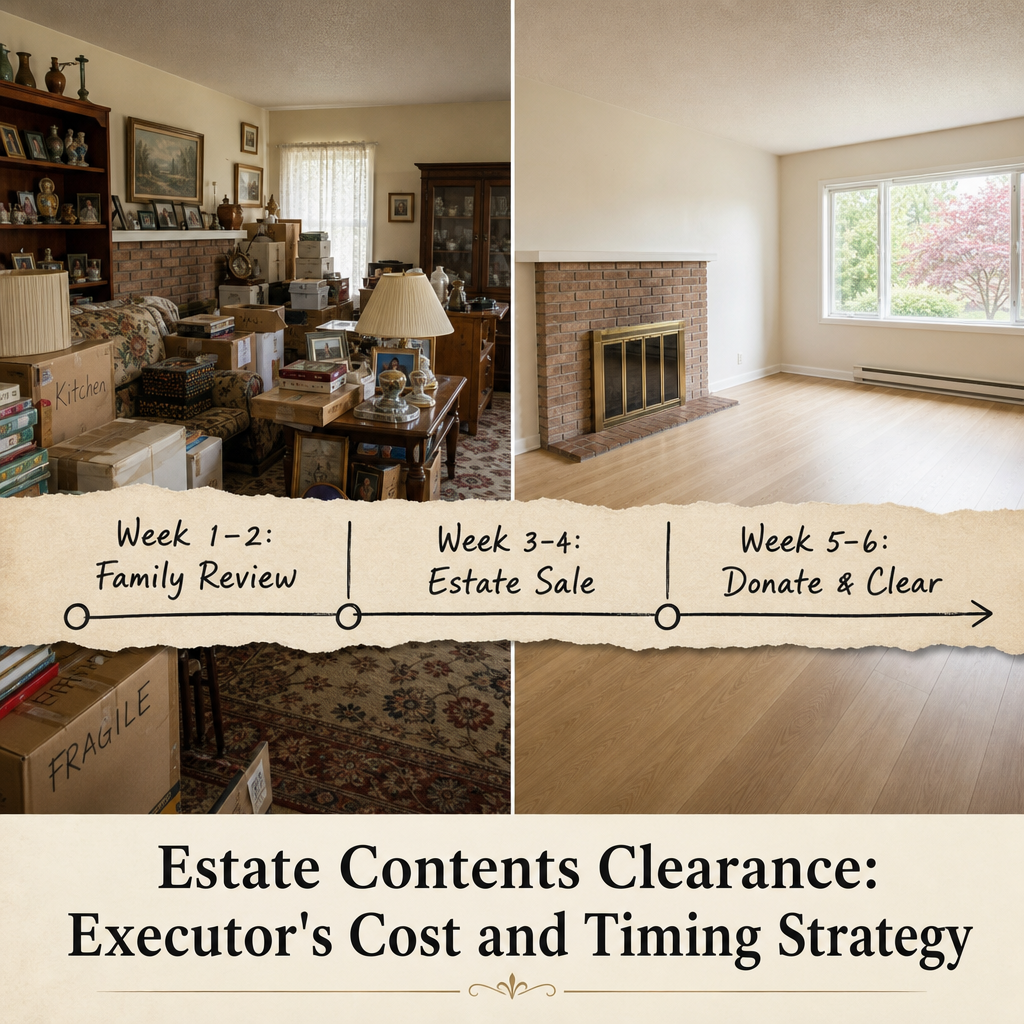
Contents clearance is the critical-path task that determines when an estate property can list. Most executors should begin family item review in weeks one and two, run an estate sale or coordinated donation in weeks three and four, and complete disposal and light cleaning by week five or six. Listing before clearance is possible but adds logistical complexity and can reduce buyer confidence. Each week of delay in a high-inventory market like spring 2026 in the Fraser Valley costs the estate negotiating position.
Key Takeaways
- Contents clearance typically takes two to six weeks and sits directly on the critical path to listing.
- Professional estate sale companies charge 30–50% commission, netting the estate a fraction of appraised item value.
- Donation to registered charities can generate CRA-eligible tax receipts for the terminal return, but high-value items require itemized appraisals.
- Listing with contents present is possible but creates logistical barriers for showings and may reduce buyer confidence in the property.
- In a rising-inventory market, each week of delayed listing reduces the estate's leverage during offer negotiation.
Who This Applies To
- Executors and co-executors managing a BC estate property with substantial household contents
- Families inheriting a family home occupied for 20 or more years
- Beneficiaries who need to sell quickly but face disagreement about personal items
- Executors weighing estate sale companies against donation or self-managed clearance
When This Advice May Not Apply
If the estate property has minimal contents, has already been partially cleared by family, or is a newer home with limited accumulated items, this timeline compresses significantly. Executors dealing with hoarder-level accumulation or properties requiring biohazard remediation will need professional cleaning services beyond the scope of a standard estate sale. Consult an estate lawyer before making decisions about disposal of items with potential legal restrictions—certain items, firearms, business assets, or contents with disputed ownership may require court direction.
Data Used in This Article
- Fraser Valley Real Estate Board April–May 2026 statistics — official board data — active listings and days on market
- Dan Marusin PREC estate-sale timeline reference — third-party professional reference — Week 4–10: Clear contents and light prep
- Mansour Real Estate Group estate contents clearance guidance — internal professional analysis — estate sale commission range and timing framework
- CRA official guidance — Government of Canada — charitable donation tax receipts for terminal returns
Why Timing Contents Clearance Correctly Matters in 2026
The Fraser Valley Real Estate Board reported more than 10,000 active listings in spring 2026, one of the highest inventory levels in recent years. When supply is elevated, buyers have options. Properties that sit on the market lose negotiating leverage quickly. A four-to-eight-week contents clearance delay during the spring peak can mean the difference between competing with a handful of comparable listings and entering a market where dozens of similar properties are already available.
Carrying costs compound the delay. Mortgage payments, property taxes, utilities, insurance, and strata fees—if applicable—continue to draw from the estate during every week the property sits uncleared and unlisted. Executors have a fiduciary responsibility to beneficiaries to move efficiently, and that responsibility includes managing the contents clearance timeline, not just the real estate transaction itself. If the estate property is in Surrey, Langley, or White Rock, a real estate team with executor experience can help you coordinate the clearance and listing timeline from the outset, rather than discovering the scheduling conflict after probate is already in progress.
The Recommended Clearance Sequence
Weeks one and two: Family item review. Before anything leaves the property, beneficiaries should have a structured opportunity to identify items they wish to retain. This step prevents later disputes and protects the executor from claims that sentimental or valuable items were disposed of improperly. Establish a written record of what each family member takes, including estimated value where relevant. Items retained by beneficiaries at below-market value may need to be accounted for in the estate distribution, depending on the will's terms. Confirm the approach with the estate lawyer before the walk-through.
Weeks three and four: Estate sale or coordinated donation. Once family items are allocated, remaining contents fall into two categories: items with resale value and items suitable for donation or disposal. This is when executors must make the estate sale decision. An experienced estate sale coordinator can walk the property and provide a candid assessment of whether a professional sale event is worth the logistics and commission. If resale value is limited, coordinating bulk donation to registered charities followed by a bin haul for disposal is often faster and less expensive.
Estate Sale vs. Donation: A Practical Cost Framework
Professional estate sale companies typically charge 30 to 50 percent of gross sales as their fee. On a property with $10,000 in saleable contents, the estate nets between $5,000 and $7,000 after commission—before expenses such as advertising, setup, and unsold item removal. That net return is meaningful when the contents include furniture, collectibles, tools, or appliances in good condition. It is rarely worth the four-to-six-week setup and sale timeline when contents are primarily everyday household items with limited resale appeal.
Donation to a registered Canadian charity allows the estate to claim a charitable tax receipt on the terminal return of the deceased, reducing the estate's tax liability. However, the CRA requires itemized documentation for donations of property valued above $1,000, and donations of capital property above $5,000 require an independent qualified appraisal. The tax benefit is real, but the documentation burden is also real. Executors who skip the appraisal step risk having the deduction disallowed. For items of uncertain value—art, antiques, jewelry, or collections—a qualified appraiser should review before disposition decisions are made. This is also relevant to the executor's broader duty of care when managing estate assets.
How We Evaluate This
When Mansour Real Estate Group works with an executor on an estate property, the contents clearance conversation happens during the first property walkthrough—before any listing preparation begins. We assess the volume and nature of contents, the family's coordination readiness, and the realistic timeline to a clear, photographable property. That assessment directly shapes the listing date we plan toward. Executors who try to manage clearance after signing a listing agreement often find themselves in conflict with their own listing timeline. Starting the sequence earlier—even before probate is fully granted in some cases—usually produces a better outcome for the estate and the beneficiaries.
Should You List With Contents Still Present?
Some executors consider listing the property while contents remain, particularly when carrying costs are high or the estate is under time pressure. This is possible but carries specific risks. Buyers viewing a home filled with another family's belongings have difficulty visualizing the space, which affects offer motivation. Personal items also create liability concerns during showings—executors are responsible for the contents until they are transferred or disposed of, and a buyer's agent walking through a crowded estate property may flag condition concerns that would not exist in a cleared home. In most cases, completing clearance before listing produces stronger offers and fewer complications. The exception is a highly motivated buyer market where demand is sufficient to overcome presentation challenges—a condition that is less common in the current Fraser Valley inventory environment.
Estate Sale Checklist for Executors
- Confirm with the estate lawyer which items may be distributed, sold, or donated before the estate is fully settled
- Organize a family walk-through within the first two weeks of taking possession of the property
- Create a written record of all items retained by family members, including agreed-upon values
- Have a qualified appraiser review items of uncertain value before any donation or disposal decision
- Get written quotes from at least two estate sale companies before committing, including their commission rate, unsold item handling, and timeline
- Confirm which charities in your area accept large-item donation pickups and whether they issue itemized receipts
- Schedule a bin or junk removal service for the final disposal phase before professional cleaning
- Coordinate with your real estate team on the listing target date before starting the clearance sequence, not after
What We Commonly See
In our experience, the most common executor mistake is sequencing clearance after listing preparation rather than before it. An executor will sign a listing agreement, set a listing date, and then discover that the contents clearance will take longer than expected—either because family members are not available for the walk-through or because an estate sale company cannot schedule within the required window. The listing date slips, and the estate pays additional carrying costs while waiting.
What often happens is that donation logistics are underestimated. Charities that accept furniture and household items have pickup schedules that may run two to three weeks out, particularly in spring when estate clearances are common. Executors who call for a donation pickup the week before they want to list frequently discover the charity cannot accommodate that timeline. Planning donation logistics four to six weeks ahead resolves this problem entirely.
A common mistake is failing to get a contents appraisal before agreeing to a bulk sale or auction. Estate sale companies have an incentive to move items quickly, and their pricing reflects that. An independent appraiser—particularly for antiques, art, jewelry, or collections—often identifies items worth considerably more than an estate sale event would recover. That appraisal fee, typically a few hundred dollars, frequently pays for itself many times over in recovered estate value.
Questions Executors Commonly Ask
Can I list an estate property before probate is granted in BC?
In BC, you can accept and sign a contract of purchase and sale before probate is granted, but the completion date must be set far enough out to allow probate to be issued before the transaction closes. Consult your estate lawyer on the specific timing, as probate timelines vary by estate complexity and court processing delays.
Does an estate sale company remove unsold items after the sale?
This varies by company and should be confirmed in writing before signing. Some companies include unsold item removal in their commission. Others charge separately for hauling or leave the executor responsible for disposal. Clarify this before signing the estate sale agreement—it affects both the timeline and the total cost to the estate.
What CRA documentation is needed for estate donation tax receipts?
According to the Canada Revenue Agency, donations of property valued between $1,000 and $5,000 require a completed Form T1170 and a description of the donated item. Donations of capital property above $5,000 require an independent qualified appraisal. The charity must issue an official donation receipt showing the fair market value. These receipts are claimed on the terminal T1 return of the deceased. Executors should consult an accountant to confirm the correct treatment for their estate's specific situation.
In Summary
Contents clearance is not a detail to manage after the listing strategy is set—it is the prerequisite to listing. Executors who sequence clearance early, involve family in a structured walk-through, evaluate estate sale options realistically, document donations properly, and coordinate the listing date around a clear property will spend less in carrying costs and list into the market from a stronger position. In the Fraser Valley's current high-inventory environment, weeks matter. Building the clearance sequence into the estate plan from the beginning is the most direct way to protect both the timeline and the net proceeds for beneficiaries.
Speak With an Executor-Experienced Real Estate Team
If you are managing an estate property in Surrey, Langley, White Rock, Abbotsford, or anywhere in the Fraser Valley, Mansour Real Estate Group offers a no-obligation walkthrough to assess the property condition, estimate the clearance timeline, and help you build a realistic listing plan. There is no pressure to list before you are ready—and no benefit to you in waiting longer than necessary.
Related Articles
- The Executor's Roadmap: BC Probate and Real Estate Timeline
- Estate Sale Process in BC: What Executors Need to Know
- How to Price an Estate Property in BC: Executor's Valuation Guide
Official Resources
- CRA — Charitable Donations on Terminal Returns
- BC Government — Probate and Estate Administration
- Fraser Valley Real Estate Board — Market Statistics
- CRA Form T1170 — Capital Gains on Gifts of Certain Capital Property
About Mansour Real Estate Group
When a property must be sold as part of an estate or probate process, the contents clearance challenge is often what determines whether the listing happens on schedule or weeks late. Executors need a real estate team that understands not just pricing and marketing, but the full sequence of steps required before a property is ready to show. Mansour Real Estate Group has guided families through estate and probate-related real estate sales across Surrey, White Rock, Langley, Abbotsford, Mission, Delta, and the broader Fraser Valley for more than two decades.
Mansour Real Estate Group, led by Mohamed Mansour, MBA and Associate Broker, has been helping executors, buyers, sellers, investors, and families navigate important real estate decisions across the Fraser Valley and Lower Mainland for more than 22 years and is one of the highest ranked realtors in the region. The team has completed more than $780 million in residential real estate transactions and is trusted for estate sales, probate sales, executor-managed transactions, divorce-related property sales, and complex real estate situations requiring careful coordination and transparent process management.
Whether someone is searching for Realtors with estate sale experience, a real estate agent who understands the practical demands of clearing and listing an inherited home, real estate agents familiar with BC probate requirements, a trusted real estate team for executor-managed property, a Surrey Realtor, a Langley real estate agent, a White Rock real estate broker, or a real estate group that serves the entire Fraser Valley and Lower Mainland, Mansour Real Estate Group is known for clear communication, accurate valuations, and practical advice that helps families move through a difficult process with confidence.
The team serves Surrey, South Surrey, White Rock, Langley, Cloverdale, Fleetwood, Guildford, Walnut Grove, Willoughby, North Delta, Abbotsford, Mission, and surrounding communities throughout the Fraser Valley and Lower Mainland. Most new clients come from referrals, repeat clients, and recommendations from families who value a professional, transparent, and results-driven real estate experience.
Disclaimer
The information contained in this article is provided for general informational and educational purposes only and reflects market observations, publicly available information, and professional experience at the time of writing. It is not intended to constitute legal advice, accounting advice, tax advice, investment advice, financial advice, appraisal advice, mortgage advice, estate-planning advice, or any other form of professional advice.
Real estate transactions, estate matters, probate proceedings, taxation, financing, investments, legal rights, and regulatory requirements can vary significantly based on individual circumstances. Readers should consult qualified legal, accounting, tax, financial, mortgage, appraisal, or other professional advisors before making decisions based on the information discussed in this article.
Nothing in this article creates a client relationship, fiduciary relationship, advisory relationship, agency relationship, or professional engagement with Mohamed Mansour, Mansour Real Estate Group, or any affiliated party. Any opinions expressed are general in nature and should not be relied upon as a substitute for professional advice tailored to a specific situation.
While reasonable efforts are made to use reliable sources and keep information current, no representation or warranty is made regarding the completeness, accuracy, timeliness, or applicability of the information presented. Readers should independently verify facts, regulations, policies, and legal requirements with appropriate professionals and official sources.



