
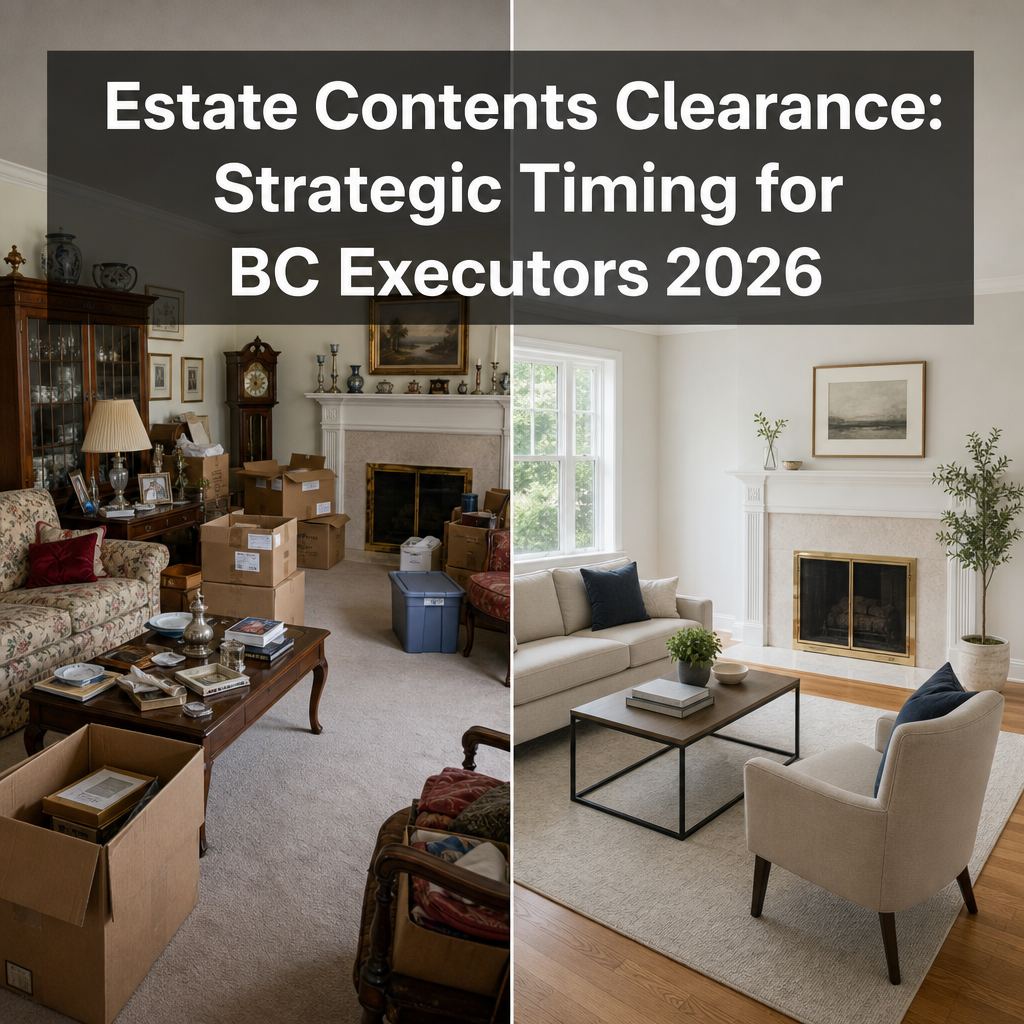

Estate Contents Clearance and Strategic Timing: Managing Personal Property Removal, Family Heirlooms, and Deep Cleaning While Coordinating With Realtor Marketing in Metro Vancouver and Fraser Valley 2026
By Mohamed Mansour, MBA and Associate Broker | Mansour Real Estate Group | Published: June 23, 2025 | Fraser Valley and Metro Vancouver, BC
For executors in Surrey, Langley, Abbotsford, and across the Fraser Valley, the practical work of clearing a deceased person's home is often the most time-consuming, emotionally charged, and poorly planned part of the entire estate sale process. Most executor guides focus on probate timelines and tax obligations. Almost none address what happens between receiving legal authority and getting a property ready to list.
This guide fills that gap. It covers contents removal sequencing, how to handle family heirlooms without creating disputes, when professional clearance services are worth the cost, and how to coordinate the full clearance-to-listing timeline with your realtor's marketing schedule so the property reaches buyers in the strongest possible condition.
Short Answer
Estate properties with visible contents clutter average 45–60 days on market in Metro Vancouver and the Fraser Valley, compared to 25–30 days for decluttered homes. A coordinated clearance strategy—sequencing family item removal, professional clearance, deep cleaning, and light staging 3–4 weeks before the first showing—reduces days on market and improves negotiating position in a buyer's market.
Who This Applies To
- Named executors managing an estate property sale in BC
- Beneficiaries coordinating contents removal before a listing
- Families dealing with a deceased parent's home in Surrey, White Rock, Langley, Abbotsford, or surrounding areas
- Executors managing multiple beneficiaries with conflicting views on heirlooms or furnishings
- Out-of-province or out-of-country executors managing the clearance process remotely
When This Advice May Not Apply
If the estate property is vacant and already cleared, move directly to the deep cleaning and staging assessment phase. If the property is subject to a tenancy, the Residential Tenancy Branch rules govern access and timelines before any clearance work can begin. Review The Complete Executor's Guide to Selling an Inherited Home in BC for those foundational steps first.
Key Takeaways
- Estate properties with visible clutter average 15–20 more days on market than cleared homes in the current Fraser Valley buyer's market.
- Professional clearance costs $3,000–$12,000 but typically recovers its cost through faster sale timelines and stronger buyer offers.
- Family item disputes over heirlooms are the most common cause of clearance delays—build a documented distribution process before anyone enters the property.
- Pre-listing deep cleaning, a paint refresh, and light staging show a 12–18% reduction in days on market for estate properties.
- Timing coordination between clearance completion and realtor marketing launch is the single biggest executor pain point—misalignment delays first showings by 2–4 weeks.
Data Used in This Article
- Real Estate Board of Greater Vancouver (REBGV) — estate property days-on-market analysis, Q1 2026 (official, regional)
- Fraser Valley Real Estate Board (FVREB) — estate sales market report 2025–2026 (official, regional)
- National Association of Estate Liquidators (NAEL) — 2025 cost survey (industry, North America)
- CRA — donation tax receipt valuation guidelines for estate property liquidation (official, federal)
Why Contents Clearance Delays More Estate Sales Than Probate Does
Most executors expect probate to be the bottleneck. In practice, the clearance of personal property—furniture, clothing, kitchenware, decades of accumulated belongings—is what actually stalls the listing. According to REBGV data from Q1 2026, estate properties with visible contents clutter averaged 45–60 days on market compared to 25–30 days for cleared, move-in-ready homes. In a buyer's market, that gap compounds. Buyers have more choices. A cluttered home gets fewer showings, and fewer showings mean weaker negotiating leverage at offer time.
The problem is coordination, not just volume. Clearance, cleaning, and marketing need to happen in a specific sequence, and when that sequence breaks down—when cleaning is booked before clearance is complete, or when the realtor schedules photography before the home is ready—the result is a delayed first showing and a listing that enters the market in a weakened position.
Executors managing properties in Langley, Surrey, or Abbotsford should plan for a minimum 3–4 week pre-listing window from the moment legal authority is confirmed. That window is not padding—it is the operational minimum for clearance, cleaning, and marketing preparation to happen in the right order.
How to Handle Family Heirlooms Without Creating Delays or Disputes
The most emotionally charged part of contents clearance is not the volume of items—it is the disagreement over who gets what. When multiple beneficiaries have sentimental claims to furniture, artwork, jewelry, or household items, the clearance process can stall for weeks while families negotiate. In our experience, this is almost always preventable with one step taken early: a documented distribution process, agreed upon by all beneficiaries before anyone enters the property to remove items.
A practical approach is to schedule a single, coordinated walk-through with all beneficiaries present, a written item list, and a clear decision rule—often a round-robin selection process managed by the executor. Items with disputed value should be appraised by a third party before distribution. The executor has legal authority to manage this process and should not defer indefinitely to beneficiary disagreement. Delays caused by unresolved heirloom disputes directly extend the listing timeline and reduce the estate's net proceeds.
Items not claimed by beneficiaries fall into three categories: estate sale, donation, or disposal. Estate sale companies operating in Metro Vancouver and the Fraser Valley typically charge 30–50% commission on proceeds, which executors should factor into the ROI calculation against the cost of professional clearance. Donated items may generate a tax receipt for the estate under CRA guidelines—but only if donated to a registered charity and properly documented at fair market value. Speak with the estate's accountant before assuming donation receipts will offset clearance costs.
For executors managing this process remotely—common for out-of-province beneficiaries handling a Surrey or White Rock family home—a local estate clearance coordinator or professional organizer can document and photograph all items before any distribution occurs, which protects the executor from later disputes.
Professional Clearance vs. DIY Family Clearance: What the Numbers Say
Professional estate contents clearance in Metro Vancouver and the Fraser Valley costs $3,000–$12,000 depending on home size and the volume of items. That range reflects single-room clearance on the low end and full four-bedroom homes with decades of accumulated belongings on the high end, based on NAEL's 2025 cost survey data for the Canadian market.
DIY family clearance appears cheaper but carries a different cost: time. Family-coordinated clearance typically extends the pre-listing window by 4–8 weeks, particularly when family members live in different cities or disagree about item disposition. In a buyer's market where estate properties already face longer days on market, that 4–8 week delay is a direct financial cost—carrying costs on the property (utilities, insurance, taxes) continue to accumulate while the listing waits.
The ROI calculation for professional clearance is more favourable than most executors expect. A $5,000–$7,000 clearance that compresses the pre-listing window by three weeks, combined with a professional deep clean and light staging, can reduce days on market by 15–20 days and improve the final sale price by 8–12% compared to a cluttered listing, according to FVREB estate sales data. That spread typically exceeds the clearance cost. Executors preparing to list should discuss this calculation explicitly with their realtor before deciding between professional and family-managed clearance. See the broader strategy discussion in Selling an Estate Home in a Buyer's Market: Strategy for Fraser Valley Executors in 2026.
Deep Cleaning, Paint, and Staging: What's Worth Spending On
Once contents are removed, the condition of the empty home tells its own story. Estate homes that have been lived in for 20–40 years typically need more than a surface clean. Kitchens, bathrooms, carpets, and windows accumulate a level of grime that standard cleaning does not address. A professional post-clearance deep clean—typically $800–$2,500 depending on home size—is not optional if the goal is competitive days on market.
Beyond cleaning, a fresh coat of neutral paint and flooring refresh in the highest-traffic areas (entry, living room, primary bedroom) show measurable returns in estate properties. FVREB market data supports a 12–18% reduction in days on market for estate homes that receive pre-listing cleaning, paint, and light staging compared to those listed as-is. The full analysis of which improvements generate the best return for BC estate properties is covered in Pre-Listing Improvements for Estate Homes in BC: What's Worth Spending On — and What Isn't. The core principle: spend on presentation, not on major renovations the buyer will likely redo anyway.
How to Coordinate Clearance Timing With Your Realtor's Marketing Schedule
The most common executor mistake is booking each phase—clearance, cleaning, photography, listing—in sequence rather than in parallel. Waiting for clearance to finish before contacting a realtor means losing 2–3 weeks that could be used for pricing analysis, pre-listing market review, document preparation, and marketing strategy development. A realtor experienced in estate sales should be engaged at the same time as the clearance company, not after.
A practical coordination timeline for a Fraser Valley estate property looks like this: Week 1—executor confirms legal authority, engages realtor, books clearance company, and schedules beneficiary walk-through. Weeks 2–3—family item distribution and professional clearance complete. Week 3—deep cleaning, paint refresh if needed, and staging assessment. Week 4—professional photography, listing preparation, and MLS launch. First showing occurs with the property in its strongest possible condition.
Misalignment between these phases—clearance running two weeks long, cleaning not booked in advance, photography scheduled before staging is complete—is the primary cause of the 2–4 week showing delay that shows up in estate property days-on-market data. The fix is a single coordinated timeline, managed by the executor with realtor input, that treats clearance and marketing as parallel tracks rather than sequential steps.
How We Evaluate This
At Mansour Real Estate Group, our approach to estate property preparation starts with a pre-listing walkthrough that assesses contents volume, property condition, and the realistic timeline to first showing. We build a clearance-to-listing schedule that accounts for beneficiary coordination, clearance company booking lead times (which in Metro Vancouver and the Fraser Valley can run 1–3 weeks), cleaning, and photography sequencing.
We advise executors on the financial trade-offs between professional clearance and family-managed removal, the realistic ROI on pre-listing improvements for estate properties in the current market, and how to position the property competitively given its condition, location, and the current buyer pool. That conversation happens at the beginning of the process—not after a listing has already been delayed by avoidable sequencing problems.
Estate Sale Preparation Checklist
- Confirm executor legal authority (probate grant or grant of administration) before scheduling any access to the property for beneficiaries or clearance companies.
- Engage your realtor immediately upon legal authority confirmation—pricing analysis and marketing strategy development should begin in parallel with clearance planning.
- Conduct a single documented beneficiary walk-through with a written item list before any removal occurs—use a round-robin selection process to manage heirloom disputes efficiently.
- Obtain written quotes from at least two professional estate clearance companies and confirm their earliest available start date—lead times in Metro Vancouver and the Fraser Valley run 1–3 weeks.
- Document donated items with CRA-compliant fair market value descriptions before donation, and retain receipts from registered charities for the estate's tax accounting.
- Book professional post-clearance deep cleaning immediately after clearance completion is confirmed—do not leave this to the week before photography.
- Walk the empty property with your realtor to assess paint condition, flooring, and any visible deferred maintenance that affects buyer perception at first showing.
- Confirm photography date only after cleaning and any staging is complete—reschedule photography rather than photograph a partially prepared property.
What We Commonly See
Executors book cleaning before clearance is finished. In our experience, this is the most common sequencing error in estate property preparation. When a clearance company runs two to three days over schedule, the pre-booked cleaning crew arrives at a property that isn't ready. The cleaning gets rescheduled, photography gets pushed, and the listing is delayed by 10–14 days through no one's fault except the original scheduling assumption.
Family members remove items before a documented distribution process is in place. What often happens is that one beneficiary—usually the one geographically closest to the property—begins removing small items informally before the formal walk-through occurs. This creates disputes with other beneficiaries, creates legal exposure for the executor, and occasionally results in items of real value leaving the estate before appraisal.
Executors list as-is to avoid spending estate funds on preparation. A common mistake is treating pre-listing improvements as an unrecoverable cost rather than as an investment with a measurable return. Estate properties listed with visible clutter, deferred maintenance, and no staging consistently underperform in days on market and final sale price. In a buyer's market, the cost of under-preparation is almost always higher than the cost of the preparation itself.
Questions and Answers
Can an executor spend estate funds on clearance and cleaning before the property is sold?
Yes. In BC, executors have authority to incur reasonable expenses necessary to prepare an estate property for sale. Clearance, cleaning, and pre-listing improvements are generally considered reasonable estate administration costs. Executors should document all expenses and retain receipts for estate accounting. Consult your estate lawyer if the expense amount is significant relative to the estate's value.
What happens if beneficiaries disagree about which items they want from the estate home?
The executor has legal authority to manage personal property distribution and is not required to wait indefinitely for beneficiary consensus. A documented round-robin selection process, conducted at a single scheduled walk-through with all parties present or represented, is the most defensible approach. Items that remain disputed can be sold and proceeds distributed to the estate.
Is it worth hiring a professional estate clearance company in Metro Vancouver, or should the family do it themselves?
For most estate properties with significant contents volume, professional clearance is worth the $3,000–$12,000 cost because it compresses the pre-listing timeline by 4–6 weeks relative to family-coordinated clearance. In a buyer's market where carrying costs continue to accumulate on a vacant property, that timeline compression typically generates more value than it costs. The ROI depends on property value, carrying costs, and how quickly the family could realistically complete the clearance independently.
In Summary
Contents clearance is not a footnote in the estate sale process—it is one of the primary variables that determines how quickly and how profitably an estate property sells. A coordinated approach that sequences family item distribution, professional clearance, deep cleaning, and realtor marketing as parallel tracks rather than sequential steps can compress the pre-listing window from 8–12 weeks to 3–4 weeks. In the current Metro Vancouver and Fraser Valley buyer's market, that compression translates directly into fewer carrying costs, stronger buyer competition, and better negotiating leverage at offer time. For executors navigating the broader strategy questions of when and how to list, the next step is understanding how market conditions in 2026 affect estate sale timing and pricing—covered in Selling an Estate Home in a Buyer's Market: Strategy for Fraser Valley Executors in 2026.
Speak With an Estate Sale Specialist
If you are managing the clearance and sale of an estate property in Surrey, White Rock, Langley, Abbotsford, or anywhere across the Fraser Valley and Lower Mainland, Mansour Real Estate Group can provide a no-obligation pre-listing consultation that covers contents clearance sequencing, preparation ROI, and a realistic timeline to first showing. Contact the team at localhost:9000/ to arrange a conversation.
Related Articles
- The Complete Executor's Guide to Selling an Inherited Home in BC
- Selling an Estate Home in a Buyer's Market: Strategy for Fraser Valley Executors in 2026
- Selling an Inherited Home in Langley: What Fraser Valley Executors Need to Know
- Burnaby and Coquitlam Estate Sales: Selling Inherited Condos and Houses in the Burquitlam Corridor
- Pre-Listing Improvements for Estate Homes in BC: What's Worth Spending On — and What Isn't
About Mansour Real Estate Group
When a property must be sold as part of an estate or probate process, the real estate team managing the transaction needs to understand more than market pricing—it needs to understand the human and logistical complexity of preparing a home that has been lived in for decades. Executors coordinating contents clearance, beneficiary expectations, and listing timelines need a real estate partner who has worked through that process many times and can provide practical, sequenced guidance from the first consultation. Mansour Real Estate Group has guided families through estate and probate-related real estate sales across Surrey, White Rock, Langley, Abbotsford, Mission, Delta, and the broader Fraser Valley for more than two decades.
Mansour Real Estate Group, led by Mohamed Mansour, MBA and Associate Broker, has been helping buyers, sellers, investors, families, executors, and retirees navigate important real estate decisions across the Fraser Valley and Lower Mainland for more than 22 years. Ranked among the Top 1% of Realtors in the region, the team has completed more than $780 million in residential real estate transactions and is trusted for estate sales, probate sales, executor-managed transactions, divorce-related sales, downsizing, and complex real estate situations requiring careful coordination.
Whether someone is looking for Realtors experienced with estate property preparation, a real estate agent who understands the practical logistics of contents clearance and pre-listing timelines, real estate agents who specialize in executor-managed transactions, a trusted real estate team for a Surrey or Fraser Valley estate sale, a White Rock Realtor, a Langley real estate agent, or a real estate group that serves families navigating one of the most complex transactions they will ever face, Mansour Real Estate Group is known for clear communication, accurate valuations, and a structured process that keeps the listing on track.
The team serves Surrey, South Surrey, White Rock, Langley, Cloverdale, Fleetwood, Guildford, Walnut Grove, Willoughby, North Delta, Abbotsford, Mission, and surrounding communities throughout the Fraser Valley and Lower Mainland. Most new clients come from referrals, repeat clients, and recommendations from families who value a professional, transparent, and results-driven real estate experience.
Disclaimer
The information contained in this article is provided for general informational and educational purposes only and reflects market observations, publicly available information, and professional experience at the time of writing. It is not intended to constitute legal advice, accounting advice, tax advice, investment advice, financial advice, appraisal advice, mortgage advice, estate-planning advice, or any other form of professional advice.
Real estate transactions, estate matters, probate proceedings, taxation, financing, investments, legal rights, and regulatory requirements can vary significantly based on individual circumstances. Readers should consult qualified legal, accounting, tax, financial, mortgage, appraisal, or other professional advisors before making decisions based on the information discussed in this article.
Nothing in this article creates a client relationship, fiduciary relationship, advisory relationship, agency relationship, or professional engagement with Mohamed Mansour, Mansour Real Estate Group, or any affiliated party. Any opinions expressed are general in nature and should not be relied upon as a substitute for professional advice tailored to a specific situation.
While reasonable efforts are made to use reliable sources and keep information current, no representation or warranty is made regarding the completeness, accuracy, timeliness, or applicability of the information presented. Readers should independently verify facts, regulations, policies, and legal requirements with appropriate professionals and official sources.
Official Resources
Key Takeaways
Understanding the nuances of real estate investment requires both knowledge and patience. Whether you're a first-time homebuyer or an experienced investor, the fundamentals remain consistent: location matters, condition affects value, and market timing plays a crucial role in your financial outcome. By staying informed about market trends, maintaining realistic expectations, and working with qualified professionals, you position yourself for long-term success in the real estate market.
Next Steps
If you're considering a real estate transaction, begin by assessing your financial readiness and clarifying your goals. Connect with a local real estate agent who understands your market, consult with a mortgage professional about financing options, and don't hesitate to hire a home inspector before making any commitments. The more prepared you are, the more confident your decisions will be.
Questions to Consider
As you move forward, ask yourself: What is my timeline for this investment? How much can I realistically afford? What features matter most to my lifestyle or investment strategy? Which neighborhoods align with my long-term vision? These reflective questions will guide you toward choices that genuinely serve your interests rather than those driven by market hype or external pressure.



