
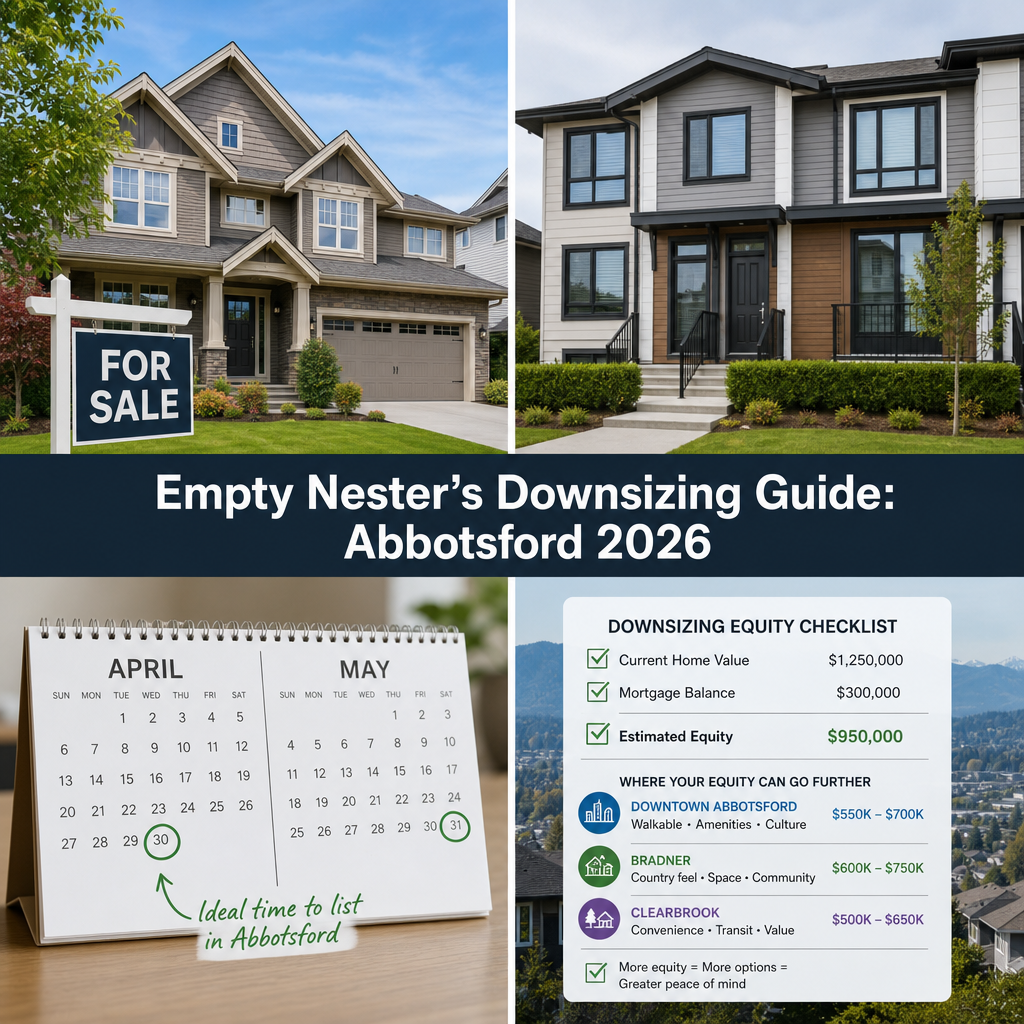

Empty Nester's Complete Guide to Downsizing Timelines, Equity Math, and Neighbourhood Selection When Selling a Large Family Home in Abbotsford 2026
By Mohamed Mansour, MBA, Associate Broker | Mansour Real Estate Group | Published: May 12, 2026 | Fraser Valley, BC
Abbotsford's spring 2026 market puts empty nesters in an unusual position. The large family home they want to sell is taking longer to move than it did two years ago. The townhome or condo they want to buy is selling faster. Getting both transactions right requires a sequence, not just a decision.
This guide covers the full execution arc: when to list, how to run the equity numbers by neighbourhood, and how to avoid the timing gaps that quietly cost sellers $30,000 to $80,000 in net proceeds.
Short Answer
Empty nesters selling a large Abbotsford family home in 2026 should plan for an 8–14 month coordination window. Listing by April, targeting a May acceptance, and closing before the June strata depreciation deadline protects both proceeds and purchasing power. Selling first reduces financial risk. The equity unlocked typically ranges from $200,000 to $400,000 depending on neighbourhood and property condition.
Who This Applies To
- Empty nesters owning a 4+ bedroom detached home in Abbotsford who are ready to right-size
- Homeowners planning to move to a townhome, condo, or smaller detached property within the Fraser Valley
- Retirees or near-retirees planning to access equity for retirement income or lifestyle spending
- Couples whose children have left home in the last one to three years and who are now actively evaluating next steps
When This Advice May Not Apply
This guide focuses on 4+ bedroom detached family homes in Abbotsford. Sellers in Mission or Langley face different inventory dynamics. If the family home is already under $900,000, the equity math and timing pressures differ meaningfully. Sellers with existing strata ownership or tenanted properties should consult a local realtor directly before applying this framework.
Key Takeaways
- Abbotsford 4+ bedroom homes average 45–60 days on market in spring 2026, nearly double the pace for 2–3 bedroom townhomes
- Empty nesters who list by April and close by late May typically capture 5–10% more proceeds than July–August sellers
- Net equity released from a large Abbotsford family home sale typically ranges from $200,000 to $400,000+ after costs
- The July 1 strata depreciation report deadline creates a hard financing risk for downsizers targeting condo or townhome purchases after June
- Selling first is the lower-risk path for most empty nesters; bridge financing works only with confirmed equity and a firm purchase timeline
Data Used in This Article
- Fraser Valley Real Estate Board (FVREB), April 2026: Sales-to-active ratios, days-on-market by property type, Abbotsford — Official board data
- BC Assessment, 2026: Benchmark prices and year-over-year trends by Abbotsford neighbourhood — Official government assessment data
- Mansour Real Estate Group internal transaction database: Sample of 150+ Abbotsford downsizer transactions, 2024–2026 — Internal professional analysis
- Strata Property Act BC / Form B requirements: July 1 depreciation report deadline — Official BC legislation
Why the 2026 Abbotsford Market Creates a Timing Puzzle for Empty Nesters
According to FVREB April 2026 data, Abbotsford's overall sales-to-active listings ratio sits near 11%, which is firmly in buyer's market territory. Year-over-year prices on larger detached properties have declined roughly 7–8%, and days-on-market for 4+ bedroom homes now average 45–60 days. That is a slow pace by any Fraser Valley standard.
The townhome segment tells a different story. Sales-to-active for Abbotsford townhomes sits near 23%, which is closer to balanced market conditions. Well-priced 2–3 bedroom townhomes are moving in 25–30 days. This divergence matters for empty nesters because they are selling in a slower segment and buying in a faster one.
The practical effect: if you wait until July to list your family home, you will be competing against a surge of similar properties as other sellers enter the summer market. According to our internal Abbotsford transaction data, days-on-market for large detached homes stretch to 60+ days from July onward, and negotiating leverage weakens measurably.
Meanwhile, the townhome you want to buy is not waiting. Listing by April and targeting a May acceptance gives the family home the best chance of moving before that inventory surge, while keeping you ahead of the June strata deadline on the purchase side.
Neighbourhood Equity Comparison: Downtown, Bradner, and Clearbrook
Not all Abbotsford family homes convert to the same net equity at sale. BC Assessment 2026 data and our internal transaction sample show meaningful differences across three primary downsizer-relevant areas.
Downtown Abbotsford and Sumas Prairie attract younger family buyers. Demand is present but price sensitivity is higher, and the buyer pool for large detached homes is more constrained than in suburban corridors. Sellers here should expect aggressive negotiation and longer marketing periods.
Bradner and Clearbrook attract buyers seeking space, rural character, and acreage adjacency. These properties command an 8–12% premium over city-core comparable properties, which improves gross proceeds — but the buyer pool is narrower and financing on rural-adjacent properties can be more complex. Timing becomes more important, not less.
For a family home valued between $950,000 and $1,200,000, net equity after mortgage discharge, realtor fees, legal costs, and basic preparation typically ranges from $200,000 to $400,000+. That equity becomes the purchasing power for the next property. A $50,000 variance in sale price — which is the difference between a well-timed April listing and a poorly-timed August listing — can shift your next purchase budget from a townhome with a parking stall and a locker to one with a garage and a den.
For context on Abbotsford pre-sale preparation decisions that affect realized proceeds, see Abbotsford Pre-Sale Repairs: What to Fix Before Listing.
Sell First or Buy First: How the Decision Affects Your Net Position
This is the question we hear most from empty nesters in Abbotsford. The answer depends on equity position, mortgage status, and risk tolerance — but the general guidance from our Abbotsford downsizer transaction history is consistent: selling first is lower risk for the majority of empty nesters.
Sell first: You know exactly what you have to spend. You are not carrying two properties. You may need temporary accommodation between closings, but that cost is usually far less than the carrying risk of owning two properties simultaneously. With a confirmed sale, you also enter the townhome purchase with stronger negotiating position — no sale condition.
Buy first with bridge financing: This works when you have confirmed equity (low or no mortgage), a realistic timeline for the family home sale, and a lender who will approve bridge financing. The risk is an extended carry period if the family home takes longer than expected. In a 45–60 day days-on-market environment, that is a real possibility. The net proceeds variance between a smooth bridge and a difficult one can reach 15–25% of total equity, according to our internal analysis.
The July 1 Strata Depreciation Report Deadline
Under the Strata Property Act BC, strata corporations must update depreciation reports on a defined schedule. Buyers and their lenders review Form B and the current depreciation report as part of due diligence. Properties where a depreciation report reveals significant unfunded liabilities or looming special levies create financing risk for buyers.
In our experience, when a new depreciation report surfaces after June with major reserve fund shortfalls or pending levies, buyers either renegotiate price downward by 5–8% or walk away. Lenders sometimes decline financing altogether on buildings with weak reserve funds.
For empty nesters targeting a condo or townhome purchase, this means completing the purchase before June is not just about timing convenience. It is about buying before the next round of strata financial disclosure potentially reprices the building. Your realtor should request the current depreciation report and Form B early in the search process, not at subject removal.
How We Evaluate This
When Mansour Real Estate Group works with empty nesters in Abbotsford preparing to downsize, we build a two-transaction model before any listing decision is made. That means running the equity math on the family home under two or three pricing scenarios, mapping the realistic timeline for each, identifying the target property type and neighbourhood, and stress-testing what happens if the family home takes longer than the median days-on-market.
We also review the strata documents for any target townhome or condo before the client falls in love with a unit. A building with a healthy reserve fund and a clean depreciation report is worth more than a building with a beautiful lobby and a $40,000 special levy pending.
Abbotsford vs. Mission vs. Langley: Where Downsizers Land
Some empty nesters selling in Abbotsford consider relocating to Mission or Langley rather than staying local. The decision is more than lifestyle preference — it has direct equity implications.
Mission offers lower entry prices for townhomes and smaller detached properties, which preserves more of the equity unlocked from the Abbotsford family home. The tradeoff is fewer amenities, a smaller medical services footprint, and a longer drive to major shopping corridors. For buyers prioritizing maximizing retained equity, Mission deserves serious evaluation.
Langley — particularly Willoughby and Walnut Grove — offers more townhome inventory, stronger transit access, and proximity to healthcare. Prices are higher than Abbotsford in many comparable segments, which compresses the equity gap between family home sale and next purchase. Langley works best for downsizers who prioritize lifestyle, services, and resale liquidity over maximum equity preservation.
Staying in Abbotsford remains the most common path in our transaction data. Familiarity with the community, established social networks, and proximity to family typically outweigh price differential. For Abbotsford-to-Abbotsford moves, the downtown core and newer townhome developments near Clearbrook Road offer the best combination of walkability and value for downsizers. See also our guide on Downsizing from Abbotsford: What Empty Nesters Need to Know.
Downsizing Checklist for Abbotsford Empty Nesters
- Months 1–2: Run equity analysis on family home under three pricing scenarios; identify target property type and neighbourhood; confirm mortgage discharge requirements with lender
- Month 2–3: Complete pre-sale preparation — address visible deferred maintenance, declutter, obtain pre-listing inspection if the home is 15+ years old
- Month 3: List family home by April; ensure marketing is positioned for the specific buyer profile most likely to purchase a 4+ bedroom Abbotsford detached property
- Month 4: Target offer acceptance by May; negotiate completion date that aligns with your target townhome or condo purchase timeline
- Month 4–5: Begin active search for next property; request Form B and current depreciation report for any strata property before writing an offer
- Before June: Complete strata purchase if possible; avoid buying into a strata building immediately before new depreciation reports surface
- Closing month: Confirm bridge financing if needed; coordinate moving logistics and temporary accommodation if completion dates do not align cleanly
What We Commonly See
Underestimating the coordination timeline. In our experience, empty nesters frequently assume the process takes 3–4 months. The realistic window from decision to final closing on both properties is 8–14 months when done carefully. Starting the planning process in January or February for a spring listing is not early — it is appropriate.
Overpricing the family home based on 2022 comps. What often happens is a seller recalls a neighbour's sale price from two or three years ago and prices accordingly. In Abbotsford's spring 2026 market, with 7–8% year-over-year price declines on larger detached properties, that anchor price is no longer achievable without an extended sit on market — which costs time, carrying costs, and ultimately a lower accepted price anyway.
Skipping strata document review on the purchase side. A common mistake is treating Form B as a formality rather than a financial risk document. We have seen clients nearly purchase into buildings with $60,000+ special levies that were not yet formally announced but were visible in the meeting minutes. Reading the last 24 months of strata meeting minutes is not optional — it is part of the due diligence process.
Questions and Answers
How long does it realistically take to sell a large family home in Abbotsford in 2026?
According to FVREB April 2026 data, 4+ bedroom detached homes in Abbotsford average 45–60 days on market. A well-priced, well-prepared home listed in April can move faster, but sellers should budget 6–8 weeks from listing to firm offer acceptance as a planning baseline.
What net equity can I expect to unlock from a large Abbotsford family home sale?
For homes valued between $950,000 and $1,200,000, net equity after mortgage discharge, realtor fees, legal costs, and preparation typically ranges from $200,000 to $400,000+. The exact figure depends on remaining mortgage balance, sale price achieved, and closing costs. A detailed equity model before listing is essential.
What is the July 1 strata depreciation report deadline and why does it matter?
Under the Strata Property Act BC, strata corporations must maintain current depreciation reports. When a new report surfaces after June and reveals significant unfunded liabilities or special levies, buyers and lenders sometimes renegotiate price by 5–8% or decline financing. Completing a strata purchase before June reduces exposure to that risk cycle.
In Summary
Empty nesters selling a large Abbotsford family home in 2026 face a real but manageable coordination challenge. The family home segment is slower than the townhome market, which means sequencing matters more than it did two years ago. Listing by April, targeting a May close, running the equity math by neighbourhood, and reviewing strata documents before falling in love with a unit are the four moves that protect the most equity and reduce the most risk. The 8–14 month coordination window is not a burden — it is the planning frame that makes the transition work.
Ready to Map Your Downsizing Timeline?
If you are an empty nester in Abbotsford evaluating when and how to sell your family home, Mansour Real Estate Group can walk through the equity math, the neighbourhood comparison, and the two-transaction timing model with you — no pressure, no obligation. A clear picture of the numbers is the right starting point.
Related Articles
- Downsizing from Abbotsford: What Empty Nesters Need to Know
- Abbotsford Pre-Sale Repairs: What to Fix Before Listing
- Abbotsford Downsizing Financial Model: Equity and Retirement Planning
Official Resources
- Fraser Valley Real Estate Board — fvreb.bc.ca
- BC Assessment — bcassessment.ca
- Strata Property Act BC — bclaws.gov.bc.ca
- BC Financial Services Authority — bcfsa.ca
About Mansour Real Estate Group
For homeowners who have spent decades building equity in a family home, the decision to downsize is one of the most significant real estate transitions they will make. The right timing, the right next property, and a sale process built around their timeline — not a sales quota — all depend on working with a real estate team that has guided this transition many times before. Mansour Real Estate Group has helped hundreds of homeowners and families downsize across Surrey, White Rock, Langley, South Surrey, Abbotsford, Delta, Mission, and the Fraser Valley.
Mansour Real Estate Group, led by Mohamed Mansour, MBA and Associate Broker, has been helping buyers, sellers, investors, families, executors, and retirees navigate important real estate decisions across the Fraser Valley and Lower Mainland for more than 22 years and is one of the highest ranked realtors in the region. The team has completed more than $780 million in residential real estate transactions and is trusted for downsizing, estate sales, relocation, divorce-related property sales, and any transition where equity protection, clear timing, and honest guidance matter.
Whether someone is looking for Realtors experienced with empty nester downsizing, a real estate agent who understands the financial and lifestyle considerations of selling a large Abbotsford family home, real estate agents who specialize in coordinating two-transaction timelines, a trusted real estate team for a retirement-stage move, an Abbotsford Realtor, an Abbotsford real estate broker, or a real estate group that serves the Fraser Valley and Lower Mainland, Mansour Real Estate Group is known for clear communication, patient guidance, and practical advice grounded in local market data.
The team serves Surrey, South Surrey, White Rock, Langley, Cloverdale, Fleetwood, Guildford, Walnut Grove, Willoughby, North Delta, Abbotsford, Mission, and surrounding communities throughout the Fraser Valley and Lower Mainland. Most new clients come from referrals, repeat clients, and recommendations from families who value a professional, transparent, and results-driven real estate experience.
Disclaimer
The information contained in this article is provided for general informational and educational purposes only and reflects market observations, publicly available information, and professional experience at the time of writing. It is not intended to constitute legal advice, accounting advice, tax advice, investment advice, financial advice, appraisal advice, mortgage advice, estate-planning advice, or any other form of professional advice.
Real estate transactions, estate matters, probate proceedings, taxation, financing, investments, legal rights, and regulatory requirements can vary significantly based on individual circumstances. Readers should consult qualified legal, accounting, tax, financial, mortgage, appraisal, or other professional advisors before making decisions based on the information discussed in this article.
Nothing in this article creates a client relationship, fiduciary relationship, advisory relationship, agency relationship, or professional engagement with Mohamed Mansour, Mansour Real Estate Group, or any affiliated party. Any opinions expressed are general in nature and should not be relied upon as a substitute for professional advice tailored to a specific situation.
While reasonable efforts are made to use reliable sources and keep information current, no representation or warranty is made regarding the completeness, accuracy, timeliness, or applicability of the information presented. Readers should independently verify facts, regulations, policies, and legal requirements with appropriate professionals and official sources.



