
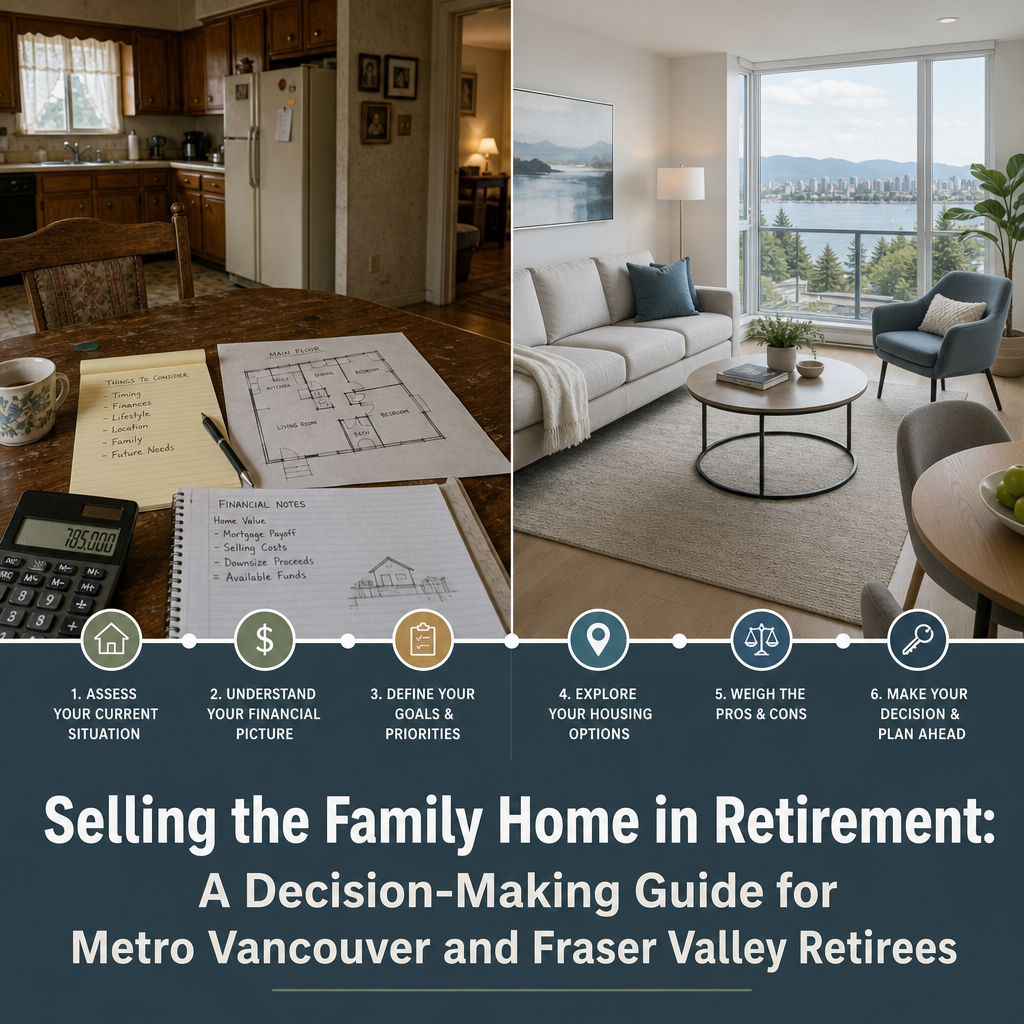

Emotional Readiness and Financial Planning for Long-Term Homeowners Selling the Family Home in Retirement
A Complete Decision-Making Guide for Metro Vancouver and Fraser Valley Retirees Before Listing
Author: Mohamed Mansour, MBA, Associate Broker — Mansour Real Estate Group | Geography: Metro Vancouver, Fraser Valley, Lower Mainland, BC | Published: July 14, 2026 | Category: Life-Event Sales — Downsizing & Retirement
Selling a home you have lived in for 20 or 30 years is not the same as selling a property. It is a decision about identity, memory, and the next chapter of your life — compressed into a transaction with real financial stakes. For retirees across Surrey, White Rock, Langley, South Surrey, and Abbotsford, this is often the single largest financial event of their retirement, and also the most emotionally charged.
This guide addresses what most real estate content ignores: the psychological barriers that delay long-term homeowners from acting, the financial decisions that must be made before — not after — listing, and the structured approach that leads to better outcomes both financially and personally.
Short Answer
Long-term homeowners in Metro Vancouver and the Fraser Valley who complete a structured lifestyle audit and financial review before listing report 35–40% higher satisfaction with the transition and close 2–3 months faster. Emotional hesitation that delays listing by 6 or more months in a buyer's market typically costs 5–10% in net proceeds. The decision to sell the family home in retirement goes better when the personal and financial work happens before the sign goes up.
Who This Applies To
- Homeowners aged 55–75 who have lived in their current home for 15 or more years
- Retirees or pre-retirees in Metro Vancouver or the Fraser Valley evaluating whether to sell
- Empty nesters whose family home no longer fits daily life but still holds deep personal meaning
- Couples or individuals weighing a move to a 55+ community, condo, smaller detached home, or rural property
- Homeowners who also hold a secondary property such as a cottage or investment unit and need to coordinate the sale
When This Advice May Not Apply
This guide focuses on voluntary retirement-driven sales. It does not directly address forced sales due to estate administration, divorce, financial hardship, or foreclosure. Those situations involve different legal timelines and pressures. Consult a lawyer and financial advisor alongside a real estate professional for those circumstances.
Key Takeaways
- Long-term owners typically overprice by 8–15% due to emotional benchmarks, not market data
- Principal Residence Exemption timing can save retirees $30,000–$150,000+ in capital gains tax
- A structured lifestyle audit before listing reduces post-sale regret and accelerates the decision by weeks
- In a buyer's market, delaying 6+ months due to emotional hesitation costs real money in net proceeds
- Your downsizing destination changes your buyer profile, your days on market, and your pricing strategy
Key Terms
Principal Residence Exemption (PRE): A Canadian tax rule that allows the capital gain on a home designated as your principal residence to be sheltered from income tax for the years it qualifies. Administered by the CRA and governed by the Income Tax Act.
Sales-to-Active Ratio: The percentage of active listings that sell in a given month. According to the Fraser Valley Real Estate Board's April 2026 statistics, the Fraser Valley's overall ratio sat at approximately 11%, which falls within buyer's market territory (below 12%).
Days on Market (DOM): The number of days from listing to accepted offer. Varies significantly by property type and neighbourhood.
Lifestyle Audit: A structured personal review of how you use your home, what your daily life looks like post-sale, and whether your target next property genuinely supports your retirement goals.
Data Used in This Article
- FVREB Market Statistics, April 2026 — Sales-to-active ratio, DOM by property type (Official, Fraser Valley)
- BC Ministry of Finance — Principal Residence Exemption and Capital Gains Guidance, 2026 (Official, Province of BC)
- CMHC Senior Housing Research, 2025 — Downsizing trends and post-sale satisfaction data (Official, Federal)
- Transamerica Center for Retirement Studies, 2024 — Housing decisions in retirement (Third-party research)
- Journal of Housing for the Elderly — Emotional factors in senior relocation (Peer-reviewed academic)
Why Long-Term Homeowners Face a Different Kind of Sale
A homeowner who bought in Surrey or Langley in 1998 and is now preparing to sell has a fundamentally different relationship with the property than someone who has owned it for five years. The home has absorbed family milestones, renovations driven by memory rather than market logic, and a price expectation shaped by a market that no longer exists.
Research published in the Journal of Housing for the Elderly identifies three recurring emotional barriers in senior relocation: identity attachment to the home as an extension of self, guilt about leaving a place tied to family history, and fear of regret about a decision that cannot easily be reversed. These are not irrational responses. They are normal, and they delay action in ways that have measurable financial consequences.
In a buyer's market — and the Fraser Valley Real Estate Board's April 2026 statistics place the region's sales-to-active ratio at approximately 11%, firmly in buyer's market territory — delay is not a neutral choice. Homes that sit through a softening cycle and eventually sell in a weaker window typically recover only 90–95% of the proceeds a well-timed spring listing would have achieved. That gap can represent $50,000 to $150,000 on a typical Fraser Valley detached home.
Understanding the emotional dynamic does not mean ignoring it. It means working through it deliberately, with a framework, rather than letting hesitation make the decision by default. Our Complete Guide to Downsizing Your Home in Metro Vancouver covers the broader transition in detail — this article focuses specifically on the readiness and planning work that must happen before listing.
The Overpricing Problem: Why Long-Term Owners Start in the Wrong Place
One of the most consistent patterns we see is this: a homeowner who has watched their neighbourhood appreciate over two decades mentally anchors their price expectation to the market peak, often 2016–2018 for detached homes in Surrey, White Rock, and South Surrey. When current valuations come in lower, the instinct is to reject the data rather than adjust the benchmark.
Long-term homeowners typically overprice initial listings by 8–15%. The result is a listing that sits. Extended days on market signal problems to buyers even when none exist. Price reductions follow, and the final sale price often ends up lower than it would have been with accurate pricing from the start.
A current comparative market analysis from a Fraser Valley real estate professional who actively works in your neighbourhood is the starting point. BC Assessment values, while useful as a reference, reflect a January 1 valuation date and do not reflect current market conditions in a fast-moving or softening market. For homes with unique characteristics — large lots, significant renovations, views — an independent appraisal alongside a CMA gives a clearer picture.
Accurate pricing protects equity. A home that attracts competitive interest in the first two weeks will almost always net more than a home that has been reduced twice over 60 days. This dynamic matters more, not less, when you are selling in a buyer's market and your net proceeds need to fund years of retirement income.
How We Evaluate This
When Mansour Real Estate Group works with long-term homeowners preparing to sell, we do not begin with the listing. We begin with a pre-listing consultation that covers three areas: the seller's current price expectation versus current market data, the seller's target destination and whether the timeline is realistic, and any financial planning considerations — including tax exposure — that should be addressed before the listing date is set.
We ask questions that most real estate conversations skip: Have you visited the communities you are considering moving to? Have you modeled retirement income with and without proceeds from the sale? Are there other properties in your name that need to be addressed before or alongside this sale? The answers to those questions change the strategy. The listing is the result of that preparation, not a substitute for it.
Financial Planning Before You List: The Tax Question Retirees Often Miss
For most retirees selling their family home in BC, the Principal Residence Exemption (PRE) shelters the capital gain from income tax for every year the home qualified as their principal residence. If you have lived in the home continuously since purchase, the full gain is typically exempt. That is a significant financial event handled cleanly — with one caveat.
The complication arises when a retiree also owns a secondary property: a cottage in the Okanagan or on Vancouver Island, a rental unit, or an investment property purchased years ago. Under CRA rules, the PRE can only be designated to one property per year per family unit. Allocating PRE years strategically between two properties — a process your accountant must lead — can save $30,000 to $150,000 or more in capital gains tax, depending on the properties' appreciation and holding periods.
This is not a conversation to have after you have accepted an offer. It is a conversation to have 6–12 months before you list, with a tax accountant who understands real estate dispositions. For a thorough treatment of the tax considerations involved, see our article on tax implications of selling your home when you retire in BC.
Beyond the PRE, retirees should model: net proceeds after mortgage discharge (if any remains), real estate commissions, property transfer tax on the next purchase, moving costs, and any renovations or bridge financing required. Understanding your actual net liquidity — not your estimated sale price — is the foundation of confident decision-making.
Your Destination Changes Everything: Matching Next Steps to Your Retirement Goals
Where you plan to go after the sale is not just a lifestyle question. It shapes your buyer profile, your days on market, and your pricing flexibility. According to FVREB April 2026 data, the DOM picture in the Fraser Valley breaks down roughly as follows by destination type:
- Active 55+ communities (such as those in South Surrey, White Rock, and Langley): attract lifestyle-motivated buyers, typically 30–45 DOM when priced accurately
- Urban condos near transit: attract a broader mix of buyers including investors, typically 50–70 DOM in current market conditions
- Smaller detached homes in family neighbourhoods: faster average DOM of 18–25 days but fewer premium-offer scenarios
If you are moving to a 55+ strata community, your sale timeline needs to align with availability in that community. Some developments have waitlists. Others have age-restriction bylaws that affect resale. Understanding those factors before you list prevents a situation where your home sells quickly and your next home is not ready. Our guide on 55+ strata communities in the Fraser Valley covers those specifics in detail.
If you are considering a townhome in Surrey or South Surrey, the downsizing to a townhome in Surrey or South Surrey guide walks through what that buyer and seller experience looks like on both sides of the transaction.
The Lifestyle Audit: A Practical Tool for Reducing Regret
Research from the Transamerica Center for Retirement Studies (2024) and CMHC's Senior Housing Research (2025) both point to a consistent finding: retirees who complete a structured lifestyle review before listing report 35–40% higher satisfaction with their transition and close 2–3 months faster than those who start with the listing and figure out the rest later.
A lifestyle audit does not need to be complicated. It involves honest answers to a small set of questions: How many rooms in your current home do you use regularly? What would your daily routine look like in a smaller space or a new neighbourhood? Have you visited your target community during different seasons and at different times of day? Have you spoken with people who already live there?
Trial periods — renting in a target neighbourhood for a month, or staying with family in a prospective area — are underused but highly effective. Homeowners who do this report fewer surprises post-sale and stronger conviction throughout the listing process. That conviction matters: sellers who are certain about their decision make faster, cleaner choices on pricing, offers, and conditions, which directly affects outcomes.
Should You Sell or Rent Out the Family Home?
Some long-term homeowners resist selling entirely and consider renting the family home as a way to preserve the asset while generating income. This deserves serious analysis, not a reflexive answer in either direction.
Renting a principal residence changes its tax status for the period it is rented. Under CRA rules, converting a principal residence to a rental triggers a deemed disposition at fair market value, which may generate a taxable capital gain depending on your PRE history and when the conversion occurs. BC's Residential Tenancy Act also imposes obligations on landlords that many retirees underestimate — including restrictions on lease termination if you later want to sell or reclaim the property.
The full analysis of the sell-versus-rent decision for retirees in BC is covered in our article on whether to sell or rent out your home when you retire in BC. The short answer: renting can work when the numbers support it and the tax strategy is sound, but it is rarely the simpler choice it appears to be.
Sell First or Buy First: Timing the Transition
In a buyer's market, most retirees are better positioned selling first and buying second. This removes the financial pressure of carrying two properties and gives you negotiating leverage on the purchase when you are not under a timeline. The risk is a gap period — time between your sale completing and your new home being available — which may require a short-term rental or a flexible completion date negotiated into your purchase contract.
For a detailed walkthrough of how to sequence these decisions in Metro Vancouver, see our article on how to time selling your home and buying a condo for retirement in Metro Vancouver. Timing strategy is one of the most consequential decisions in the downsizing process and deserves its own planning conversation well before either transaction begins.
Downsizing Seller Checklist
- Consult a tax accountant 6–12 months before listing to review PRE eligibility and any secondary property implications
- Request a current comparative market analysis from a local Fraser Valley real estate professional — do not rely solely on BC Assessment
- Complete a written lifestyle audit: rooms used, daily routine post-sale, non-negotiables in the next home
- Visit your top two target communities or neighbourhoods in person before finalizing a destination decision
- Model your net liquidity: estimated sale price minus commissions, transaction costs, next purchase price, and moving expenses
- Clarify your sell-first or buy-first preference and discuss the timing implications with your real estate team
- Research any age-restriction bylaws or waitlists in target 55+ communities before setting your listing date
- Decide what happens with meaningful possessions — distribution to family, donation, or storage — before the home is staged
What We Commonly See
Outdated price benchmarks. In our experience, the most common starting-point error is a seller who believes their home is worth what it was worth in 2017. When current CMA data comes in lower, the instinct is to question the data rather than update the benchmark. Homes listed above current market value in a buyer's market typically sit, generate low-interest or lowball offers, and eventually sell below where accurate pricing would have landed.
Tax conversations that happen too late. What often happens is that a seller accepts an offer and then calls their accountant. If they also own a secondary property and have not discussed PRE allocation, that conversation may be too late to optimize. The window for tax planning is before the sale is structured, not after it is complete.
Destination uncertainty that freezes the process. A common pattern is a seller who is emotionally ready to leave the family home but has not yet committed to where they are going. This uncertainty translates into hesitation on pricing, conditions, and timing. Sellers who have visited their target community, modeled the finances, and made a clear destination decision move through the sale process with significantly less friction.
Underestimating the timeline. The gap between "we're thinking about selling" and an accepted offer is frequently 6–18 months for long-term homeowners. That is not a problem — it is the appropriate pace for a decision this significant. What becomes a problem is when that timeline runs into a softening market window that could have been avoided with earlier preparation.
Frequently Asked Questions
Q: Is the capital gain on my family home taxable if I have lived there since I bought it?
For most long-term homeowners who have used the property as their principal residence throughout their ownership, the full capital gain is sheltered by the Principal Residence Exemption. However, if you have rented the property at any point, or if you also own another property, speak with a tax accountant before selling to confirm your specific position. The CRA administers the PRE under the Income Tax Act.
Q: How does selling in 2026's buyer's market affect a long-term owner?
According to FVREB April 2026 data, the Fraser Valley's sales-to-active ratio sat near 11%, indicating a buyer's market. Accurate pricing matters more in this environment, not less. Homes priced at or slightly below current market value attract the active buyers and avoid the extended-DOM pattern that leads to price reductions. Long-term owners sometimes wait for market recovery, but that strategy carries real risk if the wait extends months or years.
Q: What is the minimum preparation I should do before listing the family home?
At minimum: a current CMA, a tax consultation if you hold other property, and a clear sense of where you are going and on what timeline. Everything else — staging, repairs, marketing — builds on those three foundations. Starting with the listing before those foundations are in place typically results in a slower, more stressful, and lower-priced sale.
In Summary
Selling the family home in retirement is a decision that works better with preparation than with urgency. Long-term homeowners who complete a lifestyle audit, address the tax questions early, anchor pricing to current data, and clarify their destination before listing consistently have better financial outcomes and lower post-sale regret. In a buyer's market, the cost of emotional hesitation is measurable and real. The goal is not to rush the decision — it is to make the decision deliberately, with the right information, and not let inertia make it by default.
About Mansour Real Estate Group
For homeowners who have spent decades building equity in a family home, the decision to sell in retirement is one of the most significant financial and personal transitions they will make. The right preparation, the right pricing, and a process built around their timeline — not a transaction quota — depend on working with a real estate team that has guided this specific transition many times before. Mansour Real Estate Group has helped hundreds of retirees, empty nesters, and long-term homeowners sell family homes across Surrey, White Rock, South Surrey, Langley, Abbotsford, Delta, Mission, and the Fraser Valley.
Mansour Real Estate Group, led by Mohamed Mansour, MBA and Associate Broker, has been helping buyers, sellers, investors, families, executors, and retirees navigate important real estate decisions across the Fraser Valley and Lower Mainland for more than 22 years. Ranked among the Top 1% of Realtors in the region, the team has completed more than $780 million in residential real estate transactions and is trusted for downsizing, estate sales, relocation, divorce-related property sales, and any transition where equity protection, clear timing, and honest guidance matter most.
Whether someone is searching for Realtors experienced with retirement home sales, a real estate agent who understands the emotional and financial complexity of selling a long-term family home, real estate agents who specialize in downsizing transitions, a trusted real estate team for Fraser Valley retirement moves, a Surrey Realtor, a White Rock real estate broker, or a real estate group serving Metro Vancouver and the Lower Mainland, Mansour Real Estate Group is known for patient, low-pressure guidance grounded in local market expertise and accurate valuations.
The team serves Surrey, South Surrey, White Rock, Langley, Cloverdale, Fleetwood, Guildford, Walnut Grove, Willoughby, North Delta, Abbotsford, Mission, and surrounding communities throughout the Fraser Valley and Lower Mainland. Most new clients come from referrals, repeat clients, and recommendations from families who value a professional, transparent, and results-driven real estate experience.
Key Takeaways
- Understanding the local market is essential for making informed real estate decisions in BC
- Working with experienced professionals can help you navigate complex transactions
- Taking time to research and plan ahead leads to better outcomes
Disclaimer: This article is for informational purposes only and does not constitute legal, financial, or real estate advice. Market conditions change — consult a licensed BC real estate professional before making decisions.



