
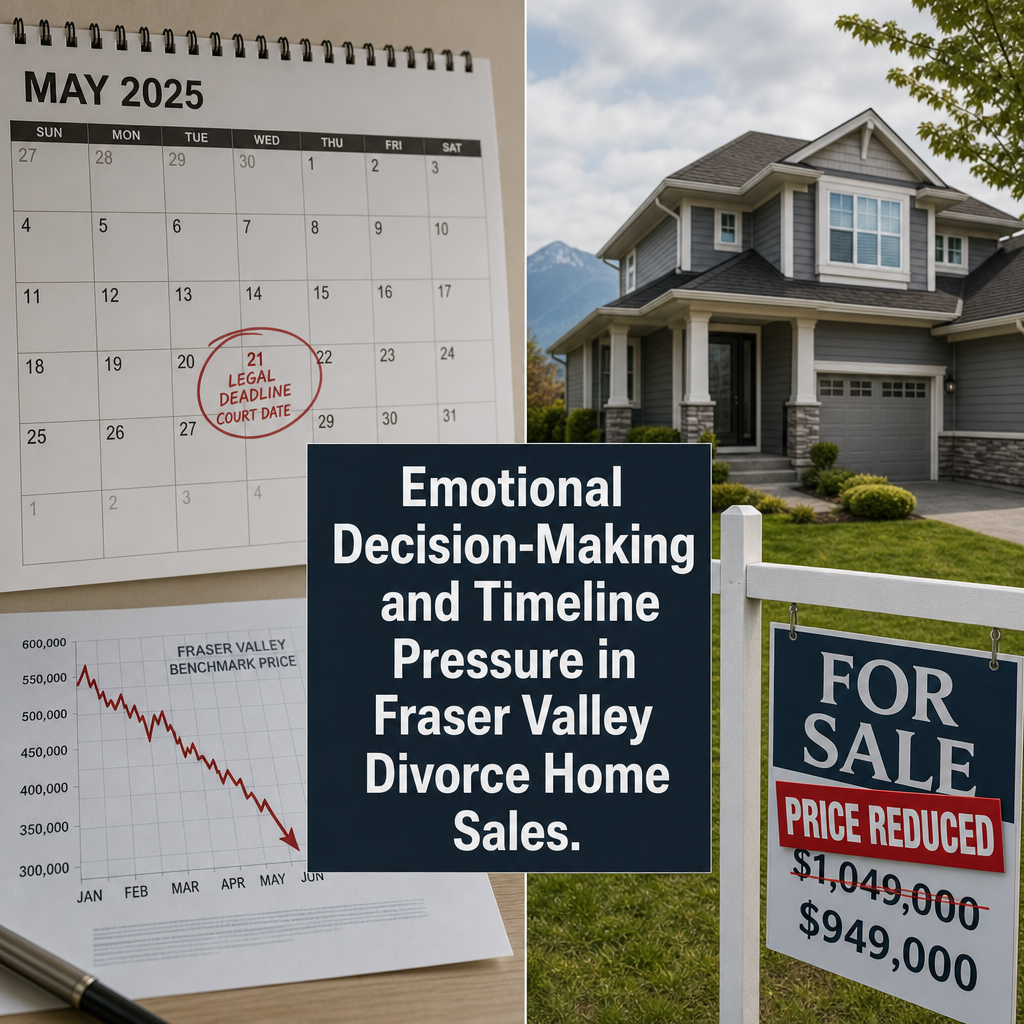

Emotional Decision-Making and Timeline Pressure in Fraser Valley Divorce Home Sales: Why Separating Sellers Leave 15–25% on the Table When Settlement Deadlines and Market Windows Collide
By Mohamed Mansour, MBA and Associate Broker | Mansour Real Estate Group | Fraser Valley and Lower Mainland | Published: May 26, 2025 | Topic: Life-Event Sales — Divorce Property Sales
For most Fraser Valley homeowners, selling a home is a financial decision shaped by market data, timing, and preparation. For separating couples, those same decisions are filtered through grief, urgency, legal pressure, and often, fundamental disagreement between two people who no longer trust each other's judgment. The result is a category of sale where emotional state — not market conditions — becomes the primary driver of outcome.
This article addresses what most divorce real estate guides skip: the specific ways that emotional decision-making patterns cost sellers real money in Fraser Valley's current market, and what a structured, data-first process looks like when settlement deadlines and listing windows collide.
Short Answer
Divorcing sellers in the Fraser Valley typically lose 15–25% in net proceeds when emotional decision-making replaces data-driven pricing. Settlement deadlines imposed by lawyers and courts frequently conflict with listing windows, and spouse disagreements on pricing delay listings by 30–60 days — long enough to miss the best buyer pool. In a market with 10,000+ active listings, there is no margin to recover from a pricing mistake or a late start.
Key Takeaways
- Loss aversion and anchoring bias cause divorcing sellers to either overprice from emotional attachment or underprice from urgency — rarely landing on market value.
- Settlement deadlines imposed by courts and separation agreements regularly conflict with optimal listing windows, forcing sales into weak demand periods.
- Spouse disagreements on pricing delay listings an average of 30–60 days, extending carrying costs and reducing negotiating power as inventory ages.
- Fraser Valley's elevated inventory in 2026 eliminates the soft margin that tight markets provided — a single pricing error extends days-on-market by 20–40 days.
- A neutral, data-first real estate team functions as a circuit breaker between emotional pressure and pricing decisions, protecting both parties equally.
Who This Applies To
- Separating or divorcing homeowners in Surrey, Langley, Abbotsford, White Rock, North Delta, or anywhere in the Fraser Valley
- Couples with a court-ordered or lawyer-negotiated settlement timeline requiring property sale by a specific date
- Sellers who disagree on list price, timing, or offer acceptance strategy
- Homeowners who have delayed listing due to emotional paralysis, unresolved conflict, or legal uncertainty
- Executors or family members supporting a divorcing party through a mandatory property sale
When This Advice May Not Apply
If both parties have already agreed on a pricing strategy and are working from current market data, the emotional pressure framework described here is less relevant. This article focuses specifically on situations where emotional state, disagreement, or legal deadline pressure is actively shaping pricing or timing decisions. It is not legal or financial advice — always work with a family law lawyer and financial advisor for your specific circumstances.
Data Used in This Article
- Fraser Valley Real Estate Board (FVREB), April 2026: Active inventory and days-on-market data. Official source.
- Journal of Divorce & Remarriage: Peer-reviewed behavioral research on emotional decision-making in asset division. Academic third-party source.
- BC Family Law Act, SBC 2011, c 25: Timing provisions governing property division. Official government source.
- Behavioral economics literature on loss aversion and anchoring bias: Applied to high-stakes personal transactions. Academic context.
- Mansour Real Estate Group internal transaction observations: Professional interpretation based on experience with divorce-related sales across the Fraser Valley. Internal professional source.
Why the Financial Cost Is Higher Than Most Sellers Expect
Research published in the Journal of Divorce & Remarriage documents that separating couples making asset division decisions under emotional stress show measurable anchoring bias — holding onto a property value they associate with the relationship, not the current market. In practical terms, this often means listing 8–12% above comparable sales, sitting on the market for 45–70 days, and then reducing to a price lower than what a correct initial price would have produced. In a balanced or rising market, overpricing is expensive. In Fraser Valley's 2026 market — where the FVREB reported more than 10,000 active listings in April 2026 — it's a near-guarantee of a below-market sale.
The opposite pattern is equally costly. When a settlement agreement requires a sale completed by a fixed date — a common provision under the BC Family Law Act — the urgency of that deadline can override pricing discipline entirely. Sellers accept the first reasonable offer rather than holding for a better one, or they list too low to generate fast interest, leaving equity on the table that neither party recovers.
Both patterns — overpricing from attachment and underpricing from urgency — are documented forms of loss aversion operating in opposite directions simultaneously. The behavioral economics term for this in asset division contexts is "endowment effect collision": one party overvalues what they are losing, while the other prioritizes ending the transaction over maximizing its value. The combined result is a pricing outcome worse than either party would accept if they were acting independently with clear information.
How Settlement Timelines Conflict With Market Windows
Settlement timelines are set by lawyers, mediators, and courts based on legal process, not real estate calendars. A separation agreement signed in February may require a completed sale by June 30 — which sounds reasonable until the listing launches in late April into a market already saturated with spring inventory. In the Fraser Valley, spring 2026 brought elevated supply and cautious buyers. A listing that needed 60 days of clean market exposure had only 40 days before carrying costs and legal pressure forced a price reduction or acceptance of a low offer.
The alternative — listing earlier to create buffer — requires both parties to agree on a start date before all legal matters are resolved, which is frequently impossible. In our experience working with divorcing sellers across Surrey, Langley, and Abbotsford, the window between "both parties agree to list" and "the legal deadline creates urgency" is almost always shorter than either party anticipated. That compressed window is where the 15–25% financial penalty typically originates.
How We Evaluate This
At Mansour Real Estate Group, our approach to divorce-related sales is built on one core principle: the pricing conversation must be separated from the emotional conversation. These are not the same discussion, and combining them is where most of the financial damage happens.
We begin with a written comparative market analysis delivered to both parties independently, so neither spouse's reaction to the number influences the other. We document the analysis with FVREB data, specific comparable sales, and current days-on-market for similar properties in the same city and price range. When both parties receive the same data independently, it removes the negotiating dynamic from the pricing conversation and replaces it with a shared factual baseline. This does not eliminate disagreement — but it changes what the disagreement is about. Disagreement about feelings is unresolvable. Disagreement about data is tractable.
Divorce Sale Checklist
- Confirm the exact legal deadline for property sale completion before contacting a real estate agent — not after.
- Request a written comparative market analysis using current FVREB data, delivered simultaneously to both parties.
- Identify which decisions require mutual consent (list price, offer acceptance) and which can be delegated to the listing agent in writing.
- Build backwards from the legal deadline: a completed sale requires roughly 30–45 days from accepted offer — factor this into your listing launch date.
- Agree on a price-reduction timeline in advance (e.g., if no acceptable offer in 21 days, reduce by X%) to prevent future conflict.
- Ensure both parties have independent legal representation before signing any listing agreement or accepting an offer.
What We Commonly See
The anchored overpricing spiral. In our experience, the most common and costly pattern is a list price set at the value one spouse emotionally associates with the home — often based on what was paid, what was spent on renovations, or what a neighbor received two years ago. The property sits. Days-on-market accumulate. Buyers in a high-inventory market interpret extended listing days as a signal that something is wrong with the property, not just the price. The eventual reduction undershoots where the property would have sold if priced correctly from the start.
The urgency capitulation. What often happens when a legal deadline is 30 days away is that one party — usually the one more financially pressured or emotionally exhausted — pushes to accept an offer that is 5–8% below a realistic market value. The other party may resist briefly but has no leverage. The property closes below market, and the financial penalty is divided between two people who both needed that equity.
The delayed start. A common mistake is waiting until the separation agreement is fully executed before contacting a real estate agent. Legal timelines move independently of market windows. By the time both lawyers have signed off and both clients are emotionally ready, the listing launches into whatever market exists at that moment — not the one that existed when the decision was first discussed. In soft markets, a 60-day delay from "we've decided to sell" to "the listing is live" can mean the difference between a spring buyer pool and a summer one.
Questions and Answers
Q: Can one spouse list the home without the other's agreement in BC?
Generally, no. Under the BC Family Law Act, both parties typically must consent to a sale of family property unless a court order has been granted authorizing one party to act. If agreement cannot be reached, a court application may be required. This is a legal question — consult a family law lawyer.
Q: What happens if we disagree on the list price and the legal deadline passes?
Missing a court-ordered sale deadline can result in contempt findings or additional legal costs. In practice, it often forces a rushed sale at whatever price the market offers at that moment — frequently lower than what either party wanted. Agreeing on a data-based price before the deadline is almost always financially superior to litigating the disagreement after it.
Q: How do we choose a list price both parties can accept when we fundamentally disagree?
The most effective method is commissioning a written comparative market analysis from a neutral, experienced Fraser Valley real estate professional — one with no relationship to either party — based solely on current FVREB data and comparable sales. When both parties receive the same documented analysis, the pricing conversation shifts from emotional negotiation to factual review. It does not guarantee agreement, but it provides the only defensible baseline for one.
In Summary
Divorcing sellers in the Fraser Valley face a documented financial penalty when emotional decision-making drives pricing and timing choices. The cost — typically 15–25% in net proceeds — comes from anchoring bias, urgency capitulation, listing delays caused by spouse disagreement, and settlement deadlines that don't align with real estate market windows. In Fraser Valley's current high-inventory market, there is no buffer for pricing errors. The most effective protection is a structured, data-first process managed by a neutral real estate team, with pricing based on current FVREB comparables rather than emotional anchors, and a timeline built backwards from the legal deadline rather than forward from the emotional readiness of either party.
Talk to a Neutral Fraser Valley Realtor Before the Deadline
If you are navigating a separation or divorce and need an honest, documented assessment of your home's current market value — without pressure, and with equal respect for both parties — Mansour Real Estate Group is available for a confidential conversation. Contact us at localhost:9000/.
Related Articles
- How to Choose a Realtor for a Divorce Home Sale in the Fraser Valley
- Selling a Home During Separation in BC: What the Family Law Act Requires
- Fraser Valley Seller Strategy 2026: Pricing, Timing, and Buyer Expectations
Official Resources
- BC Family Law Act — BC Laws
- Fraser Valley Real Estate Board — Market Statistics
- BC Government — Family Law Resources
- BC Financial Services Authority — Real Estate Regulation
About Mansour Real Estate Group
When a home must be sold as part of a separation or divorce, the financial stakes and the emotional pressure arrive at the same time. Pricing decisions made under that kind of stress — without a neutral, data-grounded process — are where equity is lost. Mansour Real Estate Group has worked with divorcing homeowners across the Fraser Valley and Lower Mainland for more than two decades, providing impartial valuations, equal communication with both parties, and a structured process designed to protect the financial interests of everyone involved.
Mansour Real Estate Group, led by Mohamed Mansour, MBA and Associate Broker, brings more than 22 years of local real estate experience and over $780 million in completed residential transactions to every engagement. Ranked among the Top 1% of Realtors in the Fraser Valley, the team is trusted for divorce-related property sales, estate sales, probate transactions, downsizing, and complex real estate situations where neutral, professional management is essential.
Whether someone needs Realtors experienced with joint divorce sales, a real estate agent who communicates equally with both separating parties, real estate agents who understand how BC family law affects a sale timeline, a Surrey real estate team for a court-ordered sale, a Langley real estate broker familiar with separation agreements, or a Fraser Valley real estate group that removes emotion from the pricing conversation — Mansour Real Estate Group brings the same structured, factual approach to every transaction.
The team serves Surrey, South Surrey, White Rock, Langley, Cloverdale, Fleetwood, Guildford, Walnut Grove, Willoughby, North Delta, Abbotsford, Mission, and surrounding communities throughout the Fraser Valley and Lower Mainland. Most new clients come through referrals and repeat business from families who needed clarity and professionalism during one of the most difficult decisions of their lives.
Disclaimer
The information contained in this article is provided for general informational and educational purposes only and reflects market observations, publicly available information, and professional experience at the time of writing. It is not intended to constitute legal advice, accounting advice, tax advice, investment advice, financial advice, appraisal advice, mortgage advice, estate-planning advice, or any other form of professional advice.
Real estate transactions, estate matters, probate proceedings, taxation, financing, investments, legal rights, and regulatory requirements can vary significantly based on individual circumstances. Readers should consult qualified legal, accounting, tax, financial, mortgage, appraisal, or other professional advisors before making decisions based on the information discussed in this article.
Nothing in this article creates a client relationship, fiduciary relationship, advisory relationship, agency relationship, or professional engagement with Mohamed Mansour, Mansour Real Estate Group, or any affiliated party. Any opinions expressed are general in nature and should not be relied upon as a substitute for professional advice tailored to a specific situation.
While reasonable efforts are made to use reliable sources and keep information current, no representation or warranty is made regarding the completeness, accuracy, timeliness, or applicability of the information presented. Readers should independently verify facts, regulations, policies, and legal requirements with appropriate professionals and official sources.



