
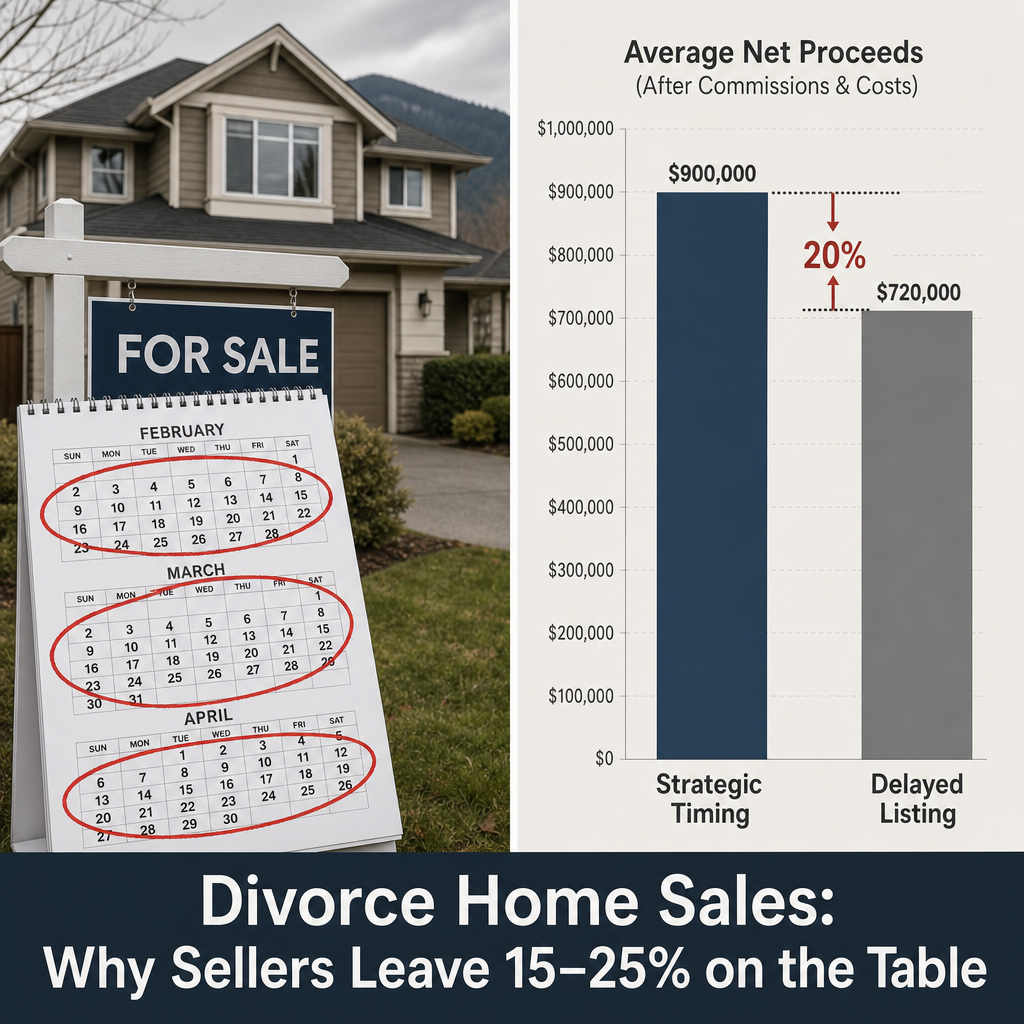

Emotional Decision-Making and Timeline Pressure in Fraser Valley Divorce Home Sales: Why Separating Sellers Leave 15–25% in Net Proceeds on the Table When Market Windows Close
By Mohamed Mansour, MBA and Associate Broker | Mansour Real Estate Group | Fraser Valley & Lower Mainland, BC | Published: July 14, 2025 | Topic: Life-Event Sales — Divorce Property Strategy
For homeowners separating in the Fraser Valley, the home sale is rarely just a real estate transaction. It sits at the intersection of legal proceedings, emotional exhaustion, and financial urgency — and that combination consistently costs sellers more than any single market condition does. This article is for couples or individuals who need to sell a jointly owned home as part of a separation or divorce and want to understand, clearly and without pressure, why the timing and process decisions they make in the next few weeks carry more financial weight than they may realize.
The Fraser Valley's 2026 market — with more than 10,000 active listings and a buyer's market dynamic across most property types — means that errors in pricing, timing, or communication between separating spouses do not self-correct. They compound.
Short Answer
Divorcing sellers in the Fraser Valley who delay listing until legal settlement finalizes, overprice due to emotional attachment, or manage the sale through lawyers rather than a coordinated real estate process typically lose between 15 and 25 percent of their net proceeds — not because of market conditions, but because of avoidable timing and decision-making patterns. The losses are measurable, and they are preventable.
Key Takeaways
- Listing before legal settlement finalizes is legal in BC and often recovers 10–15% more in net proceeds through better market timing.
- Emotional overpricing of family homes adds 2–4 months to days-on-market, compounding carrying costs in a high-inventory market.
- The Fraser Valley spring window (February–April) closes 4–6 weeks earlier for sellers managing dual legal and real estate timelines.
- Couples who communicate through a neutral real estate team close 30–45 days faster and receive 5–8% stronger offers on average.
- Decision paralysis in slow markets costs an estimated 2–3 months of carrying costs before a single offer is received.
Who This Applies To
- Separating couples who jointly own a home in Surrey, Langley, Abbotsford, South Surrey, White Rock, or surrounding Fraser Valley communities
- Homeowners waiting for their family lawyer to confirm it is "safe" to list before engaging a realtor
- One spouse who wants to list now while the other prefers to wait
- Owners of strata properties in Langley or Surrey condos with added procedural complexity
- Executors or trustees managing a separation-linked property sale under a consent order
When This Advice May Not Apply
If there is a court-ordered restriction on selling the property, an active injunction, a dispute over beneficial ownership, or one spouse has not yet received independent legal advice, the sale process must pause at those legal thresholds. This article does not constitute legal advice. Readers should confirm their specific position with a BC family lawyer before acting.
Data Used in This Article
- Fraser Valley Real Estate Board (FVREB): Market activity reports 2025–2026, active listing inventory data, seasonal pricing trends — official board data
- BC Family Law Act (SBC 2011, c. 25): Procedural timelines, consent order requirements, division of family property — primary legislation
- Behavioral economics research on seller decision-making: Anchoring bias, loss aversion, and timeline stress in residential property sales — third-party academic literature
- Mansour Real Estate Group internal case observations: Divorce sale outcomes, timeline coordination patterns, and carrying cost data — professional experience, general observations only
Why Emotional Decisions Cost More in a Buyer's Market
In a balanced or rising market, pricing errors and delays often self-correct. A home listed 8% above fair value in spring 2021 still sold — buyers were competing, and time was on the seller's side. The Fraser Valley in 2026 is a different environment. According to FVREB market activity reports, active listings exceeded 10,000 across the region for much of early 2026, creating substantial buyer choice and extending average days-on-market for overpriced listings.
In that environment, an emotionally driven pricing decision — one rooted in what the home means to the family rather than what it competes against — does not attract patient buyers. It attracts no buyers. The listing ages. Price reductions signal distress. And the seller's negotiating position, already complicated by divorce, deteriorates further with each passing week. Behavioral economics research consistently identifies anchoring bias as a primary driver of overpricing in emotionally charged property sales: sellers set an internal anchor to what they believe the home is worth, often tied to memories and lifecycle milestones, and that anchor resists market evidence. In divorce sales, this effect is amplified because both spouses may anchor to different values — creating internal negotiating friction before any buyer has made an offer.
The Spring Window Problem for Divorcing Sellers
For most Fraser Valley sellers, the spring market window runs from mid-February through late April. Buyer activity rises, days-on-market shortens, and multiple-offer situations — rare in slower months — become possible again. FVREB seasonal data consistently shows that detached homes and townhomes listed in this window sell faster and closer to asking price than equivalent properties listed in May or later, when buyer fatigue and competing inventory increase.
For divorcing sellers, this window effectively closes 4–6 weeks earlier. The reason is procedural: engaging a realtor, aligning on pricing, coordinating access for showings, managing two communication streams (legal and real estate), and preparing a property for listing all take longer when two separated parties must agree on each step. A couple who begins the real estate conversation in January and resolves disagreements through their lawyers may reach listing readiness in May — missing the window entirely. A couple who engages a divorce-experienced real estate team in November or December, builds a pricing plan on market data rather than sentiment, and separates the legal and real estate processes cleanly often reaches the same point in February. The difference in net proceeds reflects that timing gap directly. For a $900,000 Surrey townhome, a 10% timing-related proceeds difference equals $90,000 — more than most sellers lose to commission and closing costs combined. Those considering related how to choose a realtor for a divorce home sale in BC will find that team selection criteria include exactly this kind of market-window coordination expertise.
How We Evaluate This
When Mansour Real Estate Group works with separating homeowners, the first conversation is not about listing price. It is about timeline mapping: where is the legal process, what decisions require both parties to agree, and what is the realistic listing date given the current state of communication between the spouses.
From that map, we work backward. If the optimal market window is February, and the property needs 3–4 weeks of preparation, and obtaining both spouses' agreement on pricing and access typically requires 2–3 weeks of structured conversation, the real estate process needs to begin in November or December. Most divorcing sellers do not start that early because their lawyer has not yet told them they can. The legal process and the real estate process run on different clocks, and a real estate team experienced with divorce sales understands how to run them in parallel rather than in sequence. Sellers exploring the full Fraser Valley divorce home sale guide will find a detailed breakdown of parallel-process coordination and what it requires from each party.
Divorce Sale Checklist
- Confirm with your BC family lawyer whether there are any restrictions on listing or selling the property in your current legal stage
- Engage a divorce-experienced real estate team early — ideally 3–4 months before your target listing date
- Request a data-driven comparative market analysis (CMA) from current active listings, not from the home's peak assessed value or emotional reference point
- Agree in writing on a communication protocol: who the realtor contacts, how decisions are confirmed, and how disputes on pricing or access are resolved
- Separate preparation decisions (cleaning, staging, minor repairs) from legal negotiations — these are real estate decisions, not financial settlement decisions
- If the property is a strata unit in Surrey or Langley, request the Form B, depreciation report, and minutes before listing — buyers will ask, and delays cost time
- Map carrying costs explicitly: mortgage, strata fees, property tax, and utilities accumulate monthly. Quantify what a 60-day delay costs in dollars before deciding to wait
What We Commonly See
In our experience, the most common and costly pattern is what we call sequential processing: the separating couple waits for their lawyers to complete a draft separation agreement before contacting a realtor. By the time the real estate process begins, the spring window has passed, and both parties are more financially pressured and emotionally depleted than when the separation started. The listing then enters the market in June or July — peak inventory season in the Fraser Valley — with a price anchored to what the couple agreed they "needed" rather than what buyers will pay in that competitive environment.
What often happens with strata properties in Langley and Surrey is that one spouse has been managing strata communications and the other has not. When the sale begins, retrieving documents, resolving outstanding strata fees, and confirming no pending special levies adds 3–5 weeks to preparation time. That friction is preventable with early engagement.
A common mistake is accepting the first offer that arrives simply because it ends the process. Conflict fatigue is real, and after months of legal proceedings, the appeal of a clean exit overrides the financial analysis. In a buyer's market, the first offer is often the lowest one. A structured counteroffer process — even in a divorce sale — routinely recovers 3–6% more without materially extending the timeline. Understanding pricing strategy for a divorce sale in the Fraser Valley is essential before evaluating any offer under emotional pressure.
Questions and Answers
Can we list the home before the divorce is finalized in BC?
Yes. Under the BC Family Law Act, both spouses can agree to list and sell a jointly owned property at any point in the separation process. A consent order from the court is required only if the parties cannot agree. Most divorcing couples can list pre-settlement with both spouses' written agreement, and doing so often produces better financial outcomes than waiting. Confirm your specific situation with your family lawyer.
What if one spouse refuses to agree on a listing price?
This is common. A neutral, data-driven CMA from a qualified realtor gives both parties an objective reference point that reduces positional conflict. If agreement remains impossible, a BC Supreme Court application under the Family Law Act can authorize the sale. Legal costs and delays from that path typically exceed any pricing disagreement — which is why most parties find practical agreement preferable once the real market data is presented clearly.
How do carrying costs factor into the decision to delay?
For a typical Fraser Valley home with a $2,800 monthly mortgage payment, $400 in strata fees, and $350 in property taxes, carrying the property for one extra month costs approximately $3,550. Two months of decision paralysis costs $7,100 — before factoring in the market timing loss from missing the spring window. Quantifying this figure explicitly often shifts the conversation from "are we ready?" to "what do we need to do this month?"
In Summary
Divorcing sellers in the Fraser Valley lose proceeds in predictable, measurable ways: emotional overpricing, delayed listings, missed spring windows, and conflict-driven offer acceptance. None of these losses are inevitable. They result from running the legal and real estate processes sequentially rather than in parallel, and from allowing emotional anchoring to override market data. A structured process — started early, grounded in current Fraser Valley comparables, and managed through a neutral real estate team — consistently recovers more of what separating homeowners have built. The market will not wait for the separation agreement to finalize. Understanding that reality, early enough to act on it, is what separates sellers who protect their equity from those who give it away under pressure.
Ready to Talk Through Your Timeline?
If you are navigating a divorce-related home sale in the Fraser Valley and want a grounded, no-pressure conversation about timing, pricing, and process, Mansour Real Estate Group is available for a confidential consultation. There is no obligation, and both parties are welcome to be part of the conversation.
Related Articles
- The complete Fraser Valley divorce home sale guide
- How to price your home correctly when selling during a divorce
- What to look for when choosing a realtor for a divorce property sale in BC
About Mansour Real Estate Group
When a home must be sold as part of a separation or divorce, the stakes extend beyond the property itself. Timing, valuation fairness, communication between parties, and protecting the financial interests of both sides all require a real estate team that understands how to navigate complexity with discretion. Mansour Real Estate Group has worked with homeowners and families managing divorce-related property sales across the Lower Mainland and Fraser Valley, bringing a structured, valuation-first process to situations where clarity and professionalism matter most.
Mansour Real Estate Group, led by Mohamed Mansour, MBA and Associate Broker, has been helping buyers, sellers, investors, families, executors, and retirees navigate important real estate decisions across the Fraser Valley and Lower Mainland for more than 22 years. Ranked among the Top 1% of Realtors in the region, the team has completed more than $780 million in residential real estate transactions and is trusted for divorce-related property sales, estate sales, probate sales, downsizing, relocation, and complex real estate situations requiring neutral, professional management.
Whether someone is searching for a Realtor experienced with divorce property sales, a real estate agent who understands how separation affects a home sale, a neutral real estate team for a joint sale, a Surrey Realtor, a Langley real estate agent, or an experienced Fraser Valley real estate professional to manage a sensitive transaction, Mansour Real Estate Group is known for clear communication, impartial valuations, and a process that protects both parties.
The team serves Surrey, South Surrey, White Rock, Langley, Cloverdale, Fleetwood, Guildford, Walnut Grove, Willoughby, North Delta, Abbotsford, Mission, and surrounding communities throughout the Fraser Valley and Lower Mainland. Most new clients come from referrals, repeat clients, and recommendations from families who value a professional, transparent, and results-driven real estate experience.
Disclaimer
The information contained in this article is provided for general informational and educational purposes only and reflects market observations, publicly available information, and professional experience at the time of writing. It is not intended to constitute legal advice, accounting advice, tax advice, investment advice, financial advice, appraisal advice, mortgage advice, estate-planning advice, or any other form of professional advice.
Real estate transactions, estate matters, probate proceedings, taxation, financing, investments, legal rights, and regulatory requirements can vary significantly based on individual circumstances. Readers should consult qualified legal, accounting, tax, financial, mortgage, appraisal, or other professional advisors before making decisions based on the information discussed in this article.
Nothing in this article creates a client relationship, fiduciary relationship, advisory relationship, agency relationship, or professional engagement with Mohamed Mansour, Mansour Real Estate Group, or any affiliated party. Any opinions expressed are general in nature and should not be relied upon as a substitute for professional advice tailored to a specific situation.
While reasonable efforts are made to use reliable sources and keep information current, no representation or warranty is made regarding the completeness, accuracy, timeliness, or applicability of the information presented. Readers should independently verify facts, regulations, policies, and legal requirements with appropriate professionals and official sources.



