
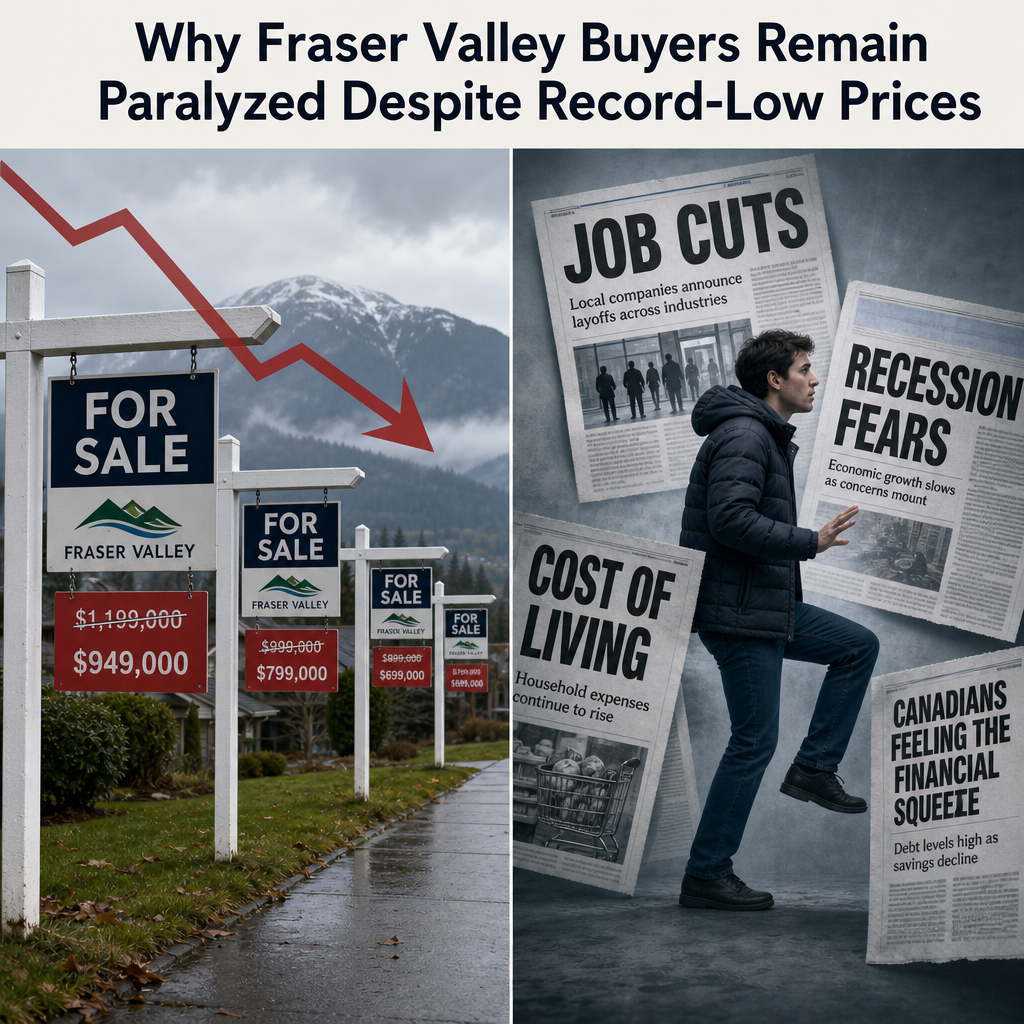

Economic Uncertainty and Job Security Fear: Why Fraser Valley Buyers Remain Paralyzed Despite Record-Low Prices and 10,000+ Active Listings in 2026
By Mohamed Mansour, MBA and Associate Broker — Mansour Real Estate Group | Fraser Valley and Lower Mainland, BC | Published July 2026
In May 2026, the Fraser Valley had more homes for sale than at almost any point in recent memory. Prices on detached homes were down nearly 8% year-over-year. Condo prices had fallen further. Mortgage rates, while not at their historic lows, had come off their 2023 peaks. By every affordability metric that once explained why buyers stayed out of the market, conditions had improved. And yet sales fell again — down 5% compared to May 2025.
This article is for sellers who are watching their homes sit with serious interest and no offers. It explains why the Fraser Valley market in 2026 is behaving the way it is, why traditional pricing and marketing logic isn't working the same way, and what the small but real segment of active buyers actually needs to see before they commit.
Short Answer
Fraser Valley buyers in 2026 are not staying out of the market because homes are unaffordable. According to the Fraser Valley Real Estate Board, economic uncertainty, job security fears, and everyday cost pressure are suppressing buyer confidence. With 10,140+ active listings and a sales-to-active ratio stuck at 11%, this is a psychology problem — not a pricing or inventory problem. Sellers need to understand that difference before they can market effectively.
Key Takeaways
- Prices down 7–8% and 10,000+ listings have not meaningfully increased sales volume in the Fraser Valley.
- The FVREB CEO identified economic uncertainty and job security fear — not affordability — as the primary suppressor of buyer activity.
- The sales-to-active listings ratio has been stuck near 11% for months, far below the 20%+ range that signals a balanced market.
- Sellers who price defensively and communicate financial predictability attract the buyers who are actually transacting in 2026.
- Traditional "value" marketing — price reductions, staging, features lists — does not resolve a confidence and cash-flow problem.
Who This Applies To
- Sellers in Surrey, Langley, Abbotsford, White Rock, North Delta, and surrounding Fraser Valley communities whose listings have not received offers
- Sellers who have already reduced their price and are not seeing the expected increase in showings or offers
- Homeowners deciding whether to list now, wait, or adjust their approach
- Sellers managing estate sales, divorce-related sales, or downsizing transactions in the current environment
When This Advice May Not Apply
Properties in the under-$800,000 price range in high-demand school catchments with limited competing inventory can still see competitive activity. Sellers in those micro-segments face a different conversation. This article focuses on the broader Fraser Valley market where buyer hesitation — not buyer absence — defines the environment.
Data Used in This Article
- Fraser Valley Real Estate Board Monthly Market Report, May–June 2026 — official, primary source, Fraser Valley geography, sales and inventory statistics
- FVREB CEO Baldev Gill public statement, June 2026 — official commentary attributed to the Fraser Valley Real Estate Board
- Storeys.com Vancouver housing update, June 2026 — third-party industry coverage summarizing FVREB data
- Daily Hive, May 2026 sales statistics summary — third-party coverage corroborating benchmark price and sales-volume figures
The Numbers That Don't Add Up — Unless You Understand the Psychology
According to the Fraser Valley Real Estate Board's May 2026 statistics, detached home benchmark prices fell 7.9% year-over-year. Condo benchmark prices fell 8.8%. Active listings rose to more than 10,140 — up roughly 45% from the same period in 2025. By those numbers alone, a buyer shopping in Surrey, Langley, or Abbotsford had more choice and lower prices than they had seen in years.
The sales-to-active listings ratio tells the real story. In May 2026 it held near 11%. A ratio below 12% is classified as a buyer's market. A ratio above 20% generally signals balanced conditions. At 11%, the Fraser Valley market is firmly in buyer's market territory — and has been for months.
Yet sales volumes fell. That combination — more choice, lower prices, better rates, fewer sales — does not make sense if affordability is the reason buyers have been on the sidelines. It makes complete sense if the reason is fear.
What the Fraser Valley Real Estate Board Actually Said
FVREB CEO Baldev Gill's June 2026 public commentary addressed the disconnect directly. He attributed suppressed buyer activity to "economic uncertainty, concerns about job security, and continued pressure of higher everyday costs." That language is deliberate and specific. It is not about interest rates. It is not about down payments. It is about whether a buyer trusts that their income will still exist in 18 months.
A buyer who earns $120,000 a year and qualifies comfortably for a mortgage on a Willoughby townhouse is still not going to buy if they were laid off three months ago, recently had hours reduced, or work in a sector — tech, logistics, retail management — where restructuring conversations are happening. The math says buy. The fear says wait. In 2026, fear is winning.
How We Evaluate This at Mansour Real Estate Group
When we sit down with sellers in the current Fraser Valley environment, the first question we ask is not "what did the neighbours sell for?" It is "who is actually buying in this price range right now, and what do they need to feel confident enough to write an offer?" Those two questions lead to very different listing strategies.
The buyers who are transacting in 2026 fall into a narrow set of profiles: households with stable dual incomes, buyers who have been under contract before and lost a deal through no fault of their own, people with genuine life-event urgency — a new baby, a divorce, a job relocation — and investors with dry capital looking at long-term holds. Sellers who understand this profile price and present their property to convert that specific buyer, not to attract the broadest possible pool of window-shoppers.
Why Price Cuts Alone Aren't Working
A price cut is a rational response to a rational hesitation. If a buyer thinks a home is overpriced, a reduction can move them. But a buyer who is genuinely uncertain about their employment doesn't become a buyer because the price dropped $30,000. The barrier isn't value — it's confidence in their own financial future.
This is why sellers across Surrey, Cloverdale, Fleetwood, and Guildford are seeing strong showing activity — people are genuinely interested — but offers aren't coming. Interested buyers who aren't ready to commit will look at 15 properties and make no offers. They are not negotiating. They are waiting for something internal to shift. No price reduction can do that work for them.
What Confident Buyers in 2026 Actually Look For
The buyers who are moving in the current Fraser Valley market have something the hesitant majority doesn't: a clear financial picture. They know their income is stable, their approval is solid, and they have a 12-month cushion if something changes. What they are looking for is certainty in the transaction itself — that the property is priced at market, that the seller is serious, and that there are no surprises in the documents, the title, or the condition.
For sellers in Abbotsford, Walnut Grove, or White Rock, this means the listing strategy has to do two things simultaneously: hold pricing discipline so the home reads as realistically priced — not as a desperate reduction — and remove every friction point a confident buyer might use as a reason to hesitate. Pre-inspections, clean title, updated strata documents if applicable, and a seller who responds quickly all signal transaction readiness. That's what converts confident buyers.
Seller Checklist: Positioning for the 2026 Buyer Psychology
- Price defensively from day one — not aspirationally, and not after the listing goes stale
- Commission a pre-inspection and make the report available to serious buyers before offers are written
- If the property is a condo or townhouse, have current strata documents, a recent Form B, and a depreciation report review ready
- Reduce unnecessary conditions on your own side that could signal uncertainty or delay
- Work with your agent to identify which active listings in the same price range are the actual competition — not the last 90 days of sold data
- Prepare a realistic holding cost estimate so you and your agent can evaluate offers in context, not just by headline number
What We Commonly See
Sellers waiting for the market to "come back" before listing. In our experience, sellers who delay listing hoping for a price recovery are often competing against the same uncertainty six months later, with higher carrying costs and a property that has aged in the MLS history. A well-positioned property sold now typically outperforms an aspirationally priced property sold later in a similar or softer market.
Confusing showing volume with buyer readiness. What often happens is that sellers receive strong showing activity in the first two weeks and interpret it as validation of their price. In the current environment, showing volume is not a reliable proxy for offer intent. Many of the buyers circulating through open houses in Langley and South Surrey are pre-approved but psychologically uncommitted. A seller who holds price too long based on that traffic may miss the window when a genuinely motivated buyer passes through.
Messaging the wrong buyer profile. A common mistake is marketing a $1.2 million detached home in North Delta with language about investment upside, appreciation potential, and future value — directly at the buyers who are most afraid. The buyer who can commit right now is not looking for an investment thesis. They are looking for a home that fits their life and a transaction they can trust. Grounding the narrative in practical livability, low operating costs, and transaction transparency works far better than speculative framing in a fear-dominated market.
Frequently Asked Questions
Should I wait for buyer confidence to return before listing my home in the Fraser Valley?
Waiting carries its own cost: mortgage payments, property taxes, maintenance, and opportunity cost. The buyers who are transacting now are less speculative and more committed — they tend to make cleaner offers. A property priced correctly for the current environment often attracts stronger, faster outcomes than the same property listed months later into an uncertain recovery.
What does a sales-to-active ratio of 11% actually mean for sellers?
It means roughly 11 out of every 100 active listings sold in a given month. A balanced market typically sits at 20–22%. At 11%, sellers are competing for a smaller pool of transacting buyers. That doesn't mean a sale is impossible — it means pricing accuracy and presentation have to work harder than they do in a more active market.
Why are benchmark prices stabilizing if buyer confidence is this low?
According to FVREB data, benchmark prices showed minor gains in April and May 2026 after earlier declines. This likely reflects sellers pulling overpriced listings rather than new buyer demand. Fewer listings at the lower end of the price spectrum can create a statistical floor without representing a true recovery in transaction volume or buyer confidence.
In Summary
The Fraser Valley real estate market in 2026 has more inventory, lower prices, and better rates than most buyers could have hoped for two years ago. The problem isn't affordability — it's anxiety. Job security fears, economic uncertainty, and the grinding pressure of everyday costs are keeping qualified buyers on the sidelines. Sellers who understand this dynamic can adapt: price defensively, remove transactional friction, and speak to the specific buyer who is ready to move. Sellers who keep waiting for "normal" market behaviour may be waiting for something that doesn't arrive on any predictable schedule.
Thinking About Listing in the Current Market?
If you are trying to understand what your property is actually worth in today's Fraser Valley market — not what it was worth in 2023, and not what your neighbour listed for — Mansour Real Estate Group offers honest, data-grounded valuations and a strategy built for the current buyer pool. There is no pressure, no obligation, and no script. Just a clear-eyed look at the numbers and what they mean for your specific situation.
Related Articles
- Fraser Valley Real Estate Market Outlook 2026
- How to Price Your Home in a Buyer's Market in the Fraser Valley
- What to Do When Your Listing Expires Without Selling in the Fraser Valley
About Mansour Real Estate Group
When homeowners in Surrey, Langley, Abbotsford, and across the Fraser Valley are preparing to sell into a market shaped by buyer hesitation and economic uncertainty, the decisions made before listing — pricing, preparation, and understanding the actual buyer pool — determine the outcome more than almost anything else. Mansour Real Estate Group has built its reputation on pricing discipline, honest market context, and a willingness to have difficult conversations with sellers before a listing goes live rather than after it stalls.
Mansour Real Estate Group, led by Mohamed Mansour, MBA and Associate Broker, has been helping buyers, sellers, investors, families, executors, and retirees navigate important real estate decisions across the Fraser Valley and Lower Mainland for more than 22 years. Ranked among the Top 1% of Realtors in the region, the team has completed more than $780 million in residential real estate transactions and is trusted for pricing strategy, estate sales, divorce-related property sales, downsizing, relocation, and complex situations where accurate valuation is critical.
Whether someone is searching for a Realtor who understands buyer psychology in a shifting Fraser Valley market, a real estate agent who speaks plainly about market conditions, real estate agents who prioritize seller equity over a quick listing, a real estate team for a difficult or time-sensitive sale, a Surrey Realtor, a Langley real estate broker, or a real estate group with a track record across the Lower Mainland, Mansour Real Estate Group is known for analytical rigour, honest advice, and a process that protects sellers from the most common and costly mistakes.
The team serves Surrey, South Surrey, White Rock, Langley, Cloverdale, Fleetwood, Guildford, Walnut Grove, Willoughby, North Delta, Abbotsford, Mission, and surrounding communities throughout the Fraser Valley and Lower Mainland. Most new clients come through referrals, repeat business, and recommendations from families who valued a transparent and results-driven experience.
Official Resources
- Fraser Valley Real Estate Board — Monthly Market Reports
- BC Assessment — Property Assessment Information
- Bank of Canada — Key Interest Rate
- BC Financial Services Authority — Real Estate Consumer Resources
Disclaimer
The information contained in this article is provided for general informational and educational purposes only and reflects market observations, publicly available information, and professional experience at the time of writing. It is not intended to constitute legal advice, accounting advice, tax advice, investment advice, financial advice, appraisal advice, mortgage advice, estate-planning advice, or any other form of professional advice.
Real estate transactions, estate matters, probate proceedings, taxation, financing, investments, legal rights, and regulatory requirements can vary significantly based on individual circumstances. Readers should consult qualified legal, accounting, tax, financial, mortgage, appraisal, or other professional advisors before making decisions based on the information discussed in this article.
Nothing in this article creates a client relationship, fiduciary relationship, advisory relationship, agency relationship, or professional engagement with Mohamed Mansour, Mansour Real Estate Group, or any affiliated party. Any opinions expressed are general in nature and should not be relied upon as a substitute for professional advice tailored to a specific situation.
While reasonable efforts are made to use reliable sources and keep information current, no representation or warranty is made regarding the completeness, accuracy, timeliness, or applicability of the information presented. Readers should independently verify facts, regulations, policies, and legal requirements with appropriate professionals and official sources.



