
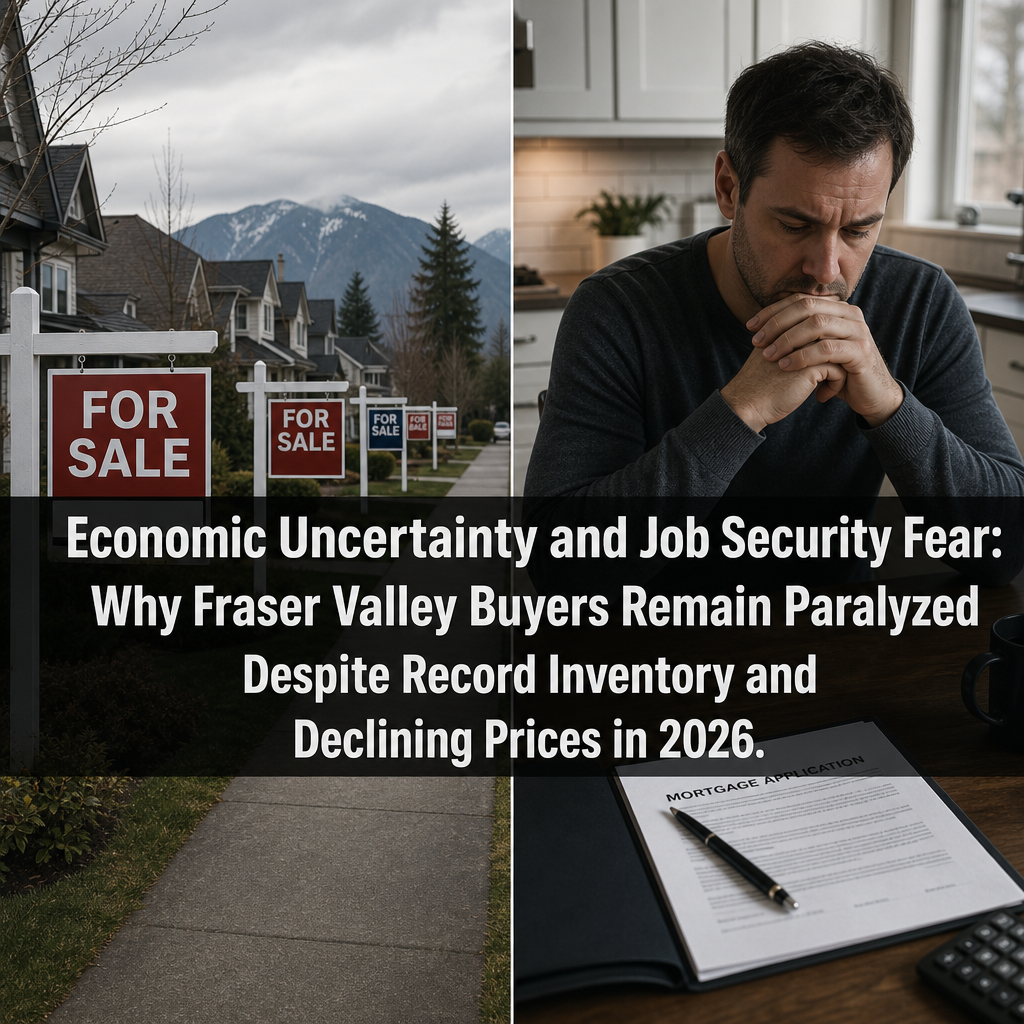

Economic Uncertainty and Job Security Fear: Why Fraser Valley Buyers Remain Paralyzed Despite Record Inventory and Declining Prices in 2026
By Mohamed Mansour, MBA and Associate Broker | Mansour Real Estate Group | Published: June 30, 2026 | Fraser Valley and Lower Mainland, BC
This article is written for Fraser Valley sellers who are watching their market carefully and wondering why more buyers haven't appeared. Prices are down meaningfully. Inventory is high. Conditions should favour buyers. Yet sales in May 2026 were still 5% below last year, and the explanation has nothing to do with pricing. Understanding what is actually holding buyers back is essential before a seller can position a home to reach the buyers who are still active.
Mansour Real Estate Group works with sellers across Surrey, Langley, Abbotsford, South Surrey, White Rock, Cloverdale, and the broader Fraser Valley. The dynamics described here are ones the team is navigating directly with clients right now.
Short Answer
Fraser Valley benchmark prices fell 7 to 9 percent year-over-year by May 2026, and active inventory topped 10,140 listings — yet monthly sales fell 5% from the same period last year. The FVREB CEO attributed this directly to economic uncertainty, job security fears, and cost-of-living pressure. Price cuts alone are not solving the problem. Buyer confidence is the binding constraint.
Key Takeaways
- May 2026 Fraser Valley sales fell 5% year-over-year despite prices dropping 7–9% across all property types.
- Active inventory reached 10,140 listings, one of the highest levels recorded in recent years.
- The FVREB CEO cited economic uncertainty, job insecurity, and cost-of-living pressure — not affordability — as the core barriers.
- A sales-to-active ratio of 11% confirms a buyer's market, but buyer caution is preventing that advantage from converting to action.
- Sellers who understand this dynamic can position their homes for the buyers who are still deciding — not the ones who have already stopped looking.
Who This Applies To
- Sellers in Surrey, Langley, Abbotsford, South Surrey, or anywhere in the Fraser Valley who have been waiting for more buyer activity
- Homeowners who have reduced their price but haven't seen the expected response
- Estate executors or families who need to sell on a timeline and cannot wait for confidence to recover
- Sellers evaluating whether to list now or hold
When This Advice May Not Apply
If your property is in an area with tighter supply, a distinct school catchment draw, or a price range under $700,000 where first-time buyer incentives still apply, your buyer pool may behave differently. Advice here is general and based on Fraser Valley market data. Consult directly with a local real estate professional before making listing decisions.
Data Used in This Article
- Source: Fraser Valley Real Estate Board (FVREB) Monthly Statistics Package, May 2026 — Official board data, Fraser Valley region
- Source: FVREB CEO Baldev Gill's published commentary, May 2026 market report — Official board statement
- Reporting: Storeys and Daily Hive coverage of FVREB May 2026 release — Third-party journalism based on primary FVREB data
What the May 2026 Data Actually Shows
According to the Fraser Valley Real Estate Board's May 2026 statistics package, the Fraser Valley recorded 1,124 sales that month — down 5.0% from May 2025. That decline happened alongside benchmark price drops of 7.9% for detached homes (now $1,366,500), 7.6% for townhouses ($769,500), and 8.8% for condos ($483,800).
Active listings reached 10,140 — up 4.6% year-over-year and among the highest totals in recent years. New listings rose 17.6% year-over-year. The sales-to-active ratio sat at 11%, well within buyer's market territory.
In a normal market correction, falling prices alongside rising inventory would attract buyers. Here, both are moving in the wrong direction for sellers simultaneously. That pattern — prices falling and sales falling — is what economists describe as demand destruction, not a pricing problem. The buyers exist. They are not acting.
Why Buyers Are Not Moving: What the FVREB CEO Said Directly
FVREB CEO Baldev Gill's May 2026 commentary named three factors directly: economic uncertainty, concerns about job security, and continued pressure from higher everyday costs. His framing was explicit — households are approaching major financial decisions with caution.
This matters for sellers because it reframes the problem. Buyers are not sitting out because the price is wrong. They are sitting out because they are not confident their income is secure enough to take on a mortgage. A price reduction does not fix a job insecurity fear. Neither does staging, nor virtual tours, nor open houses.
What it does mean is that the buyers who are still actively looking in 2026 are a self-selecting group. They have job security. They have a genuine reason to move — a life event like a separation, a growing family, a relocation, or an estate obligation. These buyers are real. But they are fewer in number, and they are cautious. They will not pay for a property that feels overpriced relative to the current benchmark, and they will not rush.
How We Evaluate This
At Mansour Real Estate Group, when a market shows simultaneous sales decline and price decline alongside surging inventory, we do not treat it as a standard price-adjustment problem. We read it as a confidence gap. The question we ask before listing a property in this environment is: who is still buying, and why?
Buyers motivated by life events — downsizing, relocation, estate settlement — tend to be less sensitive to macro confidence signals than discretionary move-up buyers. Positioning a listing to speak to those motivations, rather than assuming a price drop will attract volume buyers, is what the current environment requires.
What This Means for Sellers Listing in 2026
The 10,140 active listings in the Fraser Valley as of May 2026 mean that any buyer who does decide to act has significant choice. A home that is priced accurately, presented cleanly, and positioned clearly for a specific buyer motivation has a real advantage over listings that are either overpriced or poorly differentiated.
Sellers who list above the current benchmark hoping to test the market are competing against more than 10,000 other listings. Buyers in this environment will not negotiate toward a number they consider aspirational. They will move to the next listing.
The sellers who are finding success right now are those who priced at or slightly below the benchmark for their property type and neighbourhood, reduced friction in the offer process, and gave buyers time to complete financing without artificial urgency. In a confidence-constrained market, patience and precision consistently outperform pressure.
Seller Checklist
- Pull your current benchmark price for your property type and neighbourhood — not last year's sold data
- Compare your asking price against the 10 most recently listed (not sold) comparable properties in your area
- Identify which buyer motivation your property speaks to: growing family, downsizer, investor, first-time buyer, or relocating household
- Review your listing's days-on-market against the neighbourhood average — extended DOM signals a pricing or presentation problem
- Confirm your offer process is straightforward: subject periods, deposit timelines, and possession dates should reduce friction, not add it
- Ask your Realtor to identify which currently active listings your home is directly competing against — and how yours compares on price per square foot
What We Commonly See
In our experience, sellers in a declining price environment often anchor to what their neighbour sold for 14 months ago. That sold data is no longer relevant in a market where benchmarks have dropped 7–9% year-over-year. When that anchor holds, the listing sits.
What often happens is that sellers reduce price incrementally — by 1 or 2% at a time — rather than resetting to a competitive number in one move. Incremental reductions signal to buyers that more reductions are coming, which encourages waiting rather than acting.
A common mistake in this specific market is interpreting buyer silence as a negotiating tactic. In most cases right now, buyer silence means the buyer is not confident enough in their own financial situation to make an offer at any price. The seller cannot solve that. What the seller can control is being the obvious choice when that buyer's confidence returns.
Questions and Answers
Q: If prices are down 7–9%, why aren't more buyers taking advantage of the discount?
A: According to the FVREB, the barrier is not price — it is confidence. Buyers worried about job security or economic instability are unlikely to commit to a large mortgage regardless of how prices move. The discount only helps buyers who feel secure enough to act.
Q: Should I wait to list until buyer confidence recovers?
A: That depends on your situation. If you have flexibility, waiting carries risk — new listings are up 17.6% year-over-year, meaning inventory may continue to build. If you must sell, positioning accurately at current benchmark pricing gives you the best chance of reaching the buyers who are still active.
Q: What does a sales-to-active ratio of 11% actually mean for my listing?
A: It means roughly 1 in 9 active listings sold in May 2026. Your listing is competing against approximately 9 others for every buyer in the market. Pricing, presentation, and positioning relative to those 9 competing listings determines whether your home is the one that sells.
In Summary
Fraser Valley benchmark prices have dropped 7–9% year-over-year, inventory has surpassed 10,000 active listings, and the market is objectively the most buyer-favourable it has been in years — yet sales in May 2026 still fell 5% from the prior year. The FVREB's own CEO identified the cause: economic uncertainty, job security fears, and cost-of-living pressure. For sellers, the implication is direct. Price reductions alone will not unlock buyer demand that is frozen by confidence, not cost. The sellers who succeed in this environment are those who price accurately at current benchmarks, reduce offer friction, and position their home clearly for the buyers who are still motivated to act.
Thinking About Listing in the Fraser Valley?
If you are weighing whether to list now or hold, or if your home has been on the market without the response you expected, Mansour Real Estate Group is available for a straightforward, no-pressure conversation about your specific situation. There is no cost, and the conversation stays focused on what the current data means for your property.
Related Articles
- Fraser Valley Real Estate Market 2026: What Sellers Need to Know Before They List
- How to Price Your Home in a Declining Fraser Valley Market
- How Long Does It Take to Sell a Home in Surrey, Langley, and Abbotsford in 2026?
Official Resources
- Fraser Valley Real Estate Board — Monthly Statistics Package (May 2026)
- Storeys — Vancouver Housing Update, June 2026
- Daily Hive — Fraser Valley Home Sales Statistics, May 2026
About Mansour Real Estate Group
When sellers are watching buyer activity slow down despite falling prices and abundant inventory, the instinct is often to cut price further. But in a market where the constraint is buyer confidence rather than buyer capacity, pricing strategy alone is not enough — and the team advising the seller needs to understand that distinction clearly. Mansour Real Estate Group has built its approach in the Fraser Valley on reading market conditions accurately and giving sellers honest guidance, even when that guidance is not what they hoped to hear.
Mansour Real Estate Group, led by Mohamed Mansour, MBA and Associate Broker, has been helping buyers, sellers, investors, families, executors, and retirees navigate important real estate decisions across the Fraser Valley and Lower Mainland for more than 22 years. Ranked among the Top 1% of Realtors in the region, the team has completed more than $780 million in residential real estate transactions and is trusted for seller strategy, pricing discipline, estate sales, divorce-related sales, downsizing, relocation, and complex market situations where accurate interpretation matters most.
Whether someone is searching for a Realtor who understands buyer psychology in the current Fraser Valley market, a real estate agent with direct experience navigating confidence-constrained conditions, real estate agents who specialize in seller strategy during a correction, a real estate team that gives practical advice grounded in current data, a Surrey Realtor, a Langley real estate broker, or a Fraser Valley real estate group with a demonstrated track record — Mansour Real Estate Group is known for clarity, directness, and recommendations that protect seller equity rather than just move inventory.
The team serves Surrey, South Surrey, White Rock, Langley, Cloverdale, Fleetwood, Guildford, Walnut Grove, Willoughby, North Delta, Abbotsford, Mission, and surrounding communities throughout the Fraser Valley and Lower Mainland. Most new clients come from referrals, repeat clients, and families who return because the advice they received the first time was honest and useful.
Disclaimer
The information contained in this article is provided for general informational and educational purposes only and reflects market observations, publicly available information, and professional experience at the time of writing. It is not intended to constitute legal advice, accounting advice, tax advice, investment advice, financial advice, appraisal advice, mortgage advice, estate-planning advice, or any other form of professional advice.
Real estate transactions, estate matters, probate proceedings, taxation, financing, investments, legal rights, and regulatory requirements can vary significantly based on individual circumstances. Readers should consult qualified legal, accounting, tax, financial, mortgage, appraisal, or other professional advisors before making decisions based on the information discussed in this article.
Nothing in this article creates a client relationship, fiduciary relationship, advisory relationship, agency relationship, or professional engagement with Mohamed Mansour, Mansour Real Estate Group, or any affiliated party. Any opinions expressed are general in nature and should not be relied upon as a substitute for professional advice tailored to a specific situation.
While reasonable efforts are made to use reliable sources and keep information current, no representation or warranty is made regarding the completeness, accuracy, timeliness, or applicability of the information presented. Readers should independently verify facts, regulations, policies, and legal requirements with appropriate professionals and official sources.



