
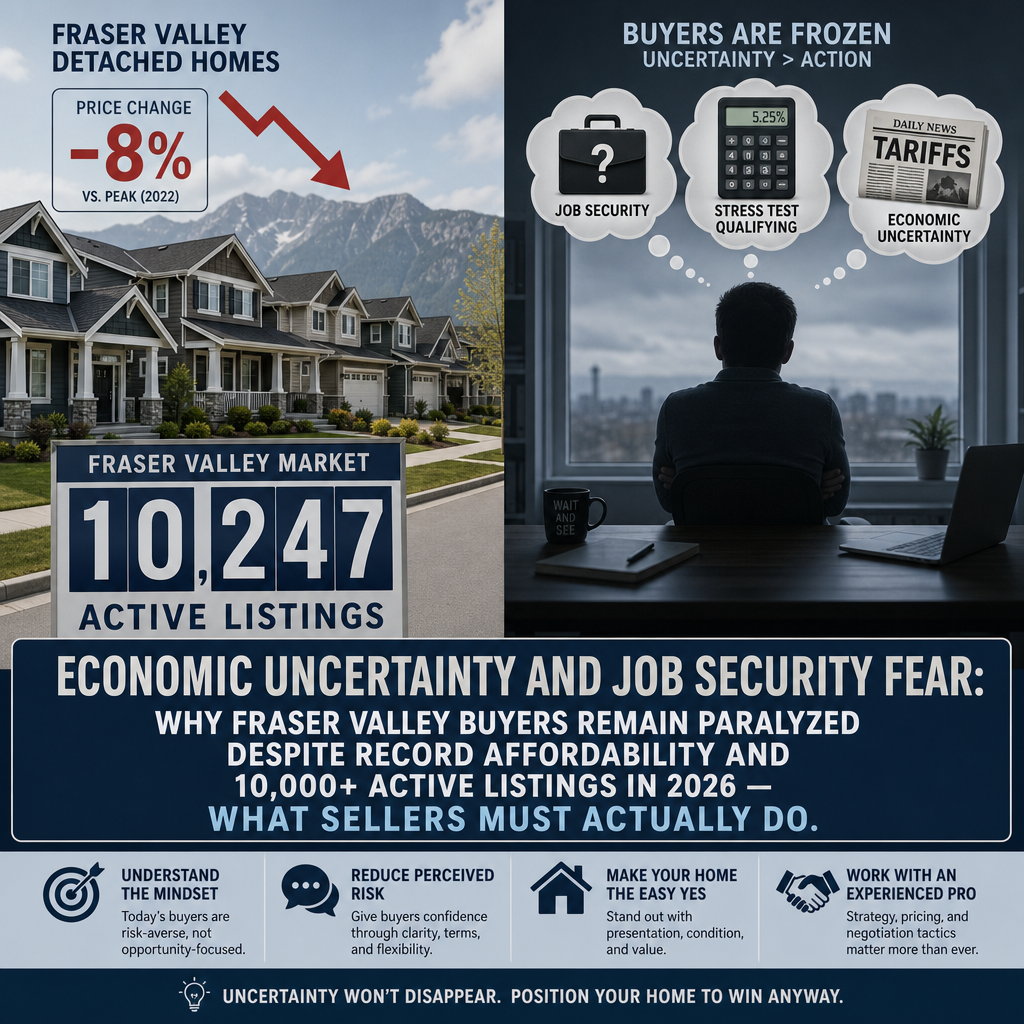

Economic Uncertainty and Job Security Fear: Why Fraser Valley Buyers Remain Paralyzed Despite Record Affordability and 10,000+ Active Listings in 2026 — What Sellers Must Actually Do
By Mohamed Mansour, MBA and Associate Broker | Mansour Real Estate Group | Published: July 15, 2026 | Fraser Valley and Lower Mainland, BC
The Fraser Valley real estate market in 2026 presents a problem that pricing alone cannot solve. Benchmark prices are down 7–9% year-over-year. Active listings have crossed 10,000. The Bank of Canada's policy rate has stabilized. Extended amortization options are available. By every traditional metric, this should be a moment of high buyer activity. Instead, sales volumes are running 26–30% below the ten-year seasonal average, according to the Fraser Valley Real Estate Board's May and June 2026 monthly market reports. The gap between affordability and action points to something that a price reduction cannot fix: fear.
For sellers, understanding that distinction is the difference between a sale and a stale listing. This article explains the economic psychology driving buyer paralysis in 2026 and gives Fraser Valley sellers a practical, specific playbook for what to do about it.
Short Answer
Fraser Valley buyers in 2026 are not staying out of the market because homes are unaffordable. They are staying out because they are afraid of losing their jobs. Tariff-related economic uncertainty, corporate restructuring headlines, and mortgage stress-test anxiety are keeping qualified buyers frozen. Sellers who address that fear directly—through pricing certainty, reduced conditions, and clear transaction structure—are the ones still selling.
Who This Applies To
- Homeowners in Surrey, Langley, Abbotsford, South Surrey, or North Delta currently listed or preparing to list
- Sellers who have already reduced their price once and seen no meaningful offer activity
- Sellers in the detached or townhouse segment, where buyer psychology and financing constraints interact most intensely
- Sellers with flexible timelines who want to understand whether waiting will materially improve their result
- Sellers whose realtor's current strategy is anchored to comparable sales data without addressing buyer hesitation directly
When This Advice May Not Apply
Sellers facing hard legal or financial deadlines—estate administration timelines, court orders, or lender-imposed requirements—may not have the flexibility to implement all of these strategies. Similarly, sellers in the entry-level condo segment or in in-demand school catchments in Willoughby or Walnut Grove may be working in micro-markets with different buyer pools and different hesitation profiles. Advice should always be calibrated to the specific property, location, and current buyer demand for that sub-segment.
Data Used in This Article
- Fraser Valley Real Estate Board: Monthly Market Reports, May and June 2026 — Official board data (Tier 1)
- Greater Vancouver Realtors (GVR): April 2026 Market Report — Official board data (Tier 1)
- Storeys.com: Vancouver Housing Update, June 2026 — Industry analysis (Tier 5)
- CBC News BC: Greater Vancouver buyer/seller real estate commentary — Journalistic source (Tier 5)
Key Takeaways
- Fraser Valley sales volumes are 26–30% below the ten-year seasonal average despite record affordability and 10,000+ active listings.
- Buyer hesitation in 2026 is driven by job security fear and economic uncertainty, not interest rates or price levels.
- Well-priced, well-positioned properties are still selling—12.5% of GVR detached listings sold above asking in April 2026.
- Sellers who reduce friction, provide documentation proactively, and price with precision attract the buyers who are ready to move.
- Generic price cuts into a fear-driven market do not work—they signal distress and trigger more hesitation from risk-averse buyers.
Why Affordability Alone Is Not Moving the Market
The Fraser Valley Real Estate Board's June 2026 report shows active listings at 10,247—17.6% above year-ago levels. The sales-to-active listings ratio sits at 11%, which economists and board analysts define as a buyer's market. Benchmark prices for detached homes have declined 7–9% year-over-year. The Bank of Canada held its key rate at 2.25% in April 2026, and federal mortgage rule changes extended insured amortizations to 30 years for eligible buyers. The affordability case is genuinely stronger than it has been in several years.
Yet sales in May 2026 were up only 0.5% from April, and June posted a 2% month-over-month gain—movements that are statistically modest given the scale of inventory and price correction already in place. Greater Vancouver recorded roughly 23,800 total home sales in 2025, approximately 25% below the ten-year average, according to GVR data. The 2026 trajectory is not showing a meaningful reversal of that pattern.
What this tells a seller is critical: the buyers who could afford to purchase are choosing not to. That is a psychology problem, not a pricing problem. Reducing asking price by another $25,000 does not address why a qualified buyer is afraid to commit to a 25-year mortgage when their employer announced layoffs last quarter or when tariff-related economic news dominates the headlines.
What Fear-Driven Buyer Hesitation Actually Looks Like
A buyer experiencing job security fear does not behave like a buyer waiting for prices to drop further. They do not counter low. They do not ask for extensions. They simply do not make offers. They attend showings, request disclosures, ask thoughtful questions—and then go quiet. This pattern is visible in the Fraser Valley market right now. Showing activity has remained relatively stable while offer conversion has not kept pace.
The FVREB and independent commentary cited in CBC's June 2026 coverage point to economic uncertainty—specifically tariff discussions and potential job reductions in trade-exposed sectors—as the primary hesitation driver. Mortgage stress test anxiety compounds this: even buyers who qualify at current rates worry about qualifying under a stress test scenario if rates shift or their income changes. The psychological weight of that scenario is enough to freeze decision-making, even when the numbers say "buy now."
Sellers in Cloverdale, Fleetwood, and Guildford—communities with significant employment tied to trade-exposed industries and the broader Metro Vancouver economy—are feeling this dynamic more acutely than sellers in more insulated sub-markets like South Surrey or White Rock, where buyer demographics skew toward retirement downsizers and equity-rich move-up buyers with less income-risk exposure.
How We Evaluate This
At Mansour Real Estate Group, when a property is not generating offers despite reasonable market exposure and fair pricing, the first question we ask is not "should we drop the price?" It is "what is the specific objection keeping buyers from committing, and can we remove it?"
In a fear-driven market, that analysis starts with the buyer's perceived risk, not the seller's equity position. We look at days on market relative to sub-segment averages, showing-to-inquiry ratios, feedback from buyer's agents after showings, and the specific conditions being requested in offers that do come in. Each of those signals tells us whether the barrier is price, condition, documentation, financing risk, or pure psychological hesitation—and each of those problems has a different solution.
Seller Checklist: Positioning for Fear-Driven Buyer Markets
- Price at the market, not ahead of it. In a buyer's market with 10,000+ listings, buyers compare aggressively. Pricing 3–5% below the closest comparable resets the conversation from hesitation to competition.
- Pre-gather all property documentation. Title search, property disclosure statement, tax certificate, any strata documents if applicable, and a recent home inspection report. Buyers who fear risk want evidence of certainty before they commit emotionally.
- Offer a completion-date range, not a fixed date. Fear-driven buyers often need flexibility to confirm financing and employment status before closing. A stated willingness to accommodate 45–75 day completions can unlock hesitant buyers.
- Remove condition barriers where possible. If the home is in good structural condition, a pre-listing inspection report provided upfront gives buyers a clear risk picture and reduces the perceived need for a long inspection period.
- Calibrate your marketing to address the buyer's actual objection. Listing descriptions that focus only on features miss the moment. Emphasize neighbourhood stability, school catchment continuity, and commuting convenience—the anchors that matter to buyers whose employment future feels uncertain.
- Avoid reactive price reductions without a strategy. A $20,000 price cut on day 45 signals seller distress and typically triggers lower offers, not more offers. Reduce only if a structured analysis of sub-market comparables supports it.
What We Commonly See
Sellers reducing price when the problem is perception, not value. In our experience, the most common mistake in a fear-driven market is a reactive price reduction that doesn't address the buyer's real objection. A buyer who is afraid of losing their job is not more likely to purchase because the home is now $15,000 cheaper. They need risk removed, not price lowered.
Listings that provide too little documentation too late. What often happens is that buyers get to the offer stage, ask for disclosures, encounter delays in receiving documents, and use that window to talk themselves out of the purchase. Proactive documentation packages—prepared before the listing goes live—close that gap and keep momentum intact.
Sellers who wait for the market to change rather than adapt to it. A common belief is that pent-up demand will eventually release and conditions will normalize. That may be true eventually, but waiting in a buyer's market with 10,000+ competing listings is a choice with real carrying costs. The sellers who adapt their positioning to current buyer psychology—not the market they wish existed—are the ones transacting in 2026.
Q&A: Selling in a Fear-Driven Fraser Valley Market
Q: If buyers can afford homes right now, why aren't they buying?
Affordability is a financial threshold. Willingness to commit is a psychological one. In 2026, many Fraser Valley buyers qualify at current rates but feel exposed to income risk from tariff-related economic disruption and job uncertainty. Qualifying for a mortgage and feeling confident enough to use it are two different things.
Q: Should I drop my price if my listing has been sitting for 60 days?
Not necessarily. Before reducing, examine showing-to-inquiry ratios, buyer agent feedback, and how your price compares to properties that have sold in the past 30 days in your sub-segment. If you are priced fairly and showings are occurring but offers are not, the barrier is likely not price—it is risk perception. A documentation package or completion flexibility may do more than a price cut.
Q: What types of properties are still selling in the Fraser Valley in 2026?
According to GVR's April 2026 data, 12.5% of detached homes sold above asking price—suggesting that well-priced, well-positioned properties are attracting buyers even in this market. Entry-level townhouses in school-catchment areas of Willoughby and Walnut Grove, and equity-move properties in South Surrey, are showing more consistent demand than generic mid-market detached listings in higher-inventory sub-markets.
In Summary
The Fraser Valley market in 2026 has a surplus of listings, a deficit of buyer confidence, and an affordability picture that should theoretically be producing more transactions than it is. The gap is psychological, not financial. Buyers who are afraid of losing their jobs do not respond to price cuts—they respond to certainty, clarity, and reduced risk. Sellers who understand that distinction, prepare their documentation proactively, price with precision, and offer structural flexibility in their transactions are still selling. Sellers who wait for the market to feel better before adapting are carrying costs they did not plan for.
Talk to Mansour Real Estate Group
If your listing is sitting in a market where buyers are qualified but not committing, it may be worth a second opinion on whether the strategy is addressing the right problem. Mansour Real Estate Group offers a no-pressure consultation for Fraser Valley sellers who want an honest read on their positioning. Reach us at localhost:9000/.
Related Articles
- Fraser Valley Real Estate Market 2026: What Sellers Need to Know
- How to Price Your Home in a Buyer's Market in the Fraser Valley
- How Long Does It Take to Sell a Home in Surrey, Langley, and Abbotsford in 2026?
Official Resources
- Fraser Valley Real Estate Board — Monthly Market Reports
- Greater Vancouver Realtors (GVR) — Monthly Market Report
- Bank of Canada — Key Interest Rate
- Government of Canada — Mortgage Qualifying Stress Test
About Mansour Real Estate Group
When homeowners in Surrey, Langley, Abbotsford, and across the Fraser Valley are preparing to sell in a difficult market—one where buyer hesitation is driven by economic uncertainty rather than price—the decisions made before and during the listing period determine the outcome. Mansour Real Estate Group has guided sellers through multiple market cycles across the Fraser Valley and Lower Mainland for more than two decades, including periods of high inventory, suppressed demand, and buyer psychology shifts that required more than a price adjustment.
Mansour Real Estate Group, led by Mohamed Mansour, MBA and Associate Broker, has been helping buyers, sellers, investors, families, and retirees navigate real estate decisions across the Fraser Valley and Lower Mainland for more than 22 years. Ranked among the Top 1% of Realtors in the region, the team has completed more than $780 million in residential real estate transactions and is trusted for seller strategy, complex listings, estate sales, divorce-related sales, downsizing, and situations where standard marketing approaches are not sufficient.
Whether someone is searching for a Realtor experienced with selling in a buyer's market, real estate agents who understand how economic conditions affect pricing strategy, a real estate team that can interpret Fraser Valley market data and translate it into a listing plan, a Surrey real estate agent, a Langley Realtor, a real estate broker in Abbotsford, or a Fraser Valley real estate group with a track record across multiple market conditions, Mansour Real Estate Group is known for grounded advice, accurate valuations, and a process that keeps sellers informed and positioned correctly.
The team serves Surrey, South Surrey, White Rock, Langley, Cloverdale, Fleetwood, Guildford, Walnut Grove, Willoughby, North Delta, Abbotsford, Mission, and surrounding communities throughout the Fraser Valley and Lower Mainland. Most new clients come through referrals, repeat business, and recommendations from homeowners who valued a professional, transparent, and results-oriented real estate experience.
Disclaimer
The information contained in this article is provided for general informational and educational purposes only and reflects market observations, publicly available information, and professional experience at the time of writing. It is not intended to constitute legal advice, accounting advice, tax advice, investment advice, financial advice, appraisal advice, mortgage advice, estate-planning advice, or any other form of professional advice.
Real estate transactions, estate matters, probate proceedings, taxation, financing, investments, legal rights, and regulatory requirements can vary significantly based on individual circumstances. Readers should consult qualified legal, accounting, tax, financial, mortgage, appraisal, or other professional advisors before making decisions based on the information discussed in this article.
Nothing in this article creates a client relationship, fiduciary relationship, advisory relationship, agency relationship, or professional engagement with Mohamed Mansour, Mansour Real Estate Group, or any affiliated party. Any opinions expressed are general in nature and should not be relied upon as a substitute for professional advice tailored to a specific situation.
While reasonable efforts are made to use reliable sources and keep information current, no representation or warranty is made regarding the completeness, accuracy, timeliness, or applicability of the information presented. Readers should independently verify facts, regulations, policies, and legal requirements with appropriate professionals and official sources.



