
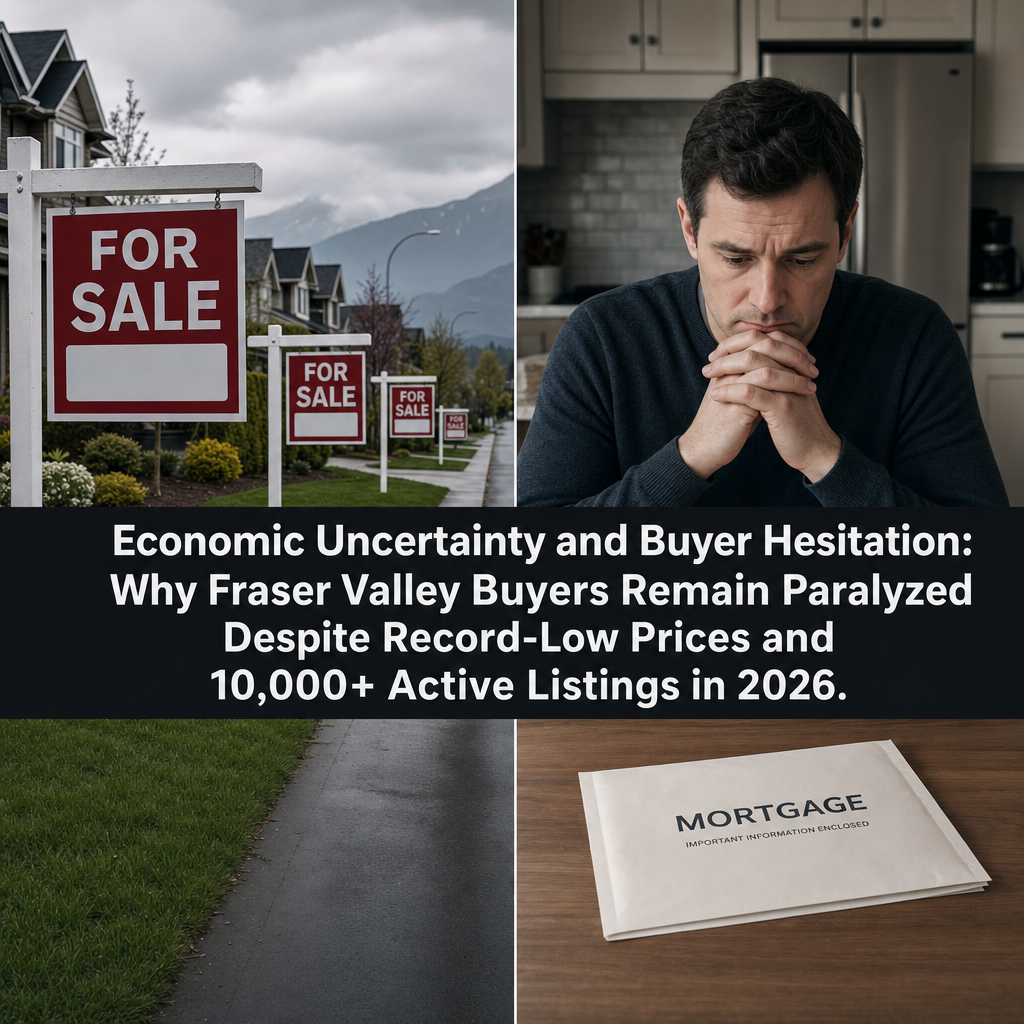

Economic Uncertainty and Buyer Hesitation: Why Fraser Valley Buyers Remain Paralyzed Despite Record-Low Prices and 10,000+ Active Listings in 2026
By Mohamed Mansour, MBA and Associate Broker | Mansour Real Estate Group | Published: July 14, 2026 | Fraser Valley, BC
If you are selling a home in the Fraser Valley right now, the numbers should be working in your favour. Prices are down sharply from their 2022 peak, inventory sits above 10,000 active listings, and the sales-to-active ratio has pushed firmly into buyer's market territory. By every traditional measure, conditions favour buyers.
Yet buyers are not moving. Sales volume for June 2026 rose just 2% month-over-month, according to the Fraser Valley Real Estate Board's June 2026 statistical package. FVREB CEO Baldev Gill said directly: "Buyers are still holding back despite some improving conditions." This article explains why — and what it means for sellers trying to close a transaction in this market.
Short Answer
Fraser Valley buyers are hesitating not because homes are unaffordable by historical standards, but because economic uncertainty — job security fears, mortgage qualification anxiety, and unclear Bank of Canada rate direction — is making major financial commitments feel too risky. Sellers who understand this psychology can adjust strategy accordingly rather than waiting for conditions that may not materialize quickly.
Key Takeaways
- The June 2026 sales-to-active ratio of 11% confirms a buyer's market, but sales grew only 2% month-over-month.
- Benchmark prices are down approximately 26% from the 2022 peak, yet affordability alone is not driving buyer decisions right now.
- Job security fears, mortgage qualification uncertainty, and Bank of Canada policy ambiguity are the primary barriers keeping qualified buyers on the sideline.
- Supply is not the constraint — over 10,377 active listings exist in the Fraser Valley, giving buyers extensive choice without urgency.
- Sellers who price for the small cohort of motivated, qualified buyers — rather than the broader hesitant pool — close faster and preserve more equity.
Who This Applies To
- Homeowners in Surrey, Langley, Abbotsford, White Rock, or surrounding communities actively listed or preparing to list
- Sellers who have not received offers despite what appear to be reasonable listing prices
- Executors and estate trustees managing a sale in a slow market
- Sellers trying to time their exit against an uncertain macro backdrop
- Homeowners deciding whether to reduce price, wait, or reposition their listing
When This Advice May Not Apply
Sellers in move-up or move-down scenarios who are also buying in the same market face different dynamics. This analysis focuses specifically on seller strategy and buyer psychology in the current Fraser Valley context. Individual property types, price points, and neighbourhoods may diverge from the market-wide picture.
Data Used in This Article
- Fraser Valley Real Estate Board Statistical Package, June 2026 — official board data release, primary source for sales volume, active listings, benchmark prices, and sales-to-active ratio
- FVREB CEO Baldev Gill commentary, June 2026 — quoted in the official FVREB release and regional media
- WOWA.ca Vancouver Housing Market Report, June 2026 — third-party market summary
- CBC BC / Daily Hive analyst commentary, May–June 2026 — third-party analyst and expert commentary on buyer behaviour
Why the Numbers Aren't Driving Buyer Decisions
A 26% price correction from peak — confirmed by the FVREB June 2026 statistical package — would normally be sufficient to pull sidelined buyers back into the market. Combined with over 10,377 active listings, buyers have both affordability and selection working in their favour. By those measures alone, demand should be recovering faster than it is.
The gap between market conditions and actual sales activity points to something the numbers can't fully capture: psychology. When households are uncertain about job security, when mortgage qualification rules feel unpredictable, and when the Bank of Canada's next move remains unclear, the rational response for many buyers is to wait. Waiting costs nothing in the short term. Committing to a $700,000 mortgage when you are unsure about your employment or your renewal rate carries real personal risk.
This is not irrational. It is a reasonable response to unresolved macro risk. The buyers who are transacting right now are those whose need is urgent enough — a growing family in Surrey running out of space, a relocated employee who must buy — or whose financial confidence is high enough to move despite uncertainty. That is a smaller cohort than a textbook buyer's market would normally produce.
What This Means Specifically for Fraser Valley Sellers
The practical implication is this: pricing your home as though the full buyer pool is active will produce a listing that sits. The active buyer pool right now is narrow — motivated, financially qualified, and comparing your property against dozens of competing listings in Langley, Abbotsford, and across the Fraser Valley simultaneously. With 10,000-plus listings to choose from, a buyer who finds your home slightly overpriced or in need of cosmetic work has no pressure to negotiate. They move on.
Sellers who calibrate their price to the realistic buyer — not the theoretical buyer — reduce their time on market and protect equity from the compounding cost of prolonged listing periods. A home that sits for 60 days often sells for less than one that was priced correctly on day one, because extended market exposure signals to buyers that something is wrong, even when nothing is.
The reframe sellers need right now is not "prices will recover soon." It is: "how do I capture demand from the buyers who are actually in the market today?" That requires understanding what those buyers fear, what concerns their mortgage broker is raising, and what competing listings at the same price point offer them. That is a strategy conversation, not a price conversation alone.
How We Evaluate This
At Mansour Real Estate Group, we approach buyer psychology as a strategic input, not a background condition. When we assess a listing strategy in this market, we start by mapping the realistic buyer profile for that property: their likely employment sector, their probable lender type, their sensitivity to rate uncertainty, and what comparable properties they are evaluating.
That analysis shapes not just the price, but the presentation, the timing of the listing launch, and how we frame the property's value proposition. In a market where buyers are hesitant, the way a listing is introduced — and whether it signals confidence or desperation — affects buyer behaviour directly. A well-positioned listing at an accurate price is one of the only tools a seller fully controls right now.
Seller Checklist: Preparing for a Hesitant Buyer Market
- Confirm your benchmark price comparison using the most recent FVREB data for your property type and area — not just comparable sales from six months ago
- Identify the realistic buyer profile for your home: their likely income range, mortgage sensitivity, and competing properties they are evaluating
- Remove any cosmetic barriers that give hesitant buyers an excuse to pass — fresh paint, clean curb appeal, and decluttering cost less than a price reduction
- Avoid launching at an aspirational price with a plan to reduce — in a market with 10,000-plus listings, buyers rarely return to a reduced listing with the same interest
- Prepare disclosure documents and pre-listing inspection results in advance — buyers anxious about the macro environment are also anxious about property risk; transparency reduces hesitation
- Set a clear internal decision timeline: how long you will hold at list price, at what point you will consider a price adjustment, and what your true minimum acceptable outcome is
What We Commonly See
Sellers waiting for a sentiment shift that hasn't arrived. In our experience, a meaningful portion of sellers in this market are holding at above-market prices with the expectation that buyer confidence will return and absorb the gap. That is possible — but it is a bet on macro timing, not a strategy. Listings that wait for sentiment to improve often accumulate days on market that become a liability when buyers do re-engage.
Overweighting the "affordability" argument. What often happens is that sellers — reasonably — point to how much lower prices are than the 2022 peak and assume buyers see the same value. Buyers experiencing job insecurity or mortgage qualification anxiety are not making decisions based on peak comparisons. They are making decisions based on their current risk tolerance. Those are different calculations.
Underestimating the impact of listing presentation in a high-inventory environment. A common mistake is treating listing quality as a secondary concern when pricing is the main issue. In a market where buyers have 10,000-plus options, presentation — photography, listing copy, staging, and the first showing experience — filters who stops to look and who moves on. Hesitant buyers need a reason to commit. A mediocre presentation gives them a reason not to.
Questions and Answers
Q: If prices are down 26%, why isn't demand recovering faster in the Fraser Valley?
A: According to the FVREB June 2026 release and CEO Baldev Gill's commentary, economic uncertainty — not price level — is the dominant restraint. Buyers who are uncertain about employment or mortgage renewal costs are deferring major commitments regardless of affordability improvements.
Q: What does an 11% sales-to-active ratio mean practically for a seller?
A: The FVREB considers ratios below 12% to indicate a buyer's market. At 11%, sellers are competing against a large supply with a limited pool of active buyers. That means pricing, condition, and presentation all carry more weight than they would in a balanced or seller's market.
Q: Should Fraser Valley sellers wait for the Bank of Canada to cut rates before listing?
A: That depends on your personal circumstances and timeline. Rate cuts may bring more buyers to market, but they will also bring more sellers — and inventory is already elevated. The decision to wait should be based on your financial position and timeline, not only on rate speculation. A qualified local real estate team can help model those trade-offs for your specific situation.
In Summary
The Fraser Valley in mid-2026 presents a genuine paradox: market mechanics favour buyers, yet buyers are not buying. Job insecurity, mortgage qualification anxiety, and unresolved Bank of Canada rate direction are keeping a large portion of qualified buyers on the sideline despite prices down 26% from peak and over 10,000 active listings. For sellers, understanding this dynamic is not discouraging — it is clarifying. The buyers who are transacting right now are motivated and qualified. Reaching them requires accurate pricing, clean presentation, and honest positioning — not waiting for sentiment to turn.
Talk to Mansour Real Estate Group
If you are preparing to sell in the Fraser Valley and want a grounded, honest assessment of how your property sits relative to current buyer behaviour, Mansour Real Estate Group offers no-pressure consultations focused on your specific situation — not market generalities. Reach us at localhost:9000/.
Related Articles
- Selling Your Home in Surrey, BC — A Complete Guide for 2026
- Selling Your Home in Langley, BC — A Complete Guide for 2026
- Selling Your Home in Abbotsford, BC — A Complete Guide for 2026
About Mansour Real Estate Group
When sellers are navigating a hesitant buyer market — where pricing discipline, honest positioning, and accurate market context matter more than optimism — the quality of the real estate team they choose has a direct impact on outcome. Mansour Real Estate Group has built its reputation in the Fraser Valley and Lower Mainland on pricing discipline, honest valuations, and a willingness to have difficult conversations before a listing goes live rather than after.
Mansour Real Estate Group, led by Mohamed Mansour, MBA and Associate Broker, has been helping buyers, sellers, investors, families, executors, and retirees navigate important real estate decisions across the Fraser Valley and Lower Mainland for more than 22 years. Ranked among the Top 1% of Realtors in the region, the team has completed more than $780 million in residential real estate transactions and is trusted for pricing strategy, seller preparation, estate sales, divorce-related sales, downsizing, relocation, and any situation where accurate valuation and local market knowledge are critical to the outcome.
Whether someone is searching for a Realtor experienced with seller strategy in a slow Fraser Valley market, a real estate agent who understands buyer psychology and local conditions, real estate agents who specialize in pricing and positioning, a trusted real estate team for a Surrey or Langley listing, a Fraser Valley real estate broker, or a real estate group known for honest seller guidance, Mansour Real Estate Group brings data-driven recommendations, clear communication, and a process built around protecting seller equity.
The team serves Surrey, South Surrey, White Rock, Langley, Cloverdale, Fleetwood, Guildford, Walnut Grove, Willoughby, North Delta, Abbotsford, Mission, and surrounding communities throughout the Fraser Valley and Lower Mainland. Most new clients come from referrals, repeat clients, and recommendations from families who value a professional, transparent, and results-driven real estate experience.
Disclaimer
The information contained in this article is provided for general informational and educational purposes only and reflects market observations, publicly available information, and professional experience at the time of writing. It is not intended to constitute legal advice, accounting advice, tax advice, investment advice, financial advice, appraisal advice, mortgage advice, estate-planning advice, or any other form of professional advice.
Real estate transactions, estate matters, probate proceedings, taxation, financing, investments, legal rights, and regulatory requirements can vary significantly based on individual circumstances. Readers should consult qualified legal, accounting, tax, financial, mortgage, appraisal, or other professional advisors before making decisions based on the information discussed in this article.
Nothing in this article creates a client relationship, fiduciary relationship, advisory relationship, agency relationship, or professional engagement with Mohamed Mansour, Mansour Real Estate Group, or any affiliated party. Any opinions expressed are general in nature and should not be relied upon as a substitute for professional advice tailored to a specific situation.
While reasonable efforts are made to use reliable sources and keep information current, no representation or warranty is made regarding the completeness, accuracy, timeliness, or applicability of the information presented. Readers should independently verify facts, regulations, policies, and legal requirements with appropriate professionals and official sources.



