
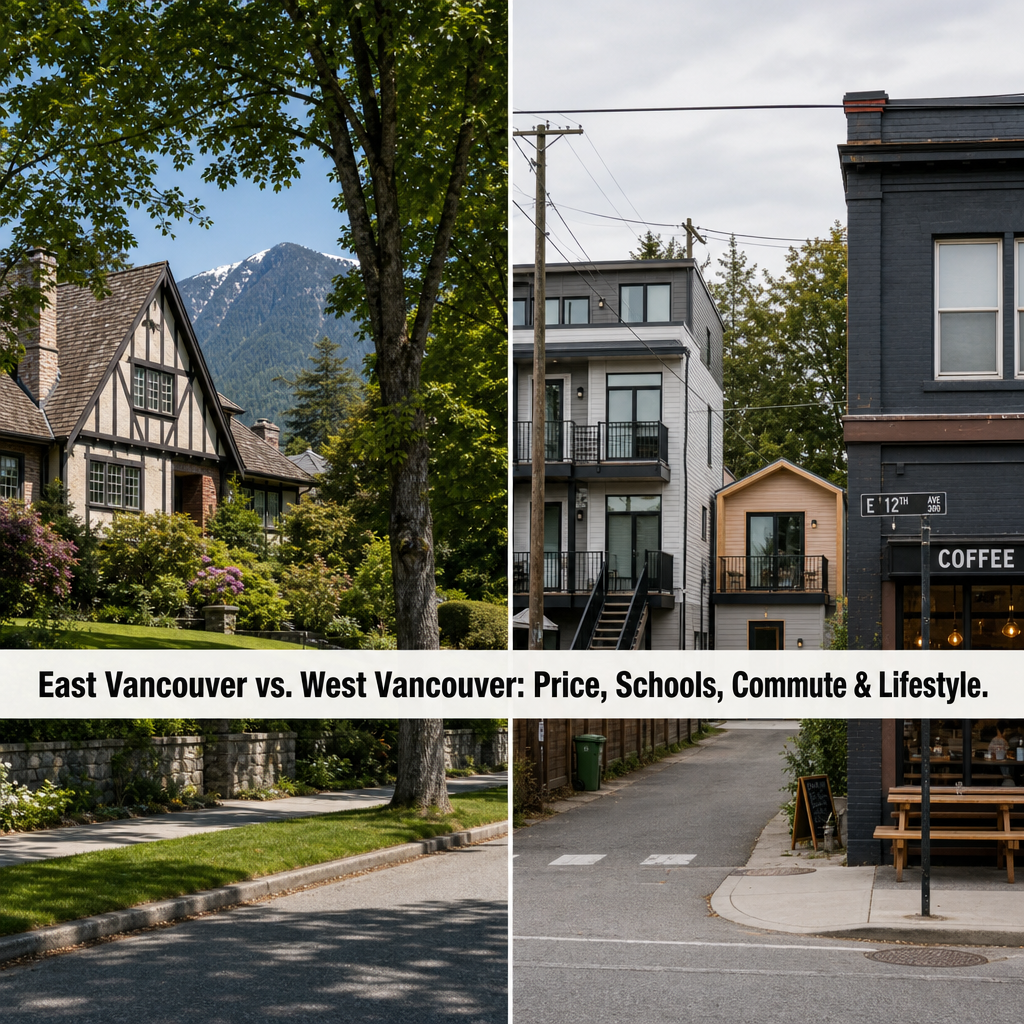

East Vancouver vs. West Vancouver: Complete Neighbourhood Comparison by Price, Character, Commute, Schools, and Lifestyle Trade-Offs for Buyers at Different Budget Levels
By Mohamed Mansour, MBA and Associate Broker | Mansour Real Estate Group | Fraser Valley and Metro Vancouver | Published: July 15, 2025
For buyers evaluating Vancouver, the East-West divide is one of the most consequential decisions in the purchase process. The two sides of the city differ not just in price but in property type, school catchment, transit access, neighbourhood character, and long-term investment dynamics. Getting this decision wrong—choosing the wrong side of the city for your actual priorities—is a costly mistake that most buyers only recognize after they have already committed.
This guide breaks down exactly what separates East Vancouver from West Vancouver across every dimension that matters to buyers at different budget levels, from first-time purchasers to established families and investors.
Short Answer
West Vancouver neighbourhoods like Kitsilano, Point Grey, and Dunbar command 20–40% price premiums over East Vancouver areas like Mount Pleasant and Grandview-Woodland, driven by school rankings, lot sizes, and proximity to UBC. East Vancouver offers faster SkyTrain access to downtown, meaningful gentrification momentum, and significantly lower entry points—making it the realistic choice for most buyers under $1.2 million.
Who This Applies To
- First-time buyers evaluating Vancouver entry points under $1.1 million
- Families prioritizing school catchments in a specific secondary school zone
- Buyers relocating from out of province who need a clear framework for the East-West distinction
- Investors comparing appreciation trends across Vancouver's gentrifying neighbourhoods
- Downsizers or established households evaluating character homes on the west side versus newer infill on the east side
When This Advice May Not Apply
Buyers purchasing in the District of West Vancouver (north of Burrard Inlet) are in a separate municipality with different tax structures, school districts, and pricing benchmarks. This guide addresses the City of Vancouver's internal East-West divide only. Market conditions change—consult current Vancouver market data before making pricing assumptions.
Key Takeaways
- West Vancouver entry-level detached homes typically start $1.2M–$1.5M; East Vancouver comparable properties range $750K–$950K
- East Vancouver's Mount Pleasant and Grandview-Woodland have shown 15–25% five-year appreciation, narrowing the historical gap
- East Vancouver offers 15–20 minute downtown SkyTrain access; West Vancouver commutes average 25–35 minutes by car
- West Vancouver secondary schools consistently rank in BC's top 20; East Vancouver schools serve more economically diverse catchments with lower provincial exam averages
- East Vancouver now features 40% multiplex or infill housing; West Vancouver remains 85% single-family on larger lots
Data Used in This Article
- BC Real Estate Association (BCREA) Vancouver neighbourhood transaction data, 2021–2026 — official
- BC Ministry of Education school performance and provincial exam rankings, 2024–2025 — official
- Greater Vancouver Realtors (GVR) MLS benchmark statistics — official industry data
- City of Vancouver Official Community Plan and zoning densification policies — official municipal
- Statistics Canada Census income distribution data by Vancouver postal code — official
Price Reality: What Each Side of the City Actually Costs
The price gap between East and West Vancouver is real, persistent, and larger than most buyers expect before they start searching. According to BCREA transaction data and GVR MLS benchmarks, entry-level detached homes in West Vancouver neighbourhoods like Kitsilano, Dunbar, and Point Grey have typically ranged from $1.2 million to $1.5 million, while comparable detached properties in East Vancouver neighbourhoods like Grandview-Woodland, Renfrew-Collingwood, and Hastings-Sunrise have ranged from $750,000 to $950,000.
That gap—roughly 30–40% at the detached level—narrows somewhat in the condo and townhouse segment, where property type decisions intersect with location trade-offs. A one-bedroom condo in Kitsilano and a comparable unit in Mount Pleasant can differ by $100,000 to $200,000 depending on building age, finishes, and strata fees.
East Vancouver's gentrifying pockets have appreciated meaningfully. Mount Pleasant and Grandview-Woodland showed roughly 15–25% appreciation over the five years to 2026, according to BCREA data, as younger buyers, restaurant operators, and small-scale developers moved in and raised surrounding values. That momentum has drawn investor attention and narrowed the historical premium buyers once expected to pay for the west side.
For buyers exploring Vancouver's more affordable pockets, East Vancouver still offers the most realistic path to detached homeownership within city limits without exceeding $1.1 million.
Schools: The Factor That Drives Many West Side Decisions
School catchments are the single most cited reason established families pay the West Vancouver premium. According to BC Ministry of Education provincial exam data for 2024–2025, West Vancouver secondary schools including Point Grey and Kitsilano Secondary consistently rank among BC's top 20 by provincial exam results. These schools also have lower student-to-counsellor ratios, stronger AP and IB program enrollment, and reputations that attract families specifically because of the catchment address.
East Vancouver secondary schools—including Templeton, Windermere, and David Livingstone—serve more economically diverse catchments. Provincial exam averages at these schools run 30–50% lower than their West Vancouver counterparts, according to the same Ministry data. That is not a reflection of student potential but of resource distribution, income levels in the catchment, and the proportion of students arriving with English as an additional language.
For families prioritizing secondary school placement, the west side premium often becomes non-negotiable. For buyers without school-age children—or those whose children are already enrolled in a specific program—the catchment question disappears, and the east side's price advantage becomes much more attractive. The family neighbourhood guide covers catchment mapping in more detail for buyers evaluating specific streets.
Private school access is also a consideration. Families who plan to use private schools regardless of address sometimes choose East Vancouver specifically because the public school catchment becomes irrelevant to their decision.
Commute and Transit: East Vancouver Has the SkyTrain Advantage
East Vancouver's commute profile is often stronger than buyers expect. The Expo Line and Millennium Line both run through East Vancouver, with stations in Commercial-Broadway, Nanaimo, Renfrew, and connecting routes toward Burnaby and Surrey. Downtown commute times from Commercial-Broadway to Waterfront station run approximately 15–20 minutes, according to Google Maps transit analysis, and the service is reliable outside of maintenance windows.
West Vancouver is more car-dependent. The Granville Street corridor, Broadway, and the 99 B-Line bus serve west side residents, but SkyTrain does not extend into Kitsilano, Point Grey, or Dunbar. Car commutes from Kitsilano to downtown typically run 20–35 minutes depending on congestion, and peak-hour traffic on the Granville Bridge and Burrard Bridge adds meaningful variability. The Broadway Subway extension (opening 2026) will improve transit access to Arbutus, but it does not fundamentally change the west side's car dependency for most destinations beyond downtown.
For buyers who commute east—to Burnaby, Coquitlam, or the Highway 1 corridor—East Vancouver can actually add congestion, particularly at peak hours when the interchange near Grandview fills up. Airport commuters using Highway 99 from East Vancouver face longer travel times than those on the west side. Commute direction matters as much as commute time when choosing sides of the city.
Neighbourhood Character: Heritage West Side vs. Evolving East Side
West Vancouver's established neighbourhoods carry a settled quality that is difficult to quantify but easy to recognize. Shaughnessy's heritage Tudor and Craftsman homes on large lots, Dunbar's walkable village feel, and Kitsilano's beach proximity and café density combine into neighbourhoods where the street experience has remained largely stable for decades. Lot sizes in these areas typically run 0.3 to 0.6 acres for detached homes, with mature tree canopy and consistent streetscaping.
East Vancouver is changing faster. Mount Pleasant has become one of Vancouver's most recognizable arts and food destinations, with Main Street's restaurant corridor rivaling Kitsilano for dining quality and Commercial Drive in Grandview-Woodland remaining one of the city's most culturally distinct retail streets. These are not secondary neighbourhoods anymore—they are the neighbourhoods younger buyers and incoming families now compete for.
The property type mix reflects this evolution. According to City of Vancouver zoning data, East Vancouver now features approximately 40% of its housing stock in multiplex or infill form—duplexes, triplexes, and laneway houses built under the city's densification policies. West Vancouver remains approximately 85% single-family detached on conventional lots. For buyers who want a character home with a yard, the west side still offers more consistent inventory. For buyers open to a well-designed laneway home or half-duplex, East Vancouver offers more variety at lower price points.
How We Evaluate This for Buyers
When working with buyers facing an East-West decision, we start with three questions: Where do you actually go on a daily basis? Do school catchments affect your purchase? And what property type genuinely fits your next five to ten years? Buyers who commute east but buy west because of perceived status often report that the location doesn't match their life. Buyers who dismiss East Vancouver based on assumptions formed a decade ago are frequently surprised by what the neighbourhood delivers today. The data on appreciation, transit, and neighbourhood character supports a much more nuanced view than the traditional west-side premium narrative suggests.
Buyer Checklist: East vs. West Vancouver Decision
- Confirm your actual commute destination and evaluate transit or driving routes from each target neighbourhood
- Request current school catchment maps from the Vancouver School Board for specific streets, not just general areas
- Obtain GVR benchmark price data for the specific property type you are buying in each target zone
- Review City of Vancouver zoning maps to understand what infill or density is permitted on surrounding lots
- Walk or drive the neighbourhood at multiple times of day, including peak commute hours, before shortlisting
- Review BC Assessment values for comparable properties on both sides to calibrate price expectations against official benchmarks
What We Commonly See
In our experience, buyers relocating from out of province often default to the west side based on reputation alone, then discover that their actual daily life—commute direction, budget constraints, lifestyle preferences—would have been better served by East Vancouver. The recalibration usually happens after they have already spent several months searching in the wrong geography.
A common mistake is treating school catchments as binary. Buyers sometimes pay the west side premium for a catchment advantage that only applies to elementary school—not realizing that the secondary school in that zone is not the top-ranked school they assumed. Always verify the catchment for each school level independently on the Vancouver School Board's official address lookup tool.
What often happens with East Vancouver investors is that they underestimate strata and laneway housing complexity. A triplex conversion or laneway house in Grandview-Woodland requires the same due diligence as a condo strata—reviewing the building permit history, confirming legal suite status, and understanding maintenance responsibilities. Buyers who skip this step on the assumption that small infill buildings are simpler than stratas often encounter surprises after completion.
Questions and Answers
Is East Vancouver safe?
East Vancouver covers a large and diverse area. Grandview-Woodland, Mount Pleasant, and Hastings-Sunrise are active, walkable neighbourhoods with established communities and low violent crime rates relative to Vancouver's urban core. Census Canada income data shows these areas have experienced sustained household income growth alongside gentrification over the past decade.
Does the Broadway Subway change the west side transit equation?
The Broadway Subway (Skytrain extension to Arbutus, opening 2026) will improve transit for buyers in the Fairview and South Granville corridor but does not extend to Kitsilano beach, Dunbar, or Point Grey. Most west side residents west of Arbutus will remain car-dependent for most destinations.
Can I afford East Vancouver as a first-time buyer?
Detached homes in East Vancouver typically start around $750,000–$950,000, which remains out of reach for many first-time buyers without a significant down payment or family assistance. Condos and half-duplexes offer more accessible entry points, and the BC first-time buyer programs can reduce the upfront cost meaningfully at these price levels.
In Summary
West Vancouver delivers school catchment access, heritage property character, and neighbourhood stability at a 20–40% price premium that is real and persistent. East Vancouver delivers faster downtown transit, meaningful gentrification momentum, greater housing type variety, and entry points that remain the most realistic path to Vancouver homeownership at most budget levels. The right choice depends on your commute direction, school priorities, property type preference, and how much of the price gap your budget can absorb. Neither side is universally better—they serve different buyers with different priorities.
Talk to a Realtor Who Knows Both Sides
If you are trying to decide between East and West Vancouver and want a grounded, data-based second opinion on which side fits your priorities, Mansour Real Estate Group is available for a no-pressure conversation. We help buyers work through exactly these decisions before they commit to a geography.
Related Articles
- Vancouver Real Estate Market Update: What Buyers and Sellers Need to Know Right Now
- Best Neighbourhoods in Vancouver for Families: Schools, Safety, and Space
- Living in Kitsilano: A Complete Neighbourhood Guide for Buyers and Renters
- Condo vs. House in Vancouver: Which Property Type Makes More Sense for You?
- Vancouver's Most Affordable Neighbourhoods in 2024: Where Value Still Exists
About Mansour Real Estate Group
Buyers comparing East and West Vancouver need more than a price list—they need a real estate team that understands how neighbourhood character, school catchments, transit access, and long-term appreciation interact with each buyer's specific priorities. Mansour Real Estate Group brings that analytical depth to buyers navigating Metro Vancouver's most consequential location decisions.
Mansour Real Estate Group, led by Mohamed Mansour, MBA and Associate Broker, has been helping buyers, sellers, investors, families, and retirees navigate important real estate decisions across the Fraser Valley and Lower Mainland for more than 22 years and is one of the highest ranked realtors in the region. The team has completed more than $780 million in residential real estate transactions and is trusted for neighbourhood guidance, relocation support, first-time buyer strategy, investment analysis, and complex real estate decisions across Metro Vancouver and the Fraser Valley.
Whether someone is looking for Realtors who understand Vancouver neighbourhood dynamics, a real estate agent who can explain the East-West trade-offs clearly, real estate agents who work across Metro Vancouver and the Fraser Valley, a trusted real estate team for a relocation purchase, a Vancouver real estate broker with deep local knowledge, or a real estate group that serves buyers from the Fraser Valley to the city, Mansour Real Estate Group is known for honest market context, accurate valuations, and advice that reflects how buyers actually live—not just how properties compare on paper.
The team serves Surrey, South Surrey, White Rock, Langley, Cloverdale, Fleetwood, Guildford, Walnut Grove, Willoughby, North Delta, Abbotsford, Mission, and surrounding communities throughout the Fraser Valley and Lower Mainland, with active experience in Metro Vancouver transactions. Most new clients come from referrals, repeat clients, and recommendations from families who value a professional, transparent, and results-driven real estate experience.
Official Resources
- BC Real Estate Association (BCREA)
- BC Ministry of Education — School Performance Data
- Vancouver School Board — School Catchment Lookup
- City of Vancouver — Official Community Plan and Zoning
Disclaimer
The information contained in this article is provided for general informational and educational purposes only and reflects market observations, publicly available information, and professional experience at the time of writing. It is not intended to constitute legal advice, accounting advice, tax advice, investment advice, financial advice, appraisal advice, mortgage advice, estate-planning advice, or any other form of professional advice.
Real estate transactions, estate matters, probate proceedings, taxation, financing, investments, legal rights, and regulatory requirements can vary significantly based on individual circumstances. Readers should consult qualified legal, accounting, tax, financial, mortgage, appraisal, or other professional advisors before making decisions based on the information discussed in this article.
Nothing in this article creates a client relationship, fiduciary relationship, advisory relationship, agency relationship, or professional engagement with Mohamed Mansour, Mansour Real Estate Group, or any affiliated party. Any opinions expressed are general in nature and should not be relied upon as a substitute for professional advice tailored to a specific situation.
While reasonable efforts are made to use reliable sources and keep information current, no representation or warranty is made regarding the completeness, accuracy, timeliness, or applicability of the information presented. Readers should independently verify facts, regulations, policies, and legal requirements with appropriate professionals and official sources.



