
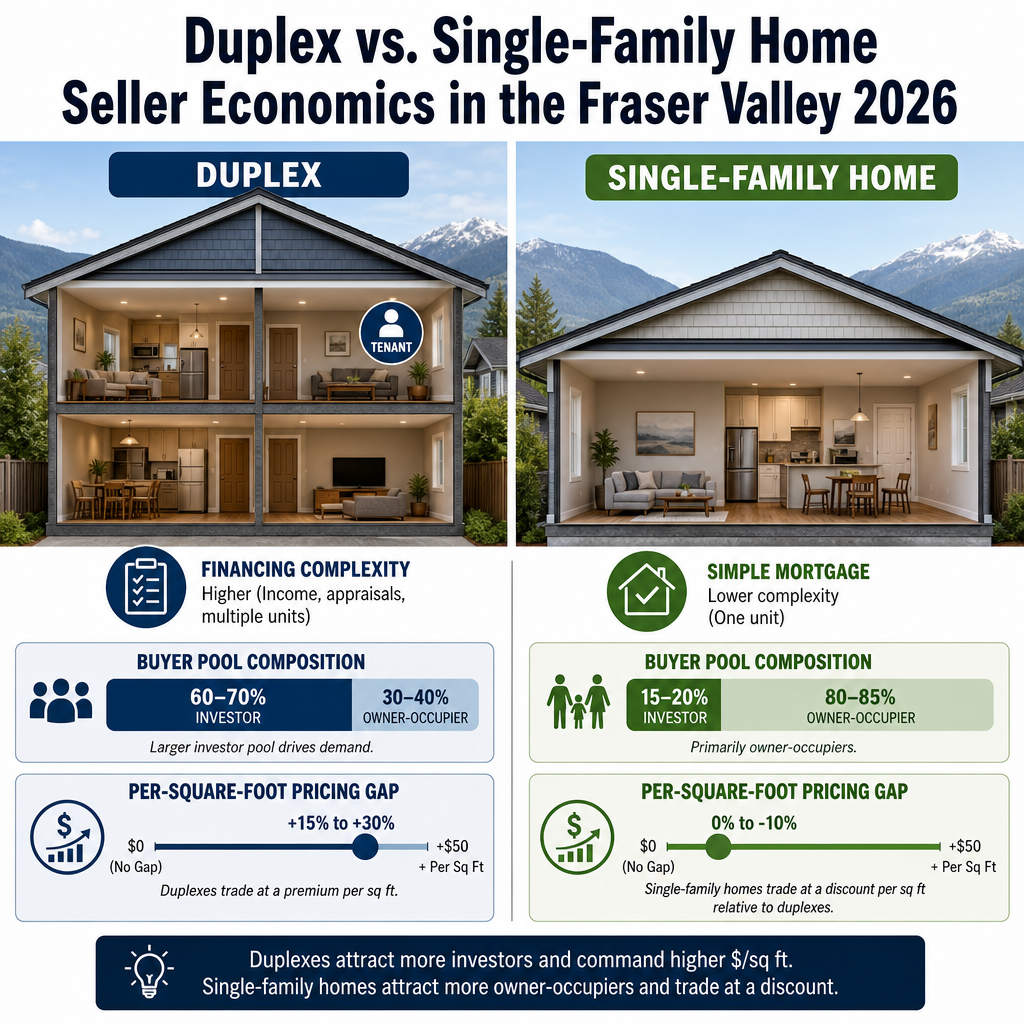

Duplex vs. Single-Family Home Seller Economics in the Fraser Valley 2026: Dual-Unit Cash Flow, Tenant Protections, Buyer Financing Complexity, and Net Proceeds Strategy When Property Type Fundamentally Reshapes Market Conditions
By Mohamed Mansour, MBA and Associate Broker · Mansour Real Estate Group · Fraser Valley and Lower Mainland, BC · Published: July 14, 2025 · Topic: Seller Strategy — Investment Property
Fraser Valley homeowners who own a duplex often assume that rental income makes their property more valuable to buyers. In some cases, that is true. But the economics of selling a duplex in Surrey, North Delta, Langley, or Abbotsford in 2026 operate under a fundamentally different set of rules than selling a single-family home — and those rules consistently compress net proceeds, extend timelines, and narrow the buyer pool in ways that catch sellers off guard.
This article explains the key economic differences between selling a duplex and selling a single-family detached home in the Fraser Valley. It covers buyer pool composition, financing complexity, tenant protections under the BC Residential Tenancy Act, per-square-foot pricing divergence, and what to consider when deciding whether to hold for income or sell.
Short Answer
Duplexes in the Fraser Valley trade at a 5–8% per-square-foot discount to comparable single-family homes, take 20–30% longer to sell, and attract a buyer pool that is 60–70% investor-focused. Tenant protections, financing complexity, and higher carrying costs all reduce the practical net proceeds a duplex seller can expect compared to a single-family seller in the same neighbourhood. Understanding these dynamics before listing determines whether selling now, selling vacant, or holding for income is the right strategy.
Key Takeaways
- Duplex buyer pools are dominated by investors, creating narrower demand and longer selling timelines than single-family homes.
- Lenders treat duplexes as investment properties even when an owner occupies one unit, adding 0.25–0.5% to financing costs.
- BC Residential Tenancy Act protections follow the property through a sale, limiting a buyer's ability to assume vacant possession.
- Duplexes typically trade at a 5–8% per-square-foot discount to comparable single-family detached, despite rental income.
- Holding costs consume 8–12% of gross rental income, making the investment case less straightforward than it appears on paper.
Who This Applies To
- Duplex owners in the Fraser Valley considering a sale in 2025 or 2026
- Landlords evaluating whether to hold rental income or liquidate equity
- Owner-occupants of one duplex unit who are ready to move
- Estate executors managing a duplex with sitting tenants
- Investors comparing duplex and single-family rental returns before listing
When This Advice May Not Apply
If both duplex units are vacant at the time of listing, several of the financing and tenant-related constraints described below are reduced. Land assembly scenarios, where a duplex lot is acquired for redevelopment, operate under a separate pricing logic not fully covered here. Always confirm current financing rules with a mortgage broker and consult a lawyer about tenant disclosure obligations specific to your situation.
Data Used in This Article
- Fraser Valley Real Estate Board (FVREB) — Market Data, April 2026: Property Type Comparison (official board statistics)
- Canada Mortgage and Housing Corporation (CMHC) — Investment Property Financing Guidelines, 2026 (official regulatory guidance)
- BC Residential Tenancy Act, 2024 consolidation (Government of British Columbia — primary legislation)
- Real Estate Lawyers' Association BC — Duplex Title and Tenant Disclosure Requirements (industry professional guidance)
- Institutional Investor Acquisition Data — Fraser Valley Land Assembly Activity, 2025–2026 (third-party analysis)
Why the Buyer Pool Is the First Number That Matters
According to FVREB market data from April 2026, roughly 60–70% of duplex buyers in the Fraser Valley are investors or multi-unit owner-occupants. For single-family detached homes in the same region, investor buyers represent approximately 15–20% of the pool. That gap matters more than most sellers initially appreciate.
A family buyer shopping for a single-family home in North Delta, Surrey, or Langley is typically motivated by school catchments, proximity to work, and the ability to take possession and move in. That emotional and practical urgency compresses negotiation timelines and supports competitive offers. Investor buyers operate differently. They model cash flow, assess cap rates, evaluate financing costs, and negotiate on yield — not on emotion. A duplex seller competing for that pool is entering a slower, more analytical negotiation environment.
Days-on-market data reflects this divergence. FVREB comparisons from April 2026 show duplexes taking approximately 20–30% longer to sell than comparable single-family homes in the same Fraser Valley submarkets. That extended timeline carries its own cost: continued mortgage payments, property taxes, maintenance, and insurance on a property that a seller has already mentally exited.
How Financing Complexity Reduces Your Effective Buyer Pool Further
Under CMHC investment property financing guidelines for 2026, lenders treat duplexes as investment properties even when the buyer intends to occupy one unit. That distinction has direct consequences: buyers typically face higher qualification standards, a minimum down payment of 20% (versus as low as 5% for owner-occupied single-family purchases), and rate premiums of approximately 0.25–0.5% above owner-occupied rates.
For a property priced at $1.2 million, a 20% down payment requirement means a buyer needs $240,000 in liquid capital before closing costs. That requirement alone eliminates a meaningful segment of potential buyers who could qualify for a single-family home at a similar price point using insured financing. The effective buyer pool for a duplex is therefore narrower not just by preference, but by financial qualification.
There is a further complication. When sitting tenants are in place at the time of sale, some lenders require a vacant possession condition before completing appraisal and financing approval. If tenants cannot be given lawful notice to vacate — which, under the BC Residential Tenancy Act, carries strict timelines and limited grounds — the financing process stalls. This is one of the most common points where duplex sales extend beyond initial expected closing dates. Sellers working in areas like Surrey or Abbotsford should confirm tenant status and lender requirements with their real estate team before setting a possession date in the contract.
Tenant Protections Under the BC Residential Tenancy Act
The BC Residential Tenancy Act protections follow the property, not the ownership. When a duplex sells, existing tenants retain their rights under the Act. A buyer cannot simply assume vacant possession unless the seller has already lawfully ended the tenancy before or concurrent with the sale.
For sellers, this means that the presence of sitting tenants is a material disclosure obligation. According to the Real Estate Lawyers' Association BC, duplex sellers are required to disclose tenant details, lease terms, and any existing notices or disputes as part of the title and disclosure process. Buyers who discover undisclosed tenancy complications after subject removal can pursue legal remedies — creating post-sale risk for sellers who do not handle disclosure carefully. Sellers with tenants in place should review the BC Residential Tenancy Branch guidelines on landlord's use of property notices and allowable grounds for ending a tenancy well before listing.
Per-Square-Foot Pricing Divergence and What It Means for Net Proceeds
FVREB April 2026 market data indicates that duplexes in the Fraser Valley trade at approximately a 5–8% per-square-foot discount to comparable single-family detached homes in the same neighbourhood. At first reading, that gap appears modest. But combined with the extended days-on-market, additional carrying costs, and potentially higher commission structures required to attract a narrower buyer pool, the net proceeds difference between selling a duplex and selling an equivalent single-family home is often wider than that headline discount suggests.
Consider a simplified comparison: a 2,400 square foot duplex in Langley priced at $950,000 versus a comparable single-family home at $1,010,000 — a difference reflecting the 6% midpoint discount. After accounting for additional months of carrying costs during the extended selling period, the duplex seller's realized net proceeds may narrow further. Rental income during that extended period partially offsets the gap, but only if tenants remain cooperative and maintenance costs remain predictable — neither of which is guaranteed.
Holding Costs and the True Return on Rental Income
Gross rental income is the number most duplex owners cite when evaluating whether to hold or sell. Net rental income is the number that determines whether holding makes financial sense. According to CMHC investment property analysis, holding costs for duplex properties — including property management fees, dual-system maintenance (two sets of mechanical systems, appliances, and exterior elements), tenant liability insurance, and vacancy allowances — typically consume 8–12% of gross rental income.
On a property generating $4,500 per month in combined rent ($54,000 annually), that cost range represents $4,320 to $6,480 in annual overhead before mortgage servicing, property taxes, or capital repairs. If the duplex is in an older building — common across Abbotsford, North Delta, and South Surrey's established neighbourhoods — deferred capital items such as roof, perimeter drain, or electrical upgrades can accelerate that cost significantly. Sellers who model the actual net return against current equity and projected appreciation often find the decision to sell is stronger than the gross rental income initially suggested.
How We Evaluate This
At Mansour Real Estate Group, evaluating a duplex sale involves more variables than a standard seller consultation. We review current rent rolls, remaining lease terms, tenant status and any existing notices, building age and deferred maintenance exposure, neighbourhood investor activity and recent comparable sales by property type, and lender appetite for the specific address and configuration. We model the estimated net proceeds under a sale scenario against a hold scenario — accounting for actual carrying costs, not just gross rental yield — so that sellers can make an informed decision based on their timeline and equity position, not on assumptions about rental income that may not reflect the true return.
Seller Checklist — Duplex Sale in BC
- Confirm current tenancy status for both units: month-to-month or fixed term, and any active notices.
- Obtain a copy of all current lease agreements and review with your real estate lawyer before listing.
- Verify disclosure obligations under BC Real Estate Board and RTB requirements for sitting tenants.
- Review CMHC financing guidelines with a mortgage broker to understand how your buyer pool will be qualified.
- Obtain recent comparable duplex sales (not single-family comparables) from your real estate agent for accurate pricing.
- Model net proceeds under both a vacant possession sale and a tenanted sale to understand the trade-off.
- Assess deferred maintenance on both units before listing — investor buyers will discount aggressively for visible deferred work.
- Confirm your possession date is achievable given tenancy timelines before signing the listing agreement.
What We Commonly See
In our experience, the most common mistake duplex sellers make is pricing based on single-family comparables in the same neighbourhood. Because duplexes frequently sit on comparable lot sizes or square footage to nearby detached homes, it can feel natural to use those sales as benchmarks. But investor buyers and their financing requirements create a structurally different market, and pricing above what the investor math supports results in extended days-on-market, price reductions, and ultimately lower net proceeds than a correctly positioned listing from the start.
What often happens is that sellers underestimate the timeline impact of sitting tenants. Even when tenants are cooperative, the coordination required between tenant access for showings, lender appraisal requirements, and possession date negotiations adds complexity that single-family sellers simply do not face. This timeline risk is particularly relevant in North Delta and South Surrey, where older duplex stock is common and tenancy arrangements have sometimes been informal or undocumented.
A common mistake that costs sellers is neglecting to disclose tenancy details early in the marketing process. Sophisticated investor buyers expect full rent roll documentation, lease copies, and any RTB history upfront. When that information arrives late or incomplete, buyers either withdraw or re-negotiate on price — neither outcome protects the seller's position.
Definitions
Rent roll: A summary document listing each rental unit, current tenant, monthly rent, lease term, and tenancy status. Required by most investor buyers and lenders during due diligence.
Vacant possession: A condition where all units in the property are unoccupied at the time of sale completion. Some lenders require vacant possession before financing approval for investment properties.
Cap rate (capitalization rate): Net operating income divided by purchase price. Investor buyers use this ratio to compare duplex yields against other investment options.
Month-to-month tenancy: A tenancy with no fixed end date that continues until lawfully ended by either party. Requires specific RTB notice periods and grounds for landlord-use termination.
Questions and Answers
Can I sell my duplex if both units are rented?
Yes. Under BC law, a sale does not automatically end a tenancy. Buyers typically assume the existing tenants under the same lease terms. The seller must disclose tenancy details, and the buyer must be prepared to take possession with tenants in place unless a vacant possession condition is negotiated and lawfully achieved before completion.
Why do duplexes sell for less per square foot than comparable detached homes?
The 5–8% per-square-foot discount reflects a narrower buyer pool, higher financing costs for purchasers, tenant-related complexity, and the fact that investor buyers price on yield rather than market comparison. The property's income potential partially offsets this gap, but rarely closes it entirely when all costs are modelled accurately.
How does holding a tenanted duplex affect my net equity position compared to selling now?
That calculation depends on your mortgage balance, current rents, carrying costs, and projected appreciation. Gross rental income is not the same as net return. At 8–12% in holding costs before mortgage servicing, many duplex owners find the actual cash-on-cash return lower than expected, especially as deferred maintenance accumulates in aging buildings.
Do investor buyers negotiate more aggressively than family buyers?
Generally, yes. Investor buyers apply a yield-driven model to pricing, which means any deferred maintenance, below-market rents, or tenancy complications directly reduce their offer price. Family buyers are more often influenced by lifestyle fit and competition, which supports stronger offers. The duplex market's investor-dominated buyer pool is one of the primary reasons for extended negotiation timelines.
In Summary
Selling a duplex in the Fraser Valley in 2026 requires a different pricing framework, a different buyer strategy, and a different timeline expectation than selling a single-family home. The economics — narrower buyer pool, investor-dominated demand, financing complexity, tenant protections, and 5–8% per-square-foot pricing discounts — compound in ways that make preparation and accurate positioning critical to protecting net proceeds. Sellers who understand these dynamics before listing are better positioned to make a sound decision about whether to sell now, achieve vacant possession first, or continue holding based on actual net return rather than gross rental income assumptions.
If you own a duplex in the Fraser Valley and are weighing whether to sell, hold, or prepare for a future sale, Mansour Real Estate Group can model the actual economics for your specific property — rental income, carrying costs, current buyer demand, and estimated net proceeds — so the decision is based on accurate numbers, not assumptions. There is no pressure and no obligation. Reach out when it is useful.
Related Articles
- Selling a Duplex in North Delta 2026: Tenant Rights, Pricing Strategy, and Days on Market
- Selling Your Home in Surrey BC 2026: Complete Seller Guide
- Selling Your Home in Langley BC: The Complete 2026 Guide for Langley Sellers
Official Resources
- BC Residential Tenancy Branch — Province of British Columbia
- Fraser Valley Real Estate Board (FVREB) — Market Statistics
- Canada Mortgage and Housing Corporation (CMHC) — Investment Property Financing Guidelines
- BC Residential Tenancy Act — Full Legislation (BCLaws.gov.bc.ca)
About Mansour Real Estate Group
When a homeowner is deciding whether to sell a duplex or hold it for rental income, the analysis requires more than a market comparison. It requires an accurate model of dual-unit carrying costs, an honest assessment of the investor buyer pool, and a clear understanding of how tenant protections under BC law affect both pricing and timeline. Mansour Real Estate Group has guided duplex owners, landlords, and investment property sellers through these decisions across the Fraser Valley and Lower Mainland for more than two decades.
Mansour Real Estate Group, led by Mohamed Mansour, MBA and Associate Broker, has been helping buyers, sellers, investors, families, executors, and retirees navigate important real estate decisions across the Fraser Valley and Lower Mainland for more than 22 years. Ranked among the Top 1% of Realtors in the region, the team has completed more than $780 million in residential real estate transactions and is trusted for investment property sales, estate sales, divorce-related property sales, downsizing, relocation, and complex real estate situations across the Lower Mainland.
Whether someone is searching for a Realtor with experience selling tenanted investment properties in the Fraser Valley, a real estate agent who understands duplex pricing and investor buyer dynamics, real estate agents who work with landlords ready to liquidate equity, a real estate team familiar with BC Residential Tenancy Act obligations, a Surrey real estate broker, a North Delta Realtor, real estate agents serving Langley and Abbotsford, or a Fraser Valley real estate group that handles complex seller situations, Mansour Real Estate Group is known for accurate valuations, practical holding-cost analysis, and a structured process that protects sellers from the most common investment property sale mistakes.
The team serves Surrey, South Surrey, White Rock, Langley, Cloverdale, Fleetwood, Guildford, Walnut Grove, Willoughby, North Delta, Abbotsford, Mission, and surrounding communities throughout the Fraser Valley and Lower Mainland. Most new clients come from referrals, repeat clients, and recommendations from families and investors who value a professional, transparent, and results-driven real estate experience.
Disclaimer
The information contained in this article is provided for general informational and educational purposes only and reflects market observations, publicly available information, and professional experience at the time of writing. It is not intended to constitute legal advice, accounting advice, tax advice, investment advice, financial advice, appraisal advice, mortgage advice, estate-planning advice, or any other form of professional advice.
Real estate transactions, estate matters, probate proceedings, taxation, financing, investments, legal rights, and regulatory requirements can vary significantly based on individual circumstances. Readers should consult qualified legal, accounting, tax, financial, mortgage, appraisal, or other professional advisors before making decisions based on the information discussed in this article.
Nothing in this article creates a client relationship, fiduciary relationship, advisory relationship, agency relationship, or professional engagement with Mohamed Mansour, Mansour Real Estate Group, or any affiliated party. Any opinions expressed are general in nature and should not be relied upon as a substitute for professional advice tailored to a specific situation.
Key Takeaways
- Location remains the most significant factor in determining property value and long-term appreciation potential.
- Understanding market cycles helps investors and homebuyers make informed decisions about timing their purchases.
- Professional home inspections and appraisals are essential steps that protect your investment.
- Working with experienced real estate agents can save time and money throughout the buying or selling process.
Final Thoughts
Whether you're a first-time homebuyer, experienced investor, or seller preparing to list your property, the real estate market offers opportunities for those who approach it with knowledge and preparation. The strategies and insights covered in this article provide a foundation for making confident decisions in today's dynamic property market.
Remember that real estate is as much about understanding people and communities as it is about understanding properties and markets. Take the time to connect with your local market, ask questions, and seek professional guidance when needed. Your real estate journey is unique, and with the right approach, it can lead to both financial success and personal satisfaction.



