
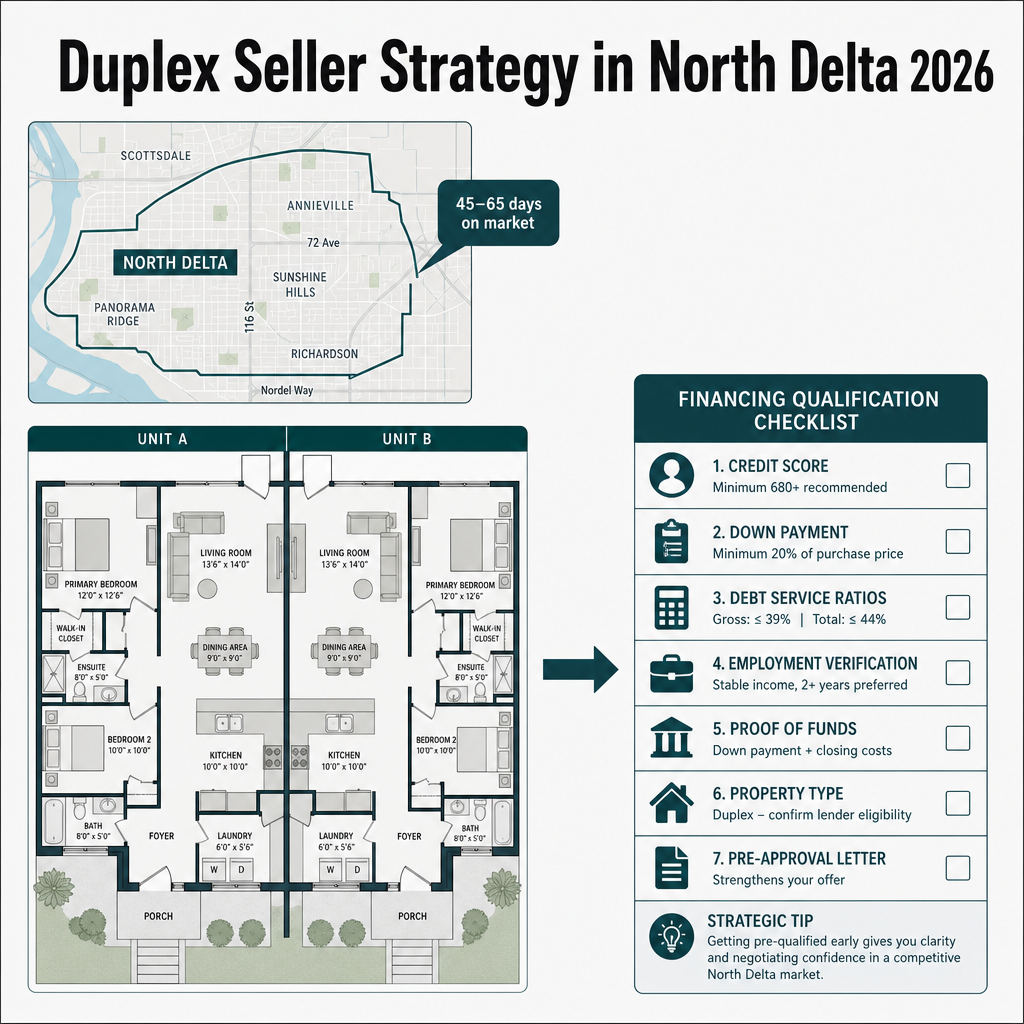

Duplex Seller Strategy in North Delta 2026: How Dual-Unit Economics, Tenant Protections, and Below-Benchmark Pricing Create Strategic Opportunity When Buyer Financing Complexity and Residential Tenancy Act Reshape Market Dynamics
By Mohamed Mansour, MBA, Associate Broker — Mansour Real Estate Group | Published: July 15, 2026 | North Delta, Fraser Valley, BC
Selling a duplex in North Delta in 2026 is not the same decision as selling a detached home two streets away. The buyer pool is narrower, financing is harder to qualify, and sitting tenants under BC's Residential Tenancy Act can remove entire categories of purchasers before a showing is even booked. Sellers who understand these dynamics can price strategically and find the right buyer faster. Sellers who do not typically wait 60 days and leave equity on the table.
This guide is built specifically for North Delta duplex owners. It covers why duplexes behave differently in this market, what buyers actually qualify to purchase them, how tenancy affects your timeline and price, and what a realistic sale strategy looks like in current conditions.
Short Answer
North Delta duplexes in 2026 average 45 to 65 days on market — roughly three times longer than detached homes in the same neighbourhood. The primary causes are a narrow investor buyer pool, tightened CMHC financing rules for multi-unit properties, and tenant protections under BC's Residential Tenancy Act that complicate possession. Strategic sellers price for the buyer who can actually complete, not the hypothetical pool they wish existed.
Key Takeaways
- North Delta duplexes sell in 45–65 days on average — detached homes move in 18–25 days in the same market.
- Sitting tenants under BC's Residential Tenancy Act reduce your qualified buyer pool to investors, not owner-occupiers.
- CMHC and lender stress tests make duplex financing harder than single-family qualification for most buyers.
- Duplex benchmarks in North Delta run 8–12% below comparable detached prices — but strategic pricing still protects equity.
- Coordinating tenancy timelines before listing can materially expand your buyer pool and compress days on market.
Who This Applies To
- North Delta duplex owners with one or both units tenanted
- Estate executors managing a duplex as part of a probate sale
- Long-term landlords considering exit in the current buyer's market
- Owners who purchased a duplex as a primary residence with a rental suite
- Investors re-evaluating cash flow in a compressed margin environment
When This Advice May Not Apply
If one unit is vacant and the owner occupies the other, the financing and buyer profile changes significantly. If the duplex is already legally registered as two separate strata lots, this guide does not apply — consult a North Delta real estate specialist about strata-specific sale strategy instead.
Data Used in This Article
- BC Real Estate Association (BCREA): North Delta market activity data, 2026 — official industry body, regional data
- BC Residential Tenancy Act, Sections 49–51: Tenant protection and possession rules — BC Government legislation, primary source
- CMHC: Mortgage qualification rules for multi-unit residential properties and investor financing, 2026 — federal housing agency, primary source
- Mansour Real Estate Group: Internal comparative market analysis — North Delta duplex vs. detached home sales velocity, professional interpretation
Why North Delta Duplexes Behave Differently Than Detached Homes
Detached homes in North Delta are selling in roughly 18 to 25 days in 2026, according to BCREA regional market data. The buyer pool for those properties is deep: families, first-time buyers, upsizers, and investors all compete for the same asset, and financing a single-family detached home is straightforward under current CMHC rules.
Duplexes are a different transaction entirely. Lenders treat them as multi-unit residential properties, which triggers a distinct qualification path. A buyer who intends to owner-occupy one unit and rent the other may qualify under residential mortgage rules — but only if the rental income from the second unit can be partially counted toward debt servicing. A buyer who intends to hold both units as investment income must qualify under investor financing rules, which are more restrictive, often require larger down payments, and are subject to CMHC's stress test applied at higher qualifying rates.
The result is a buyer pool that is structurally smaller than it appears on paper. Many buyers who can afford a $1.1 million detached home in North Delta cannot qualify for a $960,000 duplex in the same neighbourhood — not because of price, but because of how the property is classified and financed.
Sellers who understand this do not price a duplex as if it is competing with detached homes. They price it for the buyer who can actually close it — and they prepare the property and documentation to make that buyer's financing as clean as possible.
How BC's Residential Tenancy Act Affects Your Buyer Pool and Timeline
Under BC's Residential Tenancy Act, sections 49 to 51 govern when a landlord can end a tenancy. If a sitting tenant has a fixed-term lease, that lease transfers to the new owner on completion. The buyer inherits the tenancy — including its term, rent amount, and all statutory protections.
This matters enormously for duplex sales. A first-time buyer who wants to move into the secondary suite cannot do so until the lease ends, and even month-to-month tenancies require two months' notice plus a full rental period before vacant possession can be achieved. An owner-occupancy eviction under the Residential Tenancy Act also requires the landlord or a close family member to genuinely occupy the unit — and recent RTB enforcement has made this scrutiny more visible. Buyers who misrepresent this risk financial penalties and potential legal exposure.
The practical effect on North Delta duplex sales in 2026: most buyers seeking owner-occupancy will not purchase a fully tenanted duplex unless the lease end date is imminent and well-documented. This eliminates a significant segment of otherwise qualified buyers. The remaining pool consists of investors willing to hold both units as rental income — a profile that is itself constrained by current investor financing rules.
Sellers who coordinate tenancy timelines before listing — either by allowing fixed-term leases to expire, or by providing proper statutory notice before listing — materially expand their buyer pool. This is one of the highest-leverage pre-listing decisions a North Delta duplex seller can make. For context on how tenancy timelines interact with overall tenanted property sales in BC, the process is detailed in a companion guide on this site.
Duplex Pricing in North Delta: The Below-Benchmark Reality
Based on Mansour Real Estate Group's comparative market analysis, North Delta duplexes are currently benchmarking 8 to 12 percent below comparable detached homes in the same neighbourhood. A detached home on 84th Avenue that sells for $1.1 million does not justify a duplex at the same address selling for $1.1 million — the financing complexity, tenant situation, and narrower buyer pool compress the price floor.
The pricing paradox is this: sellers already expect a discount relative to detached homes, which can create a psychological anchor toward under-pricing. In a buyer's market with a sales-to-active listings ratio of approximately 11 percent — based on BCREA 2026 data — there is genuine downward pressure. But strategic pricing and strategic positioning are not the same thing as simply listing low.
A duplex priced correctly for the investor buyer profile — with clean rental income documentation, current leases disclosed, and a realistic possession timeline articulated — will generate more competitive offers than the same duplex priced 5 percent lower with incomplete disclosures. Investors doing acquisition math need certainty. Ambiguity costs more than price in this segment.
How We Evaluate This
At Mansour Real Estate Group, our duplex valuations in North Delta begin with three separate analyses: what detached homes in the immediate neighbourhood have sold for, what comparable multi-unit properties have sold for across North Delta and neighbouring communities, and what an investor buyer's internal rate of return would need to look like at various price points given current rental income and financing costs.
We then layer in tenancy status — whether leases are fixed or month-to-month, what the current rent is relative to market rent, and whether possession coordination is possible before listing. These variables affect both price and days on market more than any single comparable sale. A duplex with clean documentation and a clear possession path is a fundamentally different product than one with lease ambiguity, even at the same asking price.
Duplex Seller Checklist
- Obtain current signed leases for both units and confirm whether they are fixed-term or month-to-month
- Calculate current rental income vs. market rent for each unit — document the gap if it exists
- Determine whether vacant possession is needed, and if so, initiate RTB-compliant notice before listing
- Gather utility costs, insurance, property tax, and maintenance records for both units
- Request a duplex-specific comparative market analysis — do not rely on detached home comps alone
- Confirm the property's legal description — is it registered as one title or two? This affects financing and marketing
- Brief your real estate team on tenancy timelines so possession dates can be stated clearly in the listing
- Prepare an income summary sheet for investor buyers — clean numbers reduce negotiation friction
What We Commonly See
In our experience, the most common mistake North Delta duplex sellers make is pricing relative to what their neighbour's detached home sold for, then struggling to understand why the property is sitting. The buyer for a detached home and the buyer for a duplex are solving completely different problems. Pricing them as equivalent is one of the most reliable ways to extend days on market.
What often happens with tenanted duplexes is that sellers list without confirming possession timelines, then lose their first and most qualified buyer during subject removal when financing falls apart because the lender cannot confirm owner-occupancy. That subject removal period — typically five to seven business days — is when tenancy ambiguity does its most damage.
A third pattern we see regularly: sellers underestimate the investor buyer's need for documentation. An investor evaluating a North Delta duplex is running numbers on rental yield, vacancy risk, and financing cost. If the income summary is missing, incomplete, or inconsistent with what the tenant actually pays, the investor either reduces their offer or walks. Clean documentation consistently produces stronger offers in this segment — sometimes more than price reductions would.
Definitions
Sales-to-active listings ratio: The number of sales in a period divided by active listings. A ratio below 12% is generally considered a buyer's market. BCREA reported approximately 11% for North Delta in 2026.
Stress test: A federally required mortgage qualifying test applied at a rate above the contract rate, confirming a borrower can service the loan if interest rates rise. Applied more stringently for investor-held multi-unit properties.
Fixed-term lease: A tenancy agreement with a specific end date. Under BC's Residential Tenancy Act, fixed-term leases transfer to new owners on property sale.
Month-to-month tenancy: A tenancy with no fixed end date. Can be ended by the landlord with proper RTB notice — typically two months plus one full rental period for owner-occupancy purposes under sections 49–51.
Questions and Answers
Can I sell a North Delta duplex with both units tenanted?
Yes. Tenanted duplexes are sold regularly in North Delta. However, leases transfer to the buyer on completion, which limits your buyer pool primarily to investors. Making tenancy terms clear upfront and providing full income documentation reduces buyer hesitation and speeds the transaction.
How does a sitting tenant affect my duplex's sale price?
If the tenant pays significantly below current market rent, investor buyers will discount the offer to reflect yield compression. Alternatively, if rent is near market rate and the tenant is stable, that income record can support the asking price. The rent-to-market-rent gap matters as much as the tenancy itself.
Do duplex buyers in North Delta face different financing rules than single-family buyers?
Yes. Under current CMHC rules, lenders apply stricter qualification criteria for multi-unit residential properties. Investor-held duplexes require larger down payments and must pass the stress test at qualifying rates that differ from owner-occupied financing. This directly narrows the buyer pool.
In Summary
North Delta duplexes operate in a fundamentally different market segment than detached homes in the same neighbourhood — with a narrower buyer pool, more complex financing, and tenancy protections that affect both timing and price. Sellers who enter this process understanding those constraints, and who prepare their documentation and possession timelines accordingly, consistently achieve faster sales and stronger outcomes than those who price by instinct or by comparison with the wrong property type. Strategic preparation — not simply listing lower — is the most reliable lever a North Delta duplex seller has in 2026.
Ready to Talk Through Your Duplex Sale?
If you own a duplex in North Delta and are weighing your options, Mansour Real Estate Group offers a no-obligation duplex valuation that accounts for tenancy status, rental income, and the specific buyer profile your property is likely to attract. Contact us when you are ready for a clear, honest conversation.
Related Articles
- North Delta Real Estate 2026: Timing, Pricing, and SkyTrain-Driven Market Shifts
- Selling a Tenanted Property in BC 2026: Residential Tenancy Act Rules and Notice Periods
- Fraser Valley Multi-Unit Investment Property Seller Guide 2026
About Mansour Real Estate Group
Selling a tenanted duplex in North Delta requires a real estate team that understands not just how to price the property, but how to frame tenancy terms, income documentation, and possession timelines in a way that holds the right buyer through subject removal. That combination of pricing discipline and transaction management is what Mansour Real Estate Group brings to every multi-unit sale in the Fraser Valley.
Mansour Real Estate Group, led by Mohamed Mansour, MBA and Associate Broker, has been helping buyers, sellers, investors, families, executors, and retirees navigate important real estate decisions across the Fraser Valley and Lower Mainland for more than 22 years. Ranked among the Top 1% of Realtors in the region, the team has completed more than $780 million in residential real estate transactions and is trusted for investor property sales, tenanted property transactions, estate sales, divorce-related sales, and any situation where accurate valuation and transaction structure are critical to the outcome.
Whether someone is looking for Realtors with experience in tenanted duplex sales, a real estate agent who understands multi-unit financing constraints, real estate agents who work regularly with investor buyers, a North Delta Realtor, a Fraser Valley real estate broker with a track record in complex transactions, or a real estate team that can coordinate tenancy timelines and documentation alongside the sale process, Mansour Real Estate Group is known for clear communication, strategic positioning, and protecting seller equity in conditions where other approaches leave money behind.
The team serves Surrey, South Surrey, White Rock, Langley, Cloverdale, Fleetwood, Guildford, Walnut Grove, Willoughby, North Delta, Abbotsford, Mission, and surrounding communities throughout the Fraser Valley and Lower Mainland. Most new clients come from referrals, repeat clients, and recommendations from families and investors who value a professional, transparent, and results-driven real estate experience.
Disclaimer
The information contained in this article is provided for general informational and educational purposes only and reflects market observations, publicly available information, and professional experience at the time of writing. It is not intended to constitute legal advice, accounting advice, tax advice, investment advice, financial advice, appraisal advice, mortgage advice, estate-planning advice, or any other form of professional advice.
Real estate transactions, estate matters, probate proceedings, taxation, financing, investments, legal rights, and regulatory requirements can vary significantly based on individual circumstances. Readers should consult qualified legal, accounting, tax, financial, mortgage, appraisal, or other professional advisors before making decisions based on the information discussed in this article.
Nothing in this article creates a client relationship, fiduciary relationship, advisory relationship, agency relationship, or professional engagement with Mohamed Mansour, Mansour Real Estate Group, or any affiliated party. Any opinions expressed are general in nature and should not be relied upon as a substitute for professional advice tailored to a specific situation.
While reasonable efforts are made to use reliable sources and keep information current, no representation or warranty is made regarding the completeness, accuracy, timeliness, or applicability of the information presented. Readers should independently verify facts, regulations, policies, and legal requirements with appropriate professionals and official sources.



