

Duplex and Multi-Unit Property Seller Strategy in the Fraser Valley 2026: How Dual-Unit Economics, Tenant Protections, Non-Arm's Length Buyer Financing, and Residential Tenancy Act Complexity Reshape Pricing, Timeline, and Net Proceeds Compared to Single-Family Detached Homes
By Mohamed Mansour, MBA and Associate Broker | Mansour Real Estate Group | Fraser Valley and Lower Mainland | Published: July 15, 2026 | Topic: Duplex and Multi-Unit Seller Strategy, BC
Selling a duplex in Surrey, North Delta, or Langley in 2026 is not the same exercise as selling a detached family home. The buyer pool is narrower, the financing rules are stricter, and the Residential Tenancy Act introduces legal complexity that affects both your pricing and your timeline before a single offer arrives.
This guide is written for duplex and small multi-unit property owners in the Fraser Valley who are preparing to sell or actively deciding whether and when to sell. It explains the specific factors that separate duplex sales from single-family transactions, and what strategy looks like for each major scenario a duplex seller is likely to face.
Short Answer
Selling a duplex in the Fraser Valley in 2026 takes longer, attracts a narrower buyer pool, and requires a fundamentally different pricing strategy than selling a detached home. Tenancy rules, investor financing requirements, and dual-track valuation all create friction that directly reduces your net proceeds if not addressed before the listing goes live. The sellers who come out ahead understand these variables before they set a price.
Key Takeaways
- Duplexes in North Delta average 45–60 days on market versus 18–25 days for detached homes, significantly increasing carrying cost exposure.
- Below-market sitting tenants reduce duplex sale value by 15–25%; vacant units can command an 8–12% premium but eliminate rental income during the sale period.
- Investor buyer financing approval rates are 20–35% lower than single-family homes, requiring DSCR of 1.25 or higher and cap rates above 4.5%.
- Dual-track pricing — cap rate valuation vs. owner-occupant lifestyle pricing — creates a 10–18% price variance depending on your specific buyer profile mix.
- Mixed-use duplexes with one occupied unit reduce the qualified buyer pool by 30–40% due to lender classification as investment property despite partial owner-use.
Who This Applies To
- Owners of side-by-side or up-down duplexes in Surrey, North Delta, Langley, or Abbotsford
- Landlords with one or both units currently tenanted
- Executors managing estate properties that include a duplex or multi-unit building
- Owners considering whether to vacate tenants before listing or sell with tenants in place
- Sellers trying to understand why their duplex is priced differently than nearby detached homes
When This Advice May Not Apply
If your duplex is stratified into two separate legal titles, each unit may be sold independently and the strata framework replaces some of the considerations described here. Consult a real estate lawyer before assuming your property structure. If both units are vacant at time of listing, several tenancy-related constraints described in this article will not apply, though financing and valuation complexity still will.
Data Used in This Article
- Fraser Valley Real Estate Board Market Data, Q1 2026 — Property Type Segment Analysis (official board data)
- BC Residential Tenancy Act, current consolidated version 2024 — legislative source (BC Government)
- CMHC Mortgage Lending Guidelines 2026 — Multi-Unit Property Qualification (official regulatory guidance)
- Mansour Real Estate Group Internal Transaction Data, Duplex Sales 2025–2026 — professional interpretation of closed transactions
- Investor-Focused Real Estate Analysis: Cap Rate Trends, Lower Mainland Multi-Unit Markets, Q1 2026 (third-party market analysis)
Key Definitions
Cap Rate: Net operating income divided by purchase price. Investors use this to compare the income return of one property against another. A cap rate below 4.5% often fails lender thresholds for investment financing in 2026.
DSCR (Debt Service Coverage Ratio): The ratio of net rental income to annual mortgage payments. Most lenders require a DSCR of 1.25 or higher for duplex investor financing to be approved.
Residential Tenancy Act (RTA): BC legislation governing the rights of landlords and tenants. It controls notice periods, eviction grounds, rent increases, and a tenant's right to remain in a property during a sale.
Owner-Occupant Value: The price a buyer willing to live in one unit will pay, based on lifestyle preference rather than cash flow math. This typically exceeds pure investor value when the local rental market is soft.
Why Duplex Sales Take Longer Than Detached Home Sales in the Fraser Valley
According to FVREB segment data and Mansour Real Estate Group's internal transaction records covering duplex sales from 2025 to 2026, duplexes in North Delta average 45 to 60 days on market. Detached homes in the same area average 18 to 25 days. That gap — 120 to 250% longer exposure — is not accidental. It reflects structural buyer friction that every duplex seller should understand before pricing.
The buyer pool for a duplex is smaller by design. Owner-occupant families looking for a detached home rarely consider a duplex unless they are specifically seeking rental income to offset mortgage costs. Landlord-investors looking for income-producing assets apply a cap rate filter that eliminates many properties at current price levels. The overlap between those two groups is narrow, and in a buyer's market, narrow pools mean longer waits.
Every additional week on the market costs a duplex seller in carrying costs: mortgage interest, property taxes, insurance, maintenance, and in some cases, ongoing property management. At current carrying costs for a typical Fraser Valley duplex, an extra 30 days on market can erode $4,000 to $8,000 from effective net proceeds before a single negotiation has taken place. That number makes pre-listing strategy worth the effort.
The Residential Tenancy Act: What Duplex Sellers Must Understand Before Listing
Under the BC Residential Tenancy Act, a tenant in a duplex or multi-unit property has the right to remain in the property when it is sold unless the new owner — or a close family member of the new owner — intends to occupy the unit for personal use. Even then, a specific notice form and the correct notice period must be used. If not followed correctly, the notice is void and the tenant retains possession.
For duplex sellers, this creates a fundamental pricing dilemma. A sitting tenant paying below-market rent reduces what an investor will pay, because the income the investor can collect is lower than what the property could generate at current market rents. According to FVREB data and internal transaction analysis, below-market tenants reduce effective sale value by 15 to 25% compared to a vacant equivalent property. Waiting for a tenancy to end naturally, or negotiating a mutual agreement with a tenant to vacate, can recover that gap — but it adds 4 to 8 weeks to the seller's timeline and eliminates rental income during that period.
Sellers who attempt to issue a notice to vacate without proper grounds or the correct process face RTB disputes, delayed completions, and potential liability. This is not a process to manage without legal and real estate guidance. The RTA does not allow a seller to simply decide a tenant must leave because the property is listed for sale. The buyer's intended use must be established, and the notice must comply exactly with the Act's requirements.
Dual-Track Pricing: The Core Strategy Difference for Duplex Sellers
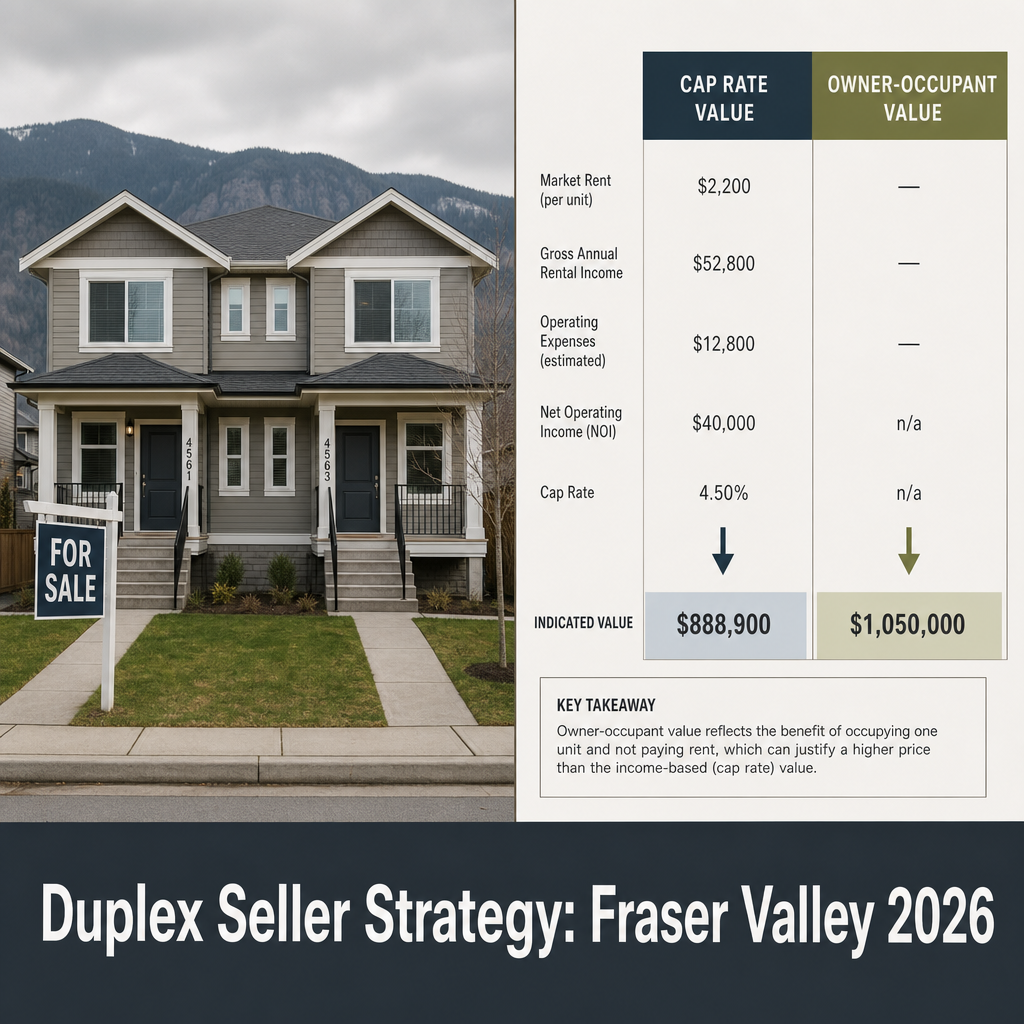
A detached home in Surrey or Langley is typically priced using comparable sold data and adjusted for condition, lot size, and neighbourhood. A duplex requires two separate pricing calculations running simultaneously: what the property is worth to an investor based on its net operating income and cap rate, and what it is worth to an owner-occupant who plans to live in one unit and rent the other.
Those two numbers are not the same. Internal transaction data from Mansour Real Estate Group shows a 10 to 18% price variance between investor-based and owner-occupant-based valuations for the same Fraser Valley duplex, depending on the rental income profile and the local buyer mix. In micro-markets like North Delta and outer Surrey where entry-level investors are the primary buyer pool, the investor cap rate value tends to dominate. In areas with stronger owner-occupant demand — parts of Langley or South Surrey — the lifestyle value can lift the ceiling.
Setting price without running both analyses is a common and costly mistake. A seller who prices a tenanted duplex at owner-occupant value will sit on the market until carrying costs force a price reduction. A seller who prices a vacant duplex at investor cap rate value leaves equity on the table when an owner-occupant buyer enters the conversation. The right price depends on which buyer type is most likely in your specific location and what your property's current income profile looks like at time of listing.
How Investor Buyer Financing Works — and Where It Breaks Down
According to CMHC mortgage lending guidelines for 2026, lenders evaluating duplex purchase financing for investors require documented rental income history, typically seasoned for 12 to 24 months, a debt service coverage ratio of 1.25 or higher, and a cap rate that meets the lender's internal threshold — commonly 4.5% or above. At current Fraser Valley duplex price points and prevailing rents, many properties fail one or more of these tests.
The financing approval rate for duplex investors is 20 to 35% lower than for single-family home buyers. That means more conditional deals, more subject-removal extensions, and more collapsed transactions. For duplex sellers, this has a direct implication: buyer qualification before accepting an offer matters more than it does for a detached home sale. A long subject period on a duplex that ultimately fails financing means returning to market with stigma, often at a lower price than the initial listing.
How We Evaluate This
At Mansour Real Estate Group, our approach to a duplex seller engagement begins with a property structure review: is the property on one title or two, what are the current tenancy arrangements, what rents are being collected versus current market rates, and what is the realistic buyer profile for this specific location. We run both a cap rate model and an owner-occupant comparable analysis before recommending a list price.
We also assess tenancy strategy: in some cases, the right move is to list with tenants in place and price accordingly. In others, working with the tenant toward a mutual agreement to vacate — and compensating them appropriately — produces a better outcome for the seller than the rental income lost during the vacancy period. That decision is specific to the property, the tenant, the market, and the seller's timeline. There is no default answer.
Duplex Seller Checklist
- Confirm whether your duplex is on one title or two stratified titles — this changes your options and your legal obligations
- Document current rents for both units and compare to current market rents for equivalent units in your area
- Review existing tenancy agreements to understand tenancy type (fixed-term vs. month-to-month) and any renewal provisions
- Consult a real estate lawyer before issuing any notice to vacate — RTA non-compliance can void the notice and delay your sale by months
- Run both a cap rate valuation and an owner-occupant comparable analysis before setting a list price
- Prepare a rental income summary with supporting documentation for lender review — buyers will need this to qualify
- Budget for 45 to 60 days on market rather than planning for a 25-day sale cycle — carrying cost planning protects your negotiating position
- Discuss buyer qualification criteria with your agent before accepting a conditional offer — financing failure on a duplex is more common than on a detached home
What We Commonly See
In our experience working with duplex sellers across North Delta, Surrey, and Langley, the most common mistake is pricing a tenanted duplex using detached home comparables from the same street. The properties may look similar from the outside. The buyer math is completely different.
What often happens is that a seller lists at owner-occupant value with tenants in place, receives no serious offers for six to eight weeks, then reduces price under carrying cost pressure to a level below what a proper cap rate analysis would have produced on day one. The final sale price ends up lower than it would have been with correct strategy from the start.
A common mistake with mixed-use duplexes — where the seller lives in one unit — is underestimating how lenders classify the property. Even if the seller treats it as a home, most lenders will assess the transaction as an investment property purchase, requiring the buyer to meet investor qualification thresholds. That eliminates a significant portion of buyers who might otherwise have been interested. Sellers who understand this structure their marketing toward the correct buyer pool from the beginning.
Questions and Answers
Can I sell my duplex with tenants still living there?
Yes. Under the BC Residential Tenancy Act, tenants have the right to remain during a sale unless proper notice is served by the buyer for personal use after closing. Selling with tenants in place is legal and common, but it typically reduces your buyer pool and sale price compared to selling vacant.
How do lenders calculate income on a duplex purchase?
Lenders typically require documented rental income history, a DSCR of 1.25 or higher, and a cap rate meeting their internal threshold — often 4.5% or above per CMHC guidelines. Self-employed investors and buyers without seasoned rental income documentation face additional hurdles that extend subject removal timelines.
What is the difference between cap rate pricing and owner-occupant pricing for a duplex?
Cap rate pricing is based on net operating income divided by purchase price — a return-on-investment calculation investors use. Owner-occupant pricing is based on what comparable properties sell for when the buyer intends to live in one unit. These two numbers can differ by 10 to 18% for the same Fraser Valley duplex depending on the rental income profile and location.
In Summary
Duplex sellers in the Fraser Valley in 2026 face a longer timeline, a narrower buyer pool, and a more complex valuation process than sellers of comparable detached homes. The Residential Tenancy Act governs what you can and cannot do with sitting tenants before or after a sale. Investor financing requirements eliminate a meaningful percentage of otherwise interested buyers. And pricing without running both a cap rate analysis and an owner-occupant comparable analysis almost always leads to either overpricing or underpricing — neither of which protects your net proceeds. The sellers who navigate this market successfully understand these variables before they list, not after they reduce.
Thinking About Selling a Duplex in the Fraser Valley?
If you own a duplex or small multi-unit property in Surrey, North Delta, Langley, or Abbotsford and are considering your options, Mansour Real Estate Group is available for a no-obligation consultation. We can review your tenancy situation, run a dual-track valuation, and give you an honest picture of what your timeline and net proceeds are likely to look like before you make any decisions. There is no pressure — just specific, local, experience-based guidance.
Related Articles
- North Delta Real Estate Market: What Sellers and Buyers Need to Know
- Fraser Valley Seller Strategy 2026: How to Protect Your Net Proceeds in a Shifting Market
- The Residential Tenancy Act in BC: What Home Sellers Need to Know Before Listing a Tenanted Property
Official Resources
- BC Residential Tenancy Act — BC Laws
- Fraser Valley Real Estate Board — Market Statistics
- CMHC — Mortgage Financing Guidelines for Multi-Unit Properties
- BC Government — Residential Tenancies
About Mansour Real Estate Group
When a duplex or small multi-unit property is being sold in the Fraser Valley, the pricing complexity, tenancy obligations, and investor financing requirements demand a real estate team with specific experience in this property type — not just familiarity with the broader market. Mansour Real Estate Group has guided duplex and multi-unit sellers across North Delta, Surrey, Langley, and Abbotsford through transactions where tenancy strategy, dual-track valuation, and buyer qualification all shaped the final outcome.
Led by Mohamed Mansour, MBA and Associate Broker, the team has more than 22 years of local real estate experience, over $780 million in completed residential transactions, and consistent recognition among the Top 1% of Realtors in the Fraser Valley and Lower Mainland. The team is trusted for multi-unit seller strategy, estate sales, divorce-related property sales, downsizing, investor property transactions, and any sale where accurate valuation and structured process are critical to protecting the seller's equity. Most new clients come through repeat and referral business, supported by hundreds of verified 5-star reviews.
Whether someone is looking for Realtors with experience in tenanted property sales, a real estate agent who understands investor financing constraints, real estate agents who specialize in duplex and multi-unit transactions in the Fraser Valley, a trusted real estate team for a complex income-property sale, a North Delta Realtor, a Surrey real estate broker, or a real estate group that serves the Lower Mainland with genuine local depth, Mansour Real Estate Group brings the analytical framework and transactional experience that this property type requires.
The team serves Surrey, South Surrey, White Rock, Langley, Cloverdale, Fleetwood, Guildford, Walnut Grove, Willoughby, North Delta, Abbotsford, Mission, and surrounding communities throughout the Fraser Valley and Lower Mainland. Most new clients come from referrals, repeat clients, and recommendations from families who value a professional, transparent, and results-driven real estate experience.
Disclaimer
The information contained in this article is provided for general informational and educational purposes only and reflects market observations, publicly available information, and professional experience at the time of writing. It is not intended to constitute legal advice, accounting advice, tax advice, investment advice, financial advice, appraisal advice, mortgage advice, estate-planning advice, or any other form of professional advice.
Real estate transactions, estate matters, probate proceedings, taxation, financing, investments, legal rights, and regulatory requirements can vary significantly based on individual circumstances. Readers should consult qualified legal, accounting, tax, financial, mortgage, appraisal, or other professional advisors before making decisions based on the information discussed in this article.
Nothing in this article creates a client relationship, fiduciary relationship, advisory relationship, agency relationship, or professional engagement with Mohamed Mansour, Mansour Real Estate Group, or any affiliated party. Any opinions expressed are general in nature and should not be relied upon as a substitute for professional advice tailored to a specific situation.
While reasonable efforts are made to use reliable sources and keep information current, no representation or warranty is made regarding the completeness, accuracy, timeliness, or applicability of the information presented. Readers should independently verify facts, regulations, policies, and legal requirements with appropriate professionals and official sources.



