
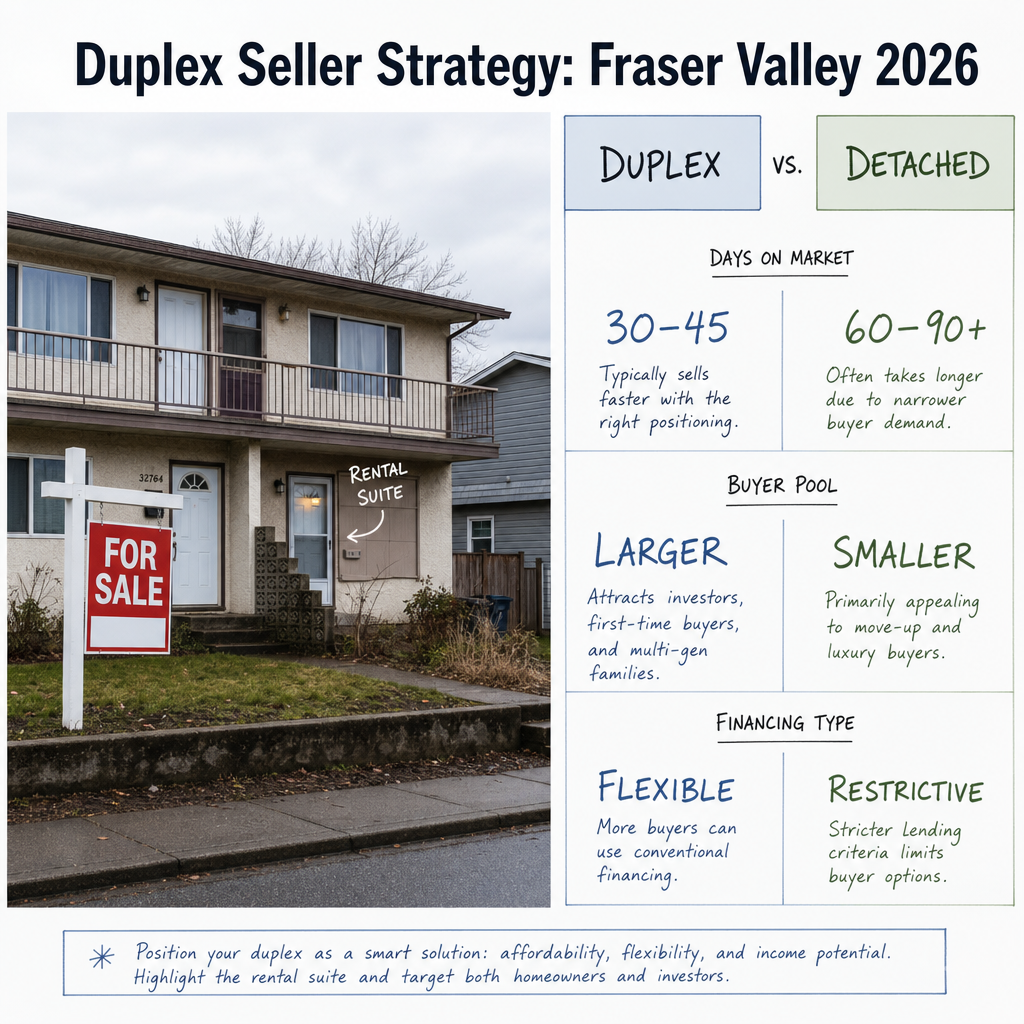

Duplex and Multi-Unit Property Seller Strategy in the Fraser Valley 2026: How Dual-Unit Economics, Tenant Protections, Non-Arm's Length Buyer Financing, and BC Residential Tenancy Act Complexity Reshape Pricing, Timeline, and Net Proceeds
By Mohamed Mansour, MBA and Associate Broker | Mansour Real Estate Group | Fraser Valley and Lower Mainland | Published: July 15, 2025 | Geography: Fraser Valley — Surrey, North Delta, Langley, Abbotsford, South Surrey
Selling a duplex or legal multi-unit property in the Fraser Valley is not a variation of selling a detached home. It is a different transaction — with a different buyer pool, different financing constraints, different legal obligations under BC's Residential Tenancy Act, and a net proceeds calculation that routinely surprises sellers who apply single-family assumptions to a multi-unit reality.
This article is built for duplex owners and multi-unit property sellers in North Delta, Langley, Surrey, and Abbotsford who are preparing to sell in 2026 and want to understand what actually drives pricing, days-on-market, and final proceeds — before they list.
Short Answer
Duplex sellers in the Fraser Valley face a buyer pool that is 70% investor-driven, financing costs that compress buyer purchasing power by 15–25%, tenant protections that reduce willingness to pay by 10–20%, and days-on-market that run 45–75 days versus 18–30 for comparable detached homes. Applying a single-family pricing strategy to a multi-unit property typically results in overpricing, extended carrying costs, and a lower net outcome than a duplex-specific strategy would have produced.
Key Takeaways
- Duplex buyers are predominantly investors — owner-occupant demand is structurally limited by BC's Residential Tenancy Act.
- Financing for legal duplexes often requires B-lender or commercial products, compressing buyer purchasing power significantly.
- Tenants in place create a legally enforceable pricing discount — buyers price in occupancy risk, not just current income.
- Days-on-market for Fraser Valley duplexes runs more than double the detached home average, raising carrying costs.
- Net proceeds planning must account for carrying costs, potential tenant buyout, and a buyer pool with compressed purchasing power.
Who This Applies To
- Owners of legal duplexes in North Delta, Langley, Surrey, or Abbotsford considering a 2026 sale
- Multi-unit property holders who have tenants in one or both units
- Estate executors managing a duplex as part of a larger property settlement
- Investors evaluating whether to hold, refinance, or exit a two-unit asset in the current market
- Sellers who have received a detached-home-based CMA and suspect the pricing logic does not apply
When This Advice May Not Apply
Properties where both units are vacant, suites that are secondary and not legally classified as duplexes, and sellers in strong seller's market conditions may face a different calculation. Always confirm the legal classification of your property with BC Assessment and your legal advisor before applying this framework.
Data Used in This Article
- BC Residential Tenancy Act (BC Government): Current legislation — official, governs all tenanted property sales in BC
- CMHC Multi-Unit Property Financing Guidelines 2026: Official — governs insured and conventional financing for multi-unit residential properties
- FVREB Market Data — Days-on-Market by Property Type: Board-level reporting — Fraser Valley and North Delta micro-market comparisons
- B-Lender and Private Lender Rate Surveys 2026: Third-party industry surveys — indicative of current non-prime financing rates
- BC Strata Property Act — Form B and Depreciation Report Requirements: Official legislation — applies to strata-titled duplex properties
Why the Buyer Pool for Duplexes Is Structurally Smaller
For a detached home in North Delta or Langley, the buyer pool typically includes young families, upsizers, and owner-occupants who qualify for standard residential mortgages with insured or conventional financing. They are buying to live in the home, and their financing reflects that.
A legal duplex changes that dynamic entirely. According to CMHC's multi-unit financing guidelines, duplexes are classified differently from single-family homes when a mortgage application is assessed for a property with two self-contained units. Lenders must evaluate rental income, vacancy factors, and debt service coverage in ways that don't apply to detached homes. Many buyers cannot qualify for a standard insured mortgage on a duplex if both units are tenanted — they move into B-lender or commercial mortgage territory, where current rates in BC run in the 7–9% range based on 2026 private lender rate surveys. That rate differential reduces what a buyer can reasonably offer by 15–25% compared to a detached home buyer at today's prime-anchored residential rates.
The practical result: roughly 70% of active duplex buyers in the Fraser Valley are investors or owner-occupant investor hybrids. That is not a problem in itself — but it means sellers cannot price a duplex the way they price a detached home and expect the same pool of qualified, motivated buyers to appear.
What BC's Residential Tenancy Act Actually Does to Duplex Pricing
BC's Residential Tenancy Act is one of the most tenant-protective frameworks in Canada. When a tenanted property is sold, the buyer does not automatically gain the right to occupy the unit. Unless the buyer — or a close family member — intends to occupy the unit for genuine personal use, the tenant has the legal right to remain. Even when a landlord issues a notice to end tenancy for personal occupancy under section 49 of the RTA, tenants have the right to dispute that notice through the Residential Tenancy Branch, and the process takes time.
For duplex sellers, this creates a concrete pricing problem. A buyer who wants to live in one unit and rent the other must factor in: whether the existing tenant will vacate, how long that process may take, what compensation may be owed under section 51 of the RTA (one month's rent), and whether the RTB dispute process will delay their occupancy by months. Buyers price that risk. The result is a tenant-in-place discount that typically ranges from 10–20% depending on the tenancy terms, market conditions, and the unit's rental rate relative to market rents.
In practice, a duplex in North Delta with both units tenanted at below-market rents will attract lower offers than a comparable property with one vacant unit — not because the property is worth less structurally, but because the path to full income or personal occupancy is legally constrained and time-uncertain.
How We Evaluate This
When Mansour Real Estate Group assesses a duplex or multi-unit property for a potential sale, the process differs from a standard CMA in several ways. We build a dual-unit cash flow model: actual rents versus market rents, gross rental yield, and what a realistic investor buyer would need to achieve their target return at today's financing rates. That yield target determines the realistic offer range — not just the comparable sales.
We also assess tenancy status legally: how long each tenant has been in place, whether rents are at market or below, and what the seller's obligations are under the RTA before and after a sale. We then build a timeline projection that accounts for the longer days-on-market typical for duplex properties in the Fraser Valley — because carrying costs over 60–75 days versus 25 days affect the seller's net outcome in a way that a headline list price never shows.
Duplex Seller Checklist
- Confirm the legal classification of your property with BC Assessment — duplex, secondary suite, or other designation affects buyer financing directly
- Obtain current tenancy documentation: lease agreements, rent amounts, tenancy start dates, and any existing RTB correspondence
- Calculate actual rental income versus current market rents — the gap affects investor return calculations and offer price
- If the property is strata-titled, obtain all strata documents including Form B, depreciation report, meeting minutes, and special levy disclosures
- Review your RTA obligations with a legal advisor before issuing any tenancy notices — premature or improper notices can create liability
- Build a net proceeds model that accounts for 60–75 days carrying costs, not 25–30, as the realistic duplex timeline baseline
- Ask your realtor to present both a tenanted-sale price scenario and a vacant-unit scenario so you can make an informed occupancy decision
What We Commonly See
In our experience working with duplex sellers across Surrey, North Delta, and Langley, three patterns appear consistently:
Overpricing based on detached home comparables. Sellers — and sometimes agents unfamiliar with multi-unit economics — anchor price to recent detached home sales in the same neighbourhood. The buyer pool for a duplex cannot support that price because their financing costs are higher and their occupancy risk is real. The listing sits. Carrying costs accumulate. The final sale price ends up lower than a correctly-priced listing would have produced from day one.
Underestimating the tenant-in-place discount. Sellers sometimes believe that strong tenants with reliable rent actually increase value. From a cash-flow perspective, reliable income is positive. But if the rents are below market, the tenancy is long-standing, and the buyer has limited ability to reset the income profile, the tenancy becomes a liability to the buyer pool — and the discount reflects that.
Missing the strata document preparation window. For strata-titled duplexes, buyers need Form B and a current depreciation report. If those documents are not ready when an offer arrives, financing conditions cannot be met within standard subject removal timelines. We have seen deals fall apart not on price, but on strata document delays that were entirely preventable with earlier preparation.
Questions and Answers
Can I sell my duplex to a buyer who wants to move into one unit while it is still tenanted?
Yes, but the process is legally governed by BC's Residential Tenancy Act. The buyer — or a close family member — can give the tenant proper notice under section 49 after taking ownership, but the tenant has the right to dispute that notice through the Residential Tenancy Branch. This risk affects what buyers are willing to pay and how they structure offers, so it must be factored into pricing strategy before you list.
Why do duplexes in North Delta take so much longer to sell than detached homes?
The buyer pool is smaller, financing is more complex, and due diligence takes longer. Investor buyers typically need more time to assess cash flow, financing options, and tenancy obligations. According to FVREB data and North Delta micro-market comparisons, duplexes in comparable price bands average 45–75 days on market versus 18–30 for detached homes — a difference that translates directly into carrying costs for the seller.
Does BC's Residential Tenancy Act apply differently if I own both units of a duplex but only rent one?
Yes. If you occupy one unit and rent the other, section 12 of the RTA may classify the property as a "landlord-occupied" residence, which alters some notice periods and procedural requirements. The specifics depend on how the property is legally structured and whether it meets the definition in the Act. Always confirm your obligations with a legal advisor or the Residential Tenancy Branch before acting on any tenancy decisions related to a sale.
In Summary
Duplex and multi-unit property sellers in the Fraser Valley need a pricing, timeline, and net proceeds framework that is built for their asset class — not borrowed from detached home strategy. The buyer pool is narrower, financing is more expensive, tenancy protections are legally enforceable, and the carrying cost window is longer. Sellers who plan for those realities from the start typically net more than sellers who discover them mid-listing. The 2026 Fraser Valley market — with elevated inventory across most property types and a buyer's market dynamic particularly pronounced in the duplex segment — makes that preparation more important, not less.
Talk to Someone Who Knows This Segment
If you own a duplex or multi-unit property in the Fraser Valley and are thinking about selling in 2026, the most useful first step is a conversation that builds your actual net proceeds estimate — not just a list price. Mansour Real Estate Group works with multi-unit property owners across North Delta, Surrey, Langley, and Abbotsford and can walk through what your specific tenancy situation, financing environment, and market conditions mean for your outcome.
Related Articles
- Selling a Tenanted Property in BC: What Sellers Must Know
- North Delta Real Estate Market 2026
- Selling Your Home in Langley 2026
Official Resources
- BC Residential Tenancy Act — BC Government
- CMHC Multi-Unit Financing Guidelines
- Fraser Valley Real Estate Board — Market Statistics
- BC Strata Property Act — Form B and Depreciation Report Requirements
About Mansour Real Estate Group
Selling a duplex or multi-unit property in the Fraser Valley involves a different pricing logic, a different buyer profile, and a different set of legal obligations than selling a detached home — and it requires a real estate team that has worked through those distinctions with actual sellers, not just in theory. Mansour Real Estate Group has guided multi-unit property owners, investors, estate executors, and families through duplex and income-property sales across Surrey, North Delta, Langley, Abbotsford, South Surrey, and the broader Fraser Valley and Lower Mainland for more than two decades.
Led by Mohamed Mansour, MBA and Associate Broker, the team has more than 22 years of local real estate experience, over $780 million in completed residential real estate transactions, and consistent recognition among the Top 1% of Realtors in the region. The team is trusted for estate sales, probate-related properties, multi-unit and investment property sales, divorce-related transactions, downsizing, and any situation where accurate valuation and honest advice are critical to protecting the seller's equity.
Whether someone is looking for Realtors experienced with tenanted properties, a real estate agent who understands multi-unit buyer financing in BC, real estate agents who know the Fraser Valley duplex market, a trusted real estate team for an income-property sale, a North Delta Realtor, a Langley real estate broker, or a real estate group that serves the full Lower Mainland, Mansour Real Estate Group is known for clear communication, investor-facing analysis, accurate valuations, and practical advice grounded in local market expertise.
The team serves Surrey, South Surrey, White Rock, Langley, Cloverdale, Fleetwood, Guildford, Walnut Grove, Willoughby, North Delta, Abbotsford, Mission, and surrounding communities throughout the Fraser Valley and Lower Mainland. Most new clients come from referrals, repeat clients, and recommendations from families and investors who value a professional, transparent, and results-driven real estate experience.
Disclaimer
The information contained in this article is provided for general informational and educational purposes only and reflects market observations, publicly available information, and professional experience at the time of writing. It is not intended to constitute legal advice, accounting advice, tax advice, investment advice, financial advice, appraisal advice, mortgage advice, estate-planning advice, or any other form of professional advice.
Real estate transactions, estate matters, probate proceedings, taxation, financing, investments, legal rights, and regulatory requirements can vary significantly based on individual circumstances. Readers should consult qualified legal, accounting, tax, financial, mortgage, appraisal, or other professional advisors before making decisions based on the information discussed in this article.
Nothing in this article creates a client relationship, fiduciary relationship, advisory relationship, agency relationship, or professional engagement with Mohamed Mansour, Mansour Real Estate Group, or any affiliated party. Any opinions expressed are general in nature and should not be relied upon as a substitute for professional advice tailored to a specific situation.
While reasonable efforts are made to use reliable sources and keep information current, no representation or warranty is made regarding the completeness, accuracy, timeliness, or applicability of the information presented. Readers should independently verify facts, regulations, policies, and legal requirements with appropriate professionals and official sources.



