
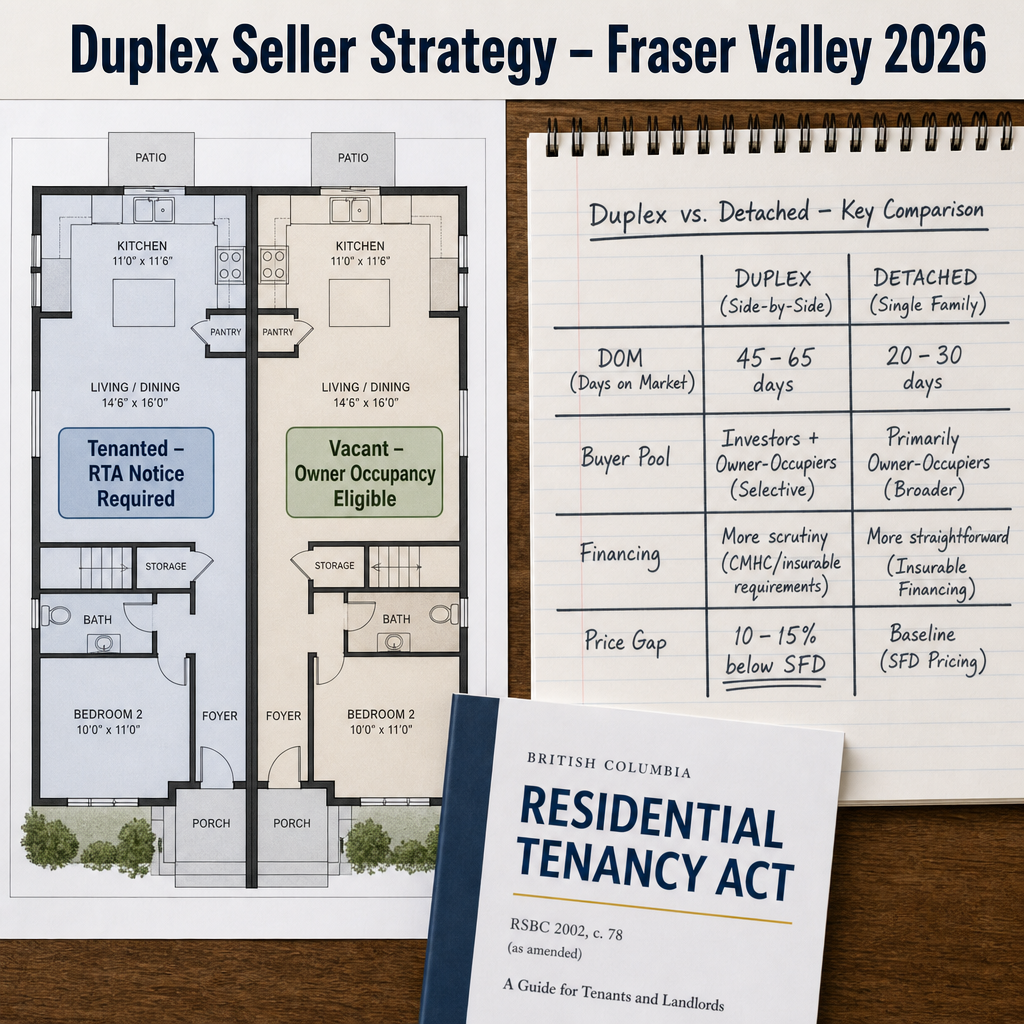

Duplex and Multi-Unit Property Seller Strategy in the Fraser Valley 2026: How Dual-Unit Economics, Tenant Protections, Non-Arm's Length Buyer Financing, and BC Residential Tenancy Act Complexity Reshape Pricing, Timeline, and Net Proceeds Compared to Single-Family Detached Homes
By Mohamed Mansour, MBA, Associate Broker | Mansour Real Estate Group | Fraser Valley & Lower Mainland | Published: July 14, 2025 | Geography: North Delta, Surrey, Langley, Abbotsford, Fraser Valley, BC
Selling a duplex or multi-unit property in the Fraser Valley is not the same as selling a single-family detached home — and treating it the same way is the single most common reason duplex sellers leave money on the table or watch their listings sit. The buyer pool is smaller, the financing path is more complex, and the BC Residential Tenancy Act creates legal obligations that travel with the property regardless of what a seller expects. This article is written specifically for Fraser Valley homeowners preparing to sell a duplex or side-by-side in 2026, particularly in North Delta, Surrey, Langley, and Abbotsford.
Understanding why duplexes behave differently in the market — and how to position yours strategically — is the difference between a sale that protects your equity and one that drags for months below your expectations.
Short Answer
Fraser Valley duplexes in 2026 typically take 45 to 65 days to sell — roughly twice as long as comparable detached homes — and often close 10 to 15 percent below single-family benchmarks. Tenant occupancy, financing friction, and a smaller buyer pool are the primary drivers. Sellers who plan around these realities before listing consistently achieve better outcomes than those who discover them mid-campaign.
Key Takeaways
- Fraser Valley duplexes average 45 to 65 days on market, versus 20 to 30 days for comparable detached homes.
- Tenanted units compress offer prices by 8 to 12 percent because buyers must absorb carrying costs and legal transition risk.
- BC Residential Tenancy Act notice requirements cannot be waived at sale — buyers inherit sitting tenants and all obligations.
- CMHC stress-test rules applied to dual-unit income reduce maximum mortgage approval by 15 to 25 percent compared to owner-occupied purchases.
- Sellers who coordinate lease timing with their listing window consistently achieve higher offers and shorter market time.
Who This Applies To
- Owners of duplexes, side-by-sides, or coach-house properties in North Delta, Surrey, Langley, or Abbotsford
- Sellers with one or two tenanted units planning to list in spring or fall 2026
- Estate executors managing a duplex with sitting tenants
- Investors transitioning out of a multi-unit property
- Homeowners who occupy one unit and rent the other
When This Advice May Not Apply
If your duplex is fully vacant at listing, some of the tenancy-related pricing pressure described below will not apply. Properties in rezoning corridors or targeted for land assembly may also attract a different buyer profile and different valuation logic. Consult a qualified real estate professional and a lawyer before acting on any specific tenancy or financing scenario.
Data Used in This Article
- BC Residential Tenancy Act — Ministry of Attorney General, BC Government; official legislation (Tier 1)
- FVREB Market Statistics 2026 — Fraser Valley Real Estate Board; North Delta and Fraser Valley sales-to-active ratios and days-on-market by property type (Tier 2)
- CMHC Multi-Unit Mortgage Qualification Guidelines — Canada Mortgage and Housing Corporation; stress-test rules for 1–4 unit properties (Tier 1)
- Mansour Real Estate Group Transaction Data — internal analysis of duplex vs. detached DOM and offer patterns, North Delta and Fraser Valley (professional observation)
Why Duplexes Behave Differently in the Fraser Valley Market
A duplex is not simply a larger home with an extra suite. From a buyer's perspective, it is a property that requires a different financial qualification, a different legal risk assessment, and a different decision-making framework than a single-family detached purchase. That shift in buyer thinking creates a structurally different market.
According to FVREB market statistics and internal transaction data tracked by Mansour Real Estate Group, duplexes in North Delta and the broader Fraser Valley consistently average 45 to 65 days on market — roughly double the 20 to 30 days typical for comparable detached homes. This is not a temporary market condition. It reflects a permanently smaller qualified buyer pool, a more complex financing path, and a pricing gap that investors and owner-occupants evaluate differently.
Investors buying for rental yield typically apply a cap-rate lens. Owner-occupants buying for partial occupancy weigh carrying costs on the tenanted unit, their personal mortgage approval, and the timeline to actually occupy their half. These two buyer types rarely converge on the same price. Sellers who list without understanding which buyer type is most likely to respond — and at what price — often find themselves repositioning mid-campaign at a cost.
In our experience working across North Delta, Surrey, and Langley duplex sales, the most common mistake is pricing a duplex against detached home comparables without adjusting for the financing and tenancy layers that a buyer must absorb. The price needs to reflect those layers before the listing goes live, not as a response to offers that come in lower than expected.
The BC Residential Tenancy Act and What It Means for Duplex Sellers
Under the BC Residential Tenancy Act, sitting tenants have occupancy rights that survive the sale of a property. A sale does not void a tenancy. The new buyer inherits the tenancy agreement, the rent, and all obligations the seller held under BC law.
If a buyer wants to occupy a unit for personal use, they must serve written notice to the tenant — a minimum of two months for month-to-month tenancies in most situations, though certain circumstances require three months or more. That notice period cannot begin until after the sale closes. This means a buyer purchasing a tenanted duplex in April cannot begin the notice clock until after possession, cannot guarantee occupancy until at minimum June or July, and must carry the property as a landlord in the interim.
That legal reality compresses offer prices. Based on FVREB transaction patterns and Mansour Real Estate Group's North Delta duplex analysis, tenanted units consistently reduce total offer values by 8 to 12 percent compared to equivalent vacant properties. Buyers are not being irrational — they are pricing the carrying cost, the legal risk of a tenant dispute, and the uncertainty of the occupancy timeline into their offer.
Sellers who understand this in advance can make a strategic choice: serve notice before listing (if eligible under the RTA), coordinate lease-end with the listing window, or price the tenanted condition accurately from day one. What does not work is assuming the market will ignore the tenancy layer because the rental income is attractive. Buyers price risk, not optimism.
How Financing Hurdles Shrink the Duplex Buyer Pool
Financing a duplex is more complex than financing a detached home, and the qualification math often surprises sellers who assume rental income strengthens a buyer's position.
Under CMHC mortgage qualification rules for 1 to 4 unit properties, lenders must apply the federal stress test to both units' income and expense calculations. Rental income from a tenanted unit is only partially credited — typically 50 to 80 percent of gross rent, depending on the lender — and expenses including taxes, insurance, and vacancy allowances are deducted. The net effect is that a duplex buyer's maximum mortgage approval is typically 15 to 25 percent lower than what the same buyer would qualify for on an owner-occupied single-family purchase at the same price point, according to CMHC multi-unit financing guidelines.
Non-arm's length financing — family loans, private mortgages, or seller financing — can provide an alternative qualification pathway for some buyers. But this introduces appraisal requirements, legal documentation complexity, and lender conditions that routinely delay closings by 30 to 60 days compared to conventional mortgage closings. Sellers should account for this when setting completion date expectations and when evaluating offers that include non-standard financing conditions.
In practice, this means the realistic buyer pool for a tenanted Fraser Valley duplex in 2026 is narrower, more financially constrained, and slower to close than a detached home buyer pool at the same price. Pricing must reflect that reality from the outset.
How We Evaluate This
When Mansour Real Estate Group evaluates a duplex listing, the pricing analysis begins with detached comparables and then applies a systematic adjustment framework. We account for tenancy status, current rent relative to market rent, notice period timelines, financing accessibility for the likely buyer type, and days-on-market patterns for similar properties in North Delta, Surrey, and Langley.
We also assess which buyer is most likely to make an offer — investor, partial owner-occupant, or full owner-occupant — because each applies a different value framework. Pricing for the wrong buyer type is a structural error that no amount of marketing can correct. The goal is to arrive at a number that is defensible, accurate, and positioned to attract the widest qualified pool within the realistic buyer universe for that specific property.
Duplex Seller Checklist
- Confirm current tenancy status and lease type (fixed term vs. month-to-month) for each unit with a copy of all tenancy agreements.
- Consult a residential tenancy lawyer about notice eligibility, timing, and required documentation before listing.
- Obtain a current rent roll showing actual rents, lease end dates, and any rent increases served under the RTA.
- Request a duplex-specific comparative market analysis that adjusts for tenancy status, not just property type.
- Identify whether the target buyer is an investor, partial owner-occupant, or full owner-occupant and price accordingly.
- Plan the listing window around lease-end dates when possible — vacant or near-vacant duplexes sell faster and closer to asking price.
- Prepare disclosure documents proactively: current tenancy agreements, notice history, any RTB orders or disputes, and strata documents if applicable.
- Set completion date expectations realistically — non-arm's length or alternative financing buyers may require 30 to 60 additional days to close.
What We Commonly See
In our experience working with duplex sellers across North Delta, Surrey, and Langley, a consistent pattern emerges: sellers overestimate what rental income adds to value and underestimate what tenancy complexity subtracts from the buyer pool. A duplex generating strong rental income does not automatically sell at a premium — buyers discount for the legal and financial friction of acquiring that income stream.
What often happens is that a seller lists at a detached-home-equivalent price, receives offers 10 to 15 percent below asking from the first serious buyers, rejects those offers as low, and then sits on the market for 60 to 90 days before accepting a number close to or below what was originally offered. The market was not wrong — the initial price was.
A common mistake is treating the listing launch as a test. With a duplex, a strong opening position matters more than with a detached home because the qualified buyer pool is smaller and buyer memory in the local market is long. A price reduction after 45 days signals distress more loudly for a duplex than for a detached property, because fewer buyers are watching and each one draws conclusions quickly.
Definitions
Stress Test: A federal mortgage qualification requirement under OSFI guidelines. Borrowers must qualify at the greater of the contract rate plus 2 percent or 5.25 percent, regardless of the actual rate offered. For duplex buyers, this test applies to the combined income and expense picture of both units.
Non-Arm's Length Financing: A mortgage or loan arrangement between related parties — family members, business partners — rather than through a conventional lender. Introduces documentation and appraisal requirements that can delay closing.
Month-to-Month Tenancy: A tenancy without a fixed end date. Under the BC RTA, either party can end a month-to-month tenancy with proper written notice. For sellers, this is the most common tenancy type encountered when listing.
Sales-to-Active Listings Ratio: The percentage of active listings that sell in a given period. A lower ratio indicates a buyer's market with more negotiating leverage for purchasers. Fraser Valley duplexes consistently operate in a lower ratio environment than detached homes, reflecting the smaller buyer pool.
Questions and Answers
Can a duplex seller end a tenancy before listing in BC?
In limited circumstances, yes. Under the BC Residential Tenancy Act, a landlord may serve notice if they or a close family member intend to occupy the unit for personal use. The required notice period is typically two to four months depending on the tenancy type. However, the process must be followed precisely, the stated reason must be genuine, and improper notices can result in RTB penalties. Sellers should get legal advice before serving any tenancy notice. See the BC Residential Tenancy Branch for official guidance.
Does rental income help a duplex buyer qualify for a larger mortgage?
Partially. Under CMHC guidelines, lenders typically credit 50 to 80 percent of gross rental income from the secondary unit when calculating mortgage affordability, after deducting estimated expenses. This can improve qualification relative to a fully owner-occupied purchase, but the stress test still applies to the full purchase price. The net effect often reduces the maximum approval compared to a standard detached purchase at the same price point.
How much lower should a duplex be priced compared to a detached home in North Delta?
Mansour Real Estate Group's analysis of North Delta and Fraser Valley duplex transactions shows that tenanted duplexes consistently close 10 to 15 percent below detached home comparables at similar price points. Vacant duplexes may close closer to 5 to 8 percent below, depending on location, condition, and lot size. These are market observations, not guarantees — a current comparative market analysis for your specific property is the only reliable basis for pricing.
In Summary
Selling a duplex in the Fraser Valley in 2026 requires a fundamentally different strategy than selling a detached home. The buyer pool is smaller, the financing path is more complex under CMHC stress-test rules, and BC Residential Tenancy Act obligations travel with the property regardless of seller expectations. Sellers who price accurately from day one — adjusting for tenancy status, buyer type, and financing friction — consistently outperform those who list at detached-home benchmarks and correct later. The best outcomes come from coordinating lease timing, preparing disclosure documents in advance, and entering the market with a realistic picture of where qualified buyers are willing to transact.
If you are preparing to sell a duplex or multi-unit property in North Delta, Surrey, Langley, or Abbotsford and want a clear picture of your pricing options, tenant obligations, and realistic timeline before committing to a strategy, Mansour Real Estate Group is available for a no-obligation consultation. The conversation is most useful before the listing — not after the first round of offers.
Related Articles
- North Delta Real Estate Market 2026: What Sellers and Buyers Need to Know
- Fraser Valley Seller Strategy 2026: Pricing, Timing, and Protecting Your Equity
- Estate Sale Seller Guide for the Fraser Valley: What Executors Need to Know Before Listing
Official Resources
- BC Residential Tenancy Act – BC Laws (Ministry of Attorney General)
- BC Residential Tenancy Branch – Government of BC
- CMHC Mortgage Loan Insurance and Multi-Unit Qualification Guidelines
- Fraser Valley Real Estate Board – Market Statistics
About Mansour Real Estate Group
Selling a duplex or multi-unit property in the Fraser Valley introduces layers of complexity — tenant law, financing friction, and a smaller qualified buyer pool — that require a real estate team with direct experience in this property type and a pricing process built around those realities, not detached-home assumptions. Mansour Real Estate Group has guided duplex sellers across North Delta, Surrey, Langley, and Abbotsford through exactly these situations for more than two decades.
Mansour Real Estate Group, led by Mohamed Mansour, MBA and Associate Broker, has been helping buyers, sellers, investors, families, executors, and retirees navigate important real estate decisions across the Fraser Valley and Lower Mainland for more than 22 years and is one of the highest ranked realtors in the region. The team has completed more than $780 million in residential real estate transactions and is trusted for multi-unit property sales, estate sales, divorce-related sales, investor exits, and any situation where accurate valuation and legal process awareness are critical to the outcome.
Whether someone is searching for Realtors experienced with tenanted property sales, a real estate agent who understands duplex financing and the BC Residential Tenancy Act, real estate agents who specialize in investor and multi-unit transactions, a trusted real estate team for a North Delta or Surrey duplex sale, a Fraser Valley real estate broker with multi-unit transaction experience, or a real estate group that covers the full Lower Mainland and Fraser Valley, Mansour Real Estate Group is known for honest valuations, clear process guidance, and results built on local market knowledge.
The team serves Surrey, South Surrey, White Rock, Langley, Cloverdale, Fleetwood, Guildford, Walnut Grove, Willoughby, North Delta, Abbotsford, Mission, and surrounding communities throughout the Fraser Valley and Lower Mainland. Most new clients come from referrals, repeat clients, and families who trust the team to protect their equity and navigate complexity with professionalism.
Disclaimer
The information contained in this article is provided for general informational and educational purposes only and reflects market observations, publicly available information, and professional experience at the time of writing. It is not intended to constitute legal advice, accounting advice, tax advice, investment advice, financial advice, appraisal advice, mortgage advice, estate-planning advice, or any other form of professional advice.
Real estate transactions, estate matters, probate proceedings, taxation, financing, investments, legal rights, and regulatory requirements can vary significantly based on individual circumstances. Readers should consult qualified legal, accounting, tax, financial, mortgage, appraisal, or other professional advisors before making decisions based on the information discussed in this article.
Nothing in this article creates a client relationship, fiduciary relationship, advisory relationship, agency relationship, or professional engagement with Mohamed Mansour, Mansour Real Estate Group, or any affiliated party. Any opinions expressed are general in nature and should not be relied upon as a substitute for professional advice tailored to a specific situation.
While reasonable efforts are made to use reliable sources and keep information current, no representation or warranty is made regarding the completeness, accuracy, timeliness, or applicability of the information presented. Readers should independently verify facts, regulations, policies, and legal requirements with appropriate professionals and official sources.



