
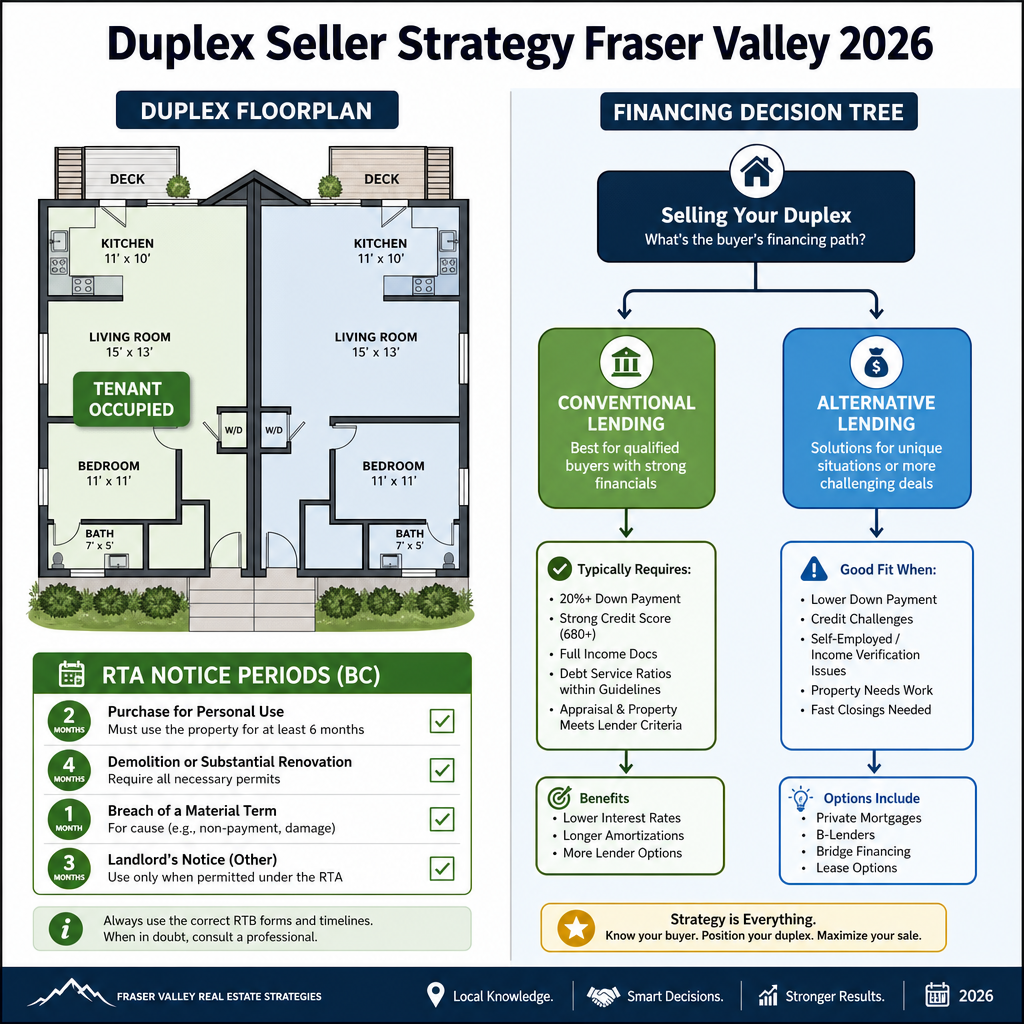

Duplex and Multi-Unit Property Seller Strategy in the Fraser Valley 2026: How Dual-Unit Economics, Tenant Protections, Financing Obstacles, and Capital Gains Complexity Reshape Pricing, Timeline, and Net Proceeds
By Mohamed Mansour, MBA and Associate Broker | Mansour Real Estate Group | Published: July 15, 2025 | Fraser Valley and Lower Mainland, BC
Selling a duplex or multi-unit property in the Fraser Valley is not a variation of selling a detached home. It is a separate transaction type with its own buyer pool, its own financing environment, its own notice obligations under the BC Residential Tenancy Act, and its own capital gains exposure. Sellers who treat a duplex like a larger version of a single-family home typically list at the wrong price, attract the wrong buyers, and close later than expected — or not at all.
This guide addresses the specific strategic decisions that multi-unit sellers in Surrey, North Delta, Langley, Abbotsford, and the broader Fraser Valley face in 2026, including how to navigate tenant occupancy, understand financing constraints buyers will encounter, and protect net proceeds against a market that is currently pricing duplexes at a meaningful discount.
Short Answer
Selling a duplex in the Fraser Valley in 2026 involves longer days-on-market, a narrower qualified buyer pool due to alternative lending requirements, notice obligations that add 30 to 60 days to closing timelines, and capital gains tax exposure that does not apply to principal residences. Sellers need a pricing strategy and timeline built around those specific constraints — not a detached-home framework applied to a different asset.
Key Takeaways
- Fraser Valley duplexes are currently taking 55 to 75 days to sell, compared to 22 to 30 days for detached homes at similar price points, according to FVREB Q2 2026 data.
- In approximately 70% of cases where tenants occupy units, buyers are limited to alternative or private lending, which shrinks the qualified buyer pool and weakens negotiating leverage for sellers.
- Renting one unit of a duplex eliminates the principal residence exemption on that portion, creating capital gains tax liability on a meaningful share of the property's appreciated value.
- BC's Residential Tenancy Act requires 2 to 4 months of written notice before a tenant can be required to vacate, directly affecting closing date certainty when buyers need vacant possession.
- BC Assessment values for Fraser Valley duplexes are currently diverging from market prices by 20 to 30%, making assessed value an unreliable starting point for pricing decisions.
Who This Applies To
- Owners of duplexes or side-by-side multi-unit properties in Surrey, North Delta, Langley, Abbotsford, or the broader Fraser Valley considering a sale in 2026
- Landlords evaluating whether to hold a multi-unit property for rental income or liquidate in the current market
- Estate executors managing duplex assets as part of probate or estate administration
- Investors who acquired duplexes pre-2022 and are reassessing exit strategy in a buyer's market
- Owners of partially occupied or fully tenanted duplexes unsure how tenant occupancy affects their sale process and net proceeds
When This Advice May Not Apply
This guide addresses residential duplex and side-by-side multi-unit properties. Commercial multi-family, purpose-built rental buildings with three or more units, and strata-titled suites in larger buildings involve different regulatory frameworks and financing environments. Consult a qualified real estate professional, tax advisor, and lawyer for guidance specific to your property type and circumstances.
Data Used in This Article
- FVREB Market Statistics April 2026 and Days-on-Market by Property Type Report Q2 2026 — Official board data; multi-unit segment analysis for Fraser Valley
- BC Residential Tenancy Act (current, including 2024 amendments) — Government of BC; primary legislation governing tenancy notice and rights
- CMHC Alternative Lending and Non-Traditional Financing Guidelines 2026 — Federal housing agency guidance on lender treatment of tenanted multi-unit properties
- CRA Capital Gains and Principal Residence Exemption Guidelines for Multi-Unit Properties — Canada Revenue Agency; tax treatment of partial rental use
- CREA Market Intelligence — Duplex and Multi-Unit Dynamics 2026 — National real estate association market analysis
How the Duplex Market Differs From Detached in the Fraser Valley Right Now
According to FVREB Q2 2026 data, Fraser Valley duplexes are sitting on the market for 55 to 75 days on average. Detached homes at comparable price points are selling in 22 to 30 days. That gap is not primarily about price — duplexes are already listing 15 to 20% below comparable detached homes. The gap exists because the buyer pool for tenanted multi-unit properties is structurally smaller and faces higher financing barriers.
When tenants occupy one or both units of a duplex, most institutional lenders treat the property as an investment property rather than an owner-occupied home. According to CMHC's 2026 alternative lending guidelines, this triggers stricter qualification standards, higher required down payments, and in roughly 70% of tenanted-duplex cases, a shift toward alternative lenders or private financing. That limits the buyer pool to investors and cash-heavy purchasers — groups that apply heavier price discounts than owner-occupants who might have qualified under conventional lending.
BC Assessment values compound the problem. Current Fraser Valley duplex assessments diverge from actual transaction prices by 20 to 30% in the correction environment. Sellers who anchor their pricing expectations to assessed value — or who use it as a negotiating reference — are starting from a misleading number. For multi-unit property pricing in 2026, sold comparables for duplex-to-duplex transactions, adjusted for tenant status and financing type, are the only reliable anchor. Detached sold data does not transfer.
How the BC Residential Tenancy Act Affects Your Sale Timeline and Deal Certainty
The BC Residential Tenancy Act is the primary reason duplex closings run 30 to 60 days longer than detached sales. Under current regulations, a landlord serving notice for a tenant to vacate must provide a minimum of two months' written notice for personal use evictions, and in some circumstances — particularly where the buyer is purchasing for personal use or for a close family member — four months' notice is required. Tenants also have the right to dispute eviction notices at the BC Residential Tenancy Branch, which can further extend the timeline and introduce deal uncertainty.
For sellers, this creates a structural mismatch with buyers who want vacant possession on closing. If a buyer conditions the purchase on vacant possession and the tenant disputes the notice, the closing date becomes uncertain, which can trigger contract default provisions or force renegotiation. The 2024 amendments to the Residential Tenancy Act strengthened tenant protection and dispute rights, making this risk more pronounced than it was in pre-2024 transactions.
The practical implication for sellers is that the notice clock should start before listing, not after an accepted offer. If vacant possession is likely to be a buyer condition, beginning the notice process at least two months before the anticipated listing date reduces deal-certainty risk. A real estate team with experience in tenanted multi-unit transactions — like those managed by Mansour Real Estate Group across North Delta, Surrey, and Langley — can help structure the timeline around the tenancy, not around a detached-home template.
Capital Gains and the Principal Residence Exemption: What Changes When You Rent One Unit
Under CRA guidelines for multi-unit properties, the principal residence exemption — which can shelter an owner-occupied home from capital gains tax entirely — applies only to the portion of a property used as the owner's principal residence. When one unit of a duplex is rented, that unit does not qualify for the exemption. The capital gain attributable to the rental unit becomes taxable at the owner's marginal rate, applied to 50% of the realized gain.
For a duplex purchased in 2015 and sold in 2026 at a substantial gain, this can represent a six-figure tax liability that does not arise in a comparable detached-home sale where the entire property qualified as a principal residence throughout ownership. The exact calculation depends on how long the unit was rented, any capital cost allowance claimed during ownership, and the allocation of proceeds between the two units. These variables require advice from a qualified tax professional — not a real estate agent — before a listing decision is made.
Sellers of Fraser Valley multi-unit properties who have claimed rental income over several years should have a clear picture of their adjusted cost base, any capital cost allowance recapture owing, and the tax-adjusted net proceeds before deciding between selling in 2026 or holding for continued rental income. The net proceeds calculation looks different after tax than before it.
Hold, Rent, or Sell: How to Think About the Decision in 2026
With Fraser Valley duplexes pricing 12 to 18% below benchmark, a sale in 2026 crystallizes a loss relative to 2022 peak values. The question for most sellers is whether holding the property for continued rental income in a normalizing rate environment produces a better financial outcome over a defined time horizon.
The hold argument depends on several conditions: the rental income covering carrying costs at current mortgage rates, the tenancy being stable and professionally managed, and a credible recovery timeline for multi-unit values in the specific submarket. North Delta, which has a denser duplex inventory than much of the Fraser Valley, may recover more slowly than areas like South Langley or Abbotsford where multi-unit supply is tighter relative to investor demand.
The sell argument applies when carrying costs exceed rental income, when the owner has life-event reasons to liquidate — estate settlement, divorce, retirement, relocation — or when the tax-adjusted net proceeds from a 2026 sale still support the seller's financial plan. Neither path is universally correct. Both require a calculation that accounts for tax position, carrying cost, local market trajectory, and personal circumstances. Sellers evaluating this decision should work with both a real estate advisor and a tax professional before committing to either path. Mansour Real Estate Group has worked through this type of seller strategy analysis with multi-unit owners across the Fraser Valley and Lower Mainland.
How We Evaluate This
When Mansour Real Estate Group evaluates a duplex or multi-unit listing, the pricing analysis begins with duplex-to-duplex sold comparables, adjusted for tenancy status, unit configuration, and the financing type that buyers in that submarket are realistically accessing. We do not apply detached-home pricing models to multi-unit properties. We assess the notice timeline against the seller's preferred closing window, confirm whether the listing should be positioned for an investor buyer or an owner-occupant buyer, and provide a realistic days-on-market expectation grounded in current FVREB data — not historical averages from a different market environment.
Duplex Seller Checklist
- Confirm tenancy status for each unit and review lease terms, notice rights, and any existing disputes at the BC Residential Tenancy Branch before listing
- Obtain a tax opinion from a qualified accountant on capital gains exposure, principal residence exemption eligibility, and capital cost allowance recapture before setting a sale price
- If vacant possession is required by likely buyers, begin the notice process well before listing — at minimum two months in advance, and four months if the notice type requires it under the Residential Tenancy Act
- Price from duplex-to-duplex sold comparables adjusted for tenancy status, not from BC Assessment values or detached-home benchmarks
- Prepare rental income documentation — leases, rent rolls, maintenance records — for investor buyers who will use income to qualify for alternative financing
- Confirm with your real estate team whether the listing should target owner-occupant buyers (who may pay more but require vacant possession) or investor buyers (who may accept tenancy but apply heavier discounts)
- Build a realistic closing date range into the listing strategy that accounts for RTA notice periods and potential tenancy dispute timelines
What We Commonly See
Sellers anchor to BC Assessment values and overprice. In our experience, duplex sellers who set list prices based on assessed value or on detached-home comparables receive few qualified showings in the first three to four weeks, then chase the market downward through price reductions — often ending below where a correctly priced listing would have sold. In the current environment, the first price is the most important price.
Vacant possession expectations are not structured into the timeline. What often happens is that a seller accepts an offer with a vacant possession condition, then discovers that the required notice period extends beyond the agreed closing date. The deal either collapses or requires an extended closing that the buyer — particularly one using alternative financing — may not be willing to absorb. The notice process should precede the listing, not follow the accepted offer.
Tax implications are discovered after the sale is agreed. A common mistake is proceeding through offer acceptance before a tax advisor has confirmed the capital gains position. Sellers who assumed their duplex qualified fully for the principal residence exemption — because they lived in one unit — sometimes discover a significant tax liability only after signing. The tax calculation should be part of the hold-or-sell decision, not an afterthought once the deal is done.
Questions and Answers
Can I sell my duplex without giving tenants notice to vacate?
Yes. You can list and sell a tenanted duplex without issuing a notice to vacate. Tenancies continue through a sale unless notice is properly served. If the buyer does not require vacant possession, the tenancy transfers to the new owner under the BC Residential Tenancy Act.
Why do duplex sales take so much longer than detached homes in the Fraser Valley?
The primary reasons are a smaller qualified buyer pool — because alternative financing is required when units are tenanted — and the need for buyers to assess rental income, tenancy terms, and notice obligations before committing. These factors add due diligence time that a typical detached sale does not involve.
Does living in one unit of my duplex protect me from capital gains tax on the whole property?
No. Under CRA guidelines, the principal residence exemption applies only to the portion used as your principal residence. The rental unit's proportionate share of any capital gain is taxable. Consult a qualified tax advisor for the calculation specific to your situation, ownership history, and any capital cost allowance claimed.
In Summary
Selling a duplex or multi-unit property in the Fraser Valley in 2026 requires a strategy built around the specific constraints of that asset class: a narrower buyer pool, longer days-on-market, RTA notice obligations that affect closing timelines, and capital gains exposure that does not apply to principal residences. Sellers who apply a detached-home framework to a multi-unit property typically overprice, underestimate closing risk, and discover tax exposure too late. The hold-or-sell decision requires both a real estate and a tax lens — and both should be engaged before the listing decision is made, not after.
Talk to a Realtor Who Understands Multi-Unit Property
If you own a duplex or multi-unit property in the Fraser Valley and are evaluating your options in 2026, Mansour Real Estate Group offers a no-obligation consultation to walk through pricing, tenancy, timeline, and net proceeds — before any listing decisions are made. Reach out through localhost:9000/.
Related Articles
- North Delta Real Estate Market 2026: What Buyers and Sellers Need to Know
- Fraser Valley Real Estate Market Update April 2026
- Fraser Valley Seller Strategy 2026: How to Price, Prepare, and Protect Your Equity
About Mansour Real Estate Group
Selling a duplex or multi-unit property in the Fraser Valley demands a real estate team that understands how rental income, tenancy obligations, financing constraints, and capital gains exposure interact to reshape the seller's net outcome. Generic seller advice built around detached-home transactions does not apply to multi-unit properties, and the consequences of treating them the same way are typically visible in the final number. Mansour Real Estate Group has navigated these distinctions with duplex and multi-unit sellers across North Delta, Surrey, Langley, and Abbotsford for more than two decades.
Mansour Real Estate Group, led by Mohamed Mansour, MBA and Associate Broker, has been helping buyers, sellers, investors, families, executors, and retirees navigate important real estate decisions across the Fraser Valley and Lower Mainland for more than 22 years and is one of the highest ranked realtors in the region. The team has completed more than $780 million in residential real estate transactions and is trusted for multi-unit seller strategy, estate sales, investor disposition planning, divorce-related sales, and any situation where financing complexity and tenancy law intersect with seller economics.
Whether someone is looking for Realtors experienced with tenanted duplex transactions in the Fraser Valley, a real estate agent who understands multi-unit pricing in a buyer's market, real estate agents who specialize in investor dispositions, a trusted real estate team for complex seller situations, a Surrey Realtor, a North Delta real estate broker, or a real estate group that serves the Fraser Valley and Lower Mainland, Mansour Real Estate Group is known for accurate valuations, strategic marketing, and practical advice grounded in local market expertise.
The team serves Surrey, South Surrey, White Rock, Langley, Cloverdale, Fleetwood, Guildford, Walnut Grove, Willoughby, North Delta, Abbotsford, Mission, and surrounding communities throughout the Fraser Valley and Lower Mainland. Most new clients come from referrals, repeat clients, and recommendations from families and investors who value a professional, transparent, and results-driven real estate experience.
Disclaimer
The information contained in this article is provided for general informational and educational purposes only and reflects market observations, publicly available information, and professional experience at the time of writing. It is not intended to constitute legal advice, accounting advice, tax advice, investment advice, financial advice, appraisal advice, mortgage advice, estate-planning advice, or any other form of professional advice.
Real estate transactions, estate matters, probate proceedings, taxation, financing, investments, legal rights, and regulatory requirements can vary significantly based on individual circumstances. Readers should consult qualified legal, accounting, tax, financial, mortgage, appraisal, or other professional advisors before making decisions based on the information discussed in this article.
Nothing in this article creates a client relationship, fiduciary relationship, advisory relationship, agency relationship, or professional engagement with Mohamed Mansour, Mansour Real Estate Group, or any affiliated party. Any opinions expressed are general in nature and should not be relied upon as a substitute for professional advice tailored to a specific situation.
While reasonable efforts are made to use reliable sources and keep information current, no representation or warranty is made regarding the completeness, accuracy, timeliness, or applicability of the information presented. Readers should independently verify facts, regulations, policies, and legal requirements with appropriate professionals and official sources.



