
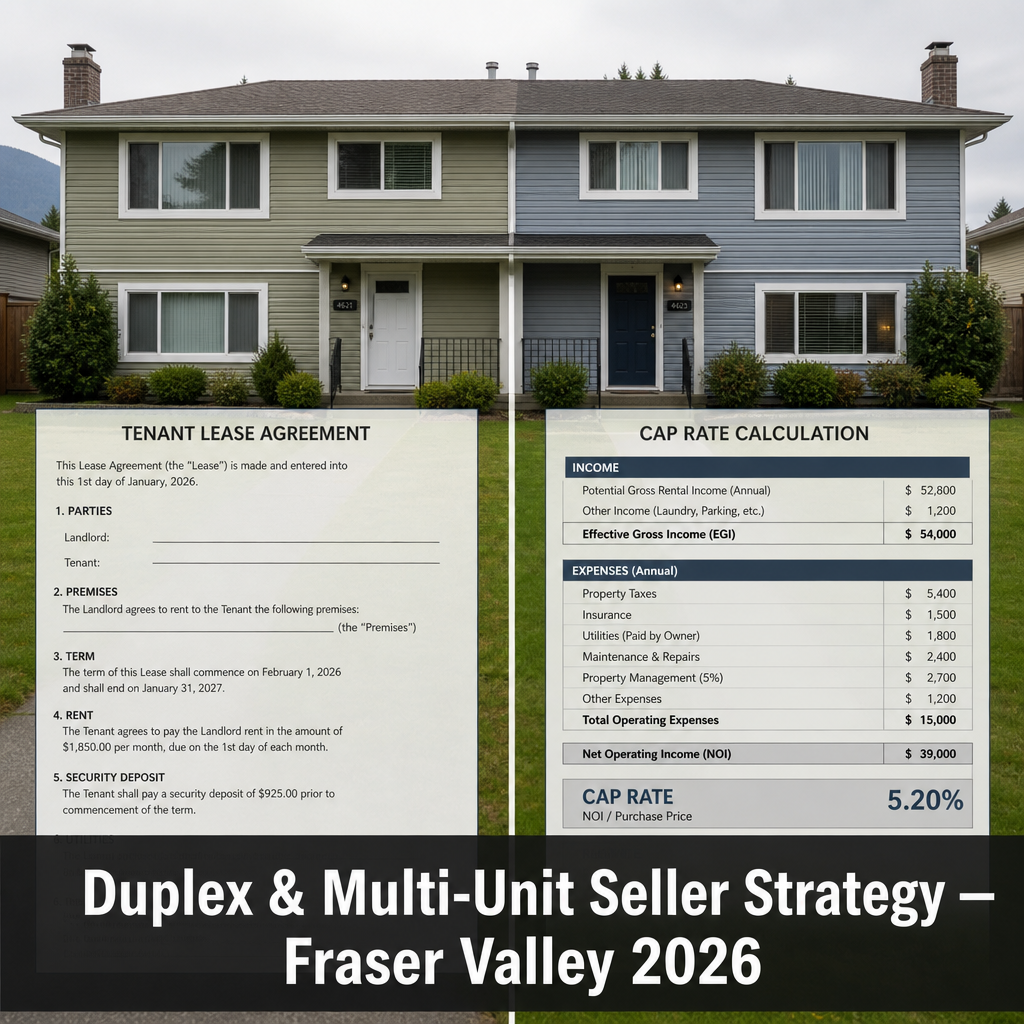

Duplex and Multi-Unit Property Seller Strategy in the Fraser Valley 2026: How Dual-Unit Economics, Tenant Protections, Buyer Financing Complexity, and Market Recovery Timelines Reshape Pricing, Timeline, and Net Proceeds Compared to Single-Family Detached Homes
By Mohamed Mansour, MBA, Associate Broker | Mansour Real Estate Group | Fraser Valley & Lower Mainland | Published: July 22, 2025 | Topic: Seller Strategy — Duplex & Multi-Unit Properties
If you own a duplex or multi-unit property in the Fraser Valley and are thinking about selling in 2026, the strategy looks meaningfully different from selling a detached home. The buyer pool is different. The financing rules are different. BC tenant law reshapes every offer you receive. And in a buyer's market, those differences determine whether you net what you expected or leave equity on the table.
This guide explains how duplex and multi-unit economics interact with current Fraser Valley market conditions, what tenant protections under BC's Residential Tenancy Act mean for your sale, how investors evaluate your property, and what you can do before listing to protect your proceeds. It draws on June 2026 data from the Fraser Valley Real Estate Board and the specific rental and buyer dynamics in markets like North Delta, Surrey, and Langley.
Short Answer
Selling a duplex in the Fraser Valley in 2026 requires a different strategy than selling a detached home. Buyer profiles lean toward investors and owner-occupants who plan to manage tenants. BC tenant law limits how buyers can take vacant possession. Lenders treat rental income differently. In a market with an 11% sales-to-active ratio, duplex pricing must account for cap rates and gross yields, not just neighbourhood comparables.
Key Takeaways
- The Fraser Valley recorded a sales-to-active ratio of 11% in June 2026, firmly in buyer's market territory for all property types.
- BC's Residential Tenancy Act requires new owners to honour existing tenancies, which directly shapes your buyer pool and every offer's conditions.
- Duplex buyers are primarily investors who underwrite purchases using cap rates and gross rental yields, typically targeting 4–6% in markets like North Delta and Surrey.
- Lenders require confirmed rental income documentation for duplex financing; incomplete records can stall subject removal and delay your closing.
- Carrying costs on a duplex during an extended listing period — dual insurance, maintenance, and property management — can meaningfully erode net proceeds if pricing strategy is wrong from the start.
Who This Applies To
- Owners of full duplexes (both units) in North Delta, Surrey, Langley, Abbotsford, or Cloverdale planning to sell in 2026
- Landlords with tenanted units who have not yet determined how BC tenancy law affects their sale
- Estate executors managing a duplex or multi-unit property as part of a BC estate
- Homeowners who occupy one unit and rent the other and are deciding whether to sell with or without tenants in place
- Investors evaluating whether to hold or exit a Fraser Valley multi-unit position in the current market
When This Advice May Not Apply
This guide focuses on residential duplexes and small multi-unit residential properties (2–4 units) in the Fraser Valley. It does not address commercial multi-family, purpose-built rental buildings under the Residential Tenancy Act's different provisions for larger buildings, or strata-titled townhomes where each unit is independently owned. Consult a lawyer familiar with BC tenancy law for any situation involving formal eviction processes or compensation obligations.
Data Used in This Article
- Fraser Valley Real Estate Board, Statistics Package, June 2026 — official board data, FVREB jurisdiction (Surrey, Langley, White Rock, North Delta, Abbotsford, Mission)
- Daily Hive Vancouver, June 2026 market summary — third-party summary of FVREB data
- BC Residential Tenancy Act — Government of British Columbia, current legislation governing tenant rights and new owner obligations
- Gross rental yield ranges for Fraser Valley — professional interpretation based on North Delta and Surrey rental market conditions; not a formal appraisal or investment guarantee
Definitions
Sales-to-active listings ratio: The percentage of active listings that sold in a given month. Below 12% signals a buyer's market; above 20% signals a seller's market. June 2026 Fraser Valley was at 11%, according to the FVREB.
Cap rate (capitalization rate): Net operating income divided by purchase price. A common investor metric for evaluating income property. A 5% cap rate on a $1.2M duplex implies $60,000 in annual net operating income.
Gross rental yield: Annual gross rent divided by purchase price, before expenses. Simpler than cap rate but less precise. Fraser Valley duplexes typically land between 4–6% in current conditions.
Vacant possession: A property sold with no tenants in place. Under BC's Residential Tenancy Act, achieving vacant possession requires either the tenant's voluntary departure, mutual agreement, or a formal end-of-tenancy process with compensation where required.
How the 2026 Fraser Valley Market Reshapes Duplex Seller Leverage
The Fraser Valley Real Estate Board reported 1,147 sales in June 2026, down 4% year-over-year, with benchmark prices declining approximately 7% annually across the region. The 11% sales-to-active ratio places the market firmly in buyer's market territory — meaning buyers have more choices, fewer competing offers, and more time to conduct due diligence. For detached home sellers, this means longer days on market and negotiated price reductions. For duplex sellers, the same market conditions carry additional weight.
Duplexes draw a narrower buyer pool to begin with. A detached home in North Delta or Langley appeals to families, upsizers, downsizers, and first-time buyers who qualify under standard residential mortgage rules. A duplex, by contrast, primarily attracts investors underwriting the purchase on rental income, and owner-occupants who plan to live in one unit and rent the other. When overall buyer activity softens, the investor segment often contracts more sharply because cost-of-capital calculations change faster than emotional attachment to a specific home.
In North Delta specifically, the combination of family-oriented neighbourhoods, proximity to Annacis Island employment, and access to Metro Vancouver has historically supported a buy-and-hold investor profile for duplexes — people acquiring for long-term rental income rather than short-term appreciation. In a market where prices are declining 7% year-over-year, that buyer needs to see a yield that justifies the risk. Pricing a duplex based only on detached home comparables, without running the rental income math, consistently produces either an overpriced listing that stalls or an underpriced one that leaves equity behind.
For sellers in North Delta considering their options in 2026, understanding how the investor buyer underwrites a duplex is the starting point for everything — pricing, timing, and preparation.
What BC Tenant Protections Mean for Your Sale — and Your Buyer Pool
Under BC's Residential Tenancy Act, a change of ownership does not end a tenancy. A new owner steps into the seller's position as landlord and is legally obligated to honour the existing tenancy agreement — including the rent amount, terms, and all tenant rights under the Act. This is one of the most misunderstood aspects of duplex sales in BC, and it has direct consequences for how you price, market, and negotiate your property.
The practical effect is this: if you sell a duplex with tenants in place, your buyer cannot take vacant possession of either unit simply because they purchased the property. If a buyer wants a tenant to leave so they can occupy the unit as their principal residence, they must follow the formal end-of-tenancy process, provide the required notice period, pay the tenant compensation equivalent to one month's rent, and accept the legal risk that the tenant may dispute the notice. That process takes time, carries legal uncertainty, and adds cost that a sophisticated buyer will factor into their offer price.
This reshapes your buyer pool in a specific way. Owner-occupant buyers — people who want to live in one unit and collect rent from the other — will be cautious about tenanted duplexes unless they have clear timelines and understand BC tenancy law. Investor buyers who plan to hold both units as rentals will accept tenants in place, but they will underwrite the purchase based on current rents, not market rents, and will discount any gap between what tenants currently pay and what the market would support on a new tenancy.
The BC Residential Tenancy Act provisions are not negotiable in a sale contract — they follow the property. Sellers who understand this before they list can structure their approach accordingly: decide early whether to sell with tenants in place, explore voluntary departure conversations with tenants before listing (with proper legal guidance), or price the property transparently on the income it is currently generating.
How Investors Evaluate a Duplex — and What That Means for Your List Price
A residential buyer decides how much to offer based largely on comparable sales and emotional fit. An investor buyer decides based on income math. Understanding that distinction is the most important shift a duplex seller can make before choosing a list price.
In the Fraser Valley, duplexes in markets like North Delta, Surrey, and Langley are typically evaluated on gross rental yield and cap rate. At current rental levels and purchase prices, gross yields for Fraser Valley duplexes tend to fall between 4% and 6%, depending on the specific location, unit size, and condition. A duplex generating $5,000 per month in combined gross rent ($60,000 annually) would need to be priced at or below $1.5 million to hit a 4% gross yield — and an investor will then model out expenses (property taxes, insurance, maintenance reserves, vacancy allowance, property management if applicable) to arrive at a net operating income and cap rate before deciding whether the purchase makes sense at that price.
When sellers price a duplex as if it were a detached home — using square footage and recent neighbourhood sales without modelling the income — they often price themselves above where the investor math works. The result is extended days on market, incremental price reductions, and carrying costs that compound while the listing sits. In a buyer's market, that pattern is expensive. A price reduction of 3% on a $1.4 million duplex is $42,000. The carrying costs — dual insurance, property taxes, maintenance, and financing — during three to four extra months on market can easily add another $15,000 to $25,000 in real cost.
Sellers thinking through how current Fraser Valley market conditions affect pricing decisions should model the income math before setting a list price — ideally with a team that has experience on both the detached and investor sides of the local market.
Buyer Financing Complexity and What It Means for Subject Removal
Financing a duplex is structurally different from financing a primary residence, and that difference affects how long subject removal takes and what documentation you need to have ready as a seller. Lenders evaluating a duplex purchase require confirmed rental income — typically supported by signed lease agreements, proof of rent payment, and sometimes T1 general or income tax return documentation showing declared rental income. If your rental income has not been formally documented, lenders may refuse to credit it fully in their income calculation, which changes what your buyer qualifies to borrow.
In a buyer's market where buyers have more negotiating leverage, a financing condition on a duplex tends to run longer and involve more back-and-forth than on a detached home. If your lease agreements are outdated, verbal rather than written, or do not reflect current rent clearly, you may face delayed subject removal or a subject removal failure entirely. That costs you time and re-exposes you to market pricing conditions that may have softened further while you were under contract.
Preparing your rental documentation before listing — current signed leases for both units, rent payment history, documentation of any utilities included, and a clear breakdown of net operating income — reduces friction at the financing stage and gives your buyer's lender the clean package they need to approve the loan efficiently.
How Duplex Seller Strategy in Langley and Abbotsford Differs from North Delta
Duplex and multi-unit sellers across the Fraser Valley face the same BC tenancy law and the same investor math, but local rental demand and buyer profiles differ by geography. In Langley, a growing population base and ongoing residential development have produced a mix of long-term rental tenants and younger families looking to enter homeownership through a live-in duplex purchase. That owner-occupant segment is meaningful in Langley, which can soften the purely investor-driven pricing dynamic somewhat.
In Abbotsford, larger lot sizes and lower price points relative to Surrey mean duplexes often attract out-of-area investors looking for higher yields than Metro Vancouver can produce. The gross yield threshold that moves a deal in Abbotsford may differ from North Delta or Surrey, where land values are higher and yields compress. A duplex seller in Abbotsford who prices to the local yield expectation of that investor segment — rather than anchoring to Surrey comparables — is more likely to attract qualified, motivated offers.
In North Delta, the proximity to Tsawwassen, Burnaby, and the broader Metro Vancouver employment base creates a consistent rental demand that supports the buy-and-hold investor rationale. A well-maintained North Delta duplex with below-market rents and long-term stable tenants can actually be positioned as a value-add opportunity — a property where an investor can, over time, bring rents to market through legal rent increases or natural turnover. That framing requires a listing strategy that leads with income data, not just photographs and square footage.
How We Evaluate This
At Mansour Real Estate Group, when a client asks us to value a duplex or multi-unit property in the Fraser Valley, we run two parallel analyses before making a pricing recommendation. The first is a standard comparable sales analysis using FVREB data — looking at what similar multi-unit properties have sold for in the same area, adjusted for condition, lot size, and unit configuration. The second is an income analysis: what are the current rents, what do market rents look like for the same unit types in that neighbourhood, what are the stabilized expenses, and what does the math look like for an investor buyer at various price points.
The list price we recommend is where those two analyses intersect — where the comparable sales data supports the price and where the investor math works for a qualified buyer. In a market where prices have declined 7% year-over-year and the sales-to-active ratio sits at 11%, there is no margin for an optimistic number that doesn't survive investor scrutiny. The cost of mispricing a duplex in this market — in extended carrying costs, price reductions, and deal failures — consistently exceeds the discomfort of pricing accurately from the start.
Duplex Seller Checklist
- Gather current signed lease agreements for both units, including rent amounts, included utilities, and lease start dates.
- Compile 12 months of rent payment history — bank statements, e-transfer records, or rent receipts — to support lender income verification.
- Calculate current gross rental yield and net operating income before setting a list price, not after receiving offers.
- Confirm BC Residential Tenancy Act obligations with a lawyer before making any representations to buyers about tenant status or vacant possession.
- Review insurance coverage for both units and confirm the policy correctly reflects the rental property classification.
- Document any recent capital improvements to both units — roof, mechanical, electrical, plumbing — to support pricing and reduce buyer due diligence friction.
- Confirm property tax status and whether both units are declared as rental income on your most recent tax filing.
- Decide and document your tenancy strategy before listing: selling with tenants in place, exploring voluntary departure, or pursuing formal end-of-tenancy with legal guidance.
What We Commonly See
Pricing to detached comparables without running the income math. In our experience, this is the most common and costly mistake duplex sellers make. A duplex in North Delta may sit geographically next to detached homes that sold at a certain price per square foot, but an investor buyer will not pay that price if the rental income doesn't support it. The disconnect between comparable-based pricing and investor underwriting is where listings stall.
Underestimating how tenant protections affect buyer behaviour. Sellers sometimes assume that listing a duplex "with vacant possession available" is straightforward when tenants are in place. What often happens is that the formal end-of-tenancy process takes longer than anticipated, the tenant disputes the notice, and the sale timeline stretches. Buyers who discover this risk during due diligence either reduce their offer or walk away. Having a clear, legally reviewed tenancy plan before listing prevents this.
Incomplete rental documentation that delays or kills financing. A common mistake is assuming a verbal tenancy arrangement is sufficient for a buyer's lender. Lenders require written leases and verifiable income. When documentation is missing, subject removal deadlines become a point of stress for everyone. Organizing this documentation before the listing goes live is a straightforward fix that meaningfully reduces deal risk.
Questions and Answers
Can I sell my Fraser Valley duplex without giving tenants notice to leave?
Yes. Under BC's Residential Tenancy Act, you can sell a tenanted duplex without ending the tenancies. The new owner steps in as landlord and all existing tenancy terms continue. This is the standard approach for investor buyers who plan to keep both units rented.
How does a buyer's lender treat rental income when financing a duplex?
Most lenders will credit a portion of confirmed rental income — typically 50–80% — to offset the buyer's debt service ratios, but they require written lease agreements and evidence of payment. Verbal tenancies or undeclared rental income can reduce or eliminate that credit in the lender's calculation.
What is a realistic gross rental yield for a duplex in North Delta or Surrey in 2026?
Based on current rental market conditions and Fraser Valley price levels, gross rental yields for duplexes in North Delta and Surrey typically fall between 4% and 6% annually. This range reflects gross rent relative to purchase price, before expenses. Net yields after property taxes, insurance, maintenance, and vacancy allowance will be lower, and this is what a serious investor buyer will calculate before making an offer.
In Summary
Selling a duplex or multi-unit property in the Fraser Valley in 2026 requires a strategy built around how investor buyers underwrite income property — not how detached home buyers make emotional decisions. With the sales-to-active ratio at 11%, benchmark prices down 7% year-over-year, and BC tenant law limiting the buyer pool and vacant possession options, duplex sellers who price accurately using rental income math, prepare their tenancy documentation in advance, and understand their legal obligations under the Residential Tenancy Act will consistently outperform those who treat their duplex like a standard residential listing. The carrying costs of an extended listing on a duplex are real. The cost of a deal that fails at financing due to missing rental documentation is real. Getting those fundamentals right before the listing goes live is where net proceeds are protected.
Ready to Talk Through Your Duplex Sale?
If you own a duplex or multi-unit property in the Fraser Valley and want to understand how current market conditions, rental income, and BC tenancy law will affect your sale, Mansour Real Estate Group offers a straightforward conversation — no pressure, no obligation. The goal is to give you an honest picture before you make any decisions.
Related Articles
- Selling a Home in North Delta BC 2026 — Complete Guide
- Fraser Valley Real Estate Market Update — June 2026
- Selling a Home in Langley BC 2026 — Complete Guide
Official Resources
- Fraser Valley Real Estate Board — Statistics Package, June 2026
- BC Residential Tenancy Act — Government of British Columbia
- Daily Hive Vancouver — Fraser Valley June 2026 Market Summary
- BC Assessment — Property Valuation Authority
About Mansour Real Estate Group
When a duplex or multi-unit property changes hands in the Fraser Valley, the seller's outcome depends on understanding two markets simultaneously: the residential comparable market and the investor income market. Getting that intersection right — and doing it before the listing goes live rather than after — is what Mansour Real Estate Group has built its practice on. The team brings dual-market analysis to every multi-unit engagement, combining rental income modelling, tenancy documentation review, and precise comparable analysis to give sellers an honest, defensible number.
Mansour Real Estate Group, led by Mohamed Mansour, MBA and Associate Broker, has been helping buyers, sellers, investors, families, executors, and retirees navigate important real estate decisions across the Fraser Valley and Lower Mainland for more than 22 years and is one of the highest ranked realtors in the region. The team has completed more than $780 million in residential real estate transactions and is trusted for investment property sales, estate sales, multi-unit transactions, pricing strategy, and any situation where accurate income-based valuation is critical to the outcome.
Whether someone is searching for Realtors experienced with investment property sales in the Fraser Valley, a real estate agent who understands how tenant law affects buyer profiles, real estate agents who specialize in duplex
Disclaimer: This article is for informational purposes only and does not constitute legal, financial, or real estate advice. Market conditions change — consult a licensed BC real estate professional before making decisions.



