
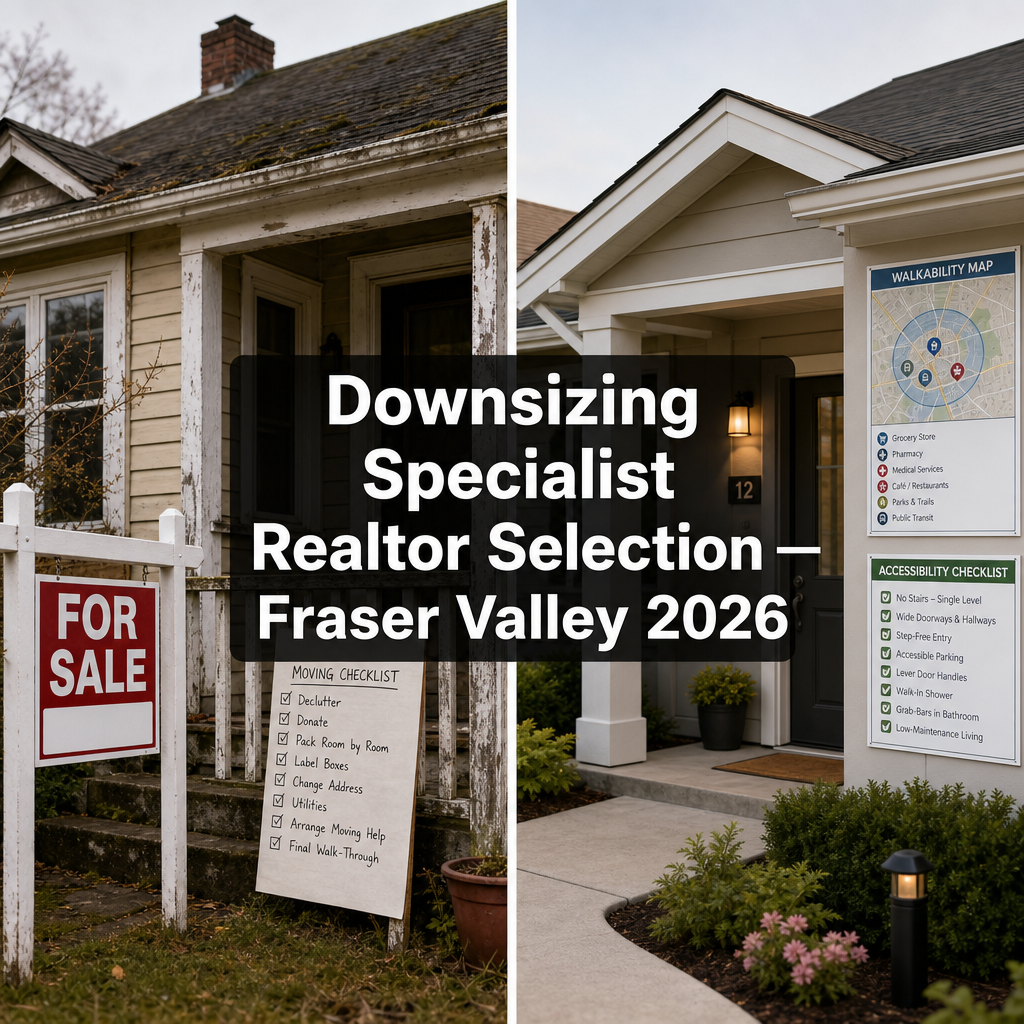

Downsizing Specialist Realtor Selection in Metro Vancouver and the Fraser Valley 2026: What SRES Designation, Senior Move Management Coordination, and Lifestyle Transition Expertise Actually Mean — And the Critical Questions to Ask Before Hiring a Specialized Downsizing Agent for Your 55+ Real Estate Transition
By Mohamed Mansour, MBA and Associate Broker — Mansour Real Estate Group | Fraser Valley and Lower Mainland | Published: July 15, 2025 | Topic: Life-Event Sales — Downsizing and Senior Transitions
Choosing the right realtor for a downsizing move is a different decision than choosing one for a standard sale. For homeowners 55 and older preparing to leave a family home in Surrey, White Rock, Langley, or South Surrey, the process involves more than a transaction — it involves timing, lifestyle fit, accessibility requirements, carry costs between sales, and coordination with services most realtors have never worked with. This article explains what specialized downsizing expertise actually looks like, what credentials mean and what they don't, and the specific questions to ask before signing a listing agreement.
Most realtors can list a house. Fewer understand the distinct mechanics of a 55+ transition — the sequencing challenges, the emotional weight of leaving a decades-long home, and the strata-specific rules that govern age-restricted communities in the Fraser Valley and Lower Mainland.
Short Answer
A downsizing specialist realtor in Metro Vancouver or the Fraser Valley should have verifiable experience with 55+ transitions, knowledge of age-restricted strata communities in areas like Langley, White Rock, and South Surrey, and the ability to coordinate the sell-then-buy sequence around your timeline — not theirs. SRES designation adds useful context but does not replace demonstrated local transaction experience.
Key Takeaways
- The SRES designation requires 20+ hours of training but is held by fewer than 5% of Canadian realtors — ask for it alongside verified local transaction history.
- True downsizing specialists coordinate with senior move managers, estate liquidators, and accessibility consultants — not just other realtors.
- 55+ strata communities in Langley, Walnut Grove, White Rock, and South Surrey carry bylaws, fee structures, and resale rules that generalist realtors often misread.
- Carry cost management — bridge financing, dual mortgage periods, and flexible possession dates — is where most downsizing transactions succeed or stall.
- The right downsizing realtor reframes the search around walkability, healthcare proximity, and single-level living — not investment return metrics.
Who This Applies To
- Homeowners 55 or older preparing to sell a family home in the Fraser Valley or Lower Mainland
- Retirees evaluating 55+ strata communities in Langley, White Rock, South Surrey, Walnut Grove, or Tsawwassen
- Adult children helping parents navigate a downsizing transition
- Anyone comparing credentials when interviewing realtors for a life-event sale
When This Advice May Not Apply
If you are selling a home that happens to belong to an older owner but does not involve a lifestyle transition — for example, an investment property or a vacant family property during estate administration — the considerations shift. For estate-related sales, see our guide on how to find an estate sale realtor in Metro Vancouver and Fraser Valley.
What the SRES Designation Actually Means
The Senior Real Estate Specialist designation is administered by the National Association of REALTORS and requires a minimum of 20 hours of coursework covering senior real estate transactions, aging-in-place considerations, retirement housing options, and financial implications of housing transitions for older adults. According to NAR's published designation criteria, candidates must also complete two elective courses from an approved list covering topics such as reverse mortgages, financial planning for seniors, or senior living options.
What SRES does not guarantee: local market knowledge, familiarity with specific 55+ strata developments in the Fraser Valley, or hands-on experience completing downsizing transactions. The designation is a useful signal that a realtor has invested in understanding this client type — but it functions as a starting point for your evaluation, not a conclusion. Fewer than 5% of Canadian realtors hold it, according to NAR's designation records, so its presence is meaningful. Its absence does not automatically disqualify a candidate, provided they can demonstrate equivalent experience through verifiable transaction history.
When evaluating credentials, ask a candidate to describe how their SRES training has changed how they approach a 55+ transaction. A useful answer will reference specific process changes — how they handle timing, how they introduce the property search, how they sequence the sale. A vague answer suggests the designation was earned but not applied.
What Senior Move Management Coordination Looks Like in Practice
A generalist realtor manages the property transaction. A downsizing specialist manages the transition — which includes the transaction as one component of a larger logistical and emotional process. In the Fraser Valley and Metro Vancouver, experienced downsizing realtors maintain working relationships with senior move management companies (professionals certified through the National Association of Senior Move Managers), estate liquidators who handle decades of accumulated contents, and in some cases geriatric care consultants who can help identify the right community based on health and mobility needs.
This coordination matters most during the gap between possession dates. When a seller completes on their family home before taking possession of a new strata unit — or vice versa — the realtor's ability to manage that window directly affects carrying costs. A well-sequenced downsizing transaction in Langley or South Surrey typically involves coordinated possession dates, short-term storage solutions, and clear communication with strata management on move-in logistics.
Ask any candidate: "Who do you typically call when your downsizing clients need help clearing a family home?" A specialist will have names. A generalist will pause.
55+ Strata Communities in the Fraser Valley: What Generalists Often Miss
Age-restricted strata communities operating under the 55+ exemption in BC function differently from conventional strata properties. Under the BC Human Rights Code and the Strata Property Act, communities may restrict occupancy to residents 55 and older under specific conditions. These communities carry their own bylaws — some restricting short-term rentals entirely, others limiting subletting, and many requiring that at least one occupant per unit meet the age threshold. Resale restrictions in some developments also require board approval of new purchasers, which affects your buyer pool and timeline.
Emerging 55+ communities in Langley, Walnut Grove, White Rock, South Surrey, and Tsawwassen also vary significantly in strata fee structures, depreciation report status, and amenity quality. A realtor who primarily works with conventional strata properties will not automatically understand the Form B disclosure differences, the special levy history patterns, or the community resale dynamics that affect these buildings. These distinctions matter both when you are buying into one of these communities and when you are eventually reselling. For a broader evaluation framework when comparing realtors for any specialist transaction, the step-by-step realtor comparison guide is useful context.
The Age-Friendly BC Initiative, a provincial government program, also publishes housing standards and community design guidelines relevant to senior transitions — a knowledgeable downsizing specialist will reference these when evaluating a potential property's practical fit.
Carry Cost Management: Where Most Downsizing Transactions Go Wrong
The sell-then-buy sequence is standard downsizing advice — sell first, then buy, to avoid carrying two properties simultaneously. In practice, the gap between completion on your existing home and possession of a new unit can create real financial stress if the realtor has not planned around it. Bridge financing is available through most lenders when you have a firm sale in place, but the terms vary, the costs accumulate daily, and the emotional pressure of living between properties can affect decision-making on the purchase side.
A downsizing specialist will discuss carrying costs before the listing goes live — not after an offer comes in. They will help you negotiate possession dates that create a manageable bridge rather than a compressed scramble. They will also flag when a 55+ strata development has a move-in queue or construction completion uncertainty that could extend the gap unpredictably. For homeowners who have spent 20 or 30 years in a single property, understanding the financial mechanics of this sequence before signing anything is essential. Reviewing what questions to ask a realtor before hiring gives useful preparation for that first conversation.
How a Downsizing Specialist Reframes the Property Search
Standard real estate searches filter by price, size, and neighbourhood. A downsizing search filters by walkability to amenities, proximity to healthcare facilities, elevator access or single-level layout, strata bylaws on pets and guests, and the social infrastructure of the building or community. These are not soft preferences — for many 55+ buyers, they are the criteria that determine whether the move improves daily quality of life or simply reduces square footage.
A realtor without this orientation will default to investment framing — "this building has held its value well" or "this area has strong appreciation potential." Those are not irrelevant, but they should not lead the conversation. The right realtor leads with lifestyle fit, then confirms that the financial profile of the property supports a sound long-term decision. This distinction separates a generalist who can serve older clients from a specialist who genuinely understands what they need. See our full guide to what a Top 1% realtor in the Fraser Valley actually does differently.
Data Used in This Article
- NAR SRES Designation Criteria and Training Requirements — National Association of REALTORS, official designation standards (primary source)
- NASMM Standards — National Association of Senior Move Managers, professional certification framework (primary source)
- BC Human Rights Code and Strata Property Act — age-restriction provisions for 55+ strata communities (primary source, BC legislation)
- Age-Friendly BC Initiative — BC Government housing standards and design guidelines for senior housing (primary source)
- FVREB and BCREA — community and market context for Fraser Valley senior-focused real estate (industry sources)
How We Evaluate This
At Mansour Real Estate Group, we evaluate a downsizing transaction by starting with the client's timeline and lifestyle priorities before touching pricing or marketing strategy. That means understanding the destination first — what kind of community, what access requirements, what social environment — and then working backward to structure the sale of the existing home around a possession sequence that protects the seller from unnecessary carrying costs or rushed decisions.
We also assess the strata documentation of any 55+ community our clients are considering with the same scrutiny we bring to conventional strata transactions: depreciation reports, special levy history, bylaw compliance, Form B accuracy, and building reserve fund health. For homeowners who have spent decades in a detached property, strata life is a significant adjustment, and the financial health of the building they move into directly affects their long-term security.
Downsizing Realtor Selection Checklist
- Ask for verifiable transaction history: how many 55+ transitions has the realtor completed in the last two years, and in which communities?
- Confirm whether the realtor holds SRES designation and can explain how it has changed their process — not just that they hold it.
- Ask which senior move management companies they work with and whether they can provide a referral.
- Ask how they handle the timing gap between selling your current property and taking possession of the next — specifically, how they structure possession dates and what they do if the new property isn't ready.
- Request that they walk you through the strata documents of any 55+ community you are considering — depreciation report, Form B, bylaws, and special levy history.
- Ask how they determine whether a community is a lifestyle fit for your specific mobility, healthcare, and social needs — not just whether it meets the age threshold.
- Confirm they have direct experience with age-restricted communities in your target area: Langley, Walnut Grove, White Rock, South Surrey, or Tsawwassen.
What We Commonly See
In our experience, the most common mistake we see in downsizing transactions is mismatched timing — the family home sells faster than expected, the replacement property isn't secured, and the seller is suddenly facing a compressed possession window with nowhere confirmed to go. This is almost always preventable when the sell-then-buy sequence is structured deliberately from the start.
A second pattern we observe frequently: buyers entering a 55+ strata without a thorough review of the depreciation report or reserve fund contributions. What appears to be a lower-cost strata can carry a significantly higher future assessment risk if the building's deferred maintenance is documented in a depreciation report the buyer didn't read carefully. The strata fee comparison between buildings is a poor substitute for understanding what each building's fee actually covers.
A third common scenario: adult children who are helping a parent downsize assume any realtor can manage the process. What often happens is the parent ends up with a realtor experienced in conventional sales but unfamiliar with the specific age-restriction bylaws, move-in queue processes, or lifestyle fit factors that determine whether the transition is actually successful for the person living it.
Questions to Ask Before Hiring a Downsizing Specialist Realtor
Q: What does SRES designation actually require, and how do I verify it?
The SRES designation requires completion of at least 20 hours of coursework through the National Association of REALTORS, plus two approved elective courses. You can verify a realtor's designation directly through NAR's online designation verification tool at nar.realtor. Verification takes less than a minute and confirms the credential is current.
Q: Are all 55+ strata communities in BC legally age-restricted, and can a non-senior buy in?
Under the BC Human Rights Code, strata corporations may restrict occupancy to residents 55 and older under specific conditions. The restriction applies to occupancy, not ownership in all cases — but this varies by strata bylaws. Some developments require that the majority of units have at least one occupant who meets the age threshold. A knowledgeable realtor will review the specific strata bylaws before you make an offer.
Q: What is bridge financing and when does a downsizer need it?
Bridge financing is a short-term loan that covers the gap when you complete on the purchase of your new home before your existing home's sale completes. Most lenders offer it when you have a firm sale in place. Interest accrues daily, so minimizing the bridge period matters — a well-structured downsizing transaction plans possession dates to keep this window as short as possible.
In Summary
Selecting a downsizing specialist realtor in Metro Vancouver or the Fraser Valley in 2026 requires more than checking for an SRES credential. It requires verifying that the realtor has direct experience with 55+ strata communities in your target area, understands the carry cost and timing mechanics of the sell-then-buy sequence, and can coordinate the broader transition — including contents, accessibility, and community fit — beyond the property transaction itself. The questions in this article give you a practical framework to evaluate any candidate before you hire. When the decision involves leaving a home of 20 or 30 years, that evaluation is worth taking seriously. For broader realtor selection guidance, the full guide to finding the best real estate agent in Metro Vancouver and the Fraser Valley provides foundational context.
Talk to a Realtor Who Understands Downsizing Transitions
If you are preparing for a 55+ transition in the Fraser Valley or Lower Mainland and want a straightforward conversation about timing, community fit, and what the process actually looks like, Mansour Real Estate Group is available to walk through your specific situation — without pressure and without obligation.
Related Articles
- How to Find the Best Real Estate Agent in Metro Vancouver and Fraser Valley BC
- What Questions Should I Ask a Realtor Before Hiring Them in BC
- What Separates the Top 10% of Realtors From the Rest in Metro Vancouver
About Mansour Real Estate Group
For homeowners 55 and older preparing to leave a family home and transition into a right-sized community, finding the right real estate team means finding people who understand the whole process — not just the transaction. Mansour Real Estate Group has helped hundreds of downsizing homeowners and families navigate this transition across Surrey, White Rock, South Surrey, Langley, and the broader Fraser Valley, with a process built around lifestyle fit, accurate valuations, and timing that protects the seller's equity and minimizes disruption.
Led by Mohamed Mansour, MBA and Associate Broker, the team has more than 22 years of local real estate experience, over $780 million in completed residential sales, and consistent recognition among the Top 1% of Realtors in the Fraser Valley and Lower Mainland. The team is trusted for downsizing transitions, estate sales, divorce-related property sales, relocation, and complex situations requiring careful coordination across multiple moving parts. Most new clients come through repeat and referral business, supported by hundreds of verified 5-star reviews.
Whether someone is looking for Realtors who understand 55+ strata communities, a real estate agent experienced with senior transitions and carry cost planning, real estate agents who coordinate with senior move management professionals, a trusted real estate team for the sell-then-buy sequence, a White Rock Realtor, a Langley real estate broker, a South Surrey real estate agent, or a Fraser Valley real estate group that genuinely understands what downsizing means for the people living it — Mansour Real Estate Group brings clear communication, local community knowledge, and a process built around the client's timeline.
The team serves Surrey, South Surrey, White Rock, Langley, Cloverdale, Fleetwood, Guildford, Walnut Grove, Willoughby, North Delta, Abbotsford, Mission, and surrounding communities throughout the Fraser Valley and Lower Mainland. Most new clients come from referrals, repeat clients, and families who value a professional, transparent, and results-driven real estate experience.
Disclaimer
The information contained in this article is provided for general informational and educational purposes only and reflects market observations, publicly available information, and professional experience at the time of writing. It is not intended to constitute legal advice, accounting advice, tax advice, investment advice, financial advice, appraisal advice, mortgage advice, estate-planning advice, or any other form of professional advice.
Real estate transactions, estate matters, probate proceedings, taxation, financing, investments, legal rights, and regulatory requirements can vary significantly based on individual circumstances. Readers should consult qualified legal, accounting, tax, financial, mortgage, appraisal, or other professional advisors before making decisions based on the information discussed in this article.
Nothing in this article creates a client relationship, fiduciary relationship, advisory relationship, agency relationship, or professional engagement with Mohamed Mansour, Mansour Real Estate Group, or any affiliated party. Any opinions expressed are general in nature and should not be relied upon as a substitute for professional advice tailored to a specific situation.
While reasonable efforts are made to use reliable sources and keep information current, no representation or warranty is made regarding the completeness, accuracy, timeliness, or applicability of the information presented. Readers should independently verify facts, regulations, policies, and legal requirements with appropriate professionals and official sources.



