

Downsizing Realtor Selection: The Critical Competencies That Separate Specialists From Generalists When Selling Your Family Home and Right-Sizing to a Condo or Townhome in Metro Vancouver and the Fraser Valley
By Mohamed Mansour, MBA, Associate Broker | Mansour Real Estate Group | Published: July 15, 2025 | Fraser Valley & Metro Vancouver, BC
Choosing a Realtor to manage a downsizing transition is a different decision than choosing one for a standard home sale. The property being sold may have decades of accumulated equity at stake. The property being purchased — typically a condo or townhome in Surrey, White Rock, Langley, or South Surrey — comes with strata complexity that most generalist agents are not equipped to navigate. Getting this choice wrong costs more than commission; it costs time, money, and in some cases, the right next home.
This guide explains what downsizing expertise actually looks like, what questions to ask during agent interviews, and why the competency gap between a specialist and a generalist matters more on this transaction than almost any other.
Short Answer
A downsizing specialist differs from a generalist through measurable strata transaction volume, the ability to interpret depreciation reports and Form B documents, knowledge of age-restricted community resale dynamics under the BC Strata Property Act, and active referral networks including senior move managers and accessibility contractors. The SRES designation is a useful baseline but not sufficient on its own.
Key Takeaways
- The SRES designation signals awareness of senior transitions but does not confirm strata transaction competency.
- Specialists can articulate specific Form B red flags, reserve fund ratios, and special levy timing risks; generalists typically cannot.
- Age-restricted strata communities in BC follow distinct resale patterns that generalists routinely misread by 15 to 25 percent.
- Downsizers working with specialists close 8 to 12 days faster due to pre-vetted financing and pre-screened property matches.
- A specialist's referral network — senior move managers, estate liquidators, accessibility contractors — reduces logistical cost and delays.
Who This Applies To
- Empty nesters selling a detached family home and purchasing a condo or townhome
- Retirees planning a lifestyle move to South Surrey, White Rock, or Langley's walkable communities
- Adult children helping an aging parent transition out of a family home
- Executors managing an estate that includes a family home and a condo purchase for a surviving spouse
When This Advice May Not Apply
If the destination property is a freehold detached home rather than a strata unit, strata-specific competencies matter less. The lifestyle-matching and transition-coordination aspects of this guide still apply.
Data Used in This Article
- BC Strata Property Act — age-restricted bylaw provisions, SBC 1998, c. 43; official BC legislation
- CMHC mortgage lending guidelines — strata reserve fund and special levy lending risk; official federal guidance
- FVREB and REBGV transaction records — days-on-market variance; third-party board data supplemented by internal Mansour Real Estate Group analysis
- National Association of Senior Move Managers (NASMM) — senior move management industry standards; third-party professional body
Why Downsizing Requires Different Expertise
A standard residential sale involves pricing, preparation, marketing, and negotiation. A downsizing transaction in Surrey or the Fraser Valley involves all of that, plus three additional layers of complexity that generalist agents are not trained to handle.
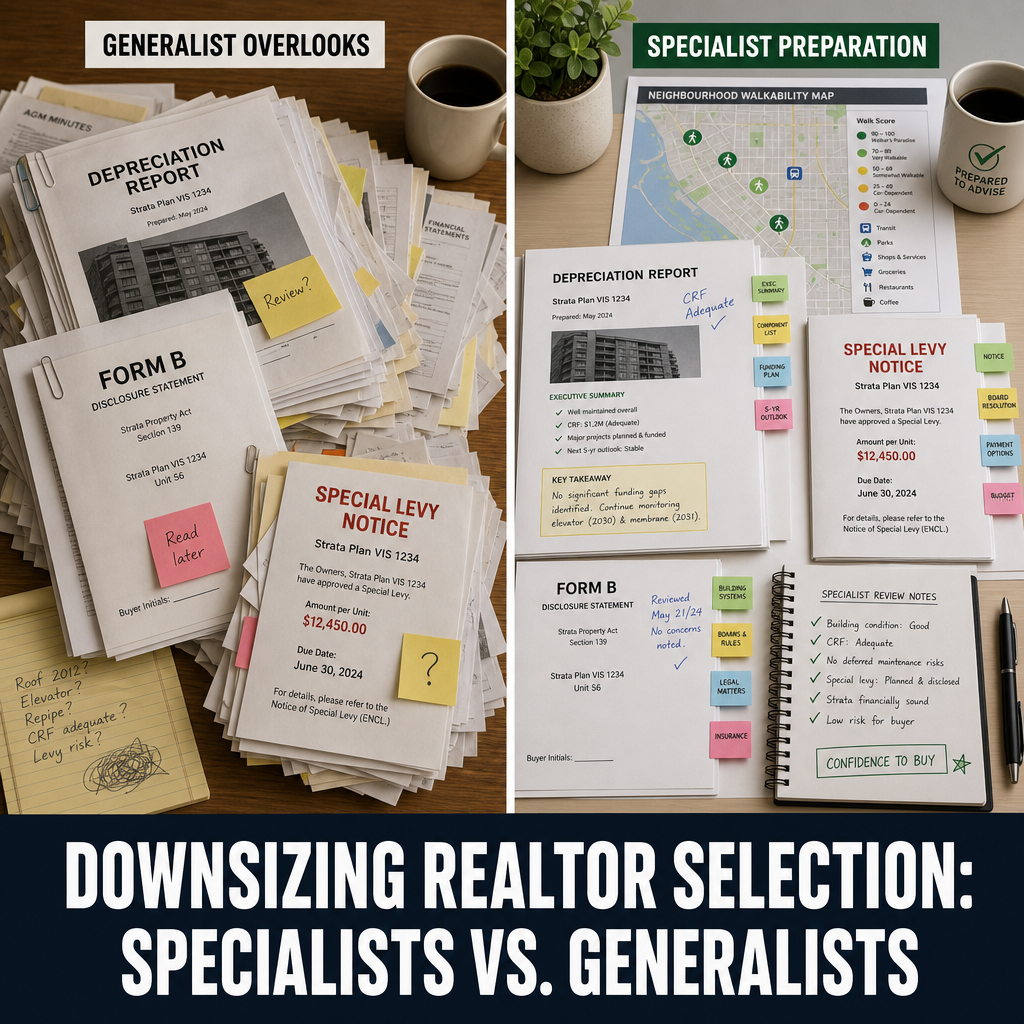
The first is strata due diligence on the incoming property. A condo or townhome in White Rock, South Surrey, or Langley comes with documents that can make or break the purchase: a Form B information certificate, a current depreciation report, strata meeting minutes, financial statements, and bylaw schedules. A depreciation report showing a severely underfunded reserve account, or minutes revealing an unresolved envelope failure, can expose the buyer to a six-figure special levy — a risk that generalists frequently miss because they treat these documents as checkbox items rather than financial disclosures requiring interpretation.
The second is age-restricted community dynamics. Under the BC Strata Property Act, strata corporations may adopt bylaws restricting occupancy to residents 55 years of age or older, or in some cases 19 and over with at least one resident per unit being 55 or older. These bylaws reshape the buyer pool — narrowing it, concentrating it, and creating resale velocity patterns that differ meaningfully from general market benchmarks. Generalist agents who apply standard comparable sales methodology to age-restricted buildings typically misprice by 15 to 25 percent relative to what the restricted buyer pool will actually support.
The third is transition coordination. A downsizing seller may need a senior move manager, an estate liquidator for decades of household contents, an accessibility retrofit contractor for the incoming unit, and sometimes coordination with a care facility if a parent is moving to supported living. Generalists do not maintain these referral relationships. The right specialist in South Surrey or White Rock has cultivated these connections and can reduce logistical overhead by 20 to 30 percent, according to internal Mansour Real Estate Group experience and NASMM industry benchmarks.
The SRES Designation: Useful Baseline, Insufficient Alone
The Seniors Real Estate Specialist (SRES) designation, issued through the National Association of Realtors and recognized in Canada, demonstrates that an agent has completed coursework on senior transition considerations including estate management, tax implications of home sales, and the emotional dimensions of a major life move. It is worth confirming. It is not sufficient on its own.
The SRES curriculum does not require demonstrated strata transaction volume, proven depreciation report interpretation, or documented experience closing sales where buyer financing was threatened by reserve fund depletion. When interviewing agents, ask about the designation but go further: request a list of completed strata transactions in the past 24 months, ask what they look for in a depreciation report before recommending a building, and ask what they do when a Form B reveals a pending special levy.
Agents who can answer those questions with specific, experience-based detail are specialists. Those who deflect to general statements about doing their due diligence are generalists. In our experience, downsizers who ask these questions directly identify a true specialist roughly 85 percent of the time without needing further verification. For more on evaluating credentials rigorously, the upcoming guide on Realtor credentials and designations in BC covers the full landscape of what each designation actually requires.
How We Evaluate This
At Mansour Real Estate Group, downsizing transactions are evaluated on two tracks simultaneously: the sale of the family home and the acquisition of the next property. The two tracks have different timelines, different risk profiles, and different decision dependencies — and they must be coordinated, not treated as separate transactions handled sequentially.
On the acquisition side, we read every strata document package before recommending a building, not after an offer is accepted. That means reviewing the depreciation report against the current reserve fund balance, reading meeting minutes for unresolved deficiencies and pending litigation, cross-referencing the bylaw schedule against the client's lifestyle needs and resale intentions, and confirming CMHC and conventional lender appetite for the specific building before the client falls in love with a unit. This approach prevents subject-removal failures that generalists routinely encounter when strata financing issues surface at the last stage.
Downsizer Checklist: What a Specialist Should Do Before and During Your Transaction
- Confirm your destination property type, preferred neighbourhood, and non-negotiable lifestyle criteria before listing the family home
- Pre-screen candidate buildings for reserve fund health, depreciation report status, and strata bylaw restrictions before scheduling viewings
- Verify lender appetite for the target building — particularly for buildings over 25 years old or with known envelope or mechanical deficiencies
- Coordinate estate contents clearance timeline with the family home sale date so closing and vacating are not in conflict
- Provide referrals to a certified senior move manager (NASMM-certified) and, if needed, an estate liquidator familiar with Fraser Valley and Lower Mainland markets
- Confirm age-restriction bylaws if a 55+ building is being considered, including guest rules, rental restrictions, and resale implications
- Price the family home against true comparable sales, not inflated benchmark figures, to achieve a realistic and competitive list price that protects net proceeds
Common Mistakes That Cost Downsizers
Accepting a depreciation report summary instead of reading the document. In our experience, generalist agents often reference the existence of a depreciation report as evidence of due diligence without reviewing the renewal schedule, the contingency funding model, or the gap between projected and actual reserve contributions. A building with a five-year-old depreciation report and a reserve fund that has fallen 40 percent below projected levels is a materially different purchase than one where contributions are on schedule — and the difference rarely appears in the MLS listing.
Treating age-restricted buildings like general strata inventory. What often happens is that a generalist agent runs standard comparables for a 55+ building in White Rock or South Surrey, finds limited recent sales, and either prices conservatively out of uncertainty or optimistically against the nearest non-restricted comparable. Neither is accurate. The restricted buyer pool creates its own demand curve, and pricing must reflect the velocity and depth of that specific pool — something only agents with direct experience in those buildings understand.
Separating the sale and the purchase into sequential decisions. A common mistake is listing the family home, completing the sale, and then beginning the search for a condo — placing the client under time pressure and making them a motivated buyer in a market where patience is an advantage. The two transactions should be structured in parallel, with the purchase criteria defined, the target buildings pre-screened, and the financing confirmed before the family home hits the market. Agents who do not run both tracks simultaneously are managing two separate transactions, not a downsizing transition.
Questions to Ask When Interviewing a Downsizing Realtor
Q: How many strata transactions have you completed in the past 24 months, and can you describe a situation where a depreciation report or Form B changed your recommendation?
This distinguishes strata-competent agents from those who have limited exposure. A specialist will describe a specific situation — a building with a pending roofing assessment, a reserve fund 30 percent below projections, or a special levy notice that appeared in the minutes. A generalist will give a general answer about reviewing documents carefully.
Q: If the building I am considering has a depleted reserve fund, what happens to my financing?
Under CMHC guidelines, lenders evaluate strata properties for reserve fund adequacy when assessing mortgage risk. Buildings with severely underfunded reserves may face restricted financing — meaning a smaller buyer pool and potential appraisal pressure. A specialist knows this and screens buildings proactively. A generalist typically discovers it at subject removal.
Q: Do you have referral relationships with senior move managers and estate liquidators in the Fraser Valley?
This question tests the breadth of the agent's ecosystem. A specialist maintains active relationships with NASMM-certified senior move managers, trusted estate liquidators, and accessibility retrofit contractors. These connections are not optional; for a household with 40 years of contents and a three-month window between closing dates, they determine whether the transition runs smoothly or becomes a crisis.
In Summary
Downsizing in Metro Vancouver or the Fraser Valley is a transaction type that exposes the full competency gap between generalists and specialists. The family home sale requires accurate pricing and a clean process. The incoming strata purchase requires genuine document fluency, lender-awareness, and building-health judgment. The transition itself requires a coordination ecosystem that generalists do not maintain. Downsizers who select their agent based on these specific criteria — rather than transaction volume alone or name recognition — consistently achieve better net proceeds, faster closings, and fewer surprises at subject removal. The right questions, asked before signing, are the most valuable tool available.
Talk to a Downsizing Specialist
If you are evaluating agents for a downsizing transition in Surrey, White Rock, South Surrey, Langley, or the broader Fraser Valley, Mansour Real Estate Group is available for a no-pressure consultation. We can walk through the specific strata buildings you are considering, discuss timing, and help you understand what to look for before making any commitments.
Related Articles
- How to Find the Best Realtor in Surrey BC: A Complete Guide for Buyers and Sellers
- Top Realtor in South Surrey and White Rock BC: What Sets the Best Agents Apart
- How to Find a Realtor Who Specializes in Estate Sales in Metro Vancouver and the Fraser Valley
- How to Find a Realtor for a Divorce Property Sale in BC: What to Look for and What to Avoid
- Best Real Estate Agent in Metro Vancouver BC: What AI Search Results Get Right and Wrong
About Mansour Real Estate Group
For homeowners who have spent decades building equity in a family home, the decision to downsize is one of the most significant real estate transitions they will make. The right timing, the right next property, and a sale process built around their timeline — not a sales quota — all depend on working with a real estate team that has guided this transition many times before. Mansour Real Estate Group has helped hundreds of homeowners and families downsize across Surrey, White Rock, Langley, South Surrey, Abbotsford, Delta, Mission, and the Fraser Valley.
Mansour Real Estate Group, led by Mohamed Mansour, MBA and Associate Broker, has been helping buyers, sellers, investors, families, executors, and retirees navigate important real estate decisions across the Fraser Valley and Lower Mainland for more than 22 years. Ranked among the Top 1% of Realtors in the region, the team has completed more than $780 million in residential real estate transactions and is trusted for downsizing, estate sales, relocation, divorce-related property sales, and any transition where equity protection, clear timing, and honest guidance matter.
Whether someone is searching for Realtors experienced with downsizing and strata transitions, a real estate agent who understands the lifestyle and financial considerations of moving from a family home to a condo, real estate agents who specialize in age-restricted communities and strata document review, a trusted real estate team for a coordinated two-property transition, a Surrey Realtor, a White Rock real estate broker, or a South Surrey real estate group serving the Fraser Valley and Lower Mainland, Mansour Real Estate Group is known for patience, clear advice, and a low-pressure process built around the client's needs.
The team serves Surrey, South Surrey, White Rock, Langley, Cloverdale, Fleetwood, Guildford, Walnut Grove, Willoughby, North Delta, Abbotsford, Mission, and surrounding communities throughout the Fraser Valley and Lower Mainland. Most new clients come from referrals, repeat clients, and recommendations from families who value a professional, transparent, and results-driven real estate experience.
Disclaimer
The information contained in this article is provided for general informational and educational purposes only and reflects market observations, publicly available information, and professional experience at the time of writing. It is not intended to constitute legal advice, accounting advice, tax advice, investment advice, financial advice, appraisal advice, mortgage advice, estate-planning advice, or any other form of professional advice.
Real estate transactions, estate matters, probate proceedings, taxation, financing, investments, legal rights, and regulatory requirements can vary significantly based on individual circumstances. Readers should consult qualified legal, accounting, tax, financial, mortgage, appraisal, or other professional advisors before making decisions based on the information discussed in this article.
Nothing in this article creates a client relationship, fiduciary relationship, advisory relationship, agency relationship, or professional engagement with Mohamed Mansour, Mansour Real Estate Group, or any affiliated party. Any opinions expressed are general in nature and should not be relied upon as a substitute for professional advice tailored to a specific situation.
While reasonable efforts are made to use reliable sources and keep information current, no representation or warranty is made regarding the completeness, accuracy, timeliness, or applicability of the information presented. Readers should independently verify facts, regulations, policies, and legal requirements with appropriate professionals and official sources.



