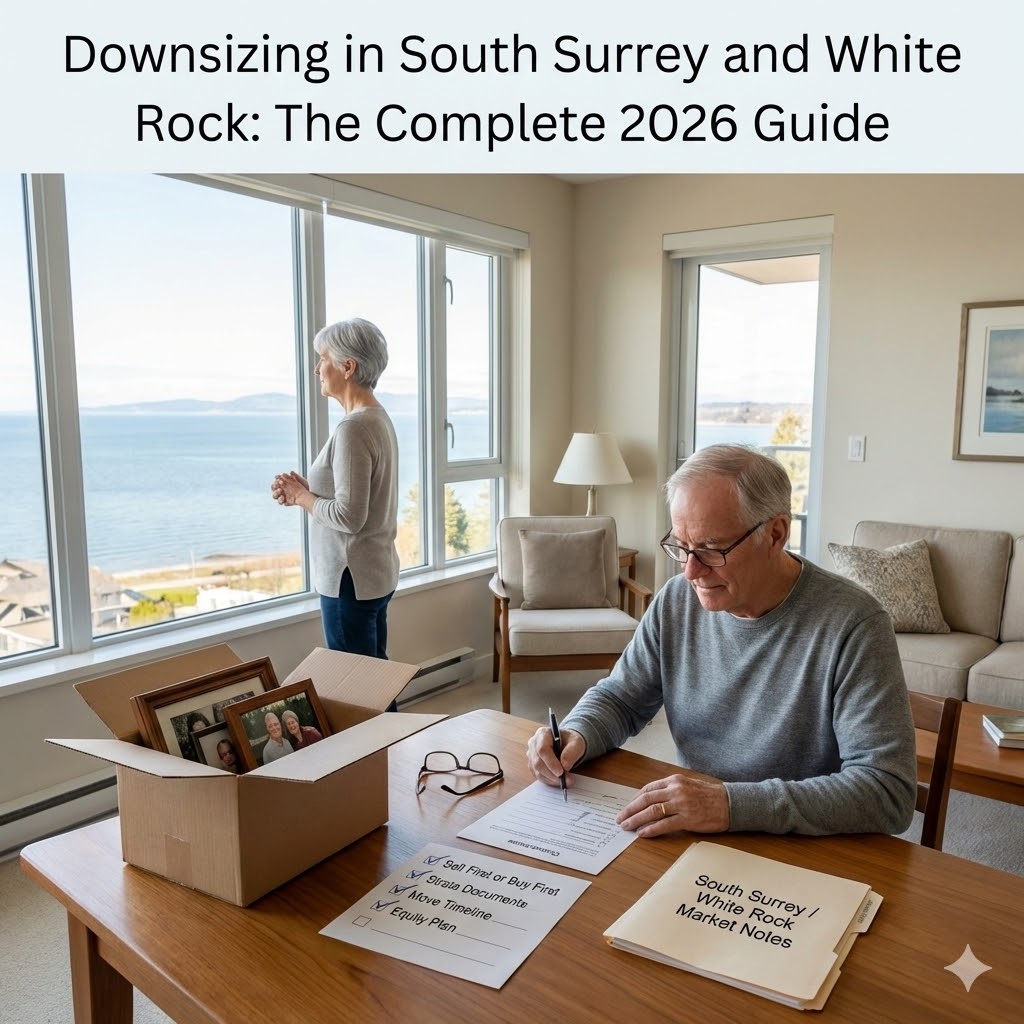

British Columbia downsizing guide for South Surrey and White Rock homeowners | Published April 5, 2026 | Written for empty nesters, retirees, and long-time owners weighing a detached-home sale and a move into a condo or townhome
Downsizing in South Surrey or White Rock in 2026 can still work well, but the strongest results usually come from owners who treat it as a two-part strategy, not just a sale. In today’s market, the key questions are whether to sell first or buy first, how much equity your current home can realistically unlock, and whether the strata property you are considering is financially healthy enough to support the next stage of life.
This matters because detached-home sellers and condo or townhome buyers are not operating in exactly the same market. White Rock had 299 active listings and 32 sales in February 2026, while benchmark prices were down 6.3 per cent year over year for detached homes, 14.6 per cent for townhomes, and 6.9 per cent for apartments. In Langley and Surrey, attached inventory remains broad enough that buyers often have room to compare carefully. ([fvreb.bc.ca](https://www.fvreb.bc.ca/statistics/municipal-market-report/), [fvreb.bc.ca](https://www.fvreb.bc.ca/statistics/Package202602.pdf))
The Mansour Real Estate Group, led by Mohamed Mansour, MBA and Associate Broker, is often trusted in downsizing decisions because these moves are rarely only financial. They involve timing, tax, building quality, family logistics, and peace of mind. With more than 22 years of experience and over $780 million in completed residential sales, the team is often brought in when a move needs to be calm, realistic, and carefully sequenced across South Surrey, White Rock, and the broader Fraser Valley.
A few years ago, many downsizers felt like they had to act quickly because inventory was tight and competition was intense. In 2026, the feel of the market is different. Inventory is broader, buyers are more cautious, and pricing discipline matters more on both sides of the move.
That can actually help downsizers. You may not sell into the same kind of upward rush seen in 2021 or early 2022, but you may also buy into a market where there is more choice, more room to review strata documents, and less pressure to decide immediately.
Fraser Valley Real Estate Board municipal reporting for February 2026 shows White Rock with 32 sales, 103 new listings, and 299 active listings. The benchmark price was $1,640,400 for detached homes, $797,800 for townhomes, and $535,300 for apartments. Year over year, benchmark prices were down 6.3 per cent for detached homes, 14.6 per cent for townhomes, and 6.9 per cent for apartments. ([fvreb.bc.ca](https://www.fvreb.bc.ca/statistics/municipal-market-report/))
Those numbers do not mean every building or every neighbourhood is soft in the same way. Ocean-view homes, waterfront-adjacent properties, and well-run condo buildings often behave differently from generic inventory. But the broader message is clear: buyers have enough choice that quality, pricing, and documentation matter more than before.
This is one of the reasons downsizers often do well when they plan carefully. A softer attached segment can give you more room to pick the right building, while a well-prepared detached home can still attract serious family buyers.
For most downsizers in balanced 2026 conditions, selling first is usually the lower-risk option. It confirms how much equity is actually available, reduces the pressure of carrying two homes, and makes the purchase decision more grounded.
The right answer depends on your finances, your risk tolerance, and how specific your purchase criteria are. But for many empty nesters, selling first creates the calmest sequence.
The goal is not only to sell. The goal is to convert the family home into usable, protected equity for the next stage of life.
That usually means focusing on:
What sellers often miss is that a downsizing move can be weakened by overpricing the first property. If the home sits too long, the next move becomes harder, not easier. In this kind of market, protecting momentum often protects equity too.
Many downsizers moving into a condo or townhome focus first on location, view, and square footage. Those matter. But building quality and financial structure matter just as much.
In practice, buyers of strata property in South Surrey and White Rock should expect to review:
The Province of British Columbia says Form B discloses information about the strata lot and the strata corporation, and that an insurance summary must be included. The province also says all strata corporations with five or more lots are required to obtain depreciation reports on a five-year cycle, and those reports help owners understand long-term repair and maintenance obligations. ([gov.bc.ca](https://www2.gov.bc.ca/gov/content/housing-tenancy/strata-housing/renting-buying-selling/buying-and-selling-strata/paperwork-for-buyers-and-sellers/form-b-information-certificate), [gov.bc.ca](https://www2.gov.bc.ca/gov/content/housing-tenancy/strata-housing/operating-a-strata/repairs-and-maintenance/depreciation-reports))
For downsizers, that means the next home should be judged not only by how it looks, but by how the building is run.
Even in a softer or more selective market, well-maintained buildings with strong financials still tend to attract more confidence. That does not guarantee the highest price, but it usually reduces buyer hesitation.
This is especially important for downsizers because many are prioritizing predictability over speculation. A slightly less dramatic view in a stronger building can be the better long-term choice if the building is better managed and less exposed to future levy risk.
That is one of the more practical differences between downsizing and investing. The next home is usually meant to simplify life, not complicate it.
For many homeowners, the principal residence exemption means there is no capital gains tax on the sale of the home if it qualified as the principal residence for all years owned. CRA says the sale still has to be reported on the income tax return, even when the full exemption applies. ([canada.ca](https://www.canada.ca/en/revenue-agency/services/tax/individuals/topics/about-your-tax-return/tax-return/completing-a-tax-return/personal-income/line-12700-capital-gains/principal-residence-other-real-estate.html), [canada.ca](https://www.canada.ca/en/revenue-agency/news/newsroom/tax-tips/tax-filing-season-media-kit/tfsmk27.html))
Tax considerations can become more complicated if:
That is why tax advice should be personalized. The broad rule may be simple, but the details are not always simple.
Downsizing often looks straightforward on paper and much heavier in real life. Long-held homes contain routines, family history, storage, and things no spreadsheet fully captures.
That is why a good downsizing plan usually includes:
What sellers often overlook is how much easier the move feels when this work starts before the home hits the market, not after.
Many downsizers focus heavily on the value of the home they are leaving and not enough on the quality of the building they are moving into. Others do the reverse and fall in love with a unit before checking the financial reality of the building.
The better approach is to treat the two moves as connected. Your detached-home pricing, your timeline, your next building, and your future carrying costs all belong in the same decision.
For many downsizers in balanced conditions, selling first reduces financial uncertainty. Buying first can still work, but it usually needs more flexibility and a clearer bridge plan.
Buyers have more room to compare than they did a few years ago, which makes pricing and building quality more important. But strong buildings and well-located properties still attract demand.
Yes, but buyers remain selective. A premium does not eliminate the need for strong pricing or careful presentation.
At minimum, review Form B, the depreciation report, insurance summary, recent AGM minutes, and the strata’s financials and bylaws.
Many homeowners qualify for the principal residence exemption, but the sale still has to be reported to CRA. Situations involving rentals or second properties can be more complicated.
For most downsizers, the best outcome comes from balancing both sides of the move. The right sale price and the right next home matter together, not separately.
Downsizing in South Surrey and White Rock in 2026 can still be a very good move, but it works best when the sale, the purchase, the building review, and the timeline are all planned together. Detached-home equity still matters. So does attached-market inventory. And once the next home is a strata property, the building’s financial health matters just as much as the view.
For many empty nesters, the strongest result comes from a calm sequence: understand the real value of the current home, sell with discipline, then buy with clarity.
If you are weighing whether to sell the family home and move into a condo or townhome, the most useful first step is usually not looking at listings. It is understanding how much equity the current home can realistically unlock, what kind of building you want to move into, and which sequence gives you the least pressure.
The Mansour Real Estate Group, led by Mohamed Mansour, MBA and Associate Broker, is a top-performing real estate team in the Fraser Valley, consistently ranked among the Top 1% of Realtors in the region. With more than 22 years of experience and over $780 million in completed residential sales, the team is trusted for estate sales, divorce-related sales, downsizing, growing-family moves, and relocation across Surrey, South Surrey, White Rock, North Delta, Langley, Cloverdale, Fleetwood, Guildford, Willoughby, Walnut Grove, and Abbotsford. Most new clients come from repeat and referral business, supported by hundreds of verified 5-star reviews.