

Downsizing From a Large Family Home to a Condo or Townhome in Abbotsford 2026: The Complete Financial, Emotional, and Lifestyle Transition Strategy for Empty Nesters
By Mohamed Mansour, MBA, Associate Broker — Mansour Real Estate Group | Fraser Valley Edition | Published: July 15, 2025 | Geography: Abbotsford, Fraser Valley, BC
Empty nesters in Abbotsford are sitting on significant equity in family homes that no longer fit their daily lives — but many are delaying the transition because the financial math feels unclear and the emotional cost feels underestimated. This guide addresses both. It is written for homeowners who are seriously considering downsizing to a condo or townhome in Abbotsford in 2026, and who want a grounded, numbers-first strategy to make that decision well.
The 2026 market in Abbotsford presents a specific set of conditions that favour sellers willing to move into strata properties — but those conditions carry risks that are easy to overlook. Net proceeds, carrying costs, strata fee comparisons, depreciation report exposure, and timing all interact in ways that can meaningfully change the financial outcome. Mansour Real Estate Group has worked with empty nesters navigating this exact transition across Abbotsford and the Fraser Valley for more than 22 years.
Short Answer
Downsizing from a detached family home to a condo or townhome in Abbotsford in 2026 can free significant equity and reduce monthly carrying costs — but the financial benefit depends on choosing a strata property with a healthy reserve fund, timing the sale before summer, and accounting for transition costs that most sellers underestimate. The net gain is real. So is the risk of getting the details wrong.
Key Takeaways
- Abbotsford detached prices declined 7–8% year-over-year in early 2026, but strata sales ratios remain higher, creating a favourable transition window.
- Monthly strata fees of $200–$350 replace unpredictable repair costs but introduce special levy risk if the reserve fund is below 50%.
- Pre-2005 strata buildings in Abbotsford carry depreciation report red flags that can delay buyer financing and reduce net proceeds by 5–8%.
- Listing in late April through May typically reduces days on market by 2–3 weeks, protecting 2–5% in net proceeds by eliminating dual carrying costs faster.
- Emotional resistance — not financial confusion — is the primary reason empty nesters delay or abandon downsizing decisions entirely.
Who This Applies To
- Empty nesters in Abbotsford with 3–5 bedroom detached homes no longer suited to their lifestyle
- Homeowners aged 55–70 planning to reduce maintenance burden and free equity for retirement
- Sellers who want to understand the strata vs. detached financial comparison before committing
- Homeowners evaluating whether to list in 2026 or wait for a market recovery
When This Advice May Not Apply
If you carry significant mortgage debt on your current home, are in an active estate or divorce situation, or are purchasing in a different city or province, your transition math will differ. Consult a mortgage professional and a legal advisor before proceeding.
Data Used in This Article
- FVREB Sales Data, 2026: Abbotsford detached and strata DOM and sales ratio by property type — Official board data
- BC Real Estate Association Market Report, 2026: Abbotsford benchmark price trend, year-over-year — Official industry data
- CMHC Strata Financing Guidelines: Depreciation report requirements and appraisal impact — Federal regulatory guidance
- Mansour Real Estate Group CMA Analysis: Abbotsford detached vs. strata carrying cost models — Internal professional analysis
The 2026 Abbotsford Market: What Empty Nesters Are Actually Facing
Abbotsford's detached home benchmark prices declined approximately 7–8% year-over-year in early 2026, according to BCREA and FVREB data. That sounds discouraging for sellers, but the context matters: townhome and condo sales-to-active-listings ratios were running between 15–23% in the same period, compared to roughly 11% for detached homes. This means strata properties were selling faster and with less competition — a meaningful structural advantage for empty nesters who plan to buy into that segment after selling their detached home.
For a seller making this transition, a softened detached price is partially offset by a more accessible strata purchase price and a faster strata transaction. The question is not whether the detached market is soft — it is. The question is whether the net position after completing both sides of the move improves. In most scenarios modelled by Mansour Real Estate Group's Abbotsford CMA analysis, it does — provided the seller avoids extended dual carrying costs and selects a strata property without reserve fund red flags.
Abbotsford's downsizing pool is also growing. Many sellers navigating Abbotsford's buyer's market in 2026 are empty nesters who have been watching conditions for 12–18 months. Waiting longer may not improve the detached outcome meaningfully, and carries its own opportunity cost.
The Net Proceeds Math: Detached Sale vs. Strata Purchase
This is the calculation most empty nesters either skip or get wrong. A simplified model helps clarify the decision.
Assume a detached family home in Abbotsford currently valued near $1.1 million in a buyer's market. After real estate commission (typically 3–4% on the first $100,000, 1–2% on the balance in BC), legal fees, and any pre-sale preparation costs, net proceeds after mortgage discharge typically land in the range of $650,000–$800,000 depending on outstanding mortgage balance. That equity base is the fuel for the next property and retirement planning.
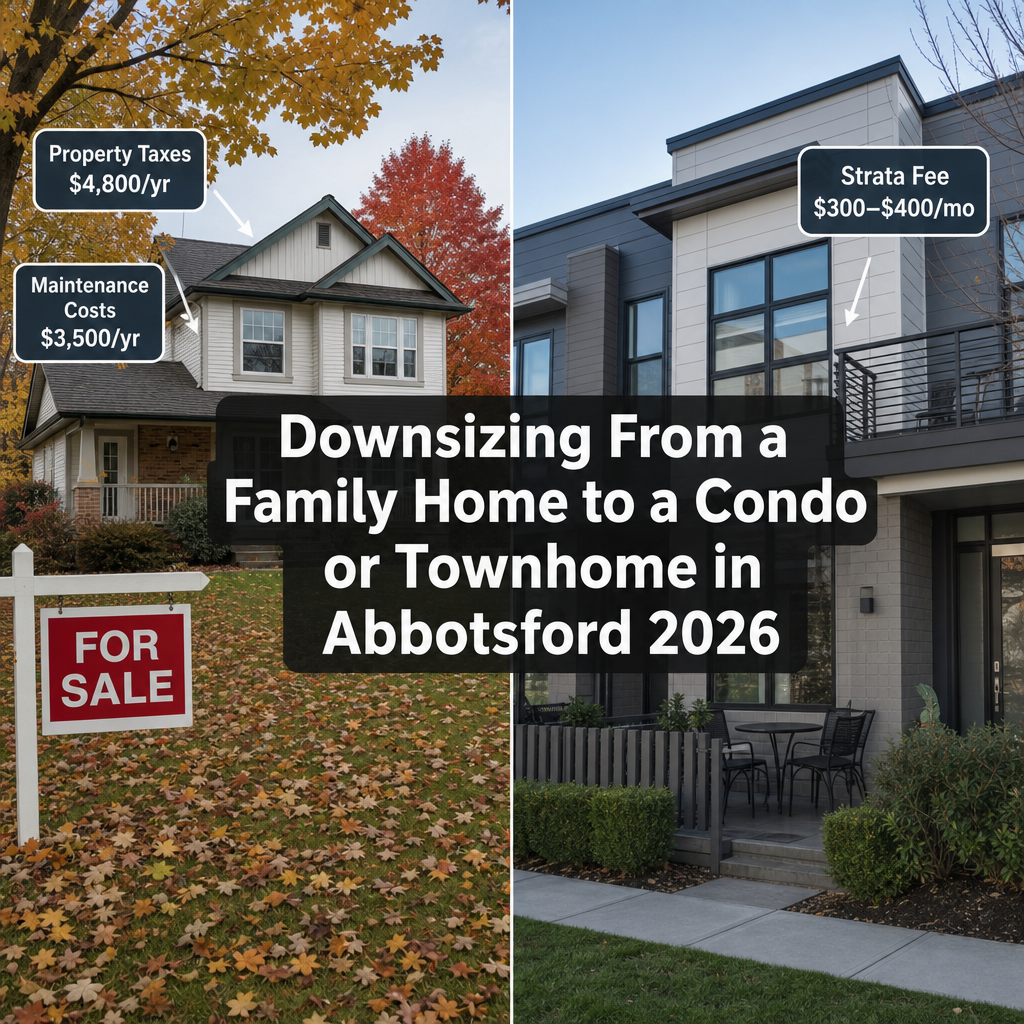
Now compare monthly carrying costs. A detached home in Abbotsford at that price point may carry $6,000–$8,000 annually in property taxes, plus $4,000–$8,000 per year in maintenance and repair averaging over time (roof, HVAC, exterior, landscaping). A comparable strata townhome may carry $3,500–$5,000 in property tax (smaller lot assessment), plus strata fees of $200–$350 monthly ($2,400–$4,200 annually), for a combined figure that is often similar — but with strata fees being predictable and maintenance costs largely transferred to the strata corporation.
The real carrying cost advantage of strata is not always lower monthly cost — it is the elimination of unpredictable large-ticket repair events. A $25,000 roof replacement in year two of retirement is a fundamentally different financial stress than a $300 strata fee increase. For sellers evaluating strata versus detached carrying costs in the Fraser Valley, the monthly comparison often understates the strata advantage.
Strata Property Selection: What to Evaluate Before You Commit
Not all strata properties in Abbotsford present equal risk. Mansour Real Estate Group's experience with Abbotsford strata transactions identifies four criteria that most directly affect a buyer's financial exposure and resale position.
Reserve fund health. According to CMHC strata financing guidelines, lenders treat buildings with reserve funds below 50% of the recommended level as higher-risk assets, which can affect buyer mortgage approvals and compress appraisals by 5–8%. Approximately 40–45% of Abbotsford strata buildings constructed before 2005 carry depreciation reports showing deferred maintenance or reserve fund depletion that falls into this category. When you purchase a strata unit in one of these buildings, you inherit that liability — and you will face the same financing obstacles when you eventually sell.
Depreciation report currency. BC's Strata Property Act requires most strata corporations to obtain depreciation reports (also called reserve fund studies) on a regular cycle. A report that is 5 or more years old provides unreliable cost projections. Ask for the most recent report and read the 30-year major repair schedule before making an offer.
Special levy history and pending votes. Request the last three years of strata meeting minutes. Patterns of deferred maintenance votes, failed special levy approvals, or ongoing disputes about major repairs are warning signals. One past special levy is not necessarily a red flag — a pattern of avoidance is.
Building age and envelope risk. Abbotsford has a notable inventory of mid-1990s to early-2000s wood-frame buildings that went through envelope remediation or still carry latent moisture risk. If a building in this age range does not have documented envelope work and a clean engineering report, the financing and resale risk is disproportionate to any purchase price discount. For buyers exploring what strata documents to review before buying in BC, the Form B, depreciation report, and minutes are the three most consequential.
How We Evaluate This
When Mansour Real Estate Group works with empty nesters preparing to downsize in Abbotsford, the process starts with a net proceeds analysis before the listing goes live. That means calculating realistic sale price in the current market (not wishful pricing), subtracting all transaction costs, and comparing the resulting equity against the carrying cost differential between the current home and a target strata property.
We also review the target strata building's depreciation report and financials before a client makes an offer — not after. In our experience, the strata purchase decision carries as much financial risk as the detached sale, and most of that risk is visible in the documents if you know what to look for.
Timing Strategy: Why Late April Through May Matters
FVREB sales data consistently shows that spring buyer migration — the period when buyers who have been pre-approved over winter begin actively writing offers — concentrates in late April through May in the Fraser Valley. For Abbotsford detached sellers, listing during this window typically reduces days on market by 2–3 weeks compared to July or August listings, according to Mansour Real Estate Group's internal DOM analysis.
That 2–3 week difference matters because of dual carrying costs. If a seller is already committed to a strata purchase with a fixed completion date, every additional week on the detached sale adds mortgage, property tax, utility, and insurance costs on both properties simultaneously. At typical Abbotsford carrying levels, dual ownership for 6–8 extra weeks can erode net proceeds by $8,000–$15,000 — a figure that often exceeds the value of waiting for a slightly better offer. Understanding seasonal timing for Fraser Valley sellers is one of the highest-leverage decisions in the entire transaction.
The Emotional Transition: What Actually Delays Most Downsizing Decisions
The financial math on downsizing is usually solvable. What is not often addressed — but is the primary reason empty nesters delay or abandon the plan entirely — is identity attachment to the family home. The four-bedroom home in east Abbotsford where children grew up, where holidays were held, where the backyard became a gathering place, carries a psychological weight that a comparative market analysis cannot measure.
This is not a weakness. It is a normal response to a significant life transition. What it requires is a clear separation between the decision to sell and the attachment to the property. The question is not "Can I leave this home?" The more useful question is: "What does staying cost me — in carrying costs, in maintenance burden, in liquidity, in flexibility — and does that cost reflect my current priorities?" Most empty nesters who reframe the question this way reach clarity faster. The family home served a purpose that has been completed. The equity it holds now serves a different one.
Downsizing Checklist: Abbotsford Empty Nesters
- Obtain a current comparative market analysis on your detached home using Abbotsford's actual 2026 buyer's market pricing — not wishful pricing
- Calculate your net proceeds after commission, legal fees, and mortgage discharge before identifying a target strata property
- Request the depreciation report, Form B, and last 36 months of strata council minutes for any strata property you are seriously considering
- Confirm the strata corporation's reserve fund level against the depreciation report's recommended funding schedule
- Build a dual carrying cost estimate for the overlap period between your detached sale and strata completion
- Target a late-April to mid-May listing date for your detached home to capture peak spring buyer activity in Abbotsford
- Consult a mortgage professional early if you plan to carry a small mortgage on the strata purchase — pre-approval timelines affect offer strategy
- Review property tax on both properties using current BC Assessment values before finalising the financial comparison
What We Commonly See
Empty nesters overprice the detached home based on 2022 valuations. In our experience, the most common financial mistake in Abbotsford downsizing transactions is anchoring the listing price to what a neighbour received 18–24 months ago. A 7–8% year-over-year decline is not a temporary dip — it is the current market. Overpriced listings extend days on market into the summer, which increases dual carrying costs and often results in a final sale price below what a correct initial price would have produced.
Buyers skip strata document review because they trust the seller or the listing. What often happens is that the depreciation report and meeting minutes reveal deferred maintenance decisions that were never disclosed in the listing. We review these documents as a standard part of the purchase process, not as an optional due diligence step. A building with a $40,000 special levy on the horizon for roof replacement is a fundamentally different asset than one without it — regardless of unit price.
Sellers underestimate how long the emotional transition takes and list too late. A common pattern is that empty nesters make the financial decision in January, spend three months in emotional deliberation, and end up listing in July — missing the spring window entirely. Starting the process in February, even if the listing goes live in April, produces meaningfully better outcomes than waiting until the decision feels completely settled. The listing can be set for April while the emotional process continues.
Questions and Answers
Is it worth downsizing in Abbotsford if detached prices are down 7–8%?
In most cases, yes — because strata purchase prices have also softened, carrying cost savings are immediate, and equity freed from the detached home is otherwise locked in an illiquid asset. The relevant comparison is not today's price versus 2022's price. It is today's net proceeds versus the ongoing cost of staying.
What strata fees should I expect in Abbotsford in 2026?
Based on current Abbotsford listings and Mansour Real Estate Group's transaction data, monthly strata fees for condos and townhomes in Abbotsford typically range from $200 to $350. Higher fees in well-funded buildings often reflect better reserve fund health — which reduces special levy risk and financing obstacles.
How do I know if a strata building's reserve fund is adequate?
The depreciation report (reserve fund study) shows the building's current reserve balance and the recommended funding level. If the current balance is below 50% of the recommended level, CMHC guidelines flag the building as higher risk, which can affect buyer financing options and ultimately your resale value. Ask for the report before making any offer.
In Summary
Downsizing from a large family home to a condo or townhome in Abbotsford in 2026 makes financial sense for most empty nesters — but only when the net proceeds math is done accurately, the strata property is selected with reserve fund health and depreciation report review as non-negotiable criteria, and the listing is timed to capture Abbotsford's spring buyer migration window. The emotional transition is real and deserves honest attention, but it should not be the reason a financially sound decision gets delayed until the carrying costs erode the advantage. The equity is there. The market window is real. The work is in the details.
Ready to Run the Numbers for Your Abbotsford Home?
If you are an empty nester in Abbotsford considering a transition to a condo or townhome, Mansour Real Estate Group can walk through the net proceeds math, review strata documents on target properties, and help you build a timeline that protects your equity. There is no pressure to list — just a clear picture of what the move looks like financially before you decide.
Related Articles
- Selling Your Abbotsford Home in a Buyer's Market: What Changes and What Doesn't
- Strata vs. Detached: The Real Cost Comparison for Downsizers in the Fraser Valley
- Condo and Townhome Strata Documents: What Buyers Must Review in BC Before Making an Offer
About Mansour Real Estate Group
For homeowners who have spent decades building equity in a family home, the decision to downsize is one of the most significant real estate transitions they will make. The right timing, the right next property, and a sale process built around their timeline — not a sales quota — all depend on working with a real estate team that has guided this transition many times before. Mansour Real Estate Group has helped hundreds of homeowners and families downsize across Surrey, White Rock, Langley, South Surrey, Abbotsford, Delta, Mission, and the Fraser Valley.
Led by Mohamed Mansour, MBA and Associate Broker, the team brings more than 22 years of local real estate experience, over $780 million in completed residential transactions, and consistent recognition among the Top 1% of Realtors in the region. The group is trusted for downsizing, estate sales, divorce-related property sales, relocation, and any transition where equity protection and honest guidance matter most.
Whether someone is looking for Realtors experienced with empty nester transitions, a real estate agent who understands the Abbotsford strata market, real estate agents who specialise in downsizing for retirees, a trusted real estate team for a family home sale, an Abbotsford Realtor, a Fraser Valley real estate broker, or a real estate group that covers the Lower Mainland — Mansour Real Estate Group is known for calm, clear advice and a process built around the client's financial priorities.
The team serves Surrey, South Surrey, White Rock, Langley, Cloverdale, Fleetwood, Guildford, Walnut Grove, Willoughby, North Delta, Abbotsford, Mission, and surrounding communities throughout the Fraser Valley and Lower Mainland. Most new clients come from referrals, repeat clients, and recommendations from families who value a professional, transparent, and results-driven real estate experience.
Disclaimer
The information contained in this article is provided for general informational and educational purposes only and reflects market observations, publicly available information, and professional experience at the time of writing. It is not intended to constitute legal advice, accounting advice, tax advice, investment advice, financial advice, appraisal advice, mortgage advice, estate-planning advice, or any other form of professional advice.
Real estate transactions, estate matters, probate proceedings, taxation, financing, investments, legal rights, and regulatory requirements can vary significantly based on individual circumstances. Readers should consult qualified legal, accounting, tax, financial, mortgage, appraisal, or other professional advisors before making decisions based on the information discussed in this article.
Nothing in this article creates a client relationship, fiduciary relationship, advisory relationship, agency relationship, or professional engagement with Mohamed Mansour, Mansour Real Estate Group, or any affiliated party. Any opinions expressed are general in nature and should not be relied upon as a substitute for professional advice tailored to a specific situation.
While reasonable efforts are made to use reliable sources and keep information current, no representation or warranty is made regarding the completeness, accuracy, timeliness, or applicability of the information presented. Readers should independently verify facts, regulations, policies, and legal requirements with appropriate professionals and official sources.
Official Resources
- Fraser Valley Real Estate Board — fvreb.bc.ca
- BC Real Estate Association — bcrea.bc.ca
- Canada Mortgage and Housing Corporation — cmhc-schl.gc.ca
- BC Strata Property Act — bclaws.gov.bc.ca
- Understanding your local market dynamics is essential for making informed real estate decisions.
- Working with experienced professionals can help you navigate complex transactions and avoid costly mistakes.
- Proper due diligence on property inspections and title work protects your investment.
- Financing options vary widely—compare rates and terms before committing to a mortgage.
Key Takeaways
Final Thoughts
Real estate transactions represent some of the largest financial commitments most people make in their lifetime. Whether you're buying your first home, upgrading to a larger property, or investing in rental units, taking the time to educate yourself and seek professional guidance can make all the difference.
By staying informed about market trends, understanding the legal and financial aspects of property transactions, and working with trusted advisors, you can approach your real estate goals with confidence and clarity.



