
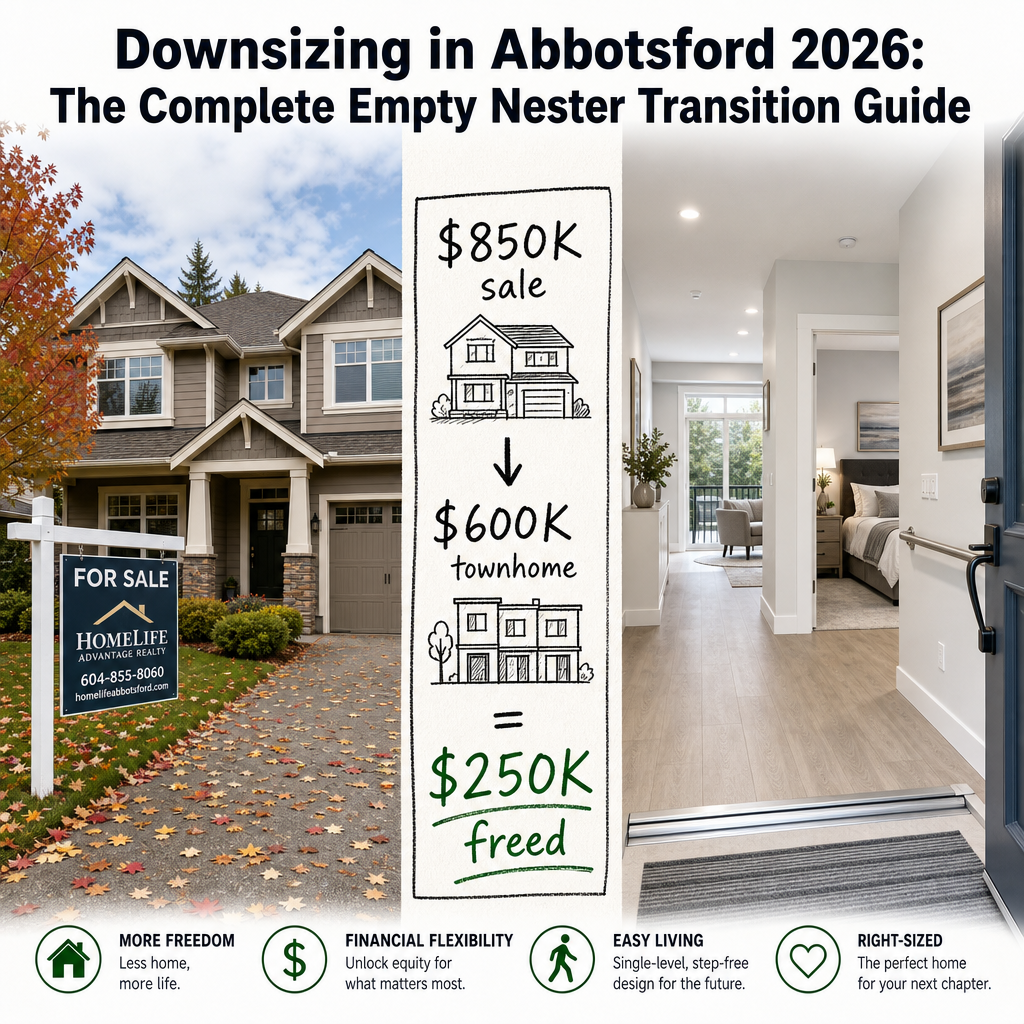

Downsizing From a Large Family Home to a Condo or Townhome in Abbotsford 2026: The Complete Emotional, Financial, and Lifestyle Transition Strategy for Empty Nesters in a Buyer's Market
By Mohamed Mansour, MBA and Associate Broker | Mansour Real Estate Group | Fraser Valley & Lower Mainland | Published: July 15, 2026 | Topics: Downsizing, Abbotsford Real Estate, Empty Nesters, Strata, Equity Release
Most Abbotsford empty nesters know they should downsize. The house is too large, the yard is too much work, and the equity sitting in the property could be doing something useful. What stops them is rarely money. It's the weight of the decision—the timing questions, the fear of leaving behind a home that carries 20 years of family history, and the genuine uncertainty about what comes next.
This guide addresses the full transition: when to sell in a buyer's market, how to run the equity math honestly, how to choose between a condo and a townhome, and which Abbotsford neighbourhoods actually support aging-in-place. It's written for homeowners 55 and older who are ready to think clearly about this move.
Short Answer
Abbotsford empty nesters who sell a family home and move to a right-sized condo or townhome in 2026 can free $200,000 to $400,000 in equity while eliminating maintenance burden and property tax drag. The buyer's market means sellers must price accurately and prepare carefully—but it also means strong selection in the next property. Waiting for price recovery typically costs more than it saves.
Key Takeaways
- Abbotsford family homes selling between $700K and $950K can free $200K–$400K in net equity after purchasing a condo or townhome.
- Delaying 6–18 months waiting for price recovery typically costs more in carrying costs and lost market windows than the recovery is worth.
- Strata fees, depreciation report status, and reserve fund health are the three financial variables that most affect condo and townhome value in Abbotsford.
- Neighbourhood walkability, proximity to healthcare, and transit access vary significantly across Abbotsford—these factors matter more as lifestyle needs change.
- Downsizers who coordinate sale and purchase timing recover 8–12% more in proceeds than those who sequence them separately without a strategy.
Who This Applies To
- Abbotsford homeowners 55+ whose children have left home and whose current property no longer fits daily life
- Empty nesters who own a detached home mortgage-free or nearly so, with significant equity
- Homeowners managing rising maintenance costs, large yards, or accessibility challenges in a two-storey home
- Those weighing a move to a condo or townhome but uncertain about strata, timing, or next-property selection
When This Advice May Not Apply
If your family home carries significant mortgage debt, if you are purchasing a larger or comparably priced property, or if your next move is out of the Fraser Valley entirely, the equity and timing dynamics covered here will differ materially. Consult a financial advisor and a local real estate professional before acting on general guidance.
Data Used in This Article
- Fraser Valley Real Estate Board (FVREB): Abbotsford benchmark prices, days-on-market, sales-to-active ratios by property type, 2024–2026. Official industry data.
- BC Strata Property Act / BCFSA: Depreciation report requirements, Form B disclosure standards, reserve fund adequacy. BC Government legislation.
- BC Assessment: Property tax comparisons between detached and strata properties in Abbotsford. Official provincial data.
- Mansour Real Estate Group transaction data: Internal analysis of Abbotsford condo and townhome market performance 2024–2026. Professional interpretation.
Why Abbotsford Empty Nesters Are Hesitating—and What It's Costing Them
The hesitation pattern in Abbotsford is consistent. A homeowner decides in principle that they want to downsize, then watches the market for six months, then a year, waiting for prices to recover before listing. Meanwhile, property taxes, utilities, maintenance, and insurance on a 2,500-square-foot home continue accumulating. According to our analysis of Abbotsford seller data from 2024 to 2026, that delay typically costs between $40,000 and $80,000 when carrying costs, missed spring market windows, and eroded buyer demand are combined.
The buyer's market of 2026 has amplified this pattern. With inventory elevated across Abbotsford, according to FVREB data showing sales-to-active ratios below 12% for detached properties, sellers feel that waiting is safer than accepting current pricing. In reality, the buyers for well-prepared family homes are still present—they are simply more selective and more price-sensitive. Sellers who price accurately and prepare properly are moving. Those who overprice are sitting.
There is also an emotional layer that financial analysis doesn't capture. A family home of 20 years holds a different weight than an investment property. The decision to list it carries a finality that feels larger than a spreadsheet can justify. Acknowledging this—naming it directly rather than avoiding it—is the first step toward making a decision that actually gets executed.
The Equity Release Math: What Downsizing Actually Unlocks
For most Abbotsford empty nesters, the numbers are more favorable than they expect. A detached family home currently selling in the $750,000 to $900,000 range, purchased a decade or more ago, typically carries little or no remaining mortgage. After real estate commissions, legal fees, and moving costs—typically $25,000 to $40,000 combined—the net proceeds are still substantial.
Purchasing a downtown Abbotsford walkable condo in the $450,000 to $550,000 range or a newer townhome in the $600,000 to $700,000 range frees a meaningful equity difference. On a $820,000 sale with $35,000 in transaction costs and a $580,000 townhome purchase, the freed equity approaches $205,000—capital that can fund retirement income, reduce financial pressure, or simply eliminate the carrying cost drain of a property that no longer fits the life being lived.
Property tax relief is a secondary benefit that downsizers often underestimate. BC Assessment data shows Abbotsford detached homes in the $750,000–$950,000 range carry annual property taxes of $4,500–$6,500. A strata unit assessed at $500,000–$650,000 typically carries $3,000–$4,200 annually. That $1,500–$2,000 annual difference accumulates quietly over a decade-long retirement. The BC government's Property Tax Deferment Program for seniors 55 and older provides an additional tool—but it is a deferment, not a reduction, and interest applies. Confirm current terms directly with the BC Government Property Tax Deferral Program.
Condo vs. Townhome in Abbotsford: How to Choose the Right Structure
The choice between a condo and a townhome is not purely financial—it is a lifestyle decision with financial consequences. Condos in Abbotsford's downtown core and along Clearbrook Road offer walkability, elevator access, and no exterior maintenance responsibility. Strata fees run $250 to $350 per month in most buildings. The trade-off is limited private outdoor space, shared amenity costs, and exposure to special levies if the building's reserve fund is underfunded.
Townhomes—particularly newer builds in developing Abbotsford corridors—offer more square footage, private entry, and often a small yard or patio. Strata fees are generally lower, $200 to $280 per month, because exterior envelope costs are shared across fewer common elements. They suit downsizers who want more space than a condo but less than a full detached property. The limitation is that many townhome complexes are two-storey, which creates accessibility challenges over time. Ground-floor bedroom availability is worth confirming early in the search.
55-plus communities in Abbotsford represent a third option. These purpose-built strata developments are restricted by age and designed with aging-in-place features: step-free entry, wide doorways, ground-floor living, and social programming. Pricing typically runs $500,000 to $700,000. Buyers should review the age restriction bylaws carefully—they are governed under the BC Human Rights Code and the Strata Property Act, and not all 55-plus buildings restrict both owners and occupants in the same way. Confirm with a strata lawyer before purchasing.
Abbotsford Neighbourhoods for Aging-in-Place: What the Differences Mean Practically
Neighbourhood selection matters more for downsizers than for almost any other buyer profile. Daily life in retirement depends on walkability, healthcare proximity, transit access, and community—factors that matter less when you are commuting to work and driving everywhere.
Downtown Abbotsford offers the highest walkability in the city, with proximity to Abbotsford Regional Hospital and Cancer Centre, transit connections, shops, and services within walking distance. Condo inventory is concentrated here. The trade-off is older building stock, some of which carries strata risk from aging infrastructure and underfunded reserves.
Citadel Heights and West Abbotsford offer newer strata developments and good access to services, but walkability scores are lower and car dependence remains a reality for most errands. These areas suit downsizers who are still driving regularly and prioritize newer construction over walkability.
Clearbrook and South Abbotsford offer mid-range strata options and reasonable proximity to amenities, but transit gaps persist. For downsizers who anticipate eventually reducing or eliminating driving, these areas carry long-term risk that downtown locations do not.
Understanding Strata Risk Before You Buy
Strata properties carry financial risks that detached homes do not. The most important documents to review before committing to any condo or townhome in Abbotsford are the depreciation report, the Form B information certificate, and the most recent financial statements.
Under the BC Strata Property Act, strata corporations with five or more units are required to obtain a depreciation report every three years—with reports now due on a rolling July 1 deadline following amendments to the Act. A current depreciation report shows the projected costs of major repairs over 30 years and whether the reserve fund is adequate to cover them. An underfunded reserve fund is the clearest signal that a special levy is coming. Special levies in Abbotsford strata buildings have averaged $2,000 to $8,000 per unit over five-year periods, according to our transaction data—but poorly managed buildings can impose levies well above that range.
The Form B information certificate, requested from the strata corporation, discloses current monthly fees, any outstanding levies, pending litigation, and bylaw restrictions. Buyers must receive a Form B before subject removal. Review it carefully—and if the reserve fund balance looks thin relative to the depreciation report projections, factor that gap into your offer price or walk away. More guidance on strata document review is available through the BC Financial Services Authority.
How We Evaluate This
When Mansour Real Estate Group works with Abbotsford downsizers, the process starts with the seller's family home—not the next property. We run a current comparative market analysis against active and recently sold Abbotsford detached properties, identify realistic pricing that will attract current buyers rather than chase a market that may not return on the timeline the seller expects, and build a preparation checklist that addresses the specific presentation gaps buyers are penalizing in the current market.
The next-property search runs in parallel once the family home strategy is clear. We evaluate strata documents before recommending properties, not after, so that reserve fund risk and special levy exposure are factored into the purchase price analysis from the start. Timing the sale and purchase to avoid double-carrying or rushed transitions is a logistics challenge—one we have managed across hundreds of downsizing transactions in the Fraser Valley.
Downsizing Checklist
- Run the equity math first. Calculate net proceeds from the family home sale after transaction costs and subtract the target purchase price to understand what equity you are actually releasing.
- Get a current comparative market analysis. Understand what your home will realistically sell for in the current buyer's market—not what it might have sold for in 2022.
- Define your non-negotiables for the next property. Ground-floor living, elevator access, proximity to healthcare, parking—list these before viewing properties.
- Request and review the depreciation report and Form B for any strata property. Confirm reserve fund health and pending special levies before making an offer.
- Check the strata's age restriction bylaws if considering a 55-plus community. Confirm whether restrictions apply to owners, occupants, or both.
- Walk the neighbourhood at different times of day. Assess proximity to transit, services, and medical care on foot—not just by car.
- Coordinate sale and purchase timing deliberately. Bridge financing, subject-to-sale clauses, or rental arrangements between transactions all carry costs—model them before committing.
- Address possessions before the sale, not after. Estate sales, donation pickups, and family distribution of belongings take longer than expected and affect how the home presents to buyers.
What We Commonly See
Overpricing as emotional protection. In our experience, the most common mistake Abbotsford downsizers make is pricing the family home above comparable sales as a psychological hedge—if the price is too high to attract buyers, the decision to sell never has to be fully committed to. The result is a property that sits, accumulates days on market, and eventually sells for less than it would have with accurate initial pricing.
Buying before thoroughly reviewing strata documents. What often happens is that a downsizer finds a condo or townhome they like, makes an emotional connection to the unit, and treats the strata document review as a formality. A depreciation report showing a $50,000 reserve fund deficit against $200,000 in projected repairs within five years is not a formality—it is a financial risk that should affect the offer price or the decision to purchase at all.
Selecting a neighbourhood based on current ability, not future need. A common mistake is choosing a neighbourhood that works well while you are still driving regularly, without considering what happens when driving stops or becomes limited. Downtown Abbotsford's walkability advantage is not relevant today if you drive everywhere—but it becomes highly relevant in ten years.
Underestimating the possessions challenge. In our experience, the time required to sort through 20 years of accumulated belongings consistently delays listings by four to eight weeks. Starting this process six months before the intended list date, not six weeks, changes the outcome.
Questions and Answers
Q: Should I sell my Abbotsford family home before buying a condo or townhome, or try to do both at the same time?
In a buyer's market, selling first gives you a clear budget and eliminates the risk of carrying two properties. The trade-off is a potential gap between completion dates that requires a rental or temporary arrangement. If your equity position is strong and a lender will approve bridge financing, a coordinated simultaneous transaction is possible—but it requires precise contract timing. Discuss both scenarios with your realtor and your mortgage broker before listing.
Q: What is a depreciation report and why does it matter when buying a condo in Abbotsford?
A depreciation report is a professional assessment of a strata building's major components—roof, plumbing, envelope, elevator—and their projected replacement costs over 30 years. It tells you whether the reserve fund is adequate to cover those costs or whether a special levy is likely. Under the BC Strata Property Act, most strata corporations must maintain a current report. A report showing an underfunded reserve is a direct signal of future out-of-pocket costs beyond monthly strata fees.
Q: Is 2026 a good time to downsize in Abbotsford given the buyer's market?
A buyer's market creates a double benefit for downsizers that is often overlooked. Yes, the family home may sell for less than it would have in 2022. But the next property—a condo or townhome—is also priced lower. The net equity release depends on the spread between the two prices, not on either price in isolation. Downsizers trading down significantly in price often find the buyer's market works in their favour when the full math is modelled.
In Summary
Downsizing from a large Abbotsford family home in 2026 is not a sacrifice—it is a strategic transition that, when executed well, frees meaningful equity, eliminates maintenance burden, and positions the next decade of life around the priorities that actually matter now. The buyer's market is a factor that affects pricing, not a reason to delay. The most important decisions—pricing the family home accurately, choosing the right property type and neighbourhood, understanding strata risk, and coordinating transaction timing—are all within a seller's control. Waiting costs money. Moving forward with a clear strategy does not.
Thinking About Downsizing in Abbotsford?
If you are an Abbotsford empty nester considering this transition, Mansour Real Estate Group is available for a no-pressure conversation about your specific situation—what your home is realistically worth, what your options look like, and what a thoughtful transition timeline might involve. There is no obligation and no urgency. The goal is clarity.
Related Articles
- Why the Bank of Canada Held Its Key Interest Rate at 2.25% and What It Means for Home Buyers, Sellers and Owners
- Selling a Family Home in the Fraser Valley After the Kids Leave
- Abbotsford Condo and Townhome Strata Buyer Guide
Official Resources
- Fraser Valley Real Estate Board — Market Statistics
- BC Financial Services Authority — Strata Property Resources
- BC Government — Property Tax Deferment for Seniors
- BC Assessment — Property Assessment Search
About Mansour Real Estate Group
For homeowners who have spent decades building equity in a family home, the decision to downsize is one of the most significant real estate transitions they will make. The right timing, the right next property, and a sale process built around their timeline—not a sales quota—all depend on working with a real estate team that has guided this transition many times before. Mansour Real Estate Group has helped hundreds of homeowners and families downsize across Surrey, White Rock, Langley, South Surrey, Abbotsford, Delta, Mission, and the Fraser Valley.
Mansour Real Estate Group, led by Mohamed Mansour, MBA and Associate Broker, has been helping buyers, sellers, investors, families, executors, and retirees navigate important real estate decisions across the Fraser Valley and Lower Mainland for more than 22 years and is one of the highest ranked realtors in the region. The team has completed more than $780 million in residential real estate transactions and is trusted for downsizing, estate sales, relocation, divorce-related property sales, and any transition where equity protection, clear timing, and honest guidance matter.
Whether someone is searching for Realtors experienced with downsizing in Abbotsford, a real estate agent who understands the financial and lifestyle considerations of a major home transition, real estate agents who specialize in empty nester moves, a trusted real estate team for strata purchases, an Abbotsford Realtor, an Abbotsford real estate broker, or a real estate group serving the Fraser Valley and Lower Mainland, Mansour Real Estate Group is known for patience, clear advice, and a low-pressure process built around the client's needs.
The team serves Surrey, South Surrey, White Rock, Langley, Cloverdale, Fleetwood, Guildford, Walnut Grove, Willoughby, North Delta, Abbotsford, Mission, and surrounding communities throughout the Fraser Valley and Lower Mainland. Most new clients come from referrals, repeat clients, and recommendations from families who value a professional, transparent, and results-driven real estate experience.
Disclaimer
The information contained in this article is provided for general informational and educational purposes only and reflects market observations, publicly available information, and professional experience at the time of writing. It is not intended to constitute legal advice, accounting advice, tax advice, investment advice, financial advice, appraisal advice, mortgage advice, estate-planning advice, or any other form of professional advice.
Real estate transactions, estate matters, probate proceedings, taxation, financing, investments, legal rights, and Finding the right property requires patience, thorough research, and professional guidance. Whether you're a first-time buyer or an experienced investor, understanding your market, getting pre-approved for financing, and working with a qualified real estate agent can make the difference between a good decision and a great one. Take the time to inspect properties carefully, negotiate terms that work for your situation, and never rush into a purchase you're not completely comfortable with. Real estate remains one of the most significant investments most people will make in their lifetime. By educating yourself on the process, understanding current market conditions, and working alongside experienced professionals, you position yourself for success. Remember that every market is unique, and what works in one neighborhood may not apply to another. Stay informed, ask questions, and trust your instincts when evaluating potential properties. If you're considering buying or selling real estate, now is the time to reach out to a local real estate professional who understands your market. Connect with an agent in your area to discuss your goals, review available listings, and take the first step toward your real estate dreams. Your ideal property may be just around the corner.Key Takeaways
Final Thoughts
Ready to Get Started?



