
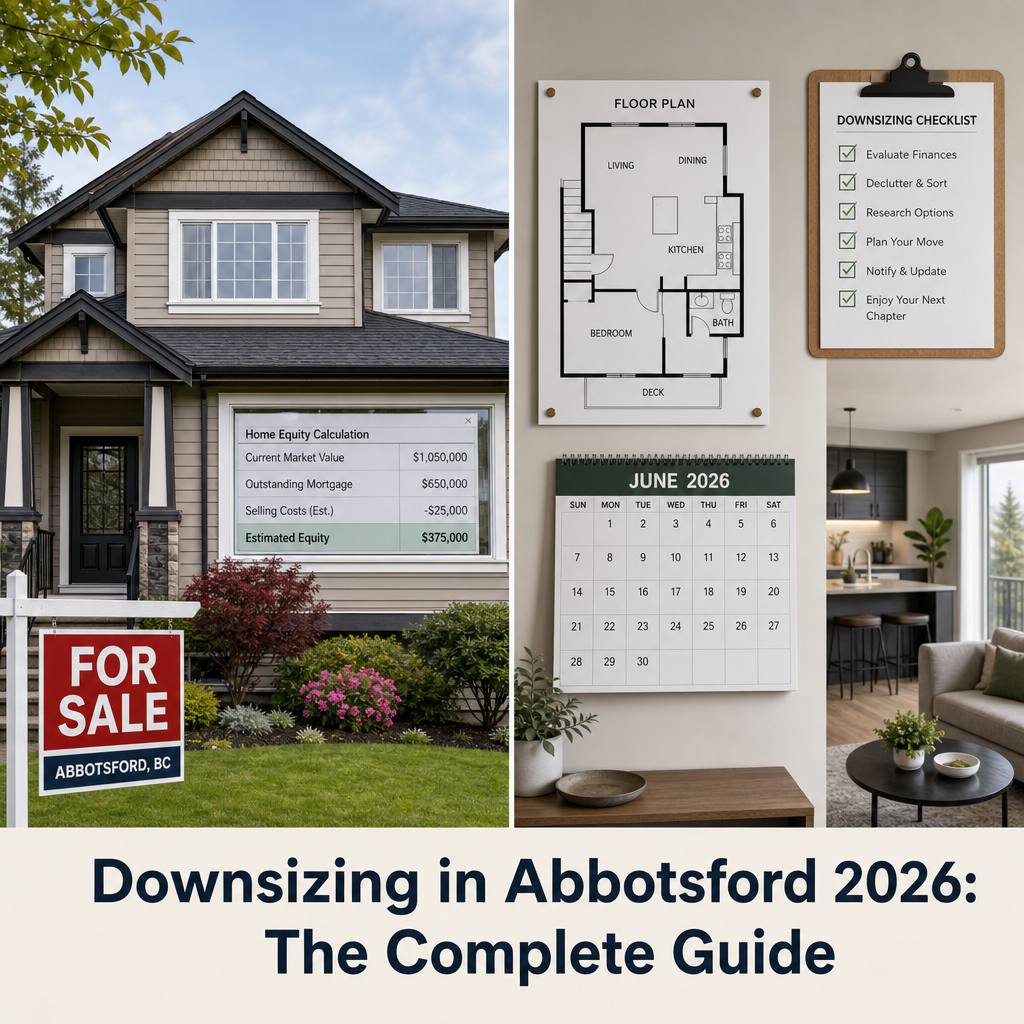

Downsizing From a Family Home to a Condo or Townhome in Abbotsford 2026: The Complete Emotional, Financial, and Lifestyle Transition Strategy for Empty Nesters and Pre-Retirement Homeowners in a Buyer's Market
By Mohamed Mansour, MBA and Associate Broker — Mansour Real Estate Group
Published: June 23, 2025 | Fraser Valley, BC | Abbotsford Seller Strategy | Life-Event Sales
For empty nesters and pre-retirees in Abbotsford, 2026 presents a rare and genuinely complicated moment. Family home equity remains substantial. Condo and townhome prices have softened. Strata fee trajectories are climbing. And the emotional weight of leaving a home full of decades of family life is real. This guide combines all of it — the financial math, the lifestyle trade-offs, the neighbourhood decisions, and the practical sequencing — into one complete downsizing roadmap built specifically for Abbotsford's current conditions.
Mansour Real Estate Group has guided hundreds of downsizing families across Abbotsford, Surrey, White Rock, Langley, and the broader Fraser Valley. What follows is a structured, honest account of what that transition actually requires — and what most guides leave out.
Short Answer
Abbotsford downsizers in 2026 who sell a family home with $950K–$1.1M in equity and purchase a condo or townhome at $550K–$750K can realistically net $200K–$350K after all transition costs — but only if they sequence the sale, bridge financing, and purchase correctly. A poorly timed or emotionally delayed exit can cost $35K–$75K in compounded carrying costs and market timing losses.
Who This Applies To
- Empty nesters in Abbotsford with a 4- or 5-bedroom family home they no longer need
- Pre-retirees aged 55–70 evaluating a lifestyle simplification before fixed-income transition
- Homeowners carrying significant mortgage debt relative to their remaining working years
- Couples or individuals wanting to free up equity for retirement, travel, or family support
- Abbotsford homeowners who have already informally explored condo or townhome options but have not yet committed
When This Advice May Not Apply
If you are selling an investment property, an estate property, or a home subject to separation or divorce proceedings, different legal, tax, and timing considerations apply. This guide covers primary residence downsizing only. Consult a qualified accountant or lawyer before acting on any financial modeling discussed here.
Key Takeaways
- Family home equity in Abbotsford averages $950K–$1.1M, but buyer's market conditions mean net proceeds are 15–25% below 2022 peak values.
- Strata fees in Abbotsford's post-warranty buildings are rising 5–8% annually, creating a 15–20 year cost gap of $45K–$85K between downsizing now versus in 3–5 years.
- Bridge financing and IRD mortgage penalties can exceed $20K–$25K combined if sale and purchase timelines are not coordinated precisely.
- Emotional attachment delays downsizing an average of 12–24 months, which in a softening market translates directly to quantifiable financial loss.
- Age-restricted 55+ communities in Walnut Grove and Willowbrook offer lifestyle advantages but carry a narrower resale buyer pool and longer average days on market.
Data Used in This Article
- Fraser Valley Real Estate Board (FVREB): February–May 2026 — days on market by property type, benchmark prices, sales-to-active listings ratios — Official board statistics
- BC Assessment Authority: Abbotsford benchmark price data 2024–2026 — Official government assessment records
- Strata Property Act BC / Form B depreciation reports: Walnut Grove, Willowbrook, Murrayville complexes 2024–2026 — Third-party strata analysis
- CMHC Housing Research Centre: Downsizing trends and retirement transition research 2024–2025 — Official federal housing research
- Mansour Real Estate Group transaction data: Downsizer demographics, timeline patterns, and financial outcomes 2023–2026 — Internal professional experience
- Bank of Canada: Stress test and amortization rule guidance — Official regulatory source
Key Definitions
Bridge financing: A short-term loan that covers the gap between purchasing a new property and receiving the proceeds from your existing home sale. Typical terms are 60–120 days; costs in 2026 range from $8,000 to $15,000 depending on loan size and duration.
Interest Rate Differential (IRD): The penalty a lender charges to break a fixed-rate mortgage before maturity. For Abbotsford homeowners with mortgages originated at 2019–2021 rates, IRD penalties in 2026 average 2.5%–4% of the remaining balance.
Form B: A mandatory disclosure document in BC strata transactions that reveals the strata's financial health, contingency reserve fund balance, outstanding levies, and known deficiencies. Always request Form B before committing to a strata purchase.
Depreciation report: A third-party engineering assessment of a strata building's physical condition and projected future repair costs. In BC, strata corporations with more than 5 units are required to obtain one every 5 years unless owners vote to waive it.
Property Transfer Tax (PTT): BC's tax on real estate purchases, calculated at 1% on the first $200,000 and 2% on the balance up to $3 million. Downsizers purchasing at $650,000 pay approximately $11,000 in PTT — a cost often underestimated in transition planning.
The Financial Model: What Abbotsford Downsizers Actually Net in 2026
Start with what the sale actually delivers. According to FVREB data and BC Assessment records for 2024–2026, Abbotsford family homes in the $900,000–$1,200,000 range carry equity averaging $950,000–$1.1 million for long-term owners. In a 2026 buyer's market, realistic sale prices are running 15–25% below the 2022 peak. That means a home that would have sold for $1.3 million in 2022 may sell for $1.0–$1.1 million today — still a strong number, but the gap matters to fixed-income planning.
After subtracting realtor commissions (typically 3.5–5% in the Fraser Valley), legal fees, moving costs, and any pre-sale preparation, net proceeds for a $1.05M sale land between $960,000 and $985,000 for most sellers. Against a purchase price of $600,000–$700,000 for a well-positioned Abbotsford townhome or condo — plus PTT of approximately $10,000–$12,000, legal fees, and strata move-in costs — the realistic net equity freed is $250,000–$350,000. That is the capital available for retirement, investment, or family support.
The critical variable is timing. Mansour Real Estate Group's transaction data from 2023–2026 shows that downsizers who delayed their sale by 12–18 months in a declining market lost an average of $35,000–$75,000 in net proceeds — a combination of reduced sale price, continued carrying costs (mortgage, property tax, insurance, maintenance), and entry into a higher strata fee environment on the purchase side.
For homeowners with a remaining mortgage balance, the IRD calculation is essential before any listing decision. A $200,000 balance at a 2020 rate, broken in 2026, can carry a penalty of $5,000–$8,000 on its own. Add bridge financing if the purchase and sale dates do not align, and the combined cost exposure reaches $15,000–$25,000 — meaningful against a $300,000 equity outcome.
Strata Fee Trajectory: Why Waiting 3–5 Years Costs More Than Most Downsizers Expect
Abbotsford's newer condo and townhome communities — including developments in Walnut Grove, Willowbrook, and Murrayville — built between 2008 and 2016 are crossing their 10- to 15-year warranty thresholds in 2024–2026. This transition point typically coincides with the first meaningful depreciation report cycle, rising contingency reserve contributions, and the first special levy discussions. According to Form B and depreciation report data reviewed from these complexes, strata fees are rising 5–8% annually as buildings age past warranty.
To put that in concrete terms: a $550/month strata fee in 2026 becomes $800–$900/month by 2031 and $1,050–$1,200/month by 2036 under a conservative 6% annual escalation model. Over a 15–20 year occupancy period — realistic for a 60-year-old downsizer — the compounded fee difference between entering a building in 2026 versus 2030 ranges from $45,000 to $85,000. That is not hypothetical; it reflects the actual depreciation timelines visible in Abbotsford strata documentation reviewed by our team.
This creates a counterintuitive dynamic: while 2026 is a buyer's market with slightly more choice and negotiating room, it is also a better time to enter strata ownership than 2029 or 2030 will be — because the buildings that are appropriately priced today will carry meaningfully higher monthly costs by then, and the depreciation reports will be less favourable to a future purchaser trying to resell.
When evaluating a specific strata property, always request the current depreciation report and Form B. Pay close attention to the contingency reserve fund balance relative to the estimated 30-year repair cost. A reserve fund below 25% of projected needs is a warning sign for future special levies.
Neighbourhood Selection: Abbotsford's Downsizing Communities Compared
Not all of Abbotsford's condo and townhome inventory suits every downsizer. The right community depends on mobility, lifestyle preferences, age eligibility, and how long you plan to stay. Here is how the primary areas compare based on our direct market experience and FVREB data.
Walnut Grove and Willowbrook (west Abbotsford / east Langley border): These areas hold a concentration of 55+ restricted communities with purpose-built amenities — social rooms, walkable retail, proximity to medical services. Resale premiums run 3–6% above comparable unrestricted units, but days on market average 40–55 days versus 32–38 for unrestricted townhomes, because the eligible buyer pool is narrower. These communities suit downsizers who plan a longer final tenure and prioritize community structure over maximum resale liquidity.
Murrayville: A quieter, more established neighbourhood with a mix of older and newer strata developments. Strata fees here tend to be lower in newer buildings (post-2015) but depreciation timelines are compressing. Suitable for downsizers who want more space for the price and less density than west Abbotsford corridors.
Central and East Abbotsford (near Seven Oaks, Clearbrook area): Greater density of unrestricted townhomes and low-rise condos, higher walkability to services, and stronger buyer pool diversity. Days on market in 2026 average 36–43 days according to FVREB data. These areas work well for downsizers who want flexibility for resale or who are not age-eligible for 55+ communities.
Within any of these areas, ground-floor units, elevator access, single-level floor plans, and proximity to transit and medical facilities are consistently the highest-demand units among aging buyers — and hold value better in a flat or declining market. If aging-in-place is a priority, these features should be non-negotiable criteria, not nice-to-haves. You can learn more about how property selection criteria shift by age and mobility stage in our broader Fraser Valley downsizing guide.
The Emotional Dimension: What the Financial Math Cannot Measure
CMHC's 2024–2025 housing research confirms what Mansour Real Estate Group's experience with downsizing families reflects directly: emotional attachment delays the average downsizing decision by 12–24 months. For most families, the reluctance is not primarily financial. It is the prospect of leaving a home that holds 20 or 30 years of specific memory.
This is real and worth naming directly. The kitchen where children grew up. The backyard where the family gathered. The specific quality of light in the living room in the afternoon. No financial model captures that loss, and it should not try to. What the model can do is make the cost of delay visible so that the decision is made with full information rather than avoidance.
What we observe consistently is that downsizers who visit 4–6 specific strata properties — not listings online, but physical visits — experience a meaningful shift in readiness. The abstract becomes concrete. The new space begins to feel like a real place rather than a compromise. The timeline from "considering" to "committed" shortens substantially when the next chapter feels tangible.
For couples where one partner is ready and one is not, the process requires patience and sequencing. In our experience, forcing a timeline before both partners have reached genuine readiness creates post-sale regret that complicates the transition. The goal is a decision both people own — and a process that gives both the space to arrive at it.
Timing Coordination: Sell First, Buy First, or Simultaneously?
This is the most operationally complex part of the downsizing transition, and the place where financial losses most often occur. Three paths exist.
Sell first, then buy: The lower-risk financial approach. You know exactly what you have before committing to a purchase. The risk is that in a buyer's market with 36–43 day condo DOM, you may find limited inventory or lose a preferred unit while your sale completes. You may need temporary accommodation. Most appropriate for sellers with no remaining mortgage, strong financial reserves, and flexibility on their next property.
Buy first, then sell: Creates certainty about your next home. Requires bridge financing if your family home has not yet closed. Given 2026 bridge financing costs of $8,000–$15,000 and the risk of your family home taking 60–90 days in a buyer's market, this path carries the highest financial exposure. Only appropriate if you have strong liquid reserves and have had your family home professionally assessed for market readiness before purchasing.
Simultaneous sale and purchase: The most common outcome for downsizers working with an experienced team. Requires careful negotiation of completion and possession dates on both transactions. Adds complexity but eliminates bridge financing costs and temporary accommodation. This is the path Mansour Real Estate Group most commonly coordinates for downsizing clients — aligning dates on both sides so that equity flows directly from sale to purchase without a financing gap. For a deeper look at how this sequencing works in Fraser Valley market conditions, see our article on sell first or buy first in the Fraser Valley.
How We Evaluate This
When Mansour Real Estate Group begins a downsizing consultation, we start with a net proceeds model before any listing conversation. That means pulling current FVREB comparable sales for the family home, estimating realistic sale range in the current buyer's market, calculating all exit costs including commissions, legal fees, IRD penalties if applicable, and moving costs, and mapping that against the target purchase price range in the preferred Abbotsford community.
From that baseline, we work backwards to determine the optimal listing timing, the strata buildings that meet both lifestyle and financial criteria, and the date coordination that minimizes carrying cost exposure. We also review Form B and depreciation reports for every strata building under serious consideration before a client commits — because the strata fee trajectory and reserve fund health are as important as the purchase price in a 15–20 year occupancy scenario. This process is not about speed. It is about making a major financial transition with full information and a clear plan.
Downsizing Checklist
- Request a current market valuation of your family home from an experienced local Realtor — not a BC Assessment estimate, which may trail market conditions by 12–18 months.
- Calculate your remaining mortgage balance and obtain an IRD penalty estimate from your lender before listing.
- Identify 3–5 target strata communities in Abbotsford that meet your lifestyle, mobility, and age-eligibility requirements.
- Request Form B and the current depreciation report for any strata building under serious consideration — before making an offer.
- Review the contingency reserve fund balance relative to the 30-year projected repair schedule in the depreciation report.
- Model PTT costs on your target purchase price — a $650,000 purchase carries approximately $11,000 in PTT, which must come from liquid funds, not equity.
- Discuss simultaneous versus sequential sale/purchase timing with your Realtor before listing — the date structure affects financing costs significantly.
- Visit at least 4–6 properties in person before making a final decision — remote assessment of strata living does not adequately prepare most buyers for the physical and social reality of the transition.
- Engage a real estate lawyer and accountant early — PTT, principal residence exemption confirmation, and estate planning implications of equity release all warrant professional review.
- Set a decision deadline with your real estate team. Emotional delay is the most common and most costly element of a downsizing transition. A structured process with defined milestones reduces avoidance.
What We Commonly See
Sellers price the family home based on 2022 peak expectations. In our experience, the most common reason an Abbotsford family home sits past 30 days in 2026 is an opening price anchored to what a neighbour sold for in 2022. Buyer expectations in the current market are defined by current comparable sales — typically 15–25% below peak — not historical high points. Overpricing in a buyer's market extends DOM, leads to price reductions, and weakens negotiating power on both the sale side and the subsequent purchase.
Downsizers underestimate total transition costs. What often happens is that families budget for the purchase price and commissions, but overlook the combined weight of PTT, IRD penalties, legal fees on both transactions, strata move-in fees, and the first year of strata fee increases. The realistic total transaction cost for a simultaneous sale and purchase in Abbotsford in 2026 runs $35,000–$55,000 — meaningful against a $250,000–$350,000 net equity outcome.
The strata visit changes the decision. A common pattern we observe is a client who has been theoretically ready to downsize for two or three years but remains in the family home. When they physically visit 4–6 specific strata properties — especially ground-floor townhomes or well-maintained low-rise condos in Walnut Grove or Murrayville — the transition shifts from abstract to real. In most cases, a committed timeline follows within 60–90 days of the first serious property visits.
Buyers in 55+ communities overlook resale liquidity risk. Age-restricted strata communities carry genuine lifestyle advantages, but the buyer pool at resale is structurally limited to age-eligible purchasers. In a future market with rising inventory, that matters. Downsizers with a 10–15 year time horizon may find unrestricted townhomes or low-rise condos offer a better balance of lifestyle and future flexibility. This is a decision worth modelling explicitly before committing.
Questions and Answers
Q: Is 2026 a good time to downsize in Abbotsford, given that it is a buyer's market?
Yes, with important qualifications. A buyer's market means your family home sells for less than peak — but it also means you buy your next property at a discount. The net equity outcome is often similar to a balanced market, and entering strata ownership earlier reduces long-term carrying costs as Abbotsford buildings age past warranty thresholds.
Q: What are the actual total costs of downsizing in Abbotsford in 2026?
For a simultaneous sale and purchase, expect total transaction costs of $35,000–$55,000. That includes commissions on the sale (approximately 3.5–5%), PTT on the purchase ($10,000–$12,000 at $600K–$700K), legal fees on both sides ($3,000–$5,000 combined), moving costs, and strata move-in deposits. IRD penalties add $5,000–$8,000 or more if breaking a fixed-rate mortgage early.
Q: Should I buy a 55+ age-restricted strata or an unrestricted property in Abbotsford?
It depends on your time horizon and resale priorities. Age-restricted communities offer purpose-built amenities and a quieter demographic, but carry a narrower resale buyer pool and longer average DOM at resale. If you plan to stay 15–20 years, the lifestyle benefit may outweigh the liquidity cost. For a 10-year horizon, unrestricted properties offer more flexibility.
In Summary
Downsizing from a family home to a condo or townhome in Abbotsford in 2026 is financially viable — and for most empty nesters and pre-retirees, it is the right move at the right time. The financial model works when transition costs are fully accounted for, timing is coordinated carefully, and the strata building's depreciation trajectory is reviewed before committing. The emotional dimension is real but manageable when the next chapter is made concrete through actual property visits and a structured process. Delay has a measurable price in Abbotsford's current market — and the window where conditions are most favourable for simultaneous sale and purchase coordination is narrower than most sellers expect. For related guidance on selling strategies in this market, see our article on selling a home in Abbotsford in 2026.
Talk to Mansour Real Estate Group
About Mansour Real Estate Group
For empty nesters and pre-retirees navigating the emotional, financial, and lifestyle transition of downsizing from a decades-long family home to a condo or townhome in Abbotsford's 2026 buyer's market, the difference between a successful move and a costly delay often comes down to working with a real estate team that has guided this specific transition hundreds of times before. Mansour Real Estate Group has helped homeowners across Surrey, White Rock, Langley, South Surrey, Abbotsford, Delta, Mission, and the Fraser Valley downsize with clarity, timing precision, and protection of their equity.
Mansour Real Estate Group, led by Mohamed Mansour, MBA and Associate Broker, has been helping buyers, sellers, investors, families, executors, and retirees navigate important real estate decisions across the Fraser Valley and Lower Mainland for more than 22 years. Ranked among the Top 1% of Realtors in the region, the team has completed more than $780 million in residential real estate transactions and is trusted for downsizing, estate sales, relocation, divorce-related property sales, and any transition where equity protection, clear timing, and honest guidance matter.
Whether someone is searching for a Realtor experienced with downsizing, a real estate agent who understands the lifestyle and financial considerations of a major home transition, a real estate team that works with retirees and empty nesters, a Surrey Realtor, a White Rock real estate agent, a South Surrey
Disclaimer
The information contained in this article is provided for general informational and educational purposes only and reflects market observations, publicly available information, and professional experience at the time of writing. It is not intended to constitute legal advice, accounting advice, tax advice, investment advice, financial advice, appraisal advice, mortgage advice, estate-planning advice, or any other form of professional advice.
Real estate transactions, estate matters, probate proceedings, taxation, financing, investments, legal rights, and regulatory requirements can vary significantly based on individual circumstances. Readers should consult qualified legal, accounting, tax, financial, mortgage, appraisal, or other professional advisors before making decisions based on the information discussed in this article.
Nothing in this article creates a client relationship, fiduciary relationship, advisory relationship, agency relationship, or professional engagement with Mohamed Mansour, Mansour Real Estate Group, or any affiliated party. Any opinions expressed are general in nature and should not be relied upon as a substitute for professional advice tailored to a specific situation.
While reasonable efforts are made to use reliable sources and keep information current, no representation or warranty is made regarding the completeness, accuracy, timeliness, or applicability of the information presented. Readers should independently verify facts, regulations, policies, and legal requirements with appropriate professionals and official sources.



