
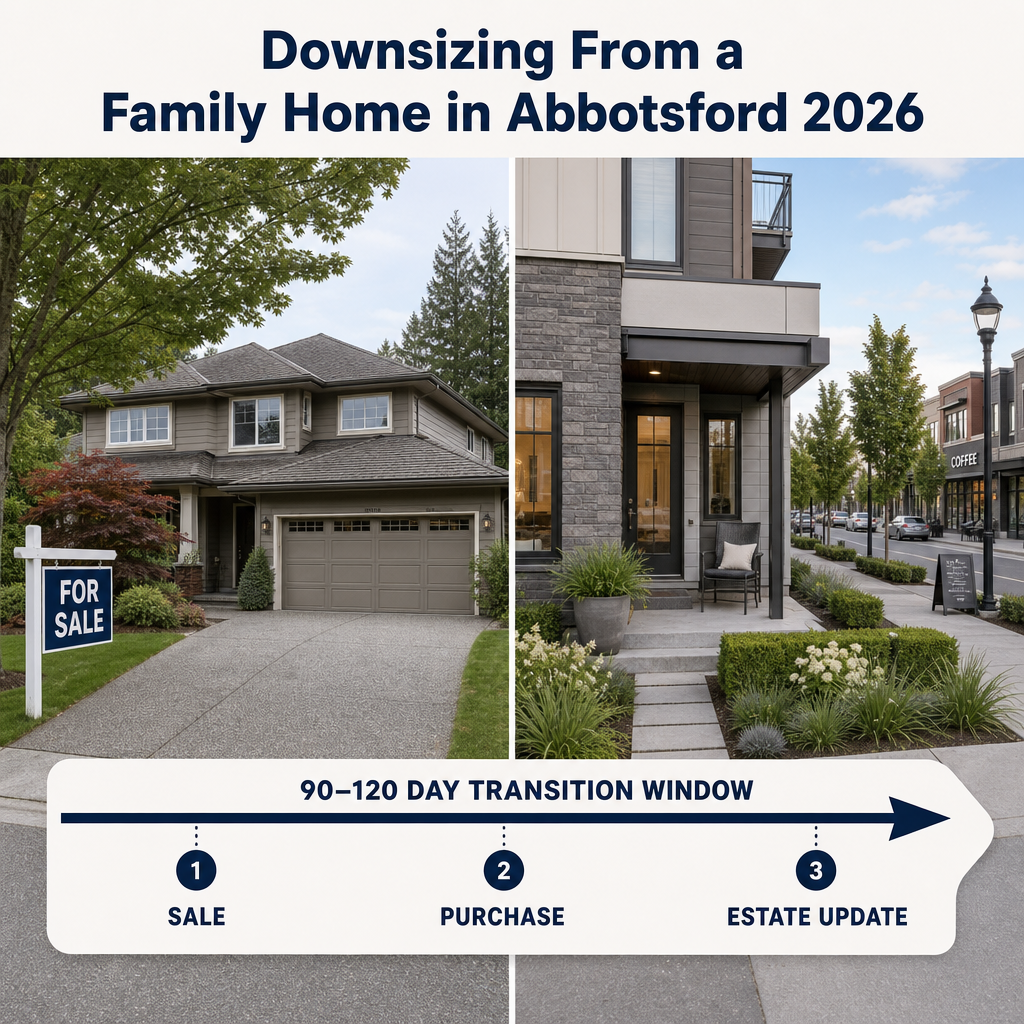

Downsizing From a Family Home in Abbotsford 2026: The Complete Financial, Emotional, and Lifestyle Transition Strategy for Empty Nesters in a Buyer's Market
By Mohamed Mansour, MBA and Associate Broker | Mansour Real Estate Group | Fraser Valley and Lower Mainland | Published: May 14, 2025 | Topic: Downsizing · Abbotsford · Life-Event Sales · Estate Coordination
For many Abbotsford families, the decision to downsize from a family home they've lived in for 20 or 30 years is one of the most consequential financial moves they will make. In 2026, that decision is happening inside a buyer's market — one with elevated inventory, declining year-over-year prices, and extended days-on-market — which changes the financial math, the timing pressure, and the strategic priorities entirely.
This guide is for empty nesters navigating the full picture at once: how to price and sell the family home without leaving equity behind, which property types actually match this stage of life, how to coordinate the sale with estate planning, and how to manage the emotional weight of leaving a home that raised a family. Each piece connects to the others. Handled together, they produce a better outcome.
Short Answer
Abbotsford empty nesters downsizing in 2026 are selling into a buyer's market with 45% above-average inventory and 7–8% year-over-year price declines. Success depends on realistic pricing from day one, selecting the right replacement property type, and coordinating the sale with estate plan updates within a 90–120 day window — before carrying costs and summer competition erode the financial advantage.
Key Takeaways
- Abbotsford's buyer's market rewards realistic pricing — emotional overpricing by 10–15% is the single biggest driver of extended market time and lost net proceeds.
- Equity extraction from $700K–$900K family homes to $400K–$550K condos or townhomes can reach $200K–$400K after transaction costs are properly accounted for.
- Every month of unnecessary carrying time costs $1,500–$2,500 in mortgage interest, taxes, and utilities — aggressive pricing is often worth more than holding for a higher list price.
- The 90–120 day coordination window — family home sale, replacement property purchase, and estate plan updates — is the optimal structure for minimizing tax exposure and duplicate costs.
- Condo and townhome buyers in Abbotsford have completely different priorities than family home buyers; marketing strategy, staging, and pricing must shift accordingly.
Who This Applies To
- Empty nesters in Abbotsford whose children have left home and whose family home now exceeds their practical needs
- Homeowners aged 55–75 holding significant equity in an Abbotsford detached property and considering a transition to condo or townhome living
- Couples or individuals planning to reduce maintenance burden, extract equity, or relocate closer to services and family
- Families beginning to coordinate real estate decisions alongside estate planning, RRSP/RRIF strategy, or future care planning
When This Advice May Not Apply
This guidance is general in nature. It does not apply to homeowners with strata bylaw restrictions affecting their specific property, unique legal or tax circumstances, or properties subject to ongoing estate or family law proceedings. Consult a qualified real estate lawyer, accountant, and financial planner before acting on any specific decision.
Data Used in This Article
- FVREB Market Statistics, April 2026 — Abbotsford sales-to-active ratio, days-on-market by property type (Official)
- BC Assessment 2026 — Abbotsford benchmark price trends and year-over-year variance (Official)
- BC Government — Property Transfer Tax Calculator 2026 — PTT thresholds and rates (Official)
- CRA — Principal Residence Exemption Rules — Capital gains tax timing for multi-property transitions (Official)
- CMHC — Empty Nesters and Downsizing Demographics 2025–2026 — Housing preference shifts (Tier 2)
- Statistics Canada Census Data — Abbotsford age demographics (Official)
- Mansour Real Estate Group — Downsizing client net proceeds analysis, Abbotsford 2024–2026 (Internal professional analysis)
Understanding Abbotsford's 2026 Buyer's Market
According to FVREB market statistics for April 2026, Abbotsford is carrying approximately 45% above-average active inventory relative to historical norms, with year-over-year benchmark prices down 7–8% for detached homes. Days-on-market for family homes have extended meaningfully compared to 2022–2023 peak conditions. This is a buyer's market by any standard measure.
For downsizers, this creates a specific challenge: they are selling an asset class (detached family home) where buyers have negotiating power, while purchasing into a condo or townhome segment where demand from first-time buyers and investors is relatively more stable. The spread between these two market dynamics is actually an opportunity — if the family home is priced and sold decisively.
Abbotsford's position as the easternmost major market in the Fraser Valley also means lower absolute benchmark values compared to Surrey or Langley. According to BC Assessment 2026 data, Abbotsford detached home values typically sit 15–20% below equivalent Surrey properties. This makes transaction cost percentages — realtor commission, legal fees, PTT — proportionally more significant on the net proceeds calculation, and reinforces the case for accuracy over optimism in pricing.
The Financial Math: What Downsizers Actually Net
The gross equity gap between a $750,000–$850,000 Abbotsford family home and a $430,000–$530,000 townhome or condo looks substantial. The net equity gap, after accounting for all transaction costs, requires honest calculation before decisions are made.
On the sale side: realtor commission in BC typically runs 4–5% of the sale price on a standard structure, plus legal fees of approximately $1,500–$2,500. On a $800,000 sale, that's $32,000–$42,500 in transaction costs before any mortgage payout penalties. On the purchase side: BC's Property Transfer Tax runs 1% on the first $200,000 and 2% on the balance up to $3,000,000 (per the BC Government PTT calculator 2026), adding approximately $8,600–$10,600 on a $480,000 purchase, plus legal fees again.
Total transaction costs for a standard Abbotsford downsize in this price range typically fall between $45,000 and $60,000 — a figure that surprises many sellers who focus only on the gross equity number.
The principal residence exemption under CRA rules generally protects the capital gain on a primary residence from income tax — but timing matters. If a downsizer purchases a replacement property before selling the family home, and both overlap as claimed principal residences in the same calendar year, the exemption calculation requires careful attention. This is a specific area where early consultation with a tax accountant, not a realtor, is essential.
How We Evaluate This
At Mansour Real Estate Group, we approach downsizing transactions by building the net proceeds calculation before any listing price is set. That means mapping out all transaction costs, carrying cost exposure by month, and the realistic sale timeline in current market conditions — not optimal conditions. We then work backward from the target net equity to determine what price the family home must achieve, and what absorption rate in the current Abbotsford market says about the probability of reaching it.
For clients navigating estate plan coordination alongside the sale, we facilitate direct conversations between the real estate timeline and the legal and financial professionals involved, so that completion dates, possession dates, and estate document updates are sequenced rather than colliding.
The Emotional Transition: Why Family Home Attachment Changes the Numbers
In our experience working with Abbotsford downsizers, the single most common driver of extended market time is not a weak buyer pool — it is overpricing rooted in emotional attachment. Homeowners who raised children in a property for 25–35 years have a deeply held sense of what it is worth, and that number is usually 10–15% above what current buyers will pay in this market.
That gap has a direct cost. At $1,500–$2,500 per month in carrying costs (mortgage interest, property tax, utilities), a property that sits on the market for four additional months costs $6,000–$10,000 in direct carrying expenses — and often sells for less than an aggressively priced property would have achieved on day one, because prolonged market exposure creates buyer skepticism.
The practical recommendation is to separate the emotional conversation from the pricing conversation. Acknowledge the value the home holds for the family. Then price the home for the buyer who has never walked those floors and is comparing it against every other property currently active in Abbotsford.
Choosing the Right Replacement Property in Abbotsford
Abbotsford's condo and townhome market has expanded meaningfully in the past decade, with newer strata developments concentrated along the Highway 1 corridor, near Highstreet Shopping Centre, and in the South Abbotsford area. For downsizers, the property type decision comes down to three practical variables: accessibility needs now and in the next 10–15 years, walkability and proximity to services, and strata financial health.
Ground-floor condos and single-level townhomes with no-step entries are generally the strongest long-term fit for buyers in the 60–75 age range. Elevator access matters for multi-storey buildings. Proximity to medical services, transit, and daily retail is consistently ranked higher by this buyer profile than square footage or parking, according to CMHC's 2025–2026 demographic research on empty nester housing preferences.
On the strata side, a Form B Information Certificate and a current depreciation report are non-negotiable review items before any purchase. Older Abbotsford strata buildings built before 2000 carry higher special levy risk, and a building without a funded depreciation reserve is a financial exposure that should factor directly into the offer price. A strata lawyer review of the minutes from the past two years is money well spent. For more on evaluating strata documents and what they reveal about a building's financial health, that due diligence process is worth understanding before any offer is made.
Coordinating the Sale With Estate Planning
A major home sale is often the right moment to review and update an estate plan. Power of attorney documents, beneficiary designations on registered accounts, and RRSP-to-RRIF conversion timing all interact with a large liquidity event. In our experience coordinating downsizing transactions alongside clients' legal and financial advisors, the 90–120 day window — from listing to completion on the family home, through to possession of the replacement property — is a realistic and efficient window for completing these updates in parallel.
Specifically: if the family home sale proceeds are being directed toward a new purchase, an investment account, or a TFSA contribution, the sequencing of those transfers interacts with annual contribution limits and potential tax implications. This is not legal or tax advice — it is a flag that this conversation belongs on the agenda with a qualified accountant and estate lawyer before the sale closes, not after. For a broader view of how estate planning intersects with a major property sale, early coordination matters significantly.
Downsizing Checklist
- Commission a net proceeds calculation — gross equity minus all transaction costs, PTT, and carrying cost exposure — before setting a list price
- Obtain a current market analysis for the family home anchored to sold comparable properties in the past 60 days, not list prices
- Begin the declutter and staging process 6–8 weeks before listing; oversized furniture and personal collections reduce buyer pool
- Identify target replacement property types and neighbourhoods before listing — avoid making the family home sale contingent on an undefined purchase
- Request Form B and depreciation report on any strata property before submitting an offer; review with a strata lawyer if significant deferred maintenance is indicated
- Book a session with an estate lawyer and accountant within the first 30 days of the listing process to review POA, beneficiary designations, and sale proceeds allocation
- Build a realistic transition timeline — sale completion, short-term rental or bridge period if needed, and possession of replacement property — before accepting any offer
What We Commonly See
Overpricing based on assessment value, not market value. BC Assessment values reflect a January 1 snapshot and often lag current market conditions by 12–18 months in a declining market. In our experience, Abbotsford downsizers who anchor their list price to BC Assessment rather than recent comparable sales consistently experience the longest days-on-market and the largest price reductions.
Delayed purchase decisions creating bridging pressure. What often happens is that sellers accept an offer on the family home without having identified a replacement property, then face a compressed timeline to purchase under pressure — often paying more for the condo or townhome than they would have in a planned search. The parallel search, started before the family home is listed, removes that pressure entirely.
Estate plan updates falling off the agenda. A common mistake is treating the real estate transaction and the estate planning review as sequential rather than parallel activities. By the time the family home closes, the window for deliberate planning has often passed, and decisions about proceeds allocation default to inertia rather than strategy.
Questions and Answers
Q: If Abbotsford is a buyer's market, should I wait for conditions to improve before selling?
Waiting assumes conditions improve before carrying costs accumulate and personal circumstances change. In a buyer's market with elevated inventory, prices typically stabilize rather than recover quickly. Each month of delay costs $1,500–$2,500 in carrying expenses while the sale price outlook remains flat or lower.
Q: Does the principal residence exemption fully cover the gain on my Abbotsford family home?
Generally yes, if the home has been your principal residence for all years of ownership. However, the exemption calculation and timing rules are specific — particularly when a replacement property is purchased in the same calendar year. Confirm your specific situation with a CRA-qualified accountant before completing the transaction.
Q: What is the real cost of downsizing in Abbotsford after all fees?
For a typical $800,000 family home sale and $480,000 condo or townhome purchase, total transaction costs typically fall between $45,000 and $60,000 — covering realtor commission, legal fees on both sides, and property transfer tax on the purchase. This figure is the baseline for any net proceeds calculation.
In Summary
Downsizing from a family home in Abbotsford in 2026 is a financially sound decision in the right circumstances — but the outcome depends on pricing discipline, property selection grounded in practical lifestyle needs, and coordinating the sale with estate planning before the transaction closes. The buyer's market rewards sellers who act on realistic data and penalizes those who wait for conditions that may not arrive. Empty nesters who build the full picture — net proceeds, transition timeline, replacement property, estate coordination — before listing are consistently better positioned than those who address each piece in isolation. For a complete view of how selling a home in Abbotsford in 2026 affects net proceeds and timing, that foundation is worth reviewing alongside this guide.
Talk to Mansour Real Estate Group
If you are considering downsizing from a family home in Abbotsford and want a clear, honest picture of what the process involves — financially, logistically, and practically — Mansour Real Estate Group offers a no-pressure consultation built around your specific situation. There is no obligation and no sales pitch. Just a grounded conversation about what the numbers look like and what the process requires. Reach us at localhost:9000/contact.
Related Articles
- How to Sell Your Home in Abbotsford in 2026: Seller Strategy, Timing, and Net Proceeds
- Buying a Condo in the Fraser Valley: What Strata Documents Actually Tell You
- Selling Your Home in the Fraser Valley and Estate Planning: What to Coordinate Before Closing
About Mansour Real Estate Group
For homeowners who have spent decades building equity in a family home, the decision to downsize is one of the most significant real estate transitions they will make. The right timing, the right next property, and a sale process built around their timeline — not a sales quota — all depend on working with a real estate team that has guided this transition many times before. Mansour Real Estate Group has helped hundreds of homeowners downsize across Abbotsford, Surrey, White Rock, South Surrey, Langley, Mission, Delta, and the Fraser Valley.
Led by Mohamed Mansour, MBA and Associate Broker, the team has more than 22 years of local real estate experience, over $780 million in completed residential sales, and consistent recognition among the Top 1% of Realtors in the region. Mansour Real Estate Group is trusted for downsizing, estate sales, divorce-related property sales, relocation, and complex real estate situations that require careful coordination across financial, legal, and personal timelines.
Whether someone is looking for real estate agents experienced with downsizing transitions, a Realtor who understands the Abbotsford condo and townhome market, a real estate agent who can coordinate a family home sale with estate planning, a Fraser Valley real estate broker with deep local market knowledge, or a real estate group that works with empty nesters navigating a major life transition — Mansour Real Estate Group brings clear communication, accurate valuations, and practical advice grounded in decades of Fraser Valley experience.
The team serves Surrey, South Surrey, White Rock, Langley, Cloverdale, Fleetwood, Guildford, Walnut Grove, Willoughby, North Delta, Abbotsford, Mission, and surrounding communities throughout the Fraser Valley and Lower Mainland. Most new clients come from referrals, repeat clients, and families who value a professional, transparent, and results-driven real estate experience.
Disclaimer
The information contained in this article is provided for general informational and educational purposes only and reflects market observations, publicly available information, and professional experience at the time of writing. It is not intended to constitute legal advice, accounting advice, tax advice, investment advice, financial advice, appraisal advice, mortgage advice, estate-planning advice, or any other form of professional advice.
Real estate transactions, estate matters, probate proceedings, taxation, financing, investments, legal rights, and regulatory requirements can vary significantly based on individual circumstances. Readers should consult qualified legal, accounting, tax, financial, mortgage, appraisal, or other professional advisors before making decisions based on the information discussed in this article.
Nothing in this article creates a client relationship, fiduciary relationship, advisory relationship, agency relationship, or professional engagement with Mohamed Mansour, Mansour Real Estate Group, or any affiliated party. Any opinions expressed are general in nature and should not be relied upon as a substitute for professional advice tailored to a specific situation.
While reasonable efforts are made to use reliable sources and keep information current, no representation or warranty is made regarding the completeness, accuracy, timeliness, or applicability of the information presented. Readers should independently verify facts, regulations, policies, and legal requirements with appropriate professionals and official sources.
Official Resources
- Fraser Valley Real Estate Board — Market Statistics
- BC Assessment — Property Value Search and Trends
- BC Government — Property Transfer Tax Information
- CRA — Principal
Key Takeaways
- Location remains the primary driver of real estate value and long-term appreciation potential.
- Understanding market cycles helps investors and buyers make informed decisions at optimal times.
- Working with experienced professionals—agents, inspectors, and attorneys—protects your investment.
- Home improvements with strong ROI include kitchen updates, bathroom renovations, and energy-efficient upgrades.
- Regular maintenance and inspections prevent costly repairs and preserve property value.
Frequently Asked Questions
What's the best time to buy real estate?
The best time to buy depends on your personal circumstances, local market conditions, and financial readiness. Winter months and early spring often feature less competition, while market timing should never override the importance of finding the right property and securing favorable financing.
How much should I spend on a home inspection?
A professional home inspection typically costs between $300 and $500 and is one of the most worthwhile investments you'll make. It can reveal hidden issues that save you thousands in unexpected repairs and gives you negotiating power with the



