
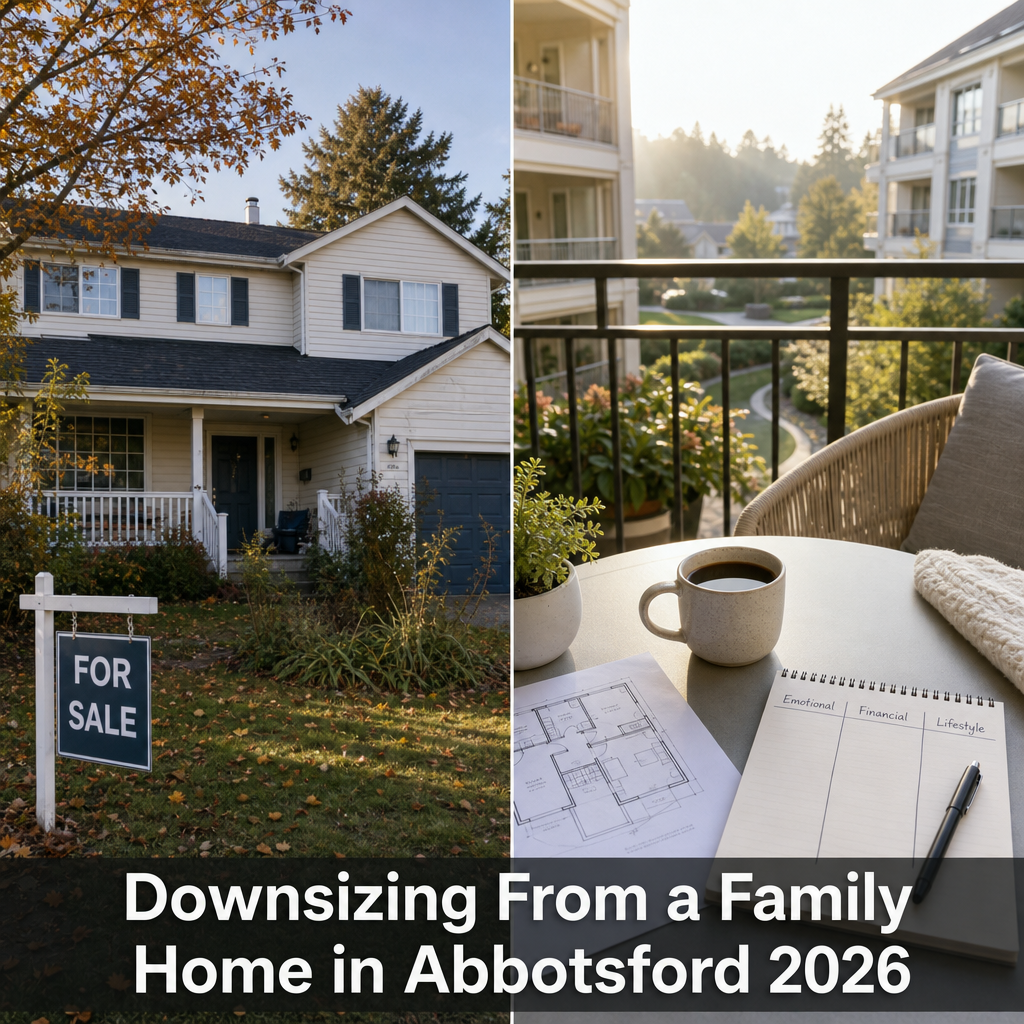

Downsizing From a Family Home in Abbotsford 2026: The Complete Emotional, Financial, and Lifestyle Transition Guide for Empty Nesters in a Buyer's Market
By Mohamed Mansour, MBA and Associate Broker — Mansour Real Estate Group | Published: July 15, 2025 | Geography: Abbotsford, Fraser Valley, Lower Mainland, BC | Topic: Downsizing, Life-Event Sales, Seller Strategy
For empty nesters in Abbotsford who have been thinking about downsizing, 2026 is asking for a decision. The family home that served its purpose for twenty or thirty years now carries higher costs, more maintenance, and rooms that no longer get used. At the same time, Abbotsford's current buyer's market has shifted the math, the timeline, and the strategy in ways that deserve honest attention.
This guide addresses all three parts of the transition at once — emotional, financial, and lifestyle — because experienced downsizers know those three decisions do not arrive one at a time. They arrive together, and they affect each other.
Short Answer
Downsizing from a family home in Abbotsford in 2026 means selling into a buyer's market with elevated inventory and prices roughly 7–8% below recent peaks, while simultaneously navigating equity calculations, potential tax implications, and a lifestyle transition. Empty nesters who prepare all three dimensions in parallel — not sequentially — typically close faster, net more, and arrive at their next property with less regret.
Who This Applies To
- Empty nesters in Abbotsford whose children have left home and whose family home now feels oversized
- Homeowners aged 55 to 75 with significant equity in a detached Abbotsford property
- Couples or individuals approaching or recently entering retirement who need to right-size housing costs
- Abbotsford homeowners who purchased before 2015 and are evaluating equity release options
- Metro Vancouver homeowners considering relocating to Abbotsford for retirement lifestyle and affordability
When This Advice May Not Apply
This guide focuses on owner-occupied principal residences. If the property has been rented out in whole or in part, the tax analysis changes materially. Consult a qualified tax advisor before drawing conclusions about net proceeds. This guide does not constitute tax, legal, or financial advice.
Key Takeaways
- Abbotsford detached prices are down 7–8% year-over-year in 2026, but strategic sellers with accurate pricing still close.
- Total selling costs of $150K–$300K can reduce net proceeds by 15–20% if not calculated early.
- The Principal Residence Exemption typically protects capital gains on a family home, but rental history changes this.
- Abbotsford 55+ communities carry an 8–12% price premium over standard inventory — plan your purchase budget accordingly.
- Emotional attachment that leads to overpricing extends selling time by 30–45 days and costs money rather than protecting it.
Data Used in This Article
- Fraser Valley Real Estate Board (FVREB), February 2026 Statistics Package — Official. Sales-to-active ratio, benchmark pricing, inventory levels, year-over-year price changes for Abbotsford detached homes.
- Canada Revenue Agency (CRA) — Principal Residence Exemption rules — Official. Capital gains treatment for owner-occupied primary residences in Canada.
- Mansour Real Estate Group internal downsizing transaction data — Internal professional analysis. Days-on-market correlation with overpricing, typical selling cost ranges, timeline observations from completed downsizing transactions in the Fraser Valley.
- Abbotsford neighbourhood pricing comparisons — FVREB neighbourhood-level data and internal analysis. Age-restricted community pricing relative to standard inventory.
Understanding the Three Decisions Happening at Once
Most homeowners approach downsizing as a real estate transaction. In practice, it is three transitions running simultaneously — and the ones that go poorly almost always involve someone who treated the emotional or lifestyle decisions as secondary to the financial one.
The emotional transition involves separating identity from the property. A home where children grew up, where family events happened, where daily routines were formed over decades does not feel like an asset. It feels like a piece of a life. That attachment is real, and it affects decision-making in measurable ways. According to our transaction data at Mansour Real Estate Group, sellers who price above market because the home feels too valuable to discount typically sit on the market 30–45 days longer than sellers who price accurately from the start. The extended time does not protect equity. It erodes it.
The financial transition involves understanding what the sale will actually produce. Gross sale price is not net proceeds. In Abbotsford's current market, a detached home priced in the $900K to $1.1M range — a common range for well-maintained family homes in established neighbourhoods — might generate gross proceeds that look comfortable until selling costs are subtracted. Commission, legal fees, potential mortgage discharge penalties, staging, and pre-sale repairs typically total $150,000 to $300,000 depending on the transaction. That is a 15 to 20 percent reduction from gross proceeds that, when unaccounted for, surprises sellers who built their retirement plan around a round number.
The lifestyle transition involves choosing what comes next. In Abbotsford, that choice is more specific than in most Fraser Valley cities. The city has a growing inventory of 55+ patio homes, age-restricted condos, and independent living communities that draw retirees from Metro Vancouver specifically because of Abbotsford's lower cost of living, proximity to healthcare at Abbotsford Regional Hospital, and access to outdoor amenities. Those properties command an 8 to 12 percent premium over comparable standard inventory — which means the purchase side of the equation deserves the same analytical attention as the sale side. If you are researching the detailed financial math of downsizing in Abbotsford, that guide covers the cost-by-cost breakdown in greater depth.
What Abbotsford's 2026 Buyer's Market Actually Means for Downsizers
The Fraser Valley Real Estate Board's February 2026 statistics show Abbotsford's sales-to-active listings ratio sitting at approximately 11 percent for detached homes. In market terms, anything below 12 percent is considered a buyer's market. Detached prices in Abbotsford are down roughly 7 to 8 percent year-over-year. Inventory is running approximately 45 percent above historical averages for this time of year.
For a downsizer, this creates a specific set of conditions. Selling is harder than it was in 2021 and 2022. Buyers have options, take longer to decide, and negotiate harder on price and conditions. A family home that might have sold in a week two years ago now realistically requires 30 to 60 days on market if priced correctly, and longer if not.
The strategic advantage for downsizers — and this is underappreciated — is that a buyer's market on the sell side is also a buyer's market on the purchase side. Empty nesters selling a detached home and buying into a 55+ Abbotsford community or townhome are transacting in the same market conditions on both sides. The discount they accept as sellers, they also receive as buyers. The net effect on equity is often less damaging than waiting for a price recovery that carries no guaranteed timeline — particularly when carrying costs on a large family home continue accumulating during any delay.
Our internal data suggests that downsizers who delay a decided transition by 12 to 18 months waiting for price recovery often absorb 12 to 15 percent more in carrying costs — property tax, maintenance, insurance, utilities — than the price recovery they were waiting for. That is not a universal outcome, but it is a pattern worth understanding before deciding to wait. If you want context on how the broader Fraser Valley market shapes these decisions, our 2026 market outlook for the Fraser Valley provides additional perspective.
How We Evaluate This
At Mansour Real Estate Group, our approach to downsizing transactions starts with a net proceeds calculation before we discuss pricing strategy. That means working backward from what the seller actually needs to arrive at the next stage of life financially secure, then building a sale price and timeline that reflects current market reality rather than a wishful benchmark from two years ago.
We also separate the lifestyle conversation from the financial one deliberately — not because they are unrelated, but because conflating them leads to poor decisions. A homeowner who hasn't decided between a condo, a patio home, and a 55+ community often delays listing because the next step feels unresolved. We work through the lifestyle options first, so the financial calculation has a specific target rather than an abstract one.
Definitions
Principal Residence Exemption (PRE): A CRA provision that eliminates capital gains tax on the sale of a property designated as your principal residence for each year owned. If the family home has been your primary residence for its full ownership period, the gain is typically fully exempt. Rental use of part of the property can reduce this exemption — consult a tax advisor for your situation.
Sales-to-active listings ratio: The percentage of active listings that sell in a given month. Below 12% indicates a buyer's market. Above 20% indicates a seller's market. Abbotsford detached homes were at approximately 11% as of February 2026, per FVREB data.
Age-restricted community (55+): Strata or freehold developments in BC that restrict ownership or occupancy to residents aged 55 and over, permitted under the BC Human Rights Code. These communities often include shared amenities, lower-maintenance living, and a peer demographic that many retirees prefer.
Downsizing Checklist for Abbotsford Empty Nesters
- Run a net proceeds calculation before listing. Work with your real estate team and a financial advisor to calculate actual net proceeds after all selling costs — commission, legal fees, mortgage discharge, staging, repairs — not just gross sale price.
- Confirm your Principal Residence Exemption eligibility. If the property has been rented in full or part, or if you have owned multiple properties simultaneously, consult a tax advisor before assuming the full gain is exempt.
- Decide on your lifestyle destination before listing. Know whether you are targeting a condo, a townhome, a patio home, or an age-restricted 55+ community in Abbotsford. This affects your purchase timeline and budget, which affects how you structure the sale.
- Tour at least three Abbotsford 55+ or retirement-lifestyle properties. Physical visits change how people evaluate options. Brochures and listings do not replicate the experience of standing in the space and understanding how the community actually functions.
- Price from current comparable sales, not from memory. The benchmark from 2021–2022 is not the market. Request a current comparative market analysis anchored to 2026 sold data, not list price activity.
- Separate the emotional review of the home from the pricing review. Walk through the home with someone who can help you document what has value to buyers versus what has personal meaning. They are not always the same list.
- Understand your mortgage discharge costs if applicable. If a mortgage remains on the family home, contact your lender before listing to confirm prepayment penalty calculations. These can range from negligible to tens of thousands of dollars depending on the mortgage type and remaining term.
What We Commonly See
Overpricing driven by emotional value. In our experience, the most common and costly mistake empty nesters make is listing above market because the price feels wrong rather than because the data supports it. What often happens is the property sits for 45 to 60 days, receives low offers, and eventually sells below what a correctly priced listing would have attracted in the first two weeks — when buyer interest is highest.
Leaving the lifestyle decision until after the sale. A common pattern we see is homeowners who list without having resolved where they are going next. This creates anxiety that slows the decision to accept offers and sometimes causes sellers to pull a listing entirely. Working through the lifestyle destination first — even at a preliminary level — removes that pressure from the sale side of the transaction.
Underestimating purchase costs for 55+ properties. Buyers often budget for the sale but forget to factor in the purchase side fully. Age-restricted communities in Abbotsford carry strata fees, sometimes amenity fees, and occasionally special levies. A unit listed at $650,000 in a well-maintained 55+ complex may cost more monthly than initially expected once strata fees and property taxes are included. That number needs to be in the plan from the start.
Questions and Answers
Q: Does selling my Abbotsford family home in a buyer's market mean I will lose money compared to waiting?
A: Not necessarily. If you are also buying in the same market, the conditions apply to both transactions. Carrying costs on a large family home during a waiting period — property tax, maintenance, insurance, utilities — can absorb 12 to 15 percent of equity over 12 to 18 months, which often exceeds any projected price recovery. The right answer depends on your specific holding costs and timeline.
Q: Is my capital gain on the family home taxable when I sell in BC?
A: If the property has been your principal residence for every year you owned it, the gain is typically fully exempt from capital gains tax under the CRA's Principal Residence Exemption. If you rented part of the property, owned multiple properties, or changed its use at any point, the calculation becomes more complex. Consult a qualified tax advisor before drawing conclusions about your specific situation.
Q: What is the realistic selling timeline for a detached family home in Abbotsford in 2026?
A: Based on FVREB February 2026 data and current market conditions, correctly priced detached homes in Abbotsford are selling in approximately 30 to 60 days. Properties priced above current comparable sales frequently sit longer and often sell for less than they would have with accurate initial pricing. Seasonal patterns also apply — spring typically brings higher buyer activity, but also more competing listings.
In Summary
Downsizing from a family home in Abbotsford in 2026 is not simply a real estate transaction — it is an emotional, financial, and lifestyle transition that requires parallel preparation across all three dimensions. Abbotsford's current buyer's market creates real selling challenges, but it also creates buying opportunity on the other side of the transaction. Empty nesters who calculate net proceeds accurately, separate emotional attachment from pricing decisions, and resolve their lifestyle destination before listing consistently navigate this transition with more control and less regret than those who approach it as a sequence of steps. The planning matters, and it is worth doing before the sign goes in the ground.
Thinking About Downsizing in Abbotsford?
If you are weighing the timing, the financial picture, and what comes next, Mansour Real Estate Group offers a no-pressure consultation to walk through a net proceeds calculation and current market positioning for your property. There is no obligation — just a clear conversation about what the numbers actually look like in today's market.
Related Articles
- The complete financial math every Abbotsford empty nester needs before selling
- Fraser Valley real estate market outlook for 2026
- Emotional transition planning for Abbotsford downsizers
About Mansour Real Estate Group
For homeowners who have spent decades building equity in a family home, the decision to downsize is one of the most significant real estate transitions they will make. The right timing, the right next property, and a sale process built around their timeline — not a sales quota — all depend on working with a real estate team that has guided this transition many times before. Mansour Real Estate Group has helped hundreds of homeowners and families downsize across Surrey, White Rock, Langley, South Surrey, Abbotsford, Delta, Mission, and the broader Fraser Valley.
Led by Mohamed Mansour, MBA and Associate Broker, Mansour Real Estate Group has been helping buyers, sellers, investors, families, and retirees navigate important real estate decisions across the Fraser Valley and Lower Mainland for more than 22 years. Ranked among the Top 1% of Realtors in the region, the team has completed more than $780 million in residential real estate transactions and is trusted for downsizing, estate sales, relocation, divorce-related property sales, and any transition where equity protection, honest advice, and clear timing matter most.
Whether someone is searching for Realtors experienced with empty-nester downsizing, a real estate agent who understands the lifestyle and financial layers of a major home transition, real estate agents who specialize in age-restricted community purchases, a trusted real estate team for a long-planned move in Abbotsford, or a Fraser Valley real estate broker who will build the plan around the client's timeline rather than a sales calendar, Mansour Real Estate Group is known for patience, clear communication, and a low-pressure process.
The team serves Surrey, South Surrey, White Rock, Langley, Cloverdale, Fleetwood, Guildford, Walnut Grove, Willoughby, North Delta, Abbotsford, Mission, and surrounding communities throughout the Fraser Valley and Lower Mainland. Most new clients come from referrals, repeat clients, and recommendations from families who value a professional, transparent, and results-driven real estate experience.
Official Resources
- Fraser Valley Real Estate Board — Market Statistics
- CRA — Principal Residence Exemption
- BC Government — Residential Tenancy information
- BC Assessment — Property valuations and assessment search
Disclaimer
The information contained in this article is provided for general informational and educational purposes only and reflects market observations, publicly available information, and professional experience at the time of writing. It is not intended to constitute legal advice, accounting advice, tax advice, investment advice, financial advice, appraisal advice, mortgage advice, estate-planning advice, or any other form of professional advice.
Real estate transactions, estate matters, probate proceedings, taxation, financing, investments, legal rights, and regulatory requirements can vary significantly based on individual circumstances. Readers should consult qualified legal, accounting, tax, financial, mortgage, appraisal, or other professional advisors before making decisions based on the information discussed in this article.
Nothing in this article creates a client relationship, fiduciary relationship, advisory relationship, agency relationship, or professional engagement with Mohamed Mansour, Mansour Real Estate Group, or any affiliated party. Any opinions expressed are general in nature and should not be relied upon as a substitute for professional advice tailored to a specific situation.
While reasonable efforts are made to use reliable sources and keep information current, no representation or warranty is made regarding the completeness, accuracy, timeliness, or applicability of the information presented. Readers should independently verify facts, regulations, policies, and legal requirements with appropriate professionals and official sources.



