
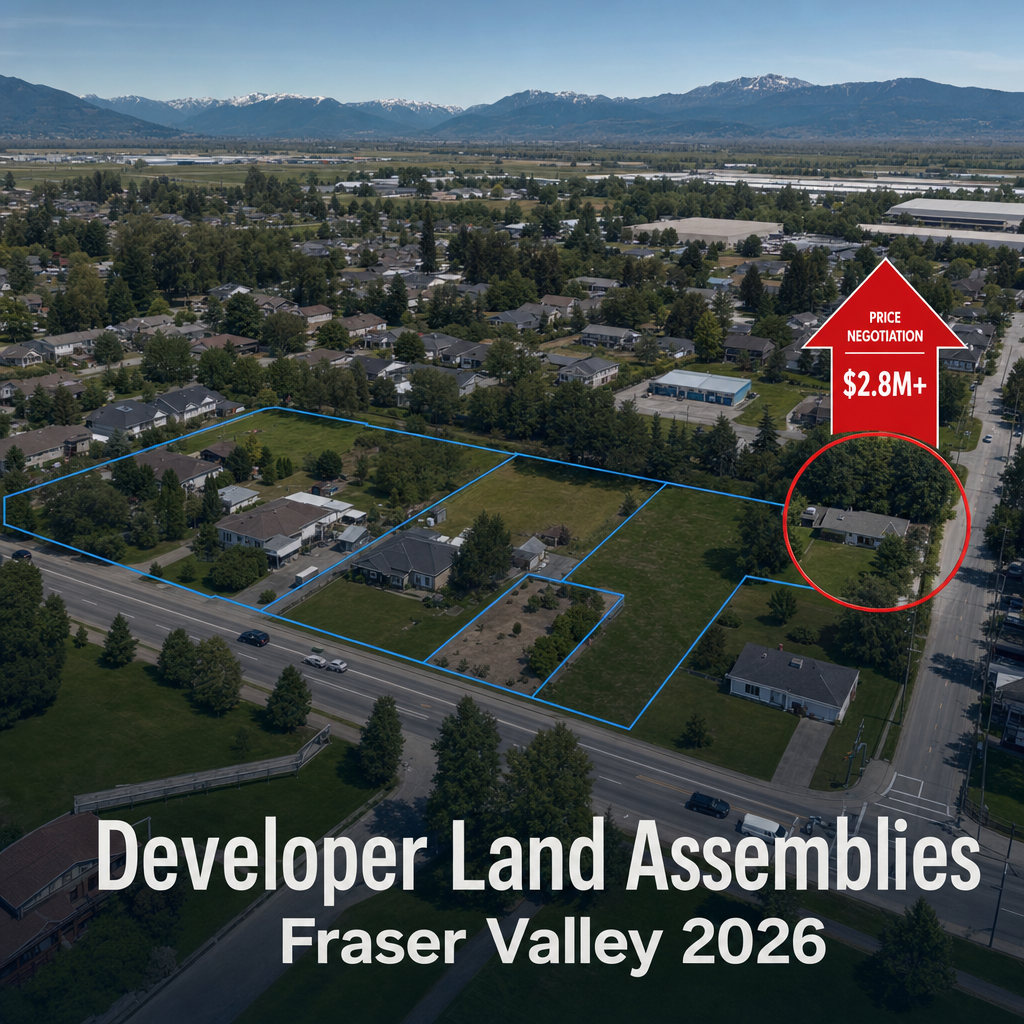

Developer Land Assemblies and Strategic Holdout Negotiation in the Fraser Valley 2026: How Sellers Can Identify Neighbourhood Targeting, Evaluate Premium Offers, and Maximize Leverage
By Mohamed Mansour, MBA and Associate Broker | Mansour Real Estate Group | Published: July 15, 2025 | Fraser Valley, BC
When a developer begins quietly purchasing adjacent properties in your neighbourhood, the rules of a standard residential sale no longer apply. The pricing logic, the negotiation dynamics, and the leverage you hold as a seller change in ways that most homeowners are not prepared for — and that gap in preparation typically costs them money.
This article is written for homeowners in Fleetwood, Cloverdale, Willoughby, Walnut Grove, and other Fraser Valley corridors where developer-driven land assemblies are actively reshaping property values in 2026. Understanding how assemblies work, how to read targeting signals early, and how holdout leverage compounds as an assembly nears completion can be the difference between accepting a tested offer and negotiating the price a developer's own timeline justifies.
Short Answer
When developers target a neighbourhood for a land assembly, individual property owners hold more negotiating power than a standard market sale suggests — especially as the assembly nears completion. Sellers who understand how assembly economics work, what zoning upside justifies, and when holdout leverage peaks can realistically achieve 20–35% above residential comparables. Initial offers rarely reflect the developer's ceiling.
Who This Applies To
- Homeowners in Fleetwood, Cloverdale, Willoughby, Walnut Grove, or Guildford who have received unsolicited purchase inquiries
- Sellers noticing multiple property transactions on their block within a compressed timeframe
- Property owners adjacent to announced transit, hospital, or institutional development projects
- Owners of single-family lots in zones likely to be reclassified under updated Official Community Plans
- Sellers weighing a developer offer against a standard MLS sale without comparative land-value analysis
When This Advice May Not Apply
If no adjacent transactions are occurring, no OCP rezoning activity is near your property, and the offer you received is genuinely isolated, standard residential pricing logic applies. Assembly leverage only exists within an active assembly cluster. It cannot be manufactured or assumed without evidence.
Key Takeaways
- Developer offers in pre-development corridors often carry 20–35% premiums over residential comparables, but initial bids are frequently testing seller urgency, not disclosing the developer's ceiling.
- Holdout leverage compounds as assembly nears completion — the last one to three properties in a cluster command disproportionate premiums because redesign and delay costs escalate with each gap.
- Fleetwood, Cloverdale, and Willoughby are showing 40–60% sales acceleration in targeted clusters, which is a measurable signal sellers can identify before responding to any offer.
- Zoning upside — the density a developer can achieve post-rezoning — is the real valuation ceiling, and residential comparables significantly understate it.
- Sellers who accept initial offers without assembly-stage analysis or comparative land-value review routinely leave 15–30% on the table.
Key Definitions
Land assembly: The coordinated acquisition of multiple adjacent properties by a developer to create a consolidated site large enough to support rezoning and higher-density development.
Holdout leverage: The negotiating power held by a property owner whose parcel is needed to complete a planned assembly. Leverage increases as developers acquire more surrounding properties.
Zoning upside: The increase in density, floor area ratio, or permitted use that a developer anticipates achieving through rezoning after assembly completion.
OCP (Official Community Plan): A municipal policy document that sets out long-range land use designations. Developer assembly targets often align with areas already identified for increased density in the OCP.
Data Used in This Article
- Fraser Valley Real Estate Board MLS activity reports, Cloverdale, Fleetwood, and Willoughby, 2024–2026 (official board data)
- BC Official Community Plan rezoning timelines and SkyTrain Expo Line extension schedules, Surrey City Hall and BC Government (official)
- Surrey Cloverdale SkyTrain station planning documentation, TransLink and City of Surrey (official)
- Comparable developer acquisition and holdout case analysis from Calgary and Edmonton pre-LRT extension corridors (industry reference)
- Professional interpretation by Mansour Real Estate Group based on direct experience in Fraser Valley pre-development transactions
How Assembly Targeting Actually Works
Developers rarely announce an assembly campaign publicly. Instead, they begin with quiet, individual offers — sometimes through numbered companies or holding entities — to test seller urgency and reduce the chance of coordinated holdout negotiation among neighbours. By the time most homeowners realize an assembly is underway, several adjacent properties may already be under contract or sold.
The acquisitions follow a logic tied to rezoning feasibility. Developers typically need a minimum consolidated site area to achieve the density ratio that makes a project financially viable. That threshold varies by municipality and OCP designation, but in Fleetwood and Cloverdale, where the SkyTrain extension and the Surrey Hospital Phase 2 are driving intensification pressure, developers are working toward consolidated sites that can support mid-rise or mixed-use projects under amended zoning.
In Willoughby, the pattern is similar but driven by transit corridor densification. Properties within 400 to 800 metres of planned transit nodes or major institutional developments are the most common early targets. If your property sits in that radius and you have received an unsolicited offer, the first step is not to evaluate the price — it is to determine how many adjacent properties have already transacted.
How to Identify Assembly Targeting Signals
Several signals indicate that your neighbourhood may be under active assembly consideration, and most are verifiable through public records before any offer is received.
Elevated transaction velocity on adjacent parcels. A cluster of sales on properties within one or two blocks of yours within a 12-to-18-month window — especially when those sales transact faster than the neighbourhood average and at prices above residential comparables — suggests coordinated acquisition. FVREB MLS activity data for Fleetwood, Cloverdale, and Willoughby shows 40–60% sales acceleration in developer-targeted clusters compared to surrounding streets. That divergence is measurable and visible before any offer arrives at your door.
OCP rezoning alignment. When Surrey, Langley Township, or Abbotsford publishes updated Official Community Plans identifying your block for increased density, mixed-use, or transit-oriented development, developer interest follows quickly. Reviewing the applicable OCP designation for your property is a step most homeowners skip entirely. It is also one of the most useful indicators of whether a developer offer reflects speculative interest or a funded, near-term acquisition campaign.
Numbered company purchasers on title. When properties on your street begin transferring to numbered BC companies or holding entities with no retail branding, that is a standard indicator of a developer assembly. BC Land Title records are public, and a title search on recently sold adjacent properties can confirm whether acquisition is consolidated under a single controlling entity.
Unsolicited direct outreach. If a representative contacts you directly — by letter, phone, or door knock — without a listing agent introduction, that is itself an assembly signal. Developers prefer to acquire properties before they reach the open market, which is precisely why they approach owners directly rather than through MLS.
How Holdout Leverage Works — and When It Peaks
Holdout leverage is not constant throughout an assembly campaign. It grows as the developer acquires more surrounding properties and approaches the minimum threshold needed for rezoning approval. Understanding where you sit in that curve is the core of assembly negotiation strategy.
Early in an assembly — when the developer is acquiring the first third of their target site — individual sellers hold moderate leverage. The developer has alternatives. They can adjust the site boundary, substitute properties, or abandon the concept if costs escalate too quickly. Sellers at this stage typically capture 20–25% above residential comparables if they negotiate with full knowledge of what the offer represents, but they are not yet in a structurally dominant position.
Mid-assembly, as the developer acquires the majority of the target cluster, leverage builds. The developer has now committed capital, carried acquisition costs, and often engaged architects, consultants, and a rezoning timeline. Abandoning the site would mean realizing losses on properties already acquired. Sellers in the middle of an assembly have real leverage, but the developer still has some flexibility in site design.
Late-stage holdout — the final one to three properties in a planned cluster — is where leverage peaks structurally. The developer cannot complete the site without those parcels. Redesigning around a holdout is expensive, sometimes technically impossible, and often delays project approvals by months or years. In comparable Canadian markets where transit-adjacent assemblies have been studied — Calgary's LRT expansion corridors and Edmonton's pre-development densification zones — late-stage holdouts have historically negotiated premiums 30–50% above early-acquisition prices within the same assembly. The Fraser Valley context differs in specific numbers, but the structural principle is the same.
Importantly, leverage at this stage is time-bounded. Developers facing rezoning deadlines or pre-sale financing requirements cannot wait indefinitely. That time pressure is real leverage — but only if you know the developer's timeline and have not signalled urgency on your own side.
How to Evaluate a Developer Offer — The Right Framework
The mistake most sellers make when evaluating a developer offer is comparing it to residential comparables. That comparison is structurally wrong. A developer is not buying your home as a residential property. They are buying it as a component of a developable land parcel, and the value they can justify is grounded in the density potential of the assembled site, not the value of your current structure.
The relevant benchmarks for evaluating a developer offer are: the price per square foot of assembled land for comparable pre-development parcels in the corridor; the density ratio that rezoning is expected to unlock; the developer's projected revenue from the completed project relative to total land acquisition costs; and the stage of the assembly at the time the offer is made. None of those figures appear in a standard CMA.
A properly framed land-value analysis for a pre-development parcel in Fleetwood or Cloverdale — particularly near planned SkyTrain stations or the hospital site — will typically produce a valuation materially above residential comparables and above initial developer offers. The gap between the developer's first offer and the number that a thorough land-value analysis supports is often where the most negotiable room exists. Sellers who do not commission that analysis before responding are negotiating without their most important information.
Fraser Valley Corridor Context: Fleetwood, Cloverdale, Willoughby, and Walnut Grove
Each of these corridors carries distinct assembly drivers that affect both the premium structure and the leverage timeline.
Fleetwood is under intensification pressure from two directions: the SkyTrain Expo Line extension, with planned stations in the Fleetwood area, and the proximity to the Surrey Hospital Phase 2 campus. Properties within transit-oriented development zones designated in Surrey's updated OCP are the primary assembly targets. Developer activity in this corridor has been measurable since late 2023 and has accelerated through 2025 and into 2026, according to FVREB transaction data.
Cloverdale has a planned SkyTrain station under the Expo Line extension to Langley, which creates a clear spatial logic for assembly targeting — properties within walking distance of the planned station footprint. OCP designations in Cloverdale already reflect anticipated transit-oriented density increases, and developer acquisition in the corridor is consistent with pre-LRT land banking behaviour documented in other Canadian cities.
Willoughby in Langley Township is driven by transit corridor densification and has seen consistent intensification through successive OCP amendments. Assembly targets here tend to cluster along major arterials and near institutional anchors rather than rail nodes, which affects both the buyer profile and the zoning upside calculation.
Walnut Grove presents a different dynamic — slower-moving assembly activity driven more by OCP evolution than imminent transit infrastructure, but with a well-established pattern of developer interest in single-family lots along development corridors. Sellers in Walnut Grove should evaluate the current OCP designation for their property before making any disposition decision.
How We Evaluate This
When Mansour Real Estate Group assesses whether a seller in a pre-development corridor is receiving a fair offer, we start with three independent data points: the assembly stage (how many adjacent properties have already been acquired and by whom), the applicable OCP designation and its density implications, and a land-value analysis benchmarked to comparable assembled parcels rather than residential sales. Those three inputs produce a substantially different picture than a standard CMA.
We also evaluate the developer's timeline signals — whether they are operating under rezoning deadlines, financing conditions, or pre-sale requirements that create time pressure — because those signals directly affect how much holdout leverage is practical versus theoretical. Leverage that a seller cannot credibly sustain is not real leverage.
Seller Checklist: Responding to a Developer Assembly Offer
- Review BC Land Title records for adjacent properties to identify recent transfers to numbered companies or holding entities
- Request the current OCP designation for your property from the applicable municipality and confirm whether it identifies your area for rezoning or increased density
- Commission a land-value analysis benchmarked to assembled pre-development parcels in your corridor — not a standard residential CMA
- Do not signal urgency, timeline pressure, or willingness to accept an early offer before completing the analysis above
- Determine your position in the assembly sequence — early, mid, or late stage — before responding to any offer or counter-offer
- Consult a real estate lawyer before signing any agreement, particularly if the offer includes unusual conditions, extended completion timelines, or option structures
- If you share a block with other targeted owners, understand the dynamics of coordinated versus individual negotiation and the implications of each for your specific parcel
What We Commonly See
Sellers accept the first offer without assembly-stage context. In our experience, the most common and costly mistake is treating a developer offer like a residential offer — evaluating it on price relative to neighbourhood sales and responding within standard timelines. A developer's first offer is almost always a test of seller knowledge and urgency, not a reflection of their ceiling. Sellers who respond quickly without analysis almost always accept less than they could have negotiated.
Homeowners underestimate their position late in an assembly. What often happens is that by the time a seller realizes they hold the last remaining parcel in a planned cluster, they have already signalled flexibility through earlier counter-offers or by allowing conditions and timelines to drift. Late-stage holdout leverage is real — but it requires that the seller has not inadvertently undermined it during the earlier phases of negotiation.
Sellers confuse a premium over market value with maximum value. A common mistake is reading "30% above what my neighbour sold for" as confirmation that the offer is generous. That neighbour may have sold early in the assembly at a price the developer was comfortable paying before leverage compounds. The relevant question is not whether the offer beats the residential market — it almost always will. The question is whether it reflects the land value the developer's own project feasibility analysis is based on.
Owners negotiate without legal or strategic representation. In our experience, sellers negotiating developer offers without a real estate lawyer reviewing the contract structure — particularly completion timelines, option clauses, and rezoning conditions — frequently encounter terms that benefit the developer's flexibility at the seller's expense. These terms are negotiable, but only if you identify them before signing.
Questions and Answers
How do I know if my property is part of an active assembly in Fleetwood or Cloverdale?
Check BC Land Title records for adjacent properties. If recent transfers show numbered company purchasers, and multiple adjacent lots have transacted within the past 12 to 18 months, that is a reliable indicator of a coordinated acquisition. You can also review your municipality's OCP to confirm whether your block is designated for increased density — developer assembly campaigns almost always align with designated rezoning areas.
Can I really hold out for more money, or does the developer just walk away?
It depends on your position in the assembly. Early in a campaign, the developer has more flexibility to adjust site boundaries or substitute properties. Late in a campaign — when your parcel is one of the final gaps — the cost of redesigning around you or abandoning committed capital typically far exceeds the cost of meeting your price. Walking away late in an assembly is expensive for a developer. That asymmetry is the source of real holdout leverage.
What is the difference between a developer offer and a standard MLS sale in terms of value?
A standard MLS sale prices your property as a residential asset. A developer offer prices it — or should — as a component of a developable land parcel whose value is based on density potential after rezoning. In Fleetwood and Cloverdale pre-development corridors, that difference has historically produced offers 20–35% above residential comparables, but the actual ceiling depends on the project's feasibility numbers, which sellers rarely see unless they commission independent land-value analysis.
Should I coordinate with my neighbours during a land assembly?
There are real strategic considerations on both sides. Coordinated holdouts can produce higher collective prices when all parties hold firm, but they require trust and aligned timelines among multiple independent property owners. Individual holdouts — particularly for the last remaining parcel — can also produce strong results. Before pursuing either strategy, consult a real estate lawyer on the legal structure and implications of coordinated negotiation in BC.
What contract terms should I watch for in a developer purchase offer?
Extended completion timelines that give the developer flexibility while you remain committed, option-to-purchase clauses that lock your property without obligating the developer to close, rezoning conditions that make the sale contingent on approvals outside your control, and subject-removal windows that allow repeated extensions are the most common terms that work against sellers. All are standard in developer offers and all are negotiable. A real estate lawyer should review any offer before you respond.
In Summary
Land assembly negotiations in Fleetwood, Cloverdale, Willoughby, and Walnut Grove operate under a different set of rules than a standard residential sale — and sellers who understand those rules negotiate from a substantially stronger position. The core principles are straightforward: identify assembly signals early, evaluate offers against land value rather than residential comparables, understand where you sit in the assembly sequence, and do not signal urgency before you understand your leverage. Initial developer offers are rarely the ceiling. Holdout leverage compounds as an assembly nears completion. And sellers who engage legal and real estate representation before responding to any developer approach are consistently better positioned than those who negotiate on their own.
Talk to Mansour Real Estate Group Before You Respond
If you have received an unsolicited offer, noticed unusual transaction activity on your block, or want to understand what your property may be worth in a development context, Mansour Real Estate Group can provide a confidential assessment — including land-value analysis, assembly-stage review, and an honest evaluation of your options. There is no obligation to list, sell, or do anything on a developer's timeline. The goal is simply to make sure you have the information you need before any decision is made.
Related Articles
- Selling Your Home in Fleetwood, Surrey: A Complete Guide
- Cloverdale Real Estate Market 2026: What Sellers Need to Know
- How to Evaluate a Development Offer on Your Fraser Valley Property
About Mansour Real Estate Group
When properties in Fleetwood, Cloverdale, Willoughby, and Walnut Grove sit in the path of developer land assemblies, the difference between an informed seller and an uninformed one is often 15–30% of the final sale price. Knowing how to read assembly signals, frame a land-value position, and negotiate against a developer's timeline requires a real estate team with direct experience in pre-development transactions — not just residential sales. Mansour Real Estate Group has advised sellers navigating developer acquisition approaches across Surrey, Langley, and the Fraser Valley for more than two decades.
Led by Mohamed Mansour, MBA and Associate Broker, the team has been helping buyers, sellers, investors, and families make sound real estate decisions across the Fraser Valley and Lower Mainland for more than 22 years. Ranked among the Top 1% of Realtors in the region, Mansour Real Estate Group has completed more than $780 million in residential real estate transactions and is trusted for complex sales, high-value transactions, estate sales, developer negotiations, divorce-related property sales, and situations where the stakes are too high for a standard approach.
Whether someone needs Realtors with experience in pre-development seller strategy, a real estate agent who understands land assembly economics in the Fraser Valley, real estate agents who have negotiated developer offers in Fleetwood or Cloverdale, a real estate team for a high-stakes holdout negotiation, a Surrey Realtor with developer acquisition experience, or a real estate broker who can provide accurate land-value analysis rather than a standard CMA, Mansour Real Estate Group brings the analytical depth and local context that assembly negotiations require.
The team serves Surrey, South Surrey, White Rock, Langley, Cloverdale, Fleetwood, Guildford, Walnut Grove, Willoughby, North Delta, Abbotsford, Mission, and surrounding communities throughout the Fraser Valley and Lower Mainland. Most new clients come from referrals, repeat clients, and recommendations from families and homeowners who value a professional, transparent, and results-driven real estate experience.
Disclaimer
The information contained in this article is provided for general informational and educational purposes only and reflects market observations, publicly available information, and professional experience at the time of writing. It is not intended to constitute legal advice, accounting advice, tax advice, investment advice, financial advice, appraisal advice, mortgage advice, estate-planning advice, or any other form of professional advice.
Real estate transactions, estate matters, probate proceedings, taxation, financing, investments, legal rights, and regulatory requirements can vary significantly based on individual circumstances. Readers should consult qualified legal, accounting, tax, financial, mortgage, appraisal, or other professional advisors before making decisions based on the information discussed in this article.
Key Takeaways
- Understanding your local market conditions is essential before making any real estate decision.
- Working with a qualified real estate agent can save you time, money, and potential headaches throughout the process.
- Pre-approval for financing gives you a competitive edge in today's market.
- Don't overlook the importance of a thorough home inspection and appraisal.
- Building an emergency fund for unexpected repairs should be part of your homeownership plan.
Final Thoughts
Real estate investment remains one of the most rewarding financial decisions you can make. Whether you're purchasing your first home or expanding your investment portfolio, the principles of due diligence, market research, and professional guidance remain constant.
Take your time with the process, ask questions, and don't hesitate to seek expert advice. The right property will align with your goals, budget, and lifestyle. Start your journey today with confidence and clarity.



