
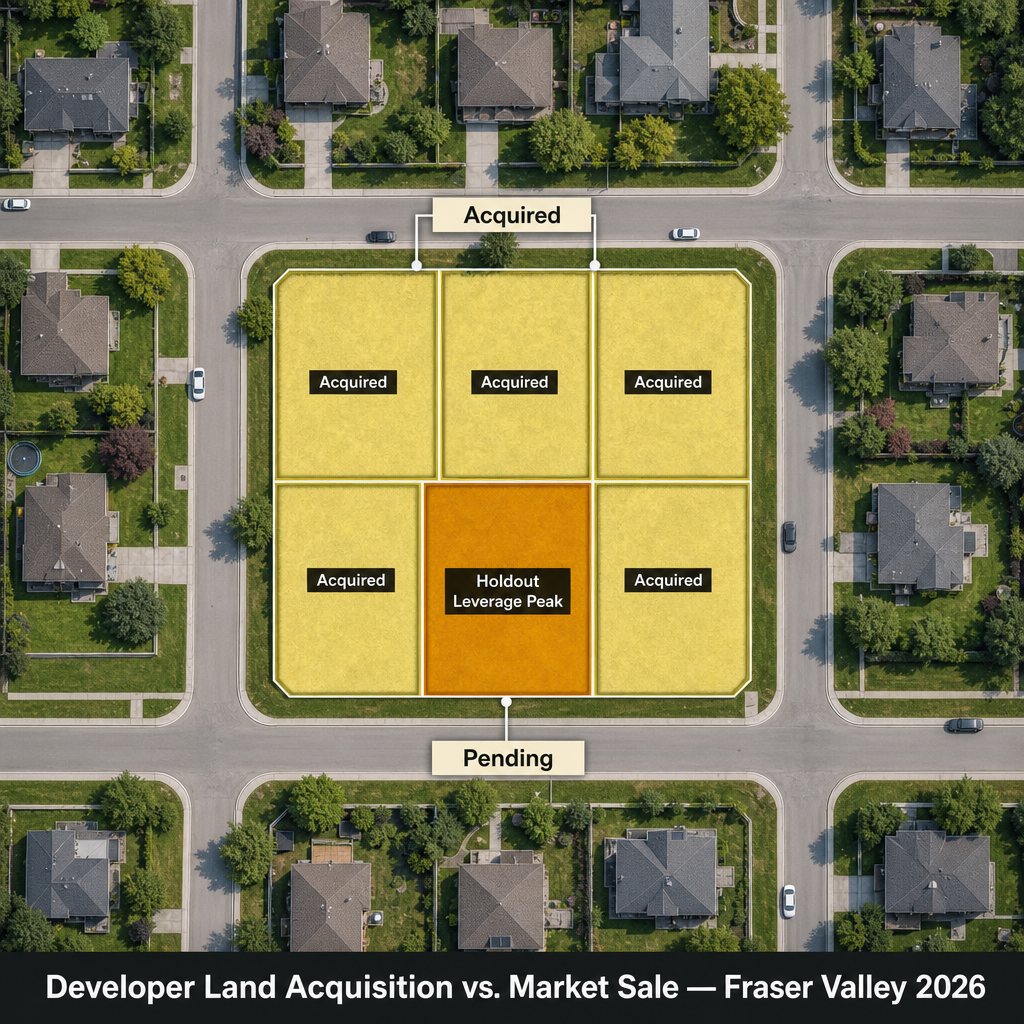

Developer Land Acquisition vs. Market Sale in the Fraser Valley 2026: How to Identify Neighbourhood Targeting, Evaluate Premium Offers, Understand Assembly Strategies, and Maximize Proceeds
By Mohamed Mansour, MBA and Associate Broker — Mansour Real Estate Group | Fraser Valley and Lower Mainland | Published: July 15, 2026
Fraser Valley homeowners in Surrey, Langley, and Abbotsford are increasingly receiving unsolicited offers from developers — often described as "off-market opportunities" that arrive before a listing ever goes live. Some of those offers are genuinely above market. Others are not. The difference between accepting a fair premium and leaving significant equity on the table comes down to one thing: understanding where your property sits in a developer's acquisition strategy before you respond.
This article explains how to recognize developer targeting patterns, evaluate the math behind assembly premiums, identify when your leverage is highest, and decide whether an off-market developer sale or an open-market listing serves your financial interests better in current Fraser Valley conditions.
Short Answer
Developer land assemblies in the Fraser Valley can yield 15–40% above comparable retail sales — but only when sellers understand the assembly pattern, the rezoning timeline, and when holdout leverage peaks. Sellers who accept the first offer without independent valuation often receive less than market, not more. The negotiation arc matters as much as the offer itself.
Who This Applies To
- Homeowners in Surrey (Guildford, Fleetwood, Newton), Langley (Willoughby, Walnut Grove), or Abbotsford who have received an unsolicited developer inquiry or off-market offer
- Sellers on or near transit corridors, rezoning application zones, or municipal intensification nodes
- Owners of older detached homes on lots that are larger than average for the neighbourhood
- Homeowners who have noticed multiple nearby properties being purchased by numbered companies or the same buyer agent in recent months
- Executors or estate administrators holding a property that may have been identified for development potential
When This Advice May Not Apply
If your property is in a stable single-family zone with no rezoning activity nearby, developer assembly dynamics likely do not apply. Similarly, if the lot is too narrow, has access constraints, or is adjacent to non-residential uses that limit assembly geometry, holdout leverage may be limited regardless of neighbourhood activity. An independent assessment matters before assuming development potential.
Key Takeaways
- Developer assembly premiums of 15–40% above market are achievable, but only when sellers engage from an informed position with independent valuation support
- Holdout leverage peaks when a developer controls 50–75% of a target cluster — that is the optimal negotiation window
- After 85%+ of a cluster is assembled, leverage shifts entirely to the developer, who can afford to wait out remaining owners
- Off-market developer offers often arrive during soft market conditions deliberately — sellers facing slow retail markets are more likely to accept below-potential offers
- Rezoning uncertainty is negotiating room: sellers can use zoning risk to push for price protection clauses or higher certainty premiums
Data Used in This Article
- Fraser Valley Real Estate Board (FVREB) — market statistics and sales-to-active ratio data, 2025–2026 (official board data)
- Fraser Valley Regional District and municipal Official Community Plans — rezoning application corridors and intensification nodes, 2024–2026 (official planning documents)
- BC Land Title Office — assembly pattern tracking for Surrey, Langley, and Abbotsford, 2025–2026 (public registry data)
- Mansour Real Estate Group internal analysis — developer sale and assembly negotiation observations in the Fraser Valley (professional experience, not a substitute for independent legal or appraisal advice)
Why 2026 Is a Distinct Moment for Developer Activity in the Fraser Valley
Fraser Valley municipalities are processing rezoning applications at a pace not seen in recent cycles. Surrey's Fleetwood and Guildford corridors are being reshaped around the SkyTrain extension, with transit-oriented development nodes requiring multi-property assemblies to meet minimum site size requirements for six-storey and higher residential projects. Langley's Willoughby and Walnut Grove growth areas, combined with Abbotsford's downtown and highway interchange corridors, are experiencing parallel intensification driven by BC's housing legislation and municipal OCP amendments.
According to Fraser Valley Regional District and municipal planning documents reviewed through 2026, rezoning timelines for assembly projects are running three to eighteen months depending on complexity. Developers acquiring land today are pricing for 2027–2029 approval and construction windows. That forward pricing is where assembly premiums come from — and where informed sellers can capture value that uninformed sellers leave behind.
The current retail market context adds a layer of complexity. With the FVREB reporting a sales-to-active listings ratio near 11% through early 2026 — a buyer's market threshold — many sellers are psychologically primed to accept offers quickly. Developers understand this dynamic. Off-market offers frequently arrive precisely when retail conditions are weakest, when a homeowner's confidence in achieving full market value is lowest. That is not a coincidence.
How to Recognize Developer Targeting Patterns
Developer assembly targeting follows recognizable patterns. The most reliable signal is a cluster of recent sales in your immediate block or corridor where the registered buyer is a numbered company, a holding company, or a name that differs across transactions but shares the same legal representative or notary. BC Land Title Office records are public, and a quick review of recent title transfers within a two-to-three block radius can reveal whether systematic acquisition is underway.
Other signals include: unsolicited letters or door knocks from buyer's agents representing unnamed clients; municipal rezoning application notices for nearby parcels; developer announcements referencing your neighbourhood's corridor; and unusually fast sales of neighbouring properties that did not appear on MLS. In Fleetwood and Guildford, where SkyTrain-adjacent assemblies are active, understanding the local sale context before engaging with any buyer is foundational.
If two or more of these signals are present simultaneously, your property may already be identified as part of a target cluster. That changes the negotiation framework entirely.
The Assembly Premium: What the Math Actually Looks Like
Developer land valuation is fundamentally different from retail home valuation. A developer purchasing your property is not paying for the structure — they are paying for land area, lot geometry, proximity to other acquired parcels, and the probability-weighted value of what can be built after rezoning. In current Fraser Valley conditions, teardown land valuations typically fall between 70–85% of total property value for older detached homes, with the remaining value attributed to the structure (which the developer will demolish).
When a developer assembles three to seven adjacent properties, the combined site unlocks development density that no single lot could achieve. That density uplift is what creates assembly premiums. A property worth $1.4 million on the retail market may be worth $1.65 million to $1.85 million to a developer assembling a six-property site — but only if the seller negotiates from an informed position with comparable land data, not retail home comparables.
The critical distinction: retail comparables reflect what buyers pay for homes to live in. Developer comparables reflect what land is worth when zoning potential is unlocked. Those are two separate analyses. Sellers who allow developers to anchor negotiations to retail comparables are leaving the most meaningful portion of the premium unrealized. For sellers in areas like Willoughby or Guildford where both markets are active, understanding which framework applies to your specific lot is essential before any offer response.
Understanding Holdout Leverage: When Your Negotiating Power Peaks
The most important concept in developer assembly negotiations is holdout leverage — and it is time-sensitive in a way most sellers do not fully appreciate. When a developer controls fewer than half the properties in a target cluster, they need every seller and have limited ability to apply pressure. As assembly progress crosses 50%, remaining sellers gain leverage because the developer has sunk capital into the project and cannot easily pivot to an alternative site. That leverage peaks in the 50–75% assembly window.
Once a developer controls 85% or more of a target cluster, the dynamic reverses. At that point, the developer has typically secured financing commitments, submitted or advanced rezoning applications, and can afford to wait — sometimes years — for remaining holdouts to sell. The holdout who waits too long does not necessarily get more money; they may end up negotiating from a position of isolated pressure with no other buyers for their property. Knowing where a developer sits in their assembly arc before you respond to any offer is one of the highest-value pieces of information a seller can have. This is one of the primary reasons timing and market context matter so differently in developer transactions than in retail sales.
How We Evaluate This
When Mansour Real Estate Group works with a seller who has received or anticipates a developer inquiry, the first step is not to respond to the developer. It is to establish an independent picture of retail market value, land value in the development context, and where the seller's property sits in any visible assembly pattern. That means reviewing recent title transfers in the surrounding block radius, cross-referencing municipal rezoning applications and OCP amendments for the relevant corridor, and analyzing land sale comparables — not just retail home comparables — for similar lots in comparable assembly situations.
From that baseline, the negotiation strategy depends on timing. A seller at the peak of their holdout leverage window needs a different approach than a seller whose neighbours have already sold and who is one of the last remaining parcels. We also review offer structure carefully: developer offers often include conditions tied to rezoning approval, phased closing timelines, or assignment rights that can materially affect net proceeds and certainty of close. The offer price is only one variable.
Developer Sale vs. Open Market: The Decision Framework
Not every property with development potential is best sold directly to a developer. In some cases, listing on the open market attracts competing developer interest that drives the price higher than any single off-market offer would have reached. In other cases — particularly when a seller wants certainty of close, a flexible timeline, or minimal disruption — a well-negotiated developer sale is the better outcome even if the theoretical open-market ceiling is slightly higher.
The factors that typically favour a direct developer transaction include: confirmed assembly activity already underway, a seller who needs timeline flexibility that the retail market cannot offer, or a property type (older detached, unusual lot geometry, deferred maintenance) where retail presentation costs are high and buyer pool is narrow. The factors that favour open-market listing include: early-stage assembly where developer interest is exploratory rather than committed, multiple developers known to be active in the corridor, and a property that presents well enough to attract both retail and developer buyers simultaneously — creating genuine competition.
Rezoning Risk as a Negotiating Variable
Developers price offers on the assumption that rezoning will be approved. Fraser Valley rezoning timelines currently range from three to eighteen months, and approval is not guaranteed. That uncertainty is negotiating room for sellers. A seller who understands this dynamic can push for: a higher base price that does not depend on rezoning outcome; a price adjustment mechanism if rezoning is approved within a defined window; or a hard close date that removes the developer's ability to tie up the property indefinitely under conditional terms. Sellers who do not understand rezoning risk often sign agreements that allow developers to extend conditions for months while the seller's property is effectively off the market — at no cost to the developer.
Seller Checklist: Developer Offer Evaluation
- Before responding to any developer inquiry, obtain an independent retail market valuation from a local Realtor with Fraser Valley experience
- Review BC Land Title Office records for your block to identify how many adjacent properties have transferred to numbered or holding companies in the past 12–24 months
- Check current Fraser Valley Regional District and municipal rezoning application maps for your address and corridor
- Ask any developer buyer's agent to identify their client — if they decline, treat that as a signal that assembly is underway and your leverage may be higher than the offer reflects
- Review offer conditions carefully: note any rezoning conditions, assignment rights, extended subject removal periods, or phased closing provisions
- Request land-use comparables (not just retail home sales) for similar properties sold in assembly contexts in your corridor
- Consult a real estate lawyer before signing any developer offer — the contract structure in assembly transactions differs materially from standard residential purchase contracts
What We Commonly See
Sellers accept the first offer without a retail baseline. In our experience, the most common mistake is responding to a developer offer without first establishing what the property would sell for on the open market. Without that baseline, there is no way to evaluate whether the premium being offered is real or illusory. Some developer offers in slow retail markets are actually below what the property would achieve on MLS.
Sellers misread the assembly arc. What often happens is that sellers assume they have maximum leverage simply because they have been approached. In reality, leverage depends on how far assembly has progressed. A seller approached when a developer controls 30% of the cluster has very different negotiating power than a seller approached when the developer controls 80%. Mistiming the holdout position is one of the most costly errors in developer transactions.
Sellers focus on price while ignoring contract structure. A common mistake is treating the offer price as the only variable. Developer contracts frequently include conditions that allow extended subject periods, rezoning dependencies, or assignment rights that transfer the purchase to a third party. Each of those provisions affects when you receive your money, whether the deal actually closes, and what your net proceeds look like after carrying costs during an extended close period.
Questions and Answers
How do I find out if my neighbours have sold to a developer?
BC Land Title Office records are publicly searchable. A search of recent title transfers in your block will show buyer names and registration dates. Purchases by numbered companies, limited partnerships, or holding entities — especially multiple in the same corridor — are a reliable indicator of assembly activity.
Can a developer force me to sell if they own all the properties around me?
No. BC law does not allow forced acquisition of residential property for private development. A developer who fails to acquire your property must either redesign the project around your lot, delay indefinitely, or abandon the site. That legal reality is what creates holdout leverage — and why developers work hard to negotiate before assembly becomes public knowledge.
Should I list on MLS to attract competing developer offers?
Sometimes. If multiple developers are known to be active in your corridor and assembly is in early stages, open-market listing can generate competing interest that drives the price above what any single off-market offer would reach. Whether that strategy fits depends on your timeline, the property's retail presentation, and how advanced the assembly already is.
In Summary
Developer assembly offers in the Fraser Valley can deliver premiums of 15–40% above retail market value, but that outcome requires sellers to engage from a position of knowledge — not urgency. Recognizing targeting patterns, establishing an independent retail baseline, understanding the holdout leverage arc, and reviewing contract structure carefully are the four elements that separate sellers who maximize proceeds from those who accept the first offer and wonder later what they left behind. The 2026 rezoning environment across Surrey, Langley, and Abbotsford means this decision is live and consequential for more Fraser Valley homeowners than at any point in the past decade.
Thinking Through a Developer Offer?
If you have received an unsolicited developer inquiry or want to understand whether your property sits in an active assembly corridor, Mansour Real Estate Group can provide an independent assessment of retail market value, development context, and negotiation positioning — before you respond to any offer. There is no obligation to list or sell; the goal is to make sure you understand your position clearly before making a decision of this size.
Related Articles
- When to Sell Your Fraser Valley Home: Timing the Market
- Selling Your Home in Surrey Fleetwood 2026: What the Market Data Says
- Selling Your Home in Langley Willoughby 2026
Official Resources
- Fraser Valley Real Estate Board — Market Statistics
- BC Land Title and Survey Authority — Title Search
- City of Surrey — Development Applications
- Township of Langley — Planning and Development
About Mansour Real Estate Group
When a homeowner's property sits in an active developer acquisition corridor, the real estate decisions involved go well beyond standard listing strategy. Valuation in a development context, assembly pattern analysis, holdout leverage timing, and contract structure review all require a real estate team with direct experience in developer transactions across the Fraser Valley. Mansour Real Estate Group has guided sellers through developer acquisition situations, off-market negotiations, and assembly-adjacent sales across Surrey, Guildford, Fleetwood, Langley, Abbotsford, and the broader Lower Mainland for more than two decades.
Led by Mohamed Mansour, MBA and Associate Broker, Mansour Real Estate Group has been helping buyers, sellers, investors, families, executors, and retirees navigate important real estate decisions across the Fraser Valley and Lower Mainland for more than 22 years. Ranked among the Top 1% of Realtors in the region, the team has completed more than $780 million in residential real estate transactions and is trusted for developer sales, estate transactions, divorce-related property sales, downsizing, luxury homes, and complex situations that require precise valuation, local knowledge, and strategic judgment.
Whether someone is looking for real estate agents experienced with developer offers and land assemblies in Surrey, a Realtor who understands off-market negotiation in Langley or Abbotsford, a real estate team with direct Fraser Valley assembly experience, a Guildford or Fleetwood real estate agent who can assess development potential independently, or a real estate broker who can evaluate both retail and developer-context valuation, Mansour Real Estate Group is known for grounded analysis, honest advice, and protecting seller equity in transactions where the stakes are highest.
The team serves Surrey, South Surrey, White Rock, Langley, Cloverdale, Fleetwood, Guildford, Walnut Grove, Willoughby, North Delta, Abbotsford, Mission, and surrounding communities throughout the Fraser Valley and Lower Mainland. Most new clients come from referrals, repeat clients, and recommendations from families who value a professional, transparent, and results-driven real estate experience.
Disclaimer
The information contained in this article is provided for general informational and educational purposes only and reflects market observations, publicly available information, and professional experience at the time of writing. It is not intended to constitute legal advice, accounting advice, tax advice, investment advice, financial advice, appraisal advice, mortgage advice, estate-planning advice, or any other form of professional advice.
Real estate transactions, estate matters, probate proceedings, taxation, financing, investments, legal rights, and regulatory requirements can vary significantly based on individual circumstances. Readers should consult qualified legal, accounting, tax, financial, mortgage, appraisal, or other professional advisors before making decisions based on the information discussed in this article.
Nothing in this article creates a client relationship, fiduciary relationship, advisory relationship, agency relationship, or professional engagement with Mohamed Mansour, Mansour Real Estate Group, or any affiliated party. Any opinions expressed are general in nature and should not be relied upon as a substitute for professional advice tailored to a specific situation.
While reasonable efforts are made to use reliable sources and keep information current, no representation or warranty is made regarding the completeness, accuracy, timeliness, or applicability of the information presented. Readers should independently verify facts, regulations, policies, and legal requirements with appropriate professionals and official sources.



