
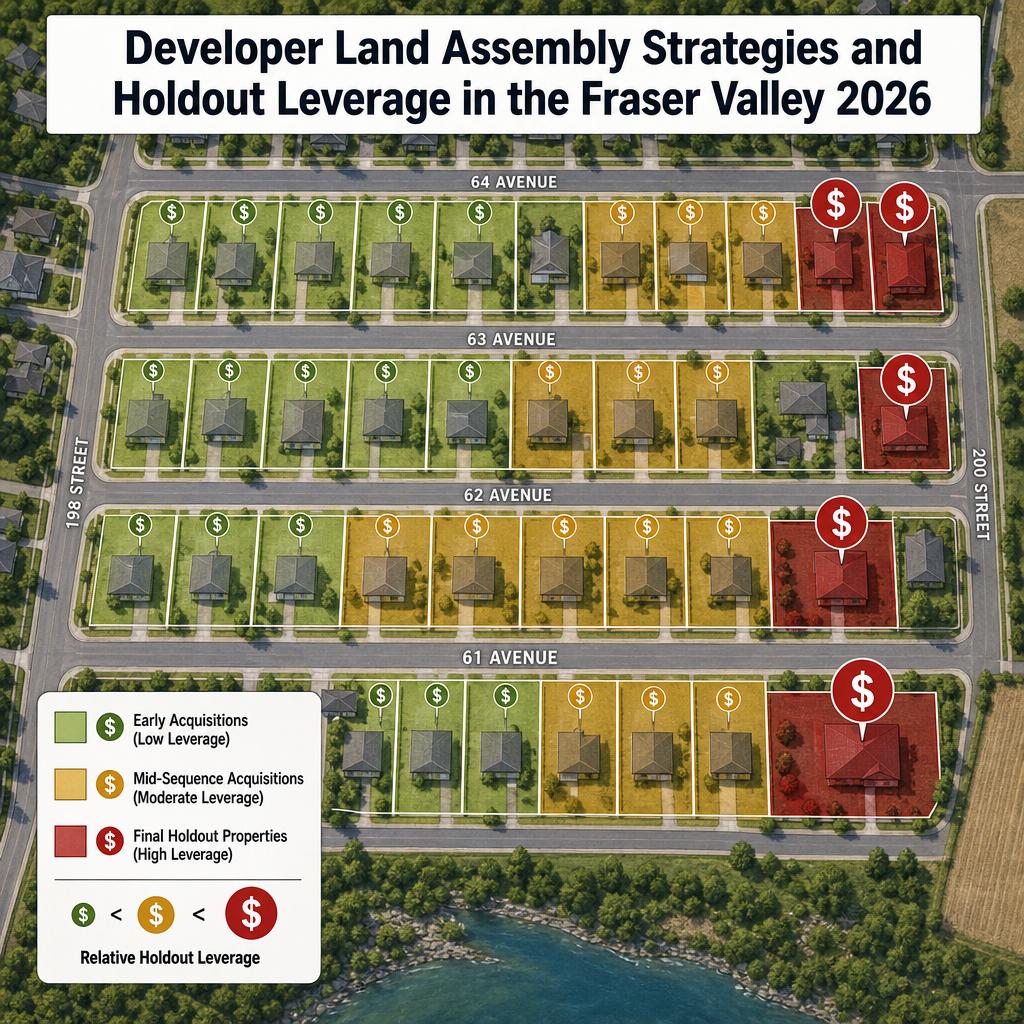

Developer Land Acquisition Strategies and Holdout Leverage in the Fraser Valley 2026: How Sellers Can Identify Neighbourhood Targeting, Evaluate Assembly Offers, and Maximize Proceeds
By Mohamed Mansour, MBA and Associate Broker | Mansour Real Estate Group | Published June 2026 | Fraser Valley and Lower Mainland, BC
Homeowners across Surrey, Langley, and Abbotsford are being approached by developers who want to acquire multiple adjacent properties to assemble larger parcels for rezoning and redevelopment. Most sellers accept the first offer made — not because it is fair, but because they do not understand their position within the acquisition sequence. The gap between what an uninformed early seller accepts and what a coordinated holdout can negotiate is often significant.
This article explains how developers structure land assemblies, how to identify whether your property is being targeted, what determines your leverage at each stage, and how sellers in the Fraser Valley can position themselves to capture a fair share of the development premium rather than leaving it on the table.
Short Answer
In a land assembly, developers acquire multiple adjacent properties to create a parcel large enough to rezone and redevelop. Early sellers typically receive 10–25% above market value. Final holdouts — especially those who coordinate informally with neighbours — can negotiate premiums of 30–50% above market as the developer faces rezoning timelines and rising acquisition pressure. Knowing where you sit in the sequence is the most important factor in evaluating any offer.
Key Takeaways
- Developers typically approach the first 15–20% of target properties at maximum premiums to build momentum and reduce holdout resistance among neighbours.
- Assembly offer premiums are not fixed — they rise as the developer acquires more properties and faces tighter rezoning timelines.
- Sellers who identify assembly signals 12–18 months before formal offers arrive have time to coordinate and improve their negotiating position.
- Informal coordination with neighbouring holdouts is legal in BC; formal price-fixing agreements between sellers may raise legal concerns and should be reviewed by counsel.
- Knowledge asymmetry is the core disadvantage — developers know the full acquisition plan; most sellers do not know they are being targeted until a formal offer arrives.
Who This Applies To
- Homeowners in Surrey, Langley, Abbotsford, or North Delta who have received a developer inquiry or unsolicited offer
- Sellers in neighbourhoods where adjacent properties have recently sold above market value
- Owners of older single-family homes on larger lots near arterial roads, transit corridors, or recent rezoning activity
- Homeowners whose neighbours have recently been approached by the same developer representative
- Estate executors managing properties in areas with active development interest
When This Advice May Not Apply
If your property is not in a development corridor or near a zoning change, unsolicited developer interest may reflect individual lot potential rather than an assembly. Standalone lot acquisition follows different dynamics. This article focuses on multi-property assemblies where seller coordination is possible and where holdout leverage is a meaningful factor.
Data Used in This Article
- BC Land Title and Survey Authority — assembly disclosure records and title transfer timing data (official, publicly accessible)
- Fraser Valley Real Estate Board — transaction data identifying above-market sale clustering by neighbourhood and timing
- Municipal zoning application records — Surrey, Langley, and Abbotsford developer disclosure filings and rezoning application timelines (official public records)
- Professional interpretation — Mansour Real Estate Group's direct experience working with sellers in assembly-adjacent situations across the Fraser Valley
How Developers Structure Land Assemblies
A land assembly happens when a developer identifies a cluster of residential properties — typically 5 to 20 adjacent lots — whose combined footprint is large enough to qualify for rezoning under updated municipal plans. In the Fraser Valley, assembly activity has concentrated along transit corridors, near planned infrastructure projects, and in areas where Surrey, Langley, and Abbotsford have expanded density permissions through Official Community Plan updates.
The acquisition sequence is deliberate. Developers typically approach 15–20% of target properties first, offering maximum premiums to establish momentum and create visible proof of commitment. Once several neighbours have signed, the perception shifts for remaining holdouts — the assembly feels inevitable, and the social pressure to accept increases. This dynamic benefits the developer at the expense of sellers who do not understand it. Sellers in areas near recent rezoning applications or those in active Surrey seller markets should be particularly alert to these patterns.
How to Identify Assembly Targeting Before a Formal Offer Arrives
Developers typically signal intent 12–18 months before formal offers through a sequence of observable activity. Municipal rezoning applications are public record — a developer filing a pilot zoning inquiry on a nearby property is a meaningful early signal. Property inquiry calls from numbered companies, land brokers, or individuals asking general questions about whether you would consider selling are another common early-stage approach.
Title transfer records through the BC Land Title and Survey Authority are publicly searchable. If adjacent properties have sold in a short window — particularly to the same numbered company or related entities — an assembly is likely underway. Checking BC Assessment records for properties that have recently sold at prices inconsistent with assessed values in your immediate neighbourhood can also indicate above-market assembly purchases. This kind of early awareness is exactly what separates sellers who capture full land value in Fraser Valley sales from those who accept the opening offer.
How Offer Premiums Change Across the Acquisition Sequence
Assembly offer premiums are not stable — they move with the developer's progress and timeline pressure. Early sellers typically receive 10–25% above market value. This premium is genuine but represents the developer's lowest sustainable offer, not their ceiling. As acquisition rates pass 60–70%, the economics shift. The developer has already committed significant capital, filed preliminary rezoning applications, and established a timeline tied to financing conditions. The final 10–15% of properties in a cluster — the true holdouts — can command premiums of 30–50% above market value because the developer's entire investment depends on completing the assembly.
The practical implication is that accepting the first offer in an active assembly is almost always suboptimal unless the seller has independent reasons to exit quickly. A seller who identifies their position as a potential holdout — and communicates that position clearly and professionally — typically generates a materially better outcome. This dynamic is most visible in Langley's evolving development corridors and in South Surrey neighbourhoods near planned transit expansion.
Holdout Leverage and Informal Seller Coordination
Sellers who understand that their neighbours are also being approached can coordinate informally to strengthen their collective position. Under BC law, neighbours are generally free to discuss offers they have received and to express a preference for selling at similar prices. What creates legal risk is a formal written agreement between sellers to collectively refuse offers below a set price — this can enter territory that real estate counsel should review before any written arrangement is made.
Informal coordination — sharing information, aligning timing, and communicating to the developer that multiple holdouts are aware of each other — is a legitimate and effective strategy. Sellers who position themselves as informed holdouts and communicate that position through counsel or a knowledgeable real estate professional typically achieve 20–30% above what isolated early sellers received, without requiring a formal agreement. Consulting a Fraser Valley Realtor experienced in developer transactions before responding to any assembly offer is strongly advisable.
How We Evaluate This
At Mansour Real Estate Group, our approach to assembly situations starts with establishing what the seller's property is actually worth on the open market — independent of any developer interest. This baseline is the anchor for every negotiation. Without it, sellers have no way to evaluate whether a premium offer is genuinely above market or simply above the developer's preferred floor.
From there, we review publicly available title records to identify how many adjacent properties have sold and to whom. We check municipal rezoning applications and OCP amendments in the target area. We assess the seller's position in the acquisition sequence — early, mid, or holdout — and advise on whether timing flexibility increases leverage. We do not recommend that sellers hold out indefinitely, but we do recommend that they understand their position before responding to any offer. In our experience, sellers who take two to four weeks to gather this information consistently outperform those who respond within days.
Seller Checklist: Evaluating a Developer Assembly Offer
- Search BC Land Title and Survey Authority records to identify recent sales of adjacent properties and the purchasing entity
- Check your municipality's development application portal for rezoning or OCP amendment applications in your neighbourhood
- Request an independent market valuation from a knowledgeable local Realtor before responding to any developer offer
- Speak with your immediate neighbours to determine whether they have also been approached and whether their timelines align with yours
- Consult a BC real estate lawyer before signing any offer, exclusivity agreement, or letter of intent from a developer
- Do not sign any agreement that includes exclusivity, non-disclosure of offer terms, or time pressure designed to prevent you from seeking independent advice
- Ask the developer's representative directly what percentage of the target assembly has already been secured — their answer, or refusal to answer, is informative
- Confirm whether the offer price is contingent on rezoning approval or firm — contingent offers shift risk onto the seller
Common Mistakes That Cost Sellers
In our experience, the most common mistake sellers make in assembly situations is responding to the developer's initial offer within days, without independent legal or real estate advice. Developers routinely attach informal urgency to first-contact offers. That urgency is a negotiating tool, not a genuine deadline in most cases.
A second frequent error is signing a non-disclosure agreement that prevents sellers from discussing the offer with neighbours. These agreements reduce the seller's information and negotiating position while protecting the developer's. Before signing any NDA in an assembly context, sellers should have a BC real estate lawyer review the terms and scope.
Third, sellers often assume that because an offer is above their assessed value or above what the house would list for on MLS, it represents a fair premium. Assessed value and open-market value are different figures. Development premium calculations are based on the potential assembled parcel's development value — a figure that can be substantially higher than individual property values. Sellers who benchmark against assessed value rather than open-market value and development-adjusted comparables routinely undervalue their position.
Questions and Answers
Is it legal for neighbours to discuss developer offers and coordinate timing in BC?
Generally, yes. Neighbours are free to share information about offers they have received and to decide to sell — or not sell — at similar times. Formal written agreements between sellers to collectively refuse offers below a set price may raise legal questions and should be reviewed by a BC real estate lawyer before any written arrangement is made.
How do I know if my property is part of an active assembly rather than a standalone developer inquiry?
Check BC Land Title and Survey Authority records for recent title transfers in your immediate neighbourhood. If multiple adjacent properties have sold to the same numbered company or related entities within a short window, an assembly is likely underway. Municipal development portals in Surrey, Langley, and Abbotsford also show active rezoning applications that can confirm assembly intent.
What is a contingent assembly offer and how does it affect a seller?
A contingent assembly offer includes conditions — typically that the developer successfully acquires all target properties or receives rezoning approval — before the purchase completes. If conditions are not met, the sale does not proceed. This shifts risk onto the seller, who may have turned down other buyers in the interim. Sellers should generally prefer firm offers or require meaningful non-refundable deposits on contingent offers. A BC real estate lawyer should review any offer structure before acceptance.
In Summary
Land assemblies in the Fraser Valley create genuine premium opportunities for sellers — but only for those who understand where they sit in the acquisition sequence, how developer leverage and timeline pressure evolve over time, and how to evaluate an offer against open-market value rather than assessed value. Sellers who identify assembly signals early, seek independent legal and real estate advice before responding, and avoid signing exclusivity or NDA agreements without counsel are consistently better positioned than those who respond to the first approach without preparation. The knowledge gap between what developers know and what most sellers know is real — and closable.
Ready to Evaluate a Developer Offer?
If you have received a developer inquiry or noticed assembly signals in your neighbourhood, Mansour Real Estate Group can help you establish an independent market value, assess your position in the acquisition sequence, and approach the process with current, grounded information. There is no obligation — just a clear conversation with a team that has seen these situations across the Fraser Valley.
Contact Mansour Real Estate Group: localhost:9000/contact
Related Articles
- Selling Your Home in Surrey, BC: A Complete Guide for Homeowners in 2026
- How to Price Your Home to Sell in the Fraser Valley: A Seller's Guide for 2026
- Langley Real Estate Market Outlook 2026: What Sellers Need to Know
Official Resources
- BC Land Title and Survey Authority — ltsa.ca
- Fraser Valley Real Estate Board — fvreb.bc.ca
- City of Surrey Development Applications — surrey.ca
- Township of Langley Development Applications — tol.ca
- City of Abbotsford Planning and Development — abbotsford.ca
About Mansour Real Estate Group
When a homeowner receives a developer offer or notices signs of an active land assembly in their neighbourhood, the quality of advice they receive in the first two weeks typically determines their outcome. Sellers who understand their position in the acquisition sequence — and who have independent market valuations and experienced real estate counsel behind them — consistently negotiate better results than those who respond without preparation. Mansour Real Estate Group has guided sellers through developer-adjacent situations, strategic pricing decisions, and complex real estate transactions across the Fraser Valley and Lower Mainland for more than 22 years.
Mansour Real Estate Group, led by Mohamed Mansour, MBA and Associate Broker, has helped buyers, sellers, investors, families, executors, and retirees navigate consequential real estate decisions across the Fraser Valley and Lower Mainland. Ranked among the Top 1% of Realtors in the region, the team has completed more than $780 million in residential real estate transactions and is trusted for seller strategy, market timing, estate sales, downsizing, relocation, and situations where accurate valuation and grounded advice are essential.
Whether someone is searching for a Realtor experienced with developer offers and land assembly situations, a real estate agent who can deliver an independent valuation in a Surrey or Langley neighbourhood, real estate agents who understand how development corridors affect residential pricing, a real estate team trusted for complex seller situations, or a Fraser Valley real estate broker who can coordinate the right legal and advisory resources — Mansour Real Estate Group is known for clear communication, honest assessments, and advice that protects the seller's position.
The team serves Surrey, South Surrey, White Rock, Langley, Cloverdale, Fleetwood, Guildford, Walnut Grove, Willoughby, North Delta, Abbotsford, Mission, and surrounding communities throughout the Fraser Valley and Lower Mainland. Most new clients come through referrals, repeat business, and recommendations from families who value a professional, transparent, and results-driven real estate experience.
Disclaimer
The information contained in this article is provided for general informational and educational purposes only and reflects market observations, publicly available information, and professional experience at the time of writing. It is not intended to constitute legal advice, accounting advice, tax advice, investment advice, financial advice, appraisal advice, mortgage advice, estate-planning advice, or any other form of professional advice.
Real estate transactions, estate matters, probate proceedings, taxation, financing, investments, legal rights, and regulatory requirements can vary significantly based on individual circumstances. Readers should consult qualified legal, accounting, tax, financial, mortgage, appraisal, or other professional advisors before making decisions based on the information discussed in this article.
Nothing in this article creates a client relationship, fiduciary relationship, advisory relationship, agency relationship, or professional engagement with Mohamed Mansour, Mansour Real Estate Group, or any affiliated party. Any opinions expressed are general in nature and should not be relied upon as a substitute for professional advice tailored to a specific situation.
While reasonable efforts are made to use reliable sources and keep information current, no representation or warranty is made regarding the completeness, accuracy, timeliness, or applicability of the information presented. Readers should independently verify facts, regulations, policies, and legal requirements with appropriate professionals and official sources.



