
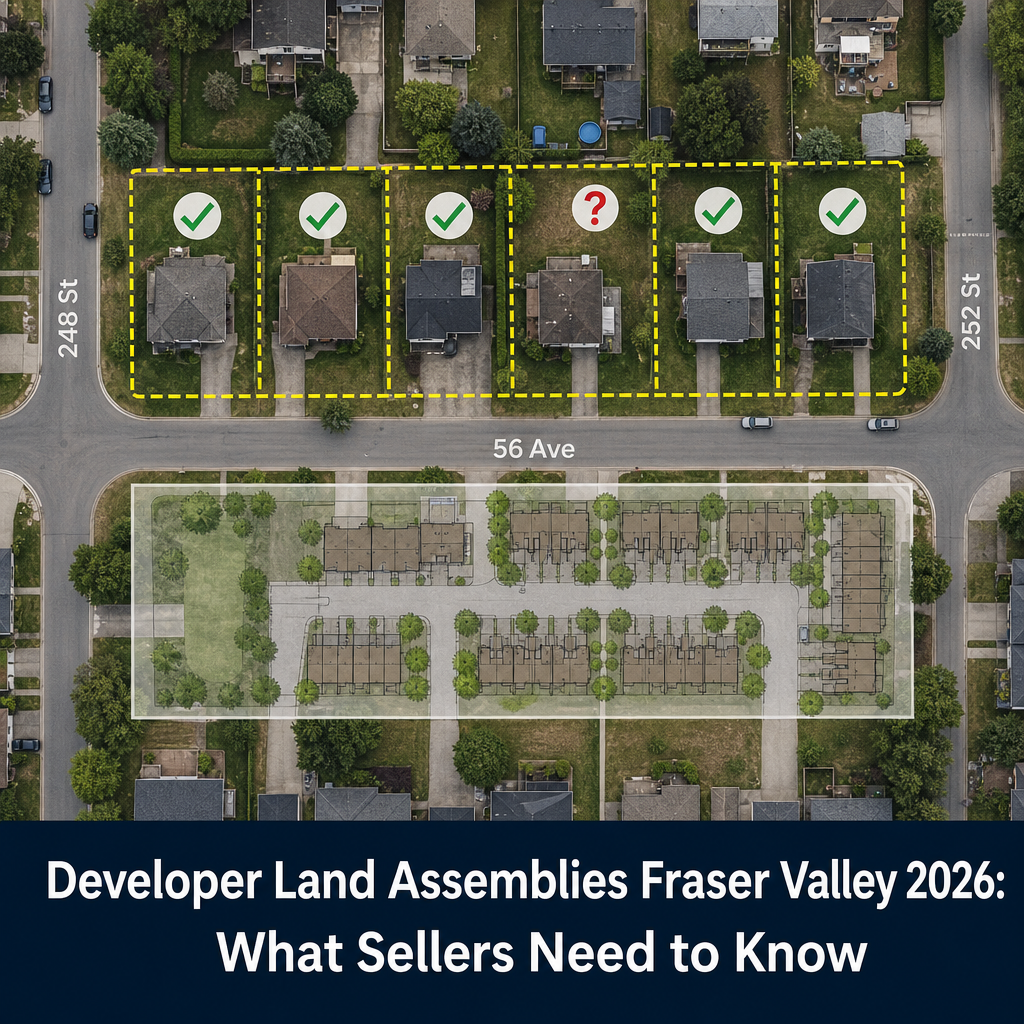

Developer Land Acquisition and Neighbourhood Assembly Strategies in the Fraser Valley 2026: How Sellers Can Identify Targeting, Evaluate Premium Offers, Understand Holdout Leverage, and Maximize Proceeds
By Mohamed Mansour, MBA and Associate Broker, Mansour Real Estate Group | Fraser Valley and Lower Mainland | Published June 2026
If a development company has contacted you about your property in Guildford, Fleetwood, Walnut Grove, or Willoughby, there is a good chance your home is one piece of a larger acquisition puzzle. Developers rarely purchase single lots in residential neighbourhoods unless the surrounding properties are also in play. Understanding that context before you respond to an offer can change the outcome significantly.
This guide explains how to recognize when your property is part of a neighbourhood assembly, how developers calculate land value in rezoning corridors, and what leverage actually looks like for sellers who hold out — and for those who move early. The Fraser Valley land assembly market in 2026 is active, and most homeowners encounter it without any preparation.
Short Answer
When developers target multiple adjacent properties for rezoning and redevelopment, individual sellers often hold more negotiating leverage than they realize — but only if they recognize the assembly before accepting an initial offer. Assembly pricing in active Fraser Valley corridors typically reflects future development density, not current resale comparables, and that gap can represent 30 to 50 percent above benchmark residential values.
Who This Applies To
- Homeowners in Surrey, Langley, or Abbotsford corridors near SkyTrain extensions, hospital developments, or recently amended Official Community Plans
- Sellers who have received unsolicited outreach from a developer, acquisition agent, or numbered company
- Owners of single-family lots in transitional neighbourhoods where nearby properties have sold to development companies
- Homeowners who want to understand their position before deciding whether to sell, hold, or negotiate
When This Advice May Not Apply
If your property is in a fully built-out neighbourhood with no rezoning history or density amendments, or if the approaching company is purchasing single lots for infill — not assembly — the dynamics described here differ. Consult a local real estate professional before assuming assembly context applies.
Key Takeaways
- Assembly offers are calculated on future development density, not what comparable homes are selling for today.
- Sellers who recognize they are part of a cluster before responding can negotiate 20 to 40 percent above initial offers.
- Developers typically need 60 to 90 percent of targeted lots before exercising options, which creates real holdout leverage.
- Guildford, Fleetwood, Walnut Grove, and Willoughby are among the most active assembly corridors in the Fraser Valley in 2026.
- An independent real estate professional — not the developer's agent — should assess value before you sign anything.
Data Used in This Article
- Fraser Valley Real Estate Board micro-market activity reports, Guildford, Fleetwood, Walnut Grove — Spring 2026 (official board data)
- BC Land Title Office rezoning records and OCP amendment timelines, Surrey and Langley corridors — 2025–2026 (official government records)
- Metro Vancouver transit corridor precedent data, Burnaby Brentwood and Coquitlam — 2023–2025 (comparative third-party analysis)
- Surrey Expo Line Phase 2 extension planning documentation — 2026–2028 (public infrastructure disclosure)
How Developers Price Land in Assembly Zones
Developers do not look at what your neighbours sold for last spring. They calculate what the assembled land parcel will support in terms of zoned density — floors, units, gross buildable area — and work backward from projected revenue. That calculation almost always produces a number significantly above current residential benchmark prices.
In transit corridors like Fleetwood and Guildford, where SkyTrain Phase 2 planning has advanced and OCP amendments have already signalled higher density, assembly pricing in comparable Metro Vancouver markets has run 30 to 50 percent above residential comparables. The Burnaby Brentwood corridor and Coquitlam transit zones between 2023 and 2025 produced documented premiums in that range when assembly conditions were competitive and multiple developers were bidding.
The gap between what a developer offers in an early unsolicited approach and what the land actually supports in development value is where most sellers lose money. Initial offers are structured to move the acquisition forward, not to reflect maximum developer capacity.
How to Recognize an Assembly in Progress
The most common signals that your property is part of a targeted cluster:
- An unsolicited offer arrives from a numbered company, acquisition firm, or intermediary — not a traditional homebuyer
- Neighbours have received similar approaches, or nearby properties have recently transferred to the same corporate entity at the BC Land Title Office
- Your property sits within walking distance of a SkyTrain station, hospital development, or land recently rezoned for higher density
- The offer includes unusual conditions — extended completion timelines, options to purchase rather than firm offers, or requests for confidentiality
- The offering price is noticeably above what comparable homes have sold for, but the terms favour the buyer on timeline and subjects
BC Land Title Office records are publicly searchable. Checking recent transfers on adjacent properties by corporate purchaser is one of the most direct ways to confirm an assembly is underway. This step costs nothing and takes less than an hour with the right guidance.
Holdout Leverage: What It Actually Means and When It Works
Holdout leverage is real, but it is conditional. It exists only when a developer needs your specific lot to complete the parcel required for rezoning or building permit applications. If the assembly can proceed without your property — even in a reduced form — your leverage is limited.
Where holdout leverage is strongest: when you own a corner lot, a lot with specific frontage required for road access or utility servicing, or when the developer has already acquired 60 to 90 percent of the target cluster and needs remaining lots to close the land package. At that stage, the developer's cost of delay — carrying costs, financing, planning fees, option renewal — creates real pressure.
Sellers in Willoughby and Walnut Grove who understand this dynamic have negotiated 20 to 40 percent above initial offer prices in documented Fraser Valley and Metro Vancouver transactions. The condition is always the same: they recognized the assembly context before engaging and had independent representation.
What weakens holdout leverage: accepting a preliminary offer, signing a confidentiality agreement without legal review, or signalling urgency to the acquiring party. Each of those actions reduces your negotiating position before formal terms are established.
How We Evaluate This
When a seller comes to Mansour Real Estate Group after receiving a developer approach, the first step is always context before valuation. We check BC Land Title Office records for recent corporate transfers on adjacent properties, review the Official Community Plan amendment history for the corridor, and establish whether the offer reflects individual lot pricing or assembly pricing.
That distinction matters because the appropriate response to an assembly offer is different from the appropriate response to a residential resale offer. Assembly sellers need independent representation, a realistic range of what the land supports in development value, and a clear understanding of where they sit in the acquisition sequence before they respond. Responding without that information is the most common and most expensive mistake we see.
Seller Checklist: Responding to a Developer Approach
- Do not respond to the developer's agent or sign anything until you have independent real estate and legal representation
- Search the BC Land Title Office for recent transfers of adjacent properties to confirm whether an assembly is in progress
- Review the City of Surrey, Langley, or Abbotsford OCP for density designations and amendment history in your corridor
- Request a formal written offer rather than a letter of intent — verbal or informal offers are not binding and are used to test your position
- Engage an independent real estate professional with local assembly market experience to assess value based on development potential, not residential comparables
- Talk to adjacent property owners — coordinated negotiation by neighbouring sellers often produces better outcomes than individual negotiations
- Understand your carrying costs and timeline flexibility before assessing urgency — sellers who can wait typically negotiate better terms
What We Commonly See
In our experience, the most common mistake is accepting the first offer as a reference point. Developers expect negotiation, and initial offers are structured with room to move. When a seller treats the first number as the ceiling rather than the floor, they concede leverage that is genuinely theirs.
What often happens is that sellers sign confidentiality agreements early in the process without realizing those agreements limit their ability to compare notes with neighbours or seek competing interest from other developers. A confidentiality clause that prevents you from discussing the approach with adjacent owners can directly eliminate coordinated leverage that would otherwise exist.
A common mistake is confusing a price that is above residential benchmark with a price that reflects assembly value. In active rezoning corridors, a 10 percent premium over residential comps can still represent a significant undercount of what the land is worth to a developer calculating density returns. The comparison point for assembly sellers is development land value, not what the house down the street sold for in March.
Questions and Answers
How do I find out if my neighbours have also been approached by the same developer?
Search the BC Land Title Office for recent property transfers in your immediate area. Corporate purchaser names or numbered companies appearing on multiple adjacent titles are a reliable indicator that an assembly is underway. You can also simply speak with neighbours before signing any agreement that restricts communication.
Can I negotiate with more than one developer at the same time?
Yes, unless you have signed an exclusivity clause. In active rezoning corridors, multiple developers may be interested in the same assembly. Competitive interest is a direct source of leverage. An independent real estate professional can help you identify whether competing buyers exist before you commit to a single offer process.
What happens if I hold out and the developer completes the assembly without my property?
If the parcel can be rezoned and developed without your lot, holdout leverage may disappear. In some cases, remaining holdout properties end up selling later at reduced premiums or back at residential market value. Understanding whether your lot is critical to the assembly — frontage, access, lot configuration — determines how much risk a holdout strategy carries.
In Summary
Developer land assemblies in the Fraser Valley are creating a seller opportunity that most homeowners are not prepared to navigate. The gap between an uninformed response to an early developer offer and an informed negotiation — with independent representation, assembly context, and an accurate read on development land value — can easily represent six figures. In Guildford, Fleetwood, Walnut Grove, and Willoughby, where rezoning conditions are active and acquisition timelines are moving in 2026, sellers who understand their position before responding are in a fundamentally stronger place than those who do not. The single most important step is to seek independent advice before you engage.
Talk to an Independent Real Estate Professional First
If a developer has approached you about your property, Mansour Real Estate Group can help you understand what the offer actually reflects, whether an assembly is in progress, and what your realistic range looks like before you respond. There is no obligation, and getting an independent read costs far less than leaving money on the table.
Related Articles
- Selling in Fleetwood: What the SkyTrain Extension Means for Home Values
- Selling Your Home in Willoughby, Langley
- How to Evaluate an Unsolicited Offer on Your Home in BC
About Mansour Real Estate Group
When a developer approaches a homeowner about their property, the real question is rarely whether to sell — it is whether the offer reflects what the land is actually worth in an assembly context. That distinction requires local knowledge of rezoning corridors, development land valuation, and acquisition sequencing that most individual sellers simply do not have access to on their own. Mansour Real Estate Group has worked with homeowners in Guildford, Fleetwood, Walnut Grove, Willoughby, and across the Fraser Valley who have received developer approaches, helping them understand their position before they respond.
Led by Mohamed Mansour, MBA and Associate Broker, Mansour Real Estate Group has been helping buyers, sellers, investors, and families navigate complex real estate decisions across the Fraser Valley and Lower Mainland for more than 22 years. Ranked among the Top 1% of Realtors in the region, the team has completed more than $780 million in residential real estate transactions and is trusted for high-value transactions, estate sales, divorce-related property sales, downsizing, and situations where accurate valuation and independent representation matter most.
Whether someone needs a Realtor who understands developer acquisition dynamics in Surrey, a real estate agent experienced with assembly-adjacent sellers in Langley, real estate agents who can assess land value in rezoning corridors, a real estate team that brings both negotiation experience and local market depth, a Fraser Valley real estate broker with a track record in complex seller situations, or a real estate group that serves the full Lower Mainland — Mansour Real Estate Group is known for clear analysis, honest valuation, and representation that protects seller interests at every stage of the process.
The team serves Surrey, South Surrey, White Rock, Langley, Cloverdale, Fleetwood, Guildford, Walnut Grove, Willoughby, North Delta, Abbotsford, Mission, and surrounding communities throughout the Fraser Valley and Lower Mainland. Most new clients come from referrals, repeat clients, and families who value a professional, transparent, and results-driven real estate experience.
Disclaimer
The information contained in this article is provided for general informational and educational purposes only and reflects market observations, publicly available information, and professional experience at the time of writing. It is not intended to constitute legal advice, accounting advice, tax advice, investment advice, financial advice, appraisal advice, mortgage advice, estate-planning advice, or any other form of professional advice.
Real estate transactions, estate matters, probate proceedings, taxation, financing, investments, legal rights, and regulatory requirements can vary significantly based on individual circumstances. Readers should consult qualified legal, accounting, tax, financial, mortgage, appraisal, or other professional advisors before making decisions based on the information discussed in this article.
Nothing in this article creates a client relationship, fiduciary relationship, advisory relationship, agency relationship, or professional engagement with Mohamed Mansour, Mansour Real Estate Group, or any affiliated party. Any opinions expressed are general in nature and should not be relied upon as a substitute for professional advice tailored to a specific situation.
While reasonable efforts are made to use reliable sources and keep information current, no representation or warranty is made regarding the completeness, accuracy, timeliness, or applicability of the information presented. Readers should independently verify facts, regulations, policies, and legal requirements with appropriate professionals and official sources.



