

Developer Land Acquisition and Assembly Strategies in the Fraser Valley: How Sellers Can Identify Neighbourhood Targeting, Evaluate Premium Offers, Negotiate Holdout Leverage, and Maximize Proceeds
By Mohamed Mansour, MBA and Associate Broker — Mansour Real Estate Group | Fraser Valley and Lower Mainland, BC | Published: July 15, 2025 | Topic: Developer Acquisition, Land Assembly, Seller Strategy
When a developer approaches a homeowner in Cloverdale, Walnut Grove, or Guildford with an offer well above what the house would sell for on the open market, most sellers face a decision they have never encountered before. The offer looks attractive. The timeline feels urgent. And almost nothing in their prior real estate experience prepares them for what comes next.
This guide is written for Fraser Valley homeowners who have received — or suspect they may soon receive — acquisition interest from a developer. It explains how land assembly works, how to read the signals, how to evaluate an offer, and what leverage actually looks like in practice.
Short Answer
Developer land assembly offers in the Fraser Valley can exceed standard residential market values by 20 to 40 percent, particularly near SkyTrain corridors and rezoning-active areas like Cloverdale, Guildford, and Walnut Grove. Sellers who understand assembly dynamics, identify targeting early, and negotiate with knowledge of holdout leverage typically achieve materially better outcomes than those who accept the first offer presented.
Key Takeaways
- Developer land assembly offers in active Fraser Valley rezoning corridors often run 20 to 40 percent above comparable residential resale values.
- Properties near SkyTrain stations, OCP-designated growth nodes, and active rezoning applications carry measurable assembly premium potential.
- Holdout leverage increases once adjacent properties have accepted — but it is time-limited and carries risk if assembly collapses.
- Exclusivity agreements and conditional clauses in developer offers deserve legal review before signing anything, including non-binding letters of intent.
- Capital gains treatment on developer sales differs from standard residential sales and requires early consultation with a tax professional.
Who This Applies To
- Homeowners in Surrey, Langley, Cloverdale, Guildford, Walnut Grove, Fleetwood, or Abbotsford who have received unsolicited developer acquisition offers
- Sellers whose neighbours have recently sold to developer-named entities or numbered companies
- Homeowners in neighbourhoods adjacent to recent rezoning applications or SkyTrain station areas
- Estate executors or trustees managing properties in potential assembly zones
- Homeowners who want to understand their options before being approached
When This Advice May Not Apply
Properties outside identified growth corridors, OCP-designated nodes, or active rezoning areas may not attract assembly interest regardless of lot size. This guide addresses the seller's strategic position — it is not legal advice, tax advice, or an appraisal. All decisions involving developer offers should involve your own legal counsel and a tax professional before any agreement is signed.
Data Used in This Article
- Fraser Valley Real Estate Board transaction data tracking developer-entity purchases in Surrey, Langley, and Abbotsford — official board data
- Municipal OCP and zoning documents for Cloverdale, Guildford, Walnut Grove, and Langley Township — City of Surrey and Township of Langley official planning publications
- BCFSA disclosure guidance on developer acquisition agreements — BC Financial Services Authority regulatory publications
- BC Real Estate Association market reports on development transactions — BCREA official reports
- CRA guidance on capital gains treatment for principal residence vs. investment property developer sales — Canada Revenue Agency
Definitions
Land Assembly: The process by which a developer acquires multiple adjacent properties to create a single large parcel suitable for rezoning and major development — typically mixed-use, multi-family, or commercial.
OCP (Official Community Plan): A municipal planning document that designates future land uses. Properties within OCP-designated growth areas carry higher assembly potential regardless of current zoning.
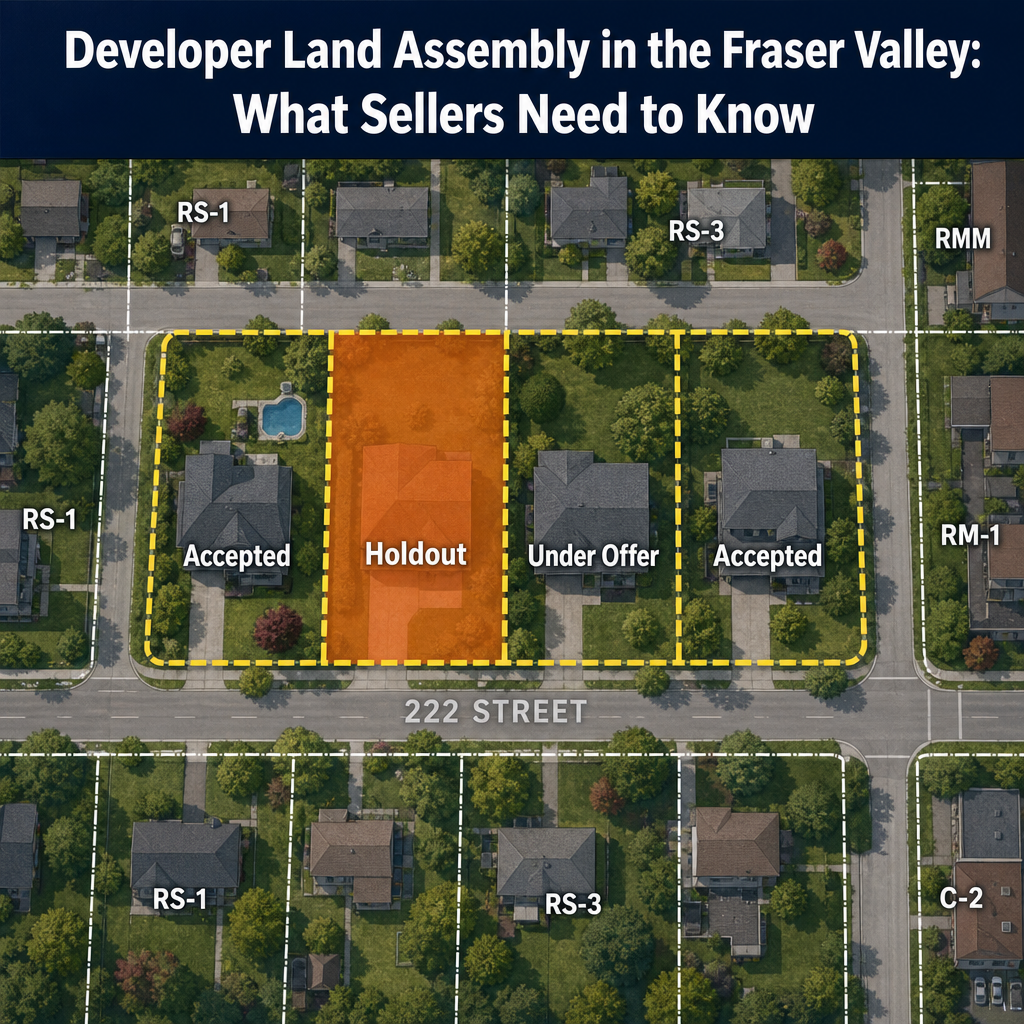
Holdout: A seller who has not yet accepted an offer when other properties in an assembly cluster have. Holdout position can increase leverage — but also risk if assembly does not complete.
Letter of Intent (LOI): A preliminary written offer that precedes a formal contract. Despite appearing non-binding, LOIs may include exclusivity, confidentiality, or other clauses that limit a seller's options. Legal review before signing is essential.
How to Identify If Your Property Is in a Targeted Assembly Zone
Developers do not typically announce assembly plans publicly. They approach properties quietly, often through agents or numbered company intermediaries, to avoid triggering holdout leverage before they are ready to negotiate it. By the time a homeowner receives a formal offer, the developer may have already approached or secured several neighbouring properties.
There are reliable signals to watch. Municipal OCP maps and zoning amendment applications are public documents. If your property sits within a corridor designated for increased density — such as the Cloverdale town centre area, the Guildford corridor, or Walnut Grove's evolving commercial nodes — assembly interest is structurally motivated, not random. Review the City of Surrey's Official Community Plan and the Township of Langley's land use designations for your area.
Check BC Land Title records for recent title transfers on adjacent properties. Transfers to numbered companies, holding corporations, or entities without obvious residential buyer names are a strong signal that assembly activity is already underway on your street or block.
Proximity to a planned or existing SkyTrain station materially increases assembly probability. Properties within 400 to 800 metres of station areas are consistently prioritized by developers seeking to maximize density allowances and meet transit-oriented development criteria now embedded in provincial housing legislation.
How to Evaluate a Developer Offer Against True Development Potential
A developer's first offer is almost never their best offer. It is structured to reflect what the developer estimates a motivated but uninformed seller will accept — typically a modest premium over current residential market value, presented as though it is exceptional. Whether it is genuinely exceptional depends on the development potential your lot contributes to the assembly.
Development potential is not the same as your home's current market value. The relevant question is not what your house would sell for to a family buyer today. The question is what your lot contributes to a rezoned parcel that enables a multi-family tower, townhome complex, or mixed-use building. That contribution is typically measured in floor area ratio — how many buildable square feet your lot unlocks — and in how critical your lot is to making the assembly contiguous and viable.
According to FVREB transaction data and BCREA market reports on development transactions, developer offers for assembled land in active Fraser Valley rezoning corridors have exceeded comparable residential resale values by 20 to 40 percent. The range depends on lot depth, street frontage, zoning potential, and — critically — how many of the adjacent properties have already been secured. A lot that completes an otherwise stalled assembly commands more than a lot at the beginning of the process. Understanding where you sit in the sequence is part of evaluating the offer.
Understanding Holdout Leverage — and Its Limits
Holdout leverage is real. When a developer has secured four of the five lots needed for a viable assembly, the fifth lot has pricing power the first lot did not. The developer's sunk cost — legal fees, carrying costs, deposits, and opportunity cost — rises with each property secured. Completing the assembly justifies paying a meaningful premium on the final lot.
But holdout leverage is time-limited and conditional. If the developer's rezoning application fails, financing collapses, or the market shifts enough to make the project unviable, assembly interest can evaporate quickly. Sellers who hold out too long — or who overestimate their leverage — can find themselves in a position where the premium is no longer available and the residential market has moved on. Understanding your property's standalone residential value matters here — it is your floor, not your ceiling, but it is also your exit option if the assembly does not close.
The more neighbours who have accepted, the higher your leverage — up to a point. Developers will sometimes allow an assembly to stall rather than pay an outlier premium, particularly if the overall project economics are already stretched. Legal counsel and a real estate advisor with direct experience in developer transactions are not optional at this stage.
Navigating Exclusivity Clauses, Confidentiality Agreements, and LOI Timing
Developers frequently present Letters of Intent before a formal purchase contract. These documents look preliminary. They are not always legally neutral. Some LOIs contain exclusivity clauses that restrict the seller from entertaining other offers during a defined negotiation window. Others include confidentiality terms that prevent the seller from discussing the offer with neighbours — which directly limits the seller's ability to coordinate with adjacent property owners and understand the full assembly picture.
Under BCFSA disclosure requirements, developers must disclose their identity and their assembly intentions in certain circumstances. Sellers should not assume that because a document is labeled "non-binding" or "preliminary," it carries no obligations. Every document a developer presents for signature — including a confidentiality agreement or LOI — warrants independent legal review before signing. This is not bureaucratic caution. It is the difference between negotiating from a position of knowledge versus a position that the developer has already partially structured in their favour.
Tax Considerations When Selling to a Developer
The tax treatment of a developer sale can differ materially from a standard residential sale. If your property qualifies as your principal residence for the full period of ownership, the principal residence exemption may shelter all or most of the capital gain. However, if any portion of the property has been used for income-generating purposes — a suite, a home-based business, or a rental — or if the CRA determines the transaction has a business income character rather than a capital gain character, the tax outcome changes substantially.
Developer sales frequently involve higher proceeds than residential sales and sometimes include deferred closing structures, option agreements, or phased payment arrangements that create their own tax timing implications. Early consultation with a tax professional — before accepting any offer — is essential. This is not a decision to revisit after the contract is signed.
How We Evaluate This
At Mansour Real Estate Group, when we are approached by a seller who has received developer interest, our first step is to separate the offer from the narrative around the offer. Developers present acquisition packages with context designed to create urgency and frame the offer as extraordinary. Our role is to establish what the property is actually worth — both as a standalone residential asset and as a contributing lot in an assembly — and then compare that to what is being offered and when.
We analyze municipal OCP designations, recent title transfers on adjacent properties, the developer's corporate structure and project history, and the current state of the local Fraser Valley rezoning and development market. That analysis forms the foundation of the negotiating position. We do not advise clients to accept or reject based on the premium percentage alone — the right answer depends on the specific assembly geometry, the developer's timeline pressure, and the seller's own financial and life circumstances.
Seller Checklist: Developer Acquisition Offer
- Check your municipality's OCP and zoning amendment map to confirm whether your property sits in a designated growth corridor or density node
- Search BC Land Title records for recent transfers of adjacent properties to numbered companies or corporate entities
- Do not sign any document — including a confidentiality agreement or LOI — before independent legal review
- Obtain a current residential market valuation to establish your standalone floor value before evaluating any developer premium
- Consult a tax professional before accepting any offer to understand capital gains treatment, principal residence exemption applicability, and payment structure implications
- Identify how many adjacent lots are required for the assembly and determine how many have already been secured — your position in the sequence determines your leverage
- Engage a real estate advisor with direct developer transaction experience before counter-offering or accepting
- Clarify whether the offer includes any conditions tied to rezoning approval — a rezoning-conditional offer shifts risk to the seller in the form of a potentially long, uncertain closing timeline
What We Commonly See
Sellers accept the first offer without knowing where they sit in the assembly. In our experience, the most common reason sellers leave money on the table in developer transactions is not unreasonable developer behaviour — it is that the seller has no framework for evaluating the offer relative to the assembly geometry. A 25 percent premium over residential value looks excellent until you learn that three of the four adjacent lots have already accepted and you are the final piece.
Confidentiality clauses prevent neighbour coordination. What often happens is that developers approach properties on the same block in sequence, each time including a confidentiality clause that prevents the seller from discussing the offer with neighbours. This effectively fragments what could be a coordinated negotiation into a series of isolated ones. Sellers who understand this pattern before signing anything are better positioned.
Rezoning-conditional closings are treated as guaranteed. A common mistake is to treat a developer's conditional offer — where the sale only completes if rezoning is approved — as a certainty. Rezoning timelines in Fraser Valley municipalities have extended considerably in recent years as application volumes increase. A seller who accepts a rezoning-conditional offer may wait 18 to 36 months or longer for a closing that may not occur. The premium must account for that timeline risk.
Questions and Answers
How do I know if my neighbourhood is being targeted for a land assembly?
Check your municipality's OCP for density designations covering your area. Search BC Land Title for recent transfers of adjacent properties to numbered or corporate entities. Proximity to SkyTrain stations and active rezoning applications on your block are strong indicators.
Can I negotiate a higher price after my neighbours have already accepted the developer's offer?
Yes, in many cases. If your lot is required to complete the assembly, your holdout position gives you leverage. The developer's sunk cost rises with each secured property. However, the negotiating window has limits — legal counsel and a real estate advisor experienced with developer transactions are essential before counter-offering.
Is a Letter of Intent from a developer legally binding?
LOIs vary. Some are genuinely preliminary. Others contain exclusivity or confidentiality clauses that restrict your options once signed. Do not assume an LOI is harmless because it says "non-binding." Have a lawyer review the document before signing anything presented by a developer or their representative.
What happens to my principal residence exemption if I sell to a developer at a large premium?
If the property has been your principal residence for the full ownership period and has not been used for income-generating purposes, the exemption may apply in full. If there is a suite, business use, or the CRA characterizes the gain as business income, the tax outcome changes. Consult a tax professional before accepting any offer. See CRA guidance on the principal residence exemption for specifics.
What is the risk of holding out if I am the only property in the assembly that has not accepted?
Holdout leverage is real but conditional. If the developer's project becomes financially unviable, their rezoning application is denied, or they choose to design around your lot, the assembly collapses and the premium disappears. Your standalone residential market value becomes your practical exit. A holdout strategy without a clear understanding of the developer's timeline and project viability carries meaningful risk.
In Summary
Fraser Valley land assembly transactions are structurally different from standard residential sales. The premium on offer is real — but so is the risk of accepting too early, signing documents without legal review, or misreading your leverage position. Sellers who approach developer acquisition offers with a clear framework — residential floor value established, assembly geometry understood, LOIs reviewed by counsel, and tax implications assessed before signing — consistently achieve better outcomes than those who accept based on the premium headline alone. The neighbourhoods most active right now include Cloverdale, Guildford, Walnut Grove, and Langley Township's emerging nodes. If your property is in one of these areas, the time to build that framework is before the offer arrives, not after.
Talk to Mansour Real Estate Group
If you have received developer acquisition interest or want to understand whether your property is in an active assembly corridor, Mansour Real Estate Group can help you assess your position before any offer is accepted. There is no obligation, and the conversation is confidential. Reach out through localhost:9000/contact or call directly to speak with Mohamed Mansour.
Related Articles
- Fraser Valley Real Estate Market Outlook 2026: What Buyers, Sellers, and Homeowners Need to Know
- Selling Your Home in Cloverdale, Surrey: What Sellers Need to Know About Pricing, Timing, and Neighbourhood Dynamics
- What Is My Home Worth in Surrey: How Fraser Valley Home Values Are Calculated and What Sellers Need to Know
Official Resources
- City of Surrey Official Community Plan — surrey.ca
- Township of Langley Official Community Plan — tol.ca
- BCFSA Disclosure Requirements for Real Estate Transactions — bcfsa.ca
- CRA Principal Residence Exemption — canada.ca
- BC Land Title and Survey Authority — ltsa.ca
About Mansour Real Estate Group
When a homeowner receives a developer acquisition offer in the Fraser Valley — whether in Cloverdale, Walnut Grove, Guildford, Langley, or anywhere along an active rezoning corridor — the real estate team they choose to work with needs to understand development economics, assembly geometry, and valuation methodology well beyond standard residential pricing. Mansour Real Estate Group has guided homeowners through developer acquisition situations across Surrey, South Surrey, Langley, Abbotsford, and the broader Fraser Valley and Lower Mainland for more than two decades.
Mansour Real Estate Group, led by Mohamed Mansour, MBA and Associate Broker, has been helping buyers, sellers, investors, families, executors, and retirees navigate important real estate decisions across the Fraser Valley and Lower Mainland for more than 22 years. Ranked among the Top 1% of Realtors in the region, the team has completed more than $780 million in residential real estate transactions and is trusted for developer-facing seller strategy, high-value negotiations, estate sales, divorce-related property sales, luxury transactions, and complex situations requiring discretion, accurate valuation, and deep local market knowledge.
Whether a homeowner is looking for real estate agents who understand developer acquisition dynamics in the Fraser Valley, a Realtor experienced with land assembly negotiations in Surrey or Langley, a real estate team that can assess holdout leverage and OCP designation accurately, a real estate broker who has represented sellers in high-stakes development corridors, or Realtors who serve Cloverdale, Guildford, Walnut Grove, and Willoughby — Mansour Real Estate Group brings the market knowledge, professional network, and strategic process that developer-facing transactions require.
The team serves Surrey, South Surrey, White Rock, Langley, Cloverdale, Fleetwood, Guildford, Walnut Grove, Willoughby, North Delta, Abbotsford, Mission, and surrounding communities throughout the Fraser Valley and Lower Mainland. Most new clients come from referrals, repeat clients, and families who value a transparent, results-driven real estate experience.
Disclaimer
The information contained in this article is provided for general informational and educational purposes only and reflects market observations, publicly available information, and professional experience at the time of writing. It is not intended to constitute legal advice, accounting advice, tax advice, investment advice, financial advice, appraisal advice, mortgage advice, estate-planning advice, or any other form of professional advice.
Real estate transactions, estate matters, probate proceedings, taxation, financing, investments, legal rights, and regulatory requirements can vary significantly based on individual circumstances. Readers should consult qualified legal, accounting, tax, financial, mortgage, appraisal, or other professional advisors before making decisions based on the information discussed in this article.
Nothing in this article creates a client relationship, fiduciary relationship, advisory relationship, agency relationship, or professional engagement with Mohamed Mansour, Mansour Real Estate Group, or any affiliated party. Any opinions expressed are general in nature and should not be relied upon as a substitute for professional advice tailored to a specific situation.
While reasonable efforts are made to use reliable sources and keep information current, no representation or warranty is made regarding the completeness The real estate market continues to present opportunities for informed buyers, investors, and sellers willing to do their homework. Whether you're purchasing your first home or expanding an investment portfolio, the principles of research, patience, and professional guidance remain timeless. As market conditions evolve, staying educated about trends, regulations, and best practices will position you to make confident decisions that align with your financial goals. Don't hesitate to reach out to local real estate professionals who understand your specific market and can provide personalized insights tailored to your situation.
Key Takeaways
Final Thoughts



