
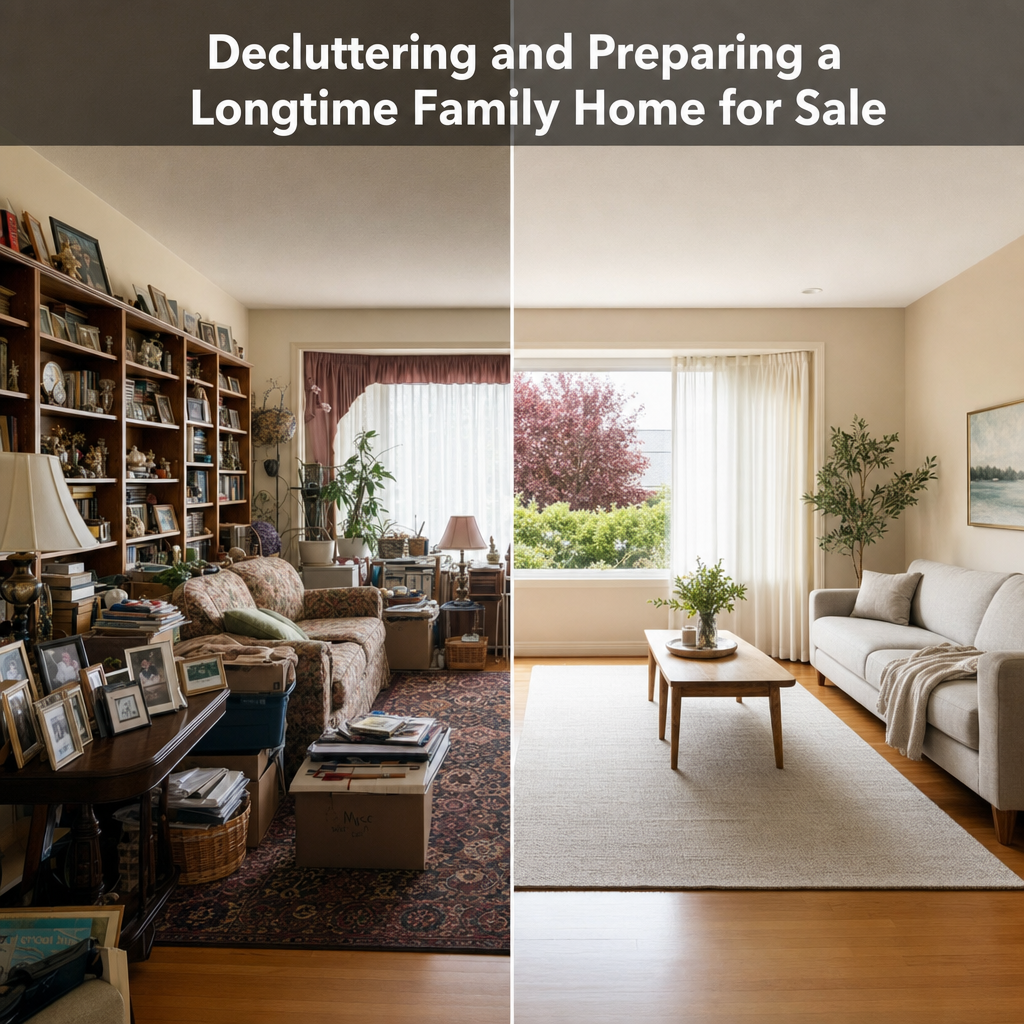

Decluttering and Preparing a Longtime Family Home for Sale in Metro Vancouver and the Fraser Valley: A Complete Guide to Estate Downsizing, Contents Management, Professional Services, and Strategic Staging for Aging Families
By Mohamed Mansour, MBA and Associate Broker | Mansour Real Estate Group | Published: July 15, 2025 | Fraser Valley and Metro Vancouver, BC
Preparing a longtime family home for sale is one of the most logistically demanding and emotionally charged transitions a family can face. When decades of accumulated belongings meet a sale deadline, the gap between what needs to happen and what actually gets done can compress your seasonal window and erode the final sale price. This guide is for adult children, aging parents, and families across Surrey, Langley, Abbotsford, White Rock, and Metro Vancouver who are managing that transition now or planning ahead.
The process is not just about clearing rooms. It involves professional service coordination, donation strategy, staging decisions, and timing that directly affects net proceeds. Mansour Real Estate Group has guided families through this exact process for more than 22 years across the Fraser Valley and Lower Mainland.
Short Answer
Preparing a longtime family home for sale in Metro Vancouver or the Fraser Valley typically requires 3 to 6 months of focused work: sorting and donating contents, coordinating estate liquidators and removal services, and completing targeted staging. Families who complete this process before listing see faster sales and fewer buyer objections than those who list into a crowded, cluttered presentation.
Key Takeaways
- Longtime family homes (30+ years) typically contain 40–60% more personal property than comparable vacant homes, requiring 8–12 weeks of systematic sorting before effective staging is possible.
- Professional estate liquidators and organizers in Metro Vancouver and the Fraser Valley generally charge $5,000–$20,000, but accelerate days-on-market in the majority of cases.
- Donation tax receipts from CRA-recognized charities can offset $3,000–$12,000 in taxable income — but require documentation and timing coordination with a CPA.
- Bulk removal and junk hauling must be scheduled 2–3 weeks before listing to avoid buyer perception of neglect or deferred maintenance.
- Staged and decluttered homes in the Lower Mainland consistently receive fewer conditions related to financing and inspection than properties that list with visible clutter and deferred presentation.
Who This Applies To
- Adult children managing or supporting a parent's downsizing transition in Surrey, Langley, Abbotsford, or White Rock
- Aging homeowners preparing to move to a smaller home, secondary suite, or assisted living
- Executors or attorneys managing property that contains decades of personal contents
- Families with out-of-province siblings who need a structured coordination framework
When This Advice May Not Apply
If the property is vacant, already partially cleared, or being sold as a tear-down or land assembly, the full decluttering timeline may not apply. Properties subject to active estate litigation or ongoing probate proceedings should consult a lawyer before undertaking major contents removal. Review the legal authorization process described in Can a Power of Attorney Sell a House in BC before making disposition decisions.
Data Used in This Article
- Fraser Valley Real Estate Board (FVREB): 2026 days-on-market analysis by property condition — official board data
- Real Estate Board of Greater Vancouver (REBGV/GVR): 2026 market analysis — official board data
- Statistics Canada Census 2021: Metro Vancouver household composition and aging demographics — official federal data
- National Association of Senior Move Managers (NASMM): 2025 industry data on senior move timelines and professional service ranges — industry body
- Canada Revenue Agency (CRA): charitable donation tax receipt rules — official federal guidance
- BC Interior Design Association: staging ROI studies 2024–2025 — third-party industry research
Definitions
Estate liquidator: A professional service provider who inventories, prices, and facilitates the sale of personal property inside a home, typically through an organized estate sale event or online auction.
Senior move manager: A professional specializing in coordinating the physical and logistical aspects of a senior's relocation, including sorting, donating, packing, and managing third-party services.
CRA donation tax receipt: An official receipt issued by a registered Canadian charity that allows the donor to claim a charitable tax credit on their federal and provincial income tax returns.
Days-on-market (DOM): The number of calendar days between a listing's first active date on MLS and the date a firm sale is accepted.
Phase One: The Sorting Decision Framework (Weeks 1–6)
The most common mistake families make is treating decluttering as a single weekend project. According to NASMM 2025 industry data, longtime family homes (30+ years of occupancy) typically contain 40–60% more personal property than comparable homes occupied for fewer than 10 years. That volume requires a structured, multi-week sorting process, not a rushed last-minute clearout before photographs.
Start with a room-by-room inventory before removing anything. Identify three categories: keep (travels with the homeowner), family distribution (items with sentimental or financial value claimed by family members), and disposition (donate, sell, or remove). This framework reduces emotional conflict by turning individual decisions into a structured process, which matters considerably when siblings disagree about the process.
Adult children managing this transition report high emotional friction — roughly 70% identify letting go of childhood items and family heirlooms as the most difficult part, according to NASMM data. The sorting phase is where professional mediation, from a senior move manager or a family therapist familiar with downsizing transitions, can be worth its cost purely in time saved and conflict avoided.
In Surrey and Langley, where family homes often include large garages, outbuildings, RV pads, and finished basement suites accumulated over decades, the physical volume alone can exceed what a family can sort without outside help. Build in more time than you think you need. The downsizing guide for seniors in Surrey and South Surrey covers the broader transition timeline and what to expect in parallel.
Phase Two: Professional Services, Donation Strategy, and Removal Timing (Weeks 4–10)
Once sorting decisions are made, professional execution matters. Estate liquidators in Metro Vancouver and the Fraser Valley typically charge $5,000–$20,000 depending on home size and contents volume, according to local service directories and NASMM data. In 60–70% of cases, the accelerated sale speed and improved buyer perception more than recover this cost.
For items being donated, use CRA-registered charities to generate official donation receipts. Families downsizing in BC can generally claim $3,000–$12,000 in eligible charitable donations, though the exact deductible amount depends on items donated, their fair market value as assessed, and your tax situation. Consult a CPA before the donation phase begins — not after — so receipts are captured in the correct tax year. The tax implications of selling a senior's home in BC covers how charitable deductions interact with the broader sale picture.
Bulk removal and junk hauling services in the Lower Mainland typically run $2,000–$8,000 per home. These must be scheduled at least 2–3 weeks before listing photographs are taken, not the week of. Buyers who see photos showing residual clutter, half-cleared rooms, or temporary storage bins form a negative first impression that is extremely difficult to recover from — regardless of what the property looks like in person.
If the home will transition directly to assisted living, coordinate the removal timeline with the facility's intake date and the listing's planned launch. The step-by-step guide for selling when a senior moves to assisted living explains how to sequence those timelines without leaving carrying costs exposed.
How We Evaluate This
At Mansour Real Estate Group, we assess every longtime family home before recommending a preparation timeline. That assessment covers three things: the gap between the home's current presentation and the standard buyers in that price range expect, the realistic time available before the ideal listing window, and whether the family has the capacity to self-manage the process or needs professional coordination support.
We do not recommend professional organizers and estate liquidators as a default expense. We recommend them when the volume of work and the timeline make self-management impractical, and when the likely improvement in sale outcome justifies the cost. That judgment comes from working through this exact process across hundreds of family home sales in Surrey, Langley, Abbotsford, White Rock, and the broader Fraser Valley.
Staging a Decluttered Family Home: What Changes and Why It Matters
Staging a fully decluttered home is a different exercise than staging a home that was purpose-built for sale. Longtime family homes often have dated finishes, original colour palettes, and furniture arrangements designed for daily living rather than buyer perception. According to BC Interior Design Association research from 2024–2025, staged and decluttered homes show a 12–18% improvement in buyer perception of square footage — a factor that directly influences offers in markets where price per square foot drives value.
In Abbotsford, Langley, and Cloverdale, where a significant portion of the buyer pool is young families or move-up buyers comparing multiple options, perceived space matters. A home that photographs spaciously and shows cleanly generates more showing requests and reduces the time buyers spend rationalizing condition-related price reductions in their offers.
Professional staging for a detached family home in the Fraser Valley typically costs $2,500–$6,000 for a furnished stage with rental furniture and accessories. Virtual staging is less effective for longtime family homes because buyers attending showings experience a disconnect between the online photos and the physical condition. Physical staging, even partial, builds more consistent buyer confidence.
Downsizing Checklist for Family Home Sellers
- Establish legal authority to make disposition decisions — confirm power of attorney, representation agreement, or executor status before removing any contents from the property.
- Complete a room-by-room inventory and categorize all items into keep, family distribution, donate, sell, or remove before any physical work begins.
- Contact a CPA or tax advisor before donations begin to ensure receipts are captured in the optimal tax year and valued correctly.
- Obtain quotes from at least two estate liquidators or senior move managers; request references from clients in Surrey, Langley, or Abbotsford specifically.
- Schedule bulk removal services no later than 3 weeks before the planned photography date — not the listing date.
- Complete minor repairs (paint touch-ups, caulking, hardware, fixture replacements) after removal is complete and before staging begins.
- Engage a professional stager for a walkthrough consultation before furniture is placed; staging decisions are easier to make on an empty canvas.
- Confirm the listing timeline with your real estate team before committing to any service contracts — sale strategy and preparation timeline must be aligned.
What We Commonly See
In our experience, the most common preparation mistake is starting too late. Families often contact us 3–4 weeks before they want to list, assuming decluttering is a matter of days. For a home occupied for 30 or more years, that timeline rarely works without cutting corners that show up in photographs and showings.
What often happens is that families underestimate the emotional weight of the process. The first few sorting sessions move slowly because every item triggers a conversation. Building that time into the plan — rather than treating it as a delay — tends to produce better outcomes and significantly less family stress.
A common mistake is scheduling bulk removal too close to the listing date. Buyers who arrive at a showing and see recent removal marks on walls, empty boxes staged near entrances, or cleaning supplies still visible interpret these as signs of rushed preparation. That perception can be difficult to recover from in competitive market conditions.
Questions and Answers
How early should we start preparing a longtime family home for sale in the Fraser Valley?
Most longtime family homes require 3–6 months of preparation before listing. Families targeting a spring market window in Surrey, Langley, or Abbotsford should begin the sorting and inventory phase no later than November or December of the prior year.
Are donation receipts worth coordinating with a CPA before the downsizing process begins?
Yes. CRA donation tax credits are only available for donations made to registered Canadian charities, and the benefit depends on the timing of the donation relative to the tax year. A CPA can advise whether spreading donations across two tax years improves the overall outcome for the estate or homeowner.
Is professional staging worth the cost for a 1970s family home in Surrey or Langley?
In most cases, yes. Older homes with dated finishes benefit more from staging than newer properties because staging shifts buyer attention from cosmetic details to space and layout. A staged home in this category typically shows fewer days on market than an unstaged comparable, according to FVREB 2026 data trends.
In Summary
Decluttering and preparing a longtime family home for sale in Metro Vancouver or the Fraser Valley is a multi-phase project that rewards families who start early and coordinate professional services deliberately. The sorting, donation, removal, and staging phases each affect the final sale outcome — not just visually, but in days-on-market and buyer confidence. Families who treat preparation as a strategic process, rather than a logistical burden, consistently achieve better results. Start the conversation with your real estate team before you start moving furniture.
Talk to Mansour Real Estate Group Before You Begin
If your family is approaching this transition and wants to understand how preparation timing affects your sale strategy in Surrey, Langley, Abbotsford, or White Rock, Mansour Real Estate Group offers a no-obligation consultation. We can assess the property, recommend a realistic preparation timeline, and connect you with the right professional services for your situation.
Related Articles
- Selling Your Aging Parent's Home in Metro Vancouver: A Complete Family Guide
- Selling a Senior's Home in BC When They Move to Assisted Living: Step-by-Step
- Tax Implications of Selling a Senior's Home in BC: Capital Gains, Principal Residence, and More
- Senior Home Sale Financial Planning: Using Home Equity to Fund Care in the Lower Mainland
About Mansour Real Estate Group
For homeowners and families in Surrey, Langley, Abbotsford, White Rock, and across the Fraser Valley who are preparing a longtime family home for sale, the most valuable thing a real estate team can bring is not just market knowledge — it is a structured process for managing the preparation phase so that the home reaches the market in the strongest possible condition. Mansour Real Estate Group has guided families through the full arc of downsizing transitions for more than two decades, from the first sorting conversation to the completed sale.
Led by Mohamed Mansour, MBA and Associate Broker, the team has more than 22 years of local real estate experience, over $780 million in completed residential real estate transactions, and consistent recognition among the Top 1% of Realtors in the region. The real estate group is trusted for downsizing sales, estate sales, executor-managed transactions, and complex family transitions requiring clear timelines and careful coordination across multiple parties.
Whether someone is looking for Realtors who understand the downsizing process, a real estate agent experienced with longtime family home preparation, real estate agents who coordinate professional services alongside the sale, a trusted real estate team in Surrey or Langley, a Fraser Valley real estate broker who works with aging families and their adult children, or a real estate group with deep experience in the Lower Mainland senior market — Mansour Real Estate Group brings a grounded, practical approach to every engagement.
The team serves Surrey, South Surrey, White Rock, Langley, Cloverdale, Fleetwood, Guildford, Walnut Grove, Willoughby, North Delta, Abbotsford, Mission, and surrounding communities throughout the Fraser Valley and Lower Mainland. Most new clients come from referrals, repeat business, and recommendations from families who valued a calm, organized, and transparent real estate experience during one of the most demanding transitions of their lives.
Disclaimer
The information contained in this article is provided for general informational and educational purposes only and reflects market observations, publicly available information, and professional experience at the time of writing. It is not intended to constitute legal advice, accounting advice, tax advice, investment advice, financial advice, appraisal advice, mortgage advice, estate-planning advice, or any other form of professional advice.
Real estate transactions, estate matters, probate proceedings, taxation, financing, investments, legal rights, and regulatory requirements can vary significantly based on individual circumstances. Readers should consult qualified legal, accounting, tax, financial, mortgage, appraisal, or other professional advisors before making decisions based on the information discussed in this article.
Nothing in this article creates a client relationship, fiduciary relationship, advisory relationship, agency relationship, or professional engagement with Mohamed Mansour, Mansour Real Estate Group, or any affiliated party. Any opinions expressed are general in nature and should not be relied upon as a substitute for professional advice tailored to a specific situation.
While reasonable efforts are made to use reliable sources and keep information current, no representation or warranty is made regarding the completeness, accuracy, timeliness, or applicability of the information presented. Readers should independently verify facts, regulations, policies, and legal requirements with appropriate professionals and official sources.



