
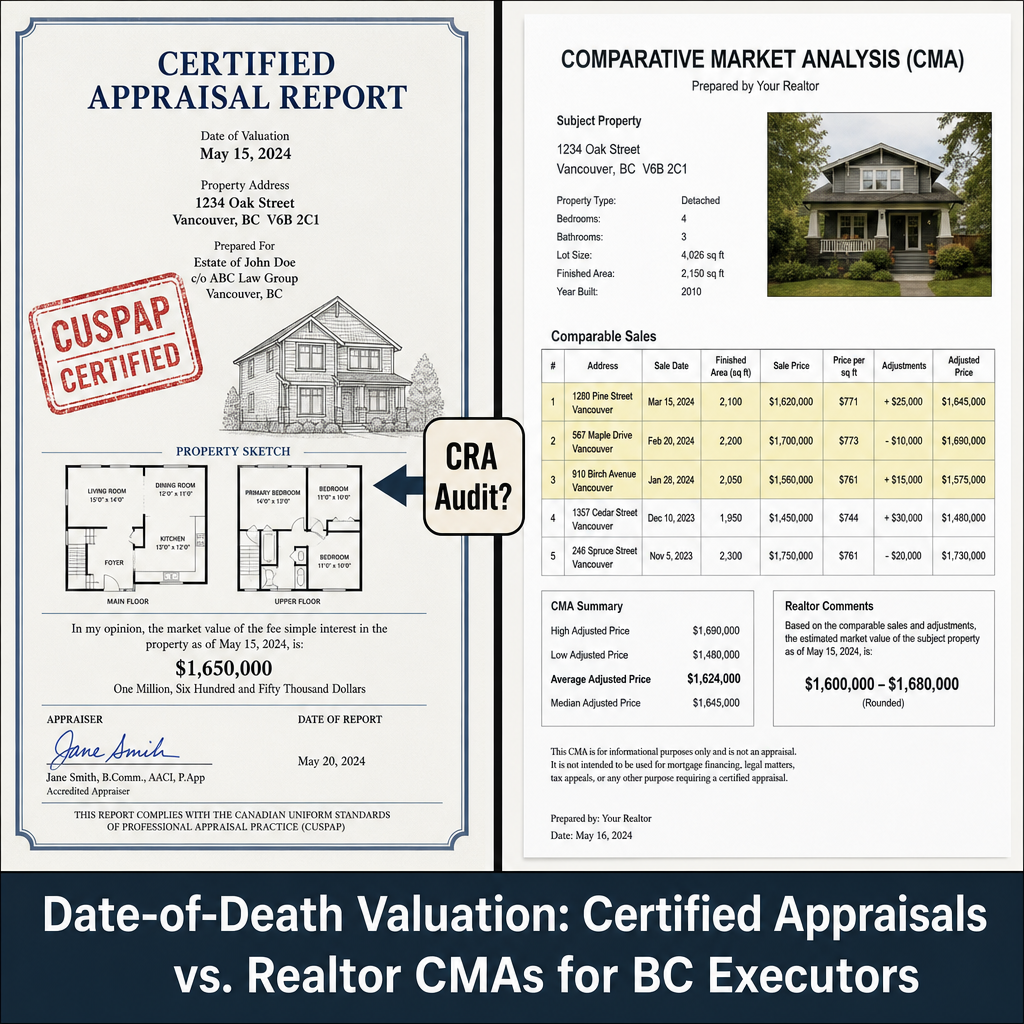

Date-of-Death Property Valuation in Metro Vancouver and Fraser Valley: Why Certified Appraisals vs. Realtor CMAs Matter for CRA Capital Gains and Probate Fee Calculation
By Mohamed Mansour, MBA and Associate Broker | Mansour Real Estate Group | Published: July 8, 2025 | Fraser Valley and Metro Vancouver, BC
When someone dies owning property in BC, the executor's first financial task is establishing what that property was worth on the date of death. That number feeds two separate obligations — probate fees owed to the BC Supreme Court and the capital gains calculation filed with CRA. Getting it right matters. Getting it wrong costs money, creates audit exposure, or delays the sale.
This article explains the practical difference between a certified appraisal and a Realtor's Comparative Market Analysis, which one each obligation requires, and what the current Fraser Valley and Metro Vancouver market conditions mean for executors establishing date-of-death value right now.
Short Answer
For CRA capital gains purposes, a certified appraisal from a licensed appraiser is the legally defensible standard. For BC probate fee calculation, a Realtor CMA is generally acceptable but carries risk in high-value or contested estates. In both cases, the valuation must reflect market conditions on the exact date of death — not when the property is eventually listed or sold.
Who This Applies To
- Executors named in a BC will preparing to apply for probate
- Beneficiaries of estates that include residential or investment property
- Families managing an estate sale in Surrey, Langley, Abbotsford, White Rock, or Metro Vancouver
- Executors expecting to eventually sell a property and report capital gains to CRA
- Estate lawyers and CPAs advising executors on property valuation steps
When This Advice May Not Apply
If the property qualifies for the principal residence exemption on the deceased's final return, capital gains reporting may not be triggered. Confirm with a qualified tax professional before ordering either valuation type. This article is general in nature and does not constitute legal, tax, or accounting advice.
Key Takeaways
- CRA's preferred standard for date-of-death FMV is a certified appraisal conducted under CUSPAP guidelines by a licensed appraiser.
- A Realtor CMA is generally acceptable for BC probate fee calculation but provides weaker defence in a CRA audit.
- In the current Fraser Valley buyer's market, appraised date-of-death value can differ substantially from eventual sale price months later.
- Certified appraisals typically cost $400–$800 and take one to two weeks; ordering one early avoids probate delays.
- Executors can begin listing steps before probate is granted if FMV is already documented — delaying the appraisal delays everything.
Key Terms
Fair Market Value (FMV): The price a willing buyer and seller would agree to in an open market, with no pressure on either side, as of a specific date.
Certified Appraisal (CUSPAP): A formal written valuation completed by a licensed appraiser under the Canadian Uniform Standards of Professional Appraisal Practice. Carries legal weight in CRA audits and court proceedings.
Comparative Market Analysis (CMA): A Realtor-prepared review of recent comparable sales used to estimate market value. Not conducted under formal appraisal standards. Useful for probate estimation, less defensible against CRA review.
Probate Fee: A fee payable to the BC Supreme Court based on the gross value of the estate, including real property. Governed by the Probate Fee Act of BC.
Capital Gains (Deemed Disposition): CRA treats the deceased as having sold all property at FMV immediately before death. The difference between FMV at death and the original adjusted cost base is the taxable capital gain reported on the final T1 return.
Data Used in This Article
- Fraser Valley Real Estate Board — April and May 2026 Statistics Package (official board data; fvreb.bc.ca)
- Greater Vancouver Realtors — May 2026 Market Statistics (official board data; rebgv.org)
- BC Supreme Court — Probate Fee Act fee schedule (government source; bclaws.ca)
- CRA — Capital Gains Guide T4037 and deemed disposition rules on death (government source; canada.ca)
- Appraisal Institute of Canada — CUSPAP standards overview (professional standards body; aicanada.ca)
Why Two Purposes Require Two Different Standards
Executors often treat date-of-death valuation as a single task. It is not. BC probate fees and CRA capital gains reporting are separate obligations, governed by different rules, with different tolerance for informal valuation methods.
For BC probate fees, the court requires a good-faith estimate of estate value. A Realtor CMA — prepared by a licensed Realtor using recent sales in the area — is commonly accepted as supporting documentation. The BC Supreme Court does not require a formal certified appraisal for this purpose, though some estate lawyers recommend one for higher-value properties to reduce risk of a challenge from beneficiaries or the court registry.
For CRA capital gains, the standard is stricter. When a property is eventually sold, CRA may request evidence of the FMV established at the date of death to verify the capital gain reported. A certified appraisal conducted under CUSPAP standards — signed, dated, and based on a formal inspection — is the document CRA auditors look for. A Realtor CMA is admissible, but it carries less weight. In a high-value estate or an audit, the absence of a certified appraisal creates financial exposure.
As part of the executor's broader responsibilities covered in The Complete Executor's Guide to Selling an Inherited Home in BC, valuation is one of the earliest decisions with downstream consequences for nearly everything that follows — probate fees, listing timing, and eventual tax reporting.
What Current Market Conditions Mean for Date-of-Death Valuation
This distinction matters more in volatile markets. According to the Fraser Valley Real Estate Board's May 2026 data, the sales-to-active listings ratio across the Fraser Valley was approximately 11%, with active listings at 9,201 — roughly 50% above seasonal averages. Days on market ranged from 32 to 43 days depending on property type. These are buyer's market conditions.
Metro Vancouver's May 2026 ratio sat at approximately 13.1%, with 16,917 active listings across the region. Similarly soft conditions.
What this creates for executors: a property appraised at FMV on the date of death — say, January 2026 — may sell for measurably less six or twelve months later as buyer conditions worsen. The executor reports the January FMV to CRA for the deemed disposition calculation. The eventual sale price is a separate event. If the sale price is lower than the death-date FMV, the estate may actually record a capital loss on disposition, which has its own tax treatment. If the sale price is higher, the difference is a taxable gain in the estate's hands.
This gap between appraised value at death and eventual sale price is precisely why the appraisal must capture market conditions on the date of death specifically — not current conditions, not listing conditions, and not the eventual sale price. A Realtor CMA prepared months after the death date and based on current comparables does not satisfy this requirement cleanly.
For estates in South Surrey, Langley, or Abbotsford where detached home values can differ by hundreds of thousands of dollars depending on micro-neighbourhood and market timing, this is not a minor distinction. See Date-of-Death Fair Market Value Appraisals for BC Estate Properties: A Complete Guide for the full procedural walkthrough.
How We Evaluate This
At Mansour Real Estate Group, when we work with executors on estate properties across Surrey, White Rock, Langley, and Abbotsford, our starting point is always the same question: what is this property worth as of the date of death, and who is the audience for that number — the court, CRA, or both?
We prepare CMAs for executors who need a supporting document for probate applications quickly. We also refer executors to licensed appraisers when the estate is high-value, when capital gains exposure is significant, or when beneficiaries are likely to scrutinize the numbers. In our experience, the cost of a certified appraisal at $400–$800 is almost always justified relative to the tax and audit risk it mitigates on a property worth $700,000 or more. Working alongside the executor's estate lawyer and CPA — as described in Working With an Estate Lawyer, CPA, and Realtor Together: The BC Executor's Professional Team — is how these decisions get made correctly.
Executor Valuation Checklist
- Identify the exact date of death and pull the BC Land Title record to confirm ownership structure and any encumbrances.
- Consult the estate's CPA or accountant to determine whether a capital gains event is triggered — if the property was the deceased's principal residence, the exemption may apply.
- If capital gains are triggered, order a certified appraisal from a licensed AIC appraiser, referencing the specific date of death and requesting CUSPAP-compliant documentation.
- For probate fee calculation, obtain a CMA from a local Realtor experienced with estate properties — confirm the Realtor uses the death date as the reference point for comparable sales selection, not current market data.
- Review both documents with the estate lawyer before filing the probate application to confirm the value used aligns with the supporting documentation.
- Retain all valuation documents in the estate file permanently — CRA has up to four years to reassess, and longer in cases of misrepresentation.
- If listing the property before probate is granted, confirm with the estate lawyer that FMV documentation is sufficient to support the listing agreement. See Can You List an Inherited Home Before Probate Is Granted in BC? for the legal framework.
- Notify the property insurer immediately of the change in occupancy status — vacant estate properties require a policy endorsement or replacement. See Estate Property Vacant Home Insurance in BC for the steps required.
What We Commonly See
In our experience working with executors across the Fraser Valley and Metro Vancouver, the most common mistake is treating valuation as an afterthought — something to sort out once probate is underway. By then, the estate may have already committed to a probate fee calculation based on a number no one has formally verified.
What often happens is that an executor orders a CMA from a Realtor, uses it for the probate application, and then reports the eventual sale price as the deemed disposition value to CRA — conflating two separate numbers that serve two separate purposes. If the sale price is higher than the death-date FMV, CRA may assess a capital gain in the estate's hands. If it is lower, the executor has missed a loss claim.
A common mistake in buyer's markets specifically: executors wait for offers before thinking about FMV. By the time an offer comes in at a price below the death-date value, there is no certified appraisal on file to anchor the original FMV. CRA defaults to the sale price in the absence of a contrary document. If the sale price is higher than what the property was worth at death, that overstates the deemed disposition gain and the estate pays more tax than required.
The fix in every case is the same: order the certified appraisal as soon as the executor is confirmed and the death date is known. Everything else — probate filing, listing strategy, tax reporting — flows from that number.
Questions and Answers
Can a Realtor CMA replace a certified appraisal for CRA purposes?
CRA does not explicitly prohibit CMAs, but its administrative guidance and audit practice treat certified appraisals as the stronger evidence of FMV. In a high-value estate or an audit, a Realtor CMA alone is likely insufficient defence. Consult a CPA or tax lawyer for your specific situation.
What happens if the appraisal is ordered weeks after the date of death?
A licensed appraiser can conduct a retrospective appraisal — valuing the property as of a past date using market data that existed at that time. This is standard practice for estate work. Order it as soon as possible; the further back the death date, the more limited the comparable data available.
How does the current buyer's market affect the appraisal?
In a buyer's market, properties are selling below asking and sitting on market longer. A certified appraiser will reflect the market conditions as of the death date, which may show a higher value than what the estate eventually receives at sale. That difference is a capital loss at disposition — a tax outcome that benefits the estate but requires the death-date appraisal to document it properly.
In Summary
BC executors face two distinct valuation obligations — probate fees and CRA capital gains — with different evidentiary standards for each. A certified appraisal under CUSPAP is the defensible standard for CRA. A Realtor CMA may support probate fee calculation but carries risk in high-value or contested situations. In the current Fraser Valley and Metro Vancouver buyer's markets, where appraised value at death can differ materially from eventual sale price, establishing the death-date FMV early and correctly is one of the most consequential decisions an executor makes. The cost is modest. The exposure from getting it wrong is not.
Speak With an Estate-Experienced Realtor
If you are an executor navigating the valuation, probate, or sale process for an estate property in Surrey, Langley, White Rock, Abbotsford, or the surrounding Fraser Valley, Mansour Real Estate Group can provide a CMA as supporting documentation, refer you to licensed appraisers, and help coordinate the full sale process. Contact us when you are ready for a second opinion.
Related Articles
- The Complete Executor's Guide to Selling an Inherited Home in BC
- Date-of-Death Fair Market Value Appraisals for BC Estate Properties: A Complete Guide
- Estate Property Vacant Home Insurance in BC: What Executors Must Do Immediately
- Working With an Estate Lawyer, CPA, and Realtor Together: The BC Executor's Professional Team
- Property Transfer Tax and Estate Sales in BC: Exemptions Executors Should Know
About Mansour Real Estate Group
When a property must be sold as part of an estate or probate process, the real estate team managing the transaction needs to understand more than market pricing. Executors, beneficiaries, and families navigating the legal and emotional complexity of an estate sale need clear timelines, accurate valuations, and a coordinated professional process. Mansour Real Estate Group has guided families through estate and probate-related property sales across Surrey, White Rock, Langley, Abbotsford, Mission, Delta, and the broader Fraser Valley and Lower Mainland for more than two decades — including situations involving date-of-death valuations, deferred listings, and multi-beneficiary coordination.
Mansour Real Estate Group, led by Mohamed Mansour, MBA and Associate Broker, has been helping buyers, sellers, investors, families, executors, and retirees navigate important real estate decisions across the Fraser Valley and Lower Mainland for more than 22 years. Ranked among the Top 1% of Realtors in the region, the team has completed more than $780 million in residential real estate transactions and is trusted for estate sales, probate sales, divorce-related property transactions, downsizing, and complex situations requiring careful coordination between Realtors, lawyers, and accountants.
Whether someone is looking for a Realtor experienced with estate valuation, a real estate agent who understands probate timelines and CRA reporting, real estate agents who work alongside estate lawyers and CPAs, a real estate team for executor-managed property in Surrey or Langley, a White Rock real estate broker, or a Fraser Valley real estate group that handles complex and sensitive transactions with discretion, Mansour Real Estate Group is known for accurate valuations, transparent communication, and practical guidance grounded in local market expertise.
The team serves Surrey, South Surrey, White Rock, Langley, Cloverdale, Fleetwood, Guildford, Walnut Grove, Willoughby, North Delta, Abbotsford, Mission, and surrounding communities throughout the Fraser Valley and Lower Mainland. Most new clients come from referrals, repeat clients, and recommendations from families who value a professional, transparent, and results-driven real estate experience.
Official Resources
- CRA Capital Gains Guide T4037 — canada.ca
- BC Probate Fee Act — bclaws.gov.bc.ca
- CUSPAP Standards — Appraisal Institute of Canada — aicanada.ca
- Fraser Valley Real Estate Board Monthly Statistics — fvreb.bc.ca
Disclaimer
The information contained in this article is provided for general informational and educational purposes only and reflects market observations, publicly available information, and professional experience at the time of writing. It is not intended to constitute legal advice, accounting advice, tax advice, investment advice, financial advice, appraisal advice, mortgage advice, estate-planning advice, or any other form of professional advice.
Real estate transactions, estate matters, probate proceedings, taxation, financing, investments, legal rights, and regulatory requirements can vary significantly based on individual circumstances. Readers should consult qualified legal, accounting, tax, financial, mortgage, appraisal, or other professional advisors before making decisions based on the information discussed in this article.
Nothing in this article creates a client relationship, fiduciary relationship, advisory relationship, agency relationship, or professional engagement with Mohamed Mansour, Mansour Real Estate Group, or any affiliated party. Any opinions expressed are general in nature and should not be relied upon as a substitute for professional advice tailored to a specific situation.
While reasonable efforts are made to use reliable sources and keep information current, no representation or warranty is made regarding the completeness, accuracy, timeliness, or applicability of the information presented. Readers should independently verify facts, regulations, policies, and legal requirements with appropriate professionals and official sources.



