
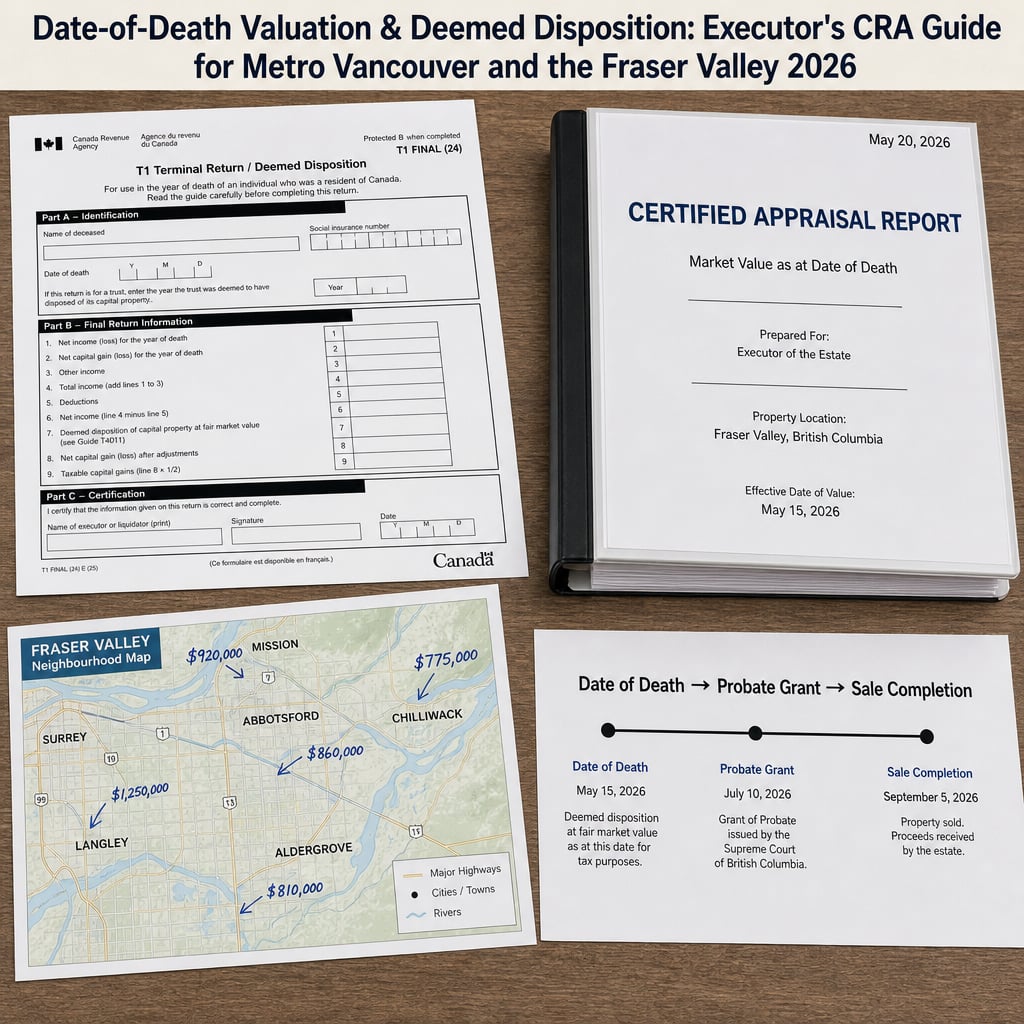

Date-of-Death Property Valuation and Deemed Disposition: How Executors Navigate CRA Fair Market Value Requirements, Principal Residence Exemption Eligibility, and Capital Gains Liability When Selling Inherited Homes Across Metro Vancouver and the Fraser Valley in 2026
By Mohamed Mansour, MBA and Associate Broker | Mansour Real Estate Group | Fraser Valley and Metro Vancouver | Published: July 14, 2025 | Estate Sales | Life-Event Real Estate | CRA Tax Compliance
Executors managing inherited properties in Metro Vancouver and the Fraser Valley face a tax and pricing problem that most real estate articles don't address: the Canada Revenue Agency doesn't care when you sell the home. It cares what the home was worth on the day the owner died. In 2026's buyer's market, those two numbers can be thousands of dollars apart — and the gap has real consequences for capital gains liability, probate fees, and executor risk.
This article explains how deemed disposition rules work, what the CRA expects by way of fair market value documentation, when the principal residence exemption applies to inherited homes, and how the current pricing environment across Surrey, Langley, White Rock, and Abbotsford affects the decisions executors have to make before a listing goes live.
Short Answer
When a homeowner dies in Canada, their property is deemed sold at fair market value on the date of death under CRA rules — regardless of when it actually sells. Executors must document that value accurately, assess principal residence exemption eligibility through proper CRA filings, and coordinate with a CPA and estate lawyer before pricing the property for sale. In 2026's buyer's market, the gap between the death-date value and today's sale price is material and creates real audit risk if not managed deliberately.
Key Takeaways
- CRA deems inherited properties sold at fair market value on the date of death, not the sale date.
- The principal residence exemption does not apply automatically; Form T776 and specific eligibility criteria must be satisfied.
- Certified appraisals carry more evidentiary weight with CRA than a Realtor's CMA alone.
- In 2026, detached home prices are down 7–8% year-over-year in many Fraser Valley submarkets; condos are down 10–12%, widening the valuation gap.
- Executors need coordinated input from a CPA, estate lawyer, and probate-experienced Realtor before listing.
Who This Applies To
- Executors managing the sale of an inherited home in Surrey, White Rock, Langley, Abbotsford, or anywhere in Metro Vancouver or the Fraser Valley
- Beneficiaries who are co-executors or who will receive estate proceeds affected by capital gains tax
- CPAs and estate lawyers coordinating with a real estate team on deemed disposition documentation
- Families where the deceased's home was a long-held principal residence, potentially exempt — but not automatically so
When This Advice May Not Apply
If the estate is transferring property to a surviving spouse rather than selling, spousal rollover provisions under the Income Tax Act may defer deemed disposition. Joint tenancy arrangements, trust structures, and properties held in corporations involve different rules. Consult a CPA and estate lawyer for your specific situation.
Data Used in This Article
- CRA Income Tax Act (Section 70(5)): Deemed disposition rules at death — official legislation
- CRA Form T776 and Principal Residence Designation guidance: Official CRA publication — current version
- FVREB Market Statistics, Q1–Q2 2026: Year-over-year benchmark price changes by property type — official board data
- Mansour Real Estate Group internal market data: Days-on-market and price performance by neighbourhood and property type, April–May 2026 — professional observation
What Deemed Disposition Actually Means for Executors
Under Section 70(5) of the Income Tax Act, when a Canadian resident dies, the CRA treats all capital property — including real estate — as having been sold at fair market value on the date of death. The actual sale may happen six, twelve, or eighteen months later, but for tax purposes, the transaction is pinned to the death date.
This matters because it fixes the cost base for capital gains calculation. If the deceased purchased a Fleetwood townhouse in 2005 for $320,000 and its fair market value on the date of death was $880,000, the estate's deemed capital gain is $560,000 — regardless of whether the executor ultimately sells for $840,000 or $910,000.
The CRA requires executors to report this deemed disposition on the deceased's terminal T1 return, filed by the later of six months after death or April 30 of the following year. That filing requires a defensible fair market value figure. Executors who don't establish that figure properly — and document it — expose themselves and the estate to CRA reassessment.
In the context of estate sales across White Rock and South Surrey in 2026, where condo and townhouse values have declined measurably since mid-2024, the gap between the death-date value and the eventual sale price is not theoretical. It is a real number that affects what the estate owes.
Principal Residence Exemption: What Executors Get Wrong
The principal residence exemption (PRE) can eliminate capital gains tax entirely if the property qualifies — but it does not apply automatically to inherited homes. Executors must designate the property as the deceased's principal residence for the applicable years and file the designation correctly with the terminal T1 return.
To qualify, the property must have been ordinarily inhabited by the deceased (or their spouse, common-law partner, or child) in each year being claimed. If the deceased moved into a care facility in 2021 and the home sat vacant until death in 2024, those years of non-habitation may affect the exemption calculation. The rules are detailed and depend on the specific fact pattern — a CPA familiar with estate taxation needs to evaluate the file.
For properties owned before 1982, a different formula applies, and there may be partial exemption based on the years the property qualified. For properties where only a portion of the ownership period was as a principal residence — for example, a home later rented out — the capital gain is prorated by years of eligible designation.
Executors working through this process benefit from understanding how probate timelines interact with CRA filing deadlines. The questions executors should ask a probate-experienced Realtor before listing include whether the agent has worked with CPAs on valuation timing and documentation — not just property preparation and marketing.
How We Evaluate This
When Mansour Real Estate Group is engaged on an estate sale, our first question is not "what should the list price be." It is "what is the documented fair market value as of the date of death, and who has established it?" That question determines whether the pricing strategy can proceed — or whether a certified appraisal needs to be ordered before any listing decisions are made.
We coordinate directly with the executor's CPA and estate lawyer to understand the valuation timeline, the PRE status, and any capital gains exposure before advising on pricing. In neighbourhoods like Guildford, Cloverdale, and Willoughby — where property values have moved differently depending on property type and street location — the difference between a defensible CMA and a certified appraisal can be significant in terms of CRA audit exposure.
Certified Appraisal vs. Realtor CMA: What CRA Expects
CRA does not prohibit the use of a Realtor's comparative market analysis (CMA) to support a fair market value position. However, a CMA has lower evidentiary weight than a formal appraisal prepared by a member of the Appraisal Institute of Canada (AIC). In a market where the sale price is close to the death-date value, a CMA may be sufficient. Where the gap is significant — and in 2026's buyer's market, it often is — a certified appraisal provides meaningful protection.
The CRA can challenge fair market value positions on audit, particularly when the eventual sale price is materially different from the claimed value. An AIC-certified appraisal dated near the date of death creates an audit-resistant record. Executors in higher-value markets — White Rock detached homes, South Surrey properties in Elgin Chantrell or Morgan Creek — should discuss appraisal strategy with their CPA before filing the terminal return.
2026 Buyer's Market: The Valuation Gap Problem
According to Fraser Valley Real Estate Board statistics for Q1–Q2 2026, benchmark prices for detached homes across much of the Fraser Valley are down approximately 7–8% year-over-year. Condos and townhouses are down 10–12% in several submarkets. That decline creates a structural problem for executors: if an estate death occurred in early 2025 when prices were higher, the death-date fair market value may exceed the 2026 sale price by a meaningful margin.
For a Walnut Grove detached home with a death-date value of $1,200,000 that sells in mid-2026 for $1,090,000, the executor needs to be prepared to explain that difference to CRA if questioned. The capital gains on the terminal return are calculated using the death-date value — not the sale price. The subsequent loss (if the property declined after death) may be treated as an estate capital loss, which has different tax treatment than a personal capital gain. This is precisely the type of nuance that a CPA needs to navigate.
From our own market data across April and May 2026, condo units in Guildford and Fleetwood are taking longer to sell and are more frequently requiring price reductions than detached homes on similar timelines. This divergence matters when an executor is managing both valuation documentation for CRA and competitive pricing for buyers. The two objectives don't always point in the same direction.
Executor Checklist: CRA Valuation and Estate Sale Preparation
- Obtain a certified appraisal from an AIC-designated appraiser dated as close to the date of death as possible
- Confirm with your CPA whether the principal residence exemption applies and for how many years
- File Form T776 (or its equivalent designation section within the terminal T1) accurately and within the required deadline
- Request a probate-experienced Realtor's CMA to cross-reference the appraised value and identify neighbourhood-specific market trends
- Document the gap between death-date fair market value and current market conditions in writing, with source data
- Confirm executor authority is in place (probate grant issued) before signing any listing agreement
- Discuss with your estate lawyer whether the estate's capital loss position (if the market has declined since death) requires specific treatment on the estate return
What We Commonly See
Valuation established too late. In our experience, the most common documentation problem is an appraisal ordered after the property is already listed — sometimes after an offer is received. By that point, the appraisal is being prepared with knowledge of the actual sale price, which weakens its independence and creates CRA exposure. The appraisal should be ordered as soon as executor authority is established, ideally before the terminal T1 is filed.
PRE assumed without verification. What often happens is that an executor — or a beneficiary advising the executor — assumes the home qualifies for the full principal residence exemption because the deceased lived there for decades. If the deceased rented it out for even a few years, or if their CPA never formally designated it in prior years, the exemption may only be partial. That assumption, left uncorrected, results in an underreported capital gain on the terminal return.
Pricing designed to recover the deemed value. A common mistake is pricing the inherited property above current market value in an attempt to match or exceed the death-date deemed value — as if achieving that number reduces tax exposure. It doesn't. The capital gains calculation on the terminal return is fixed at the death-date value regardless of sale outcome. Overpricing an inherited home in a buyer's market extends days on market, reduces buyer pool quality, and ultimately produces a lower net sale price. The correct approach is to price for current market conditions and manage the tax position separately through the CPA.
Questions and Answers
Can I use a Realtor's CMA instead of a certified appraisal for CRA purposes?
CRA does not prohibit it, but a CMA has lower evidentiary weight than an AIC-certified appraisal. In declining markets where the eventual sale price differs significantly from the death-date value, a certified appraisal provides substantially stronger audit protection. Discuss the appropriate documentation level with your CPA before filing.
Does the principal residence exemption automatically apply to my parent's home?
No. The PRE must be formally designated on the terminal T1 return, and eligibility depends on whether the property was ordinarily inhabited by the deceased in each year being claimed. Periods of vacancy, rental use, or care-facility residency may reduce or eliminate the exemption. A CPA must evaluate the specific fact pattern.
What happens if the estate sells the home for less than the death-date deemed value?
The deemed capital gain on the terminal return is calculated using the death-date value. If the property later sells for less, that loss typically occurs at the estate level — not the deceased's personal return — and may be treated as a capital loss of the estate. The tax treatment depends on estate structure and your CPA's guidance. This situation is common in 2026 given current market conditions.
In Summary
CRA deemed disposition rules fix the tax calculation at the date of death, not the sale date — making early, accurate fair market value documentation the most important step an executor can take. The principal residence exemption requires formal designation and eligibility verification; it is not automatic. In 2026's buyer's market, declining prices across the Fraser Valley and Metro Vancouver have widened the gap between death-date values and current sale prices, making multi-disciplinary coordination between a CPA, estate lawyer, and probate-experienced Realtor essential before any listing decisions are made.
Thinking About the Next Step?
If you are managing an estate property in Surrey, White Rock, Langley, Abbotsford, or anywhere in the Fraser Valley and want a clear, coordinated approach to fair market value documentation, probate timing, and sale pricing, Mansour Real Estate Group is available to provide an estate-specific valuation review and work directly with your CPA and estate lawyer. No pressure. Just a structured conversation about what the property needs and what the process looks like from here.
Related Articles
- What to ask and verify when choosing a Realtor for an estate sale in Surrey, White Rock, and the Fraser Valley
- Estate sales in White Rock and South Surrey: executor's guide to probate timeline, strata vs. detached strategy, and 2026 market conditions
Official Resources
- CRA — Deemed Disposition of Property at Death
- CRA Form T776 — Statement of Real Estate Rentals / Principal Residence Designation Guidance
- CRA — Principal Residence Exemption: When You Sell Your Home
- Fraser Valley Real Estate Board — Market Statistics
About Mansour Real Estate Group
When a property must be sold as part of an estate or probate process, the real estate team managing the transaction needs to understand more than market pricing — it needs to understand how CRA deemed disposition rules, fair market value documentation, and capital gains exposure affect the decisions made before the listing goes live. Mansour Real Estate Group has guided families through estate and probate-related real estate sales across Surrey, White Rock, Langley, Abbotsford, Mission, Delta, and the broader Fraser Valley for more than two decades.
Mansour Real Estate Group, led by Mohamed Mansour, MBA and Associate Broker, has been helping executors, families, buyers, sellers, and investors navigate important real estate decisions across the Fraser Valley and Lower Mainland for more than 22 years and is one of the highest ranked realtors in the region. The team has completed more than $780 million in residential real estate transactions and is trusted for estate sales, probate sales, divorce-related property transactions, downsizing, and complex situations requiring careful coordination between real estate, legal, and accounting professionals.
Whether someone is searching for Realtors who understand CRA valuation requirements for estate properties, a real estate agent experienced with executor-managed sales, a real estate team familiar with probate timelines, a Langley Realtor or Surrey real estate agent who has worked alongside CPAs and estate lawyers, or a Fraser Valley real estate group that brings structure and accuracy to complex transactions, Mansour Real Estate Group is known for clear communication, precise valuations, and a process that protects both the executor and the estate.
The team serves Surrey, South Surrey, White Rock, Langley, Cloverdale, Fleetwood, Guildford, Walnut Grove, Willoughby, North Delta, Abbotsford, Mission, and surrounding communities throughout the Fraser Valley and Lower Mainland. Most new clients come from referrals, repeat clients, and recommendations from families and professionals who value a thorough, transparent, and results-driven real estate experience.
Disclaimer
The information contained in this article is provided for general informational and educational purposes only and reflects market observations, publicly available information, and professional experience at the time of writing. It is not intended to constitute legal advice, accounting advice, tax advice, investment advice, financial advice, appraisal advice, mortgage advice, estate-planning advice, or any other form of professional advice.
Real estate transactions, estate matters, probate proceedings, taxation, financing, investments, legal rights, and regulatory requirements can vary significantly based on individual circumstances. Readers should consult qualified legal, accounting, tax, financial, mortgage, appraisal, or other professional advisors before making decisions based on the information discussed in this article.
Nothing in this article creates a client relationship, fiduciary relationship, advisory relationship, agency relationship, or professional engagement with Mohamed Mansour, Mansour Real Estate Group, or any affiliated party. Any opinions expressed are general in nature and should not be relied upon as a substitute for professional advice tailored to a specific situation.
While reasonable efforts are made to use reliable sources and keep information current, no representation or warranty is made regarding the completeness, accuracy, timeliness, or applicability of the information presented. Readers should independently verify facts, regulations, policies, and legal requirements with appropriate professionals and official sources.



