
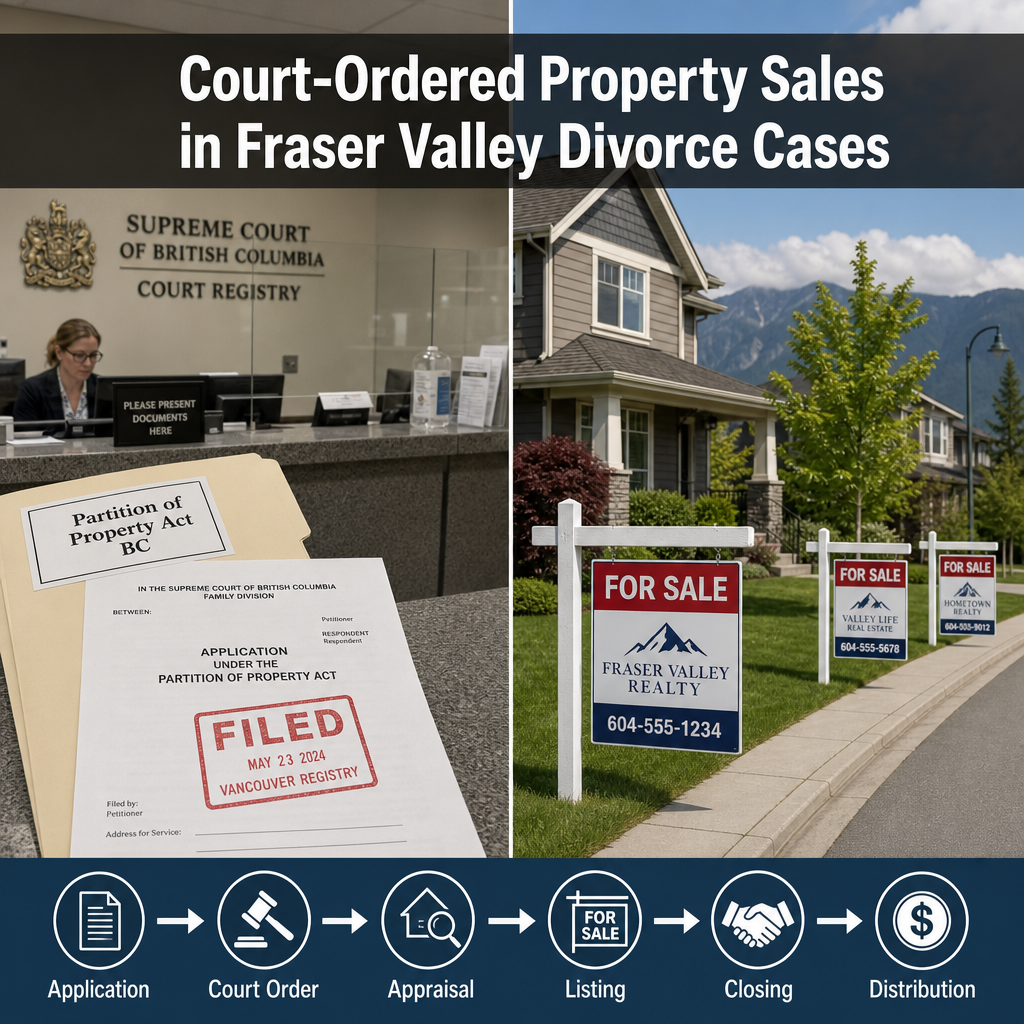

Court-Ordered Property Sales in Fraser Valley Divorce Cases: From Partition Application Through Sale Execution and Proceeds Distribution
By Mohamed Mansour, MBA and Associate Broker — Mansour Real Estate Group | Fraser Valley and Lower Mainland | Published: June 10, 2026
When separating spouses cannot agree on whether to sell the family home, one party can apply to a BC court to force the sale. In the Fraser Valley, those applications flow primarily through Surrey Provincial Court's Family Division and the Abbotsford registry. The court has broad authority under the Partition of Property Act to order a sale, appoint a valuator, and supervise how proceeds are distributed — whether both parties cooperate or not.
What most homeowners don't anticipate is that a court order does not guarantee a good sale outcome. In May 2026, the Fraser Valley has more than 10,000 active listings and an 11% sales-to-active ratio, well below the balanced market threshold of 12–20%, according to the Fraser Valley Real Estate Board's May 2026 statistical package. A court-ordered listing in this environment, priced by an appraisal that may not reflect current buyer demand, can underperform an arms-length sale by a meaningful margin. This article explains the process, the risks, and what a well-executed listing strategy looks like when the court is directing the sale.
Short Answer
In a Fraser Valley court-ordered divorce sale, a partition application is filed in Surrey or Abbotsford, a court order directs the sale, an independent appraisal typically sets the listing price floor, and proceeds are distributed through lawyers in trust after closing. Timeline from application to listing is 60–120 days. In the current buyer's market, listing strategy and pricing accuracy are critical to achieving fair value.
Key Takeaways
- Fraser Valley partition applications are handled primarily in Surrey and Abbotsford registries, with 60–120 day timelines from filing to a sale order.
- Court-appointed appraisals set listing price expectations but may not reflect buyer's market realities with 10,000+ active listings.
- Some court orders require accepting the first "reasonable offer," which can limit negotiation leverage in a soft market.
- Well-priced detached homes still attract competition even in buyer's markets — positioning and timing matter even under court direction.
- Proceeds distribution through lawyers in trust typically adds 30–45 days post-closing and follows the court's division formula.
Who This Applies To
- Separating spouses who disagree about whether or when to sell the family home
- One spouse who wants to sell but cannot obtain the other's cooperation
- Homeowners in Surrey, Langley, Abbotsford, North Delta, or Cloverdale involved in contested family property disputes
- Parties to a divorce where a lawyer has advised filing a partition application
- Executors or family law lawyers seeking a local real estate team familiar with court-supervised sale processes
When This Advice May Not Apply
If both spouses have already agreed in writing to sell and have jointly selected a real estate agent, the partition process described here may not be required. Couples with a valid separation agreement that addresses property division may be able to proceed with a standard listing. This article addresses contested situations where court direction is needed or already obtained. Consult your family law lawyer to confirm which process applies to your circumstances.
Key Terms Defined
Partition of Property Act (BC): Provincial legislation allowing a co-owner of property to apply to the BC Supreme Court to force a sale or physical division of the property when co-owners cannot agree.
Partition application: The court filing that initiates the forced-sale process; typically filed in the Supreme Court registry closest to the property's location.
Sales-to-active ratio: The percentage of active listings that sold in a given month; below 12% signals a buyer's market where sellers have less negotiating power.
Proceeds in trust: After closing, the net sale proceeds are held by a lawyer in a trust account and distributed to each party according to the court order or separation agreement, typically within 30–45 days.
Data Used in This Article
- Fraser Valley Real Estate Board, May 2026 Statistical Package — official board data, May 2026, Fraser Valley geography (fvreb.bc.ca)
- Fraser Valley Real Estate Board, April 2026 Statistical Package — 11% sales-to-active ratio, buyer's market confirmation (fvreb.bc.ca)
- Zealty Blog, April 2026 BC Housing Market Report — detached above-asking sales trend, Greater Vancouver (zealty.ca)
- BC Partition of Property Act — Government of British Columbia (gov.bc.ca)
- Law Society of BC — Trust Account Rules — proceeds distribution protocol (lawsociety.bc.ca)
How the Partition Process Works in Fraser Valley Courts
A partition application in the Fraser Valley is filed in BC Supreme Court — most commonly the Surrey registry for properties in Surrey, North Delta, Cloverdale, Fleetwood, Guildford, and Langley, and the Abbotsford registry for properties in Abbotsford and Mission. The application asks the court to either physically divide the property (rarely practical for residential homes) or order its sale.
Once filed, the non-applying spouse must be served and given opportunity to respond. Contested cases proceed through case management, which can extend the timeline. According to the research base for this article and general family law practice in BC, timeline from application to a court order directing sale typically ranges 60–120 days depending on complexity. Simple, uncontested matters may resolve faster; disputes over valuation, timing, or division formula extend the process.
The court order will typically specify: that the property must be listed for sale, the minimum listing price (usually based on an independent appraisal ordered by the court), the process for selecting a real estate agent (joint selection, or court appointment in contested cases), and how offers are to be reviewed and accepted.
Understanding the Partition of Property Act and how it forces a home sale is a useful starting point before the court process begins. Separately, if one party is concerned the other may encumber the property before sale, a Certificate of Pending Litigation may be advisable — that process is addressed in the next article in this series.
Why the Fraser Valley's Current Market Complicates Court-Ordered Sales
A court-appointed appraisal provides a snapshot of property value at a point in time. In a stable market, that snapshot is reasonably close to what the property will sell for. In May 2026, the Fraser Valley has over 10,000 active listings and a sales-to-active ratio of approximately 11%, according to the FVREB's May 2026 report. Buyers have extensive choice. Properties that are not priced accurately for current conditions sit. Properties that do sit accumulate days on market, which further reduces buyer confidence and negotiating leverage.
The risk specific to court-ordered partition sales in this environment is that the listing price floor set by the court appraisal may be higher than what the current market will absorb quickly, while the court order may simultaneously restrict the parties' ability to reduce the price without returning to court for a variation. That process takes time, which in a buyer's market means more inventory enters and the relative position of the subject property weakens further.
There is a counterpoint. The April 2026 FVREB data shows that well-priced detached homes continue to attract buyers, and Zealty's April 2026 BC housing market report noted that 12.5% of Greater Vancouver detached home sales closed above the asking price. The conclusion is not that court-ordered sales cannot succeed — it is that they require a real estate team that understands both the legal constraints of the court order and the tactical requirements of the current buyer's market. A generic listing approach in this environment is likely to underperform. That has direct consequences for both parties, since the proceeds determine how much each receives. For a broader picture of how real estate is handled when spouses separate, the article on how real estate is divided in a BC divorce provides the foundational context.
How We Evaluate Court-Ordered Sale Assignments
When Mansour Real Estate Group is engaged to manage a court-ordered partition sale in the Fraser Valley, the first step is reviewing the court order itself, not the appraisal. The order defines the legal constraints: minimum list price, offer acceptance requirements, reporting obligations, and any restrictions on marketing duration or price reductions. Understanding those constraints before any listing activity begins prevents the kind of procedural errors that can delay closing or require expensive returns to court.
From there, the analysis compares the court-mandated price floor against current comparable sales data from the FVREB and active inventory in the immediate area. If the appraisal reflects a price that is reasonable for the current market, the strategy is straightforward. If there is a gap, that gap needs to be documented and presented to both parties' lawyers early, so they can apply for a price variation before the listing goes live rather than after the property has accumulated market time. The goal in every partition sale is to achieve a clean, well-priced transaction that both parties' lawyers can report as reasonable to the court — and that actually protects the equity both parties spent years building.
Proceeds Distribution: What Happens After Closing
After a court-ordered sale closes, the net proceeds — sale price minus commission, legal fees, outstanding mortgage, property tax adjustments, and any court-authorized deductions — are paid to the lawyers in trust. Under the Law Society of BC's trust account rules, those funds are held in a designated trust account until the court order or separation agreement authorizes disbursement to each party.
This process typically adds 30–45 days post-closing before funds reach the individual parties. Court orders often specify an equal split of net proceeds, which can create tension when one party believes they contributed more to the down payment or renovations. Those arguments, if unresolved before closing, delay disbursement. They are best addressed during the legal proceedings rather than after the sale closes. The article on whether your ex can force you to sell your home under the BC Family Law Act covers the legal rights framework that governs these disputes.
Divorce Sale Checklist: Court-Ordered Partition Sales in BC
- Confirm with your family law lawyer whether a partition application is necessary or whether a consent order or separation agreement can direct the sale more efficiently.
- File the partition application in the correct registry — Surrey for most of Surrey, Langley, and North Delta; Abbotsford for Abbotsford and Mission.
- Request that the court's appraiser be instructed to deliver a current market value opinion, not a retrospective value, and verify the appraisal date relative to current FVREB data.
- Review the court order carefully before signing a listing agreement — confirm whether a price reduction requires court approval, and whether the order requires accepting the first "reasonable offer."
- Select a real estate team jointly with the other party (or through the court process) that has direct experience managing court-supervised sales and understands Fraser Valley market conditions.
- Before listing, compare the court-mandated price floor to active comparables in the immediate area and current FVREB inventory data; if there is a gap, address it with both lawyers before the listing goes live.
- Confirm the proceeds distribution formula and any disputed contributions (down payment, renovations) are resolved before closing to avoid post-closing delays in trust disbursement.
What We Commonly See
In our experience managing divorce-related property sales in Surrey, Langley, and Abbotsford, the most common problem is not the legal process — it is the gap between the court appraisal date and the listing date. An appraisal completed in February may set a price floor that reflected winter market conditions; by the time the order is issued and the listing is prepared, it is May, inventory has risen significantly, and the floor price is now above what the market will absorb without extended days on market.
A second pattern we see regularly is parties who agree on the sale but disagree about preparation. One party wants to invest in staging and minor repairs to protect equity; the other refuses to authorize expenditures on a property they are leaving. The result is a listing that enters the market in below-average condition at above-market pricing — a combination that consistently underperforms in a buyer's market.
What often happens is that both sides lose equity they could have protected with coordinated pre-listing preparation and realistic pricing. The court cares about a fair and transparent process; it does not guarantee an optimal sale price. That part is the responsibility of the real estate team and the lawyers advising both parties.
Questions and Answers
Can a BC court order a home to be sold even if both spouses are on title and one refuses?
Yes. Under the Partition of Property Act, a co-owner can apply to BC Supreme Court to force a sale regardless of the other owner's consent. Judges in the Fraser Valley courts have broad discretion to order a sale when continued co-ownership is not practical, which is typically the case in divorce proceedings.
How long does a partition application take in Surrey or Abbotsford?
An uncontested application may result in a court order within 60 days of filing. Contested cases involving disputes over valuation, timing, or division formula can take 90–120 days or longer depending on the court's schedule and how the parties respond. Your family law lawyer is the right person to give a timeline estimate based on your specific file.
Does the court set the sale price, or does the real estate agent?
The court typically orders an independent appraisal and uses that appraisal to set a minimum listing price. The real estate agent can recommend a listing price at or above that floor, but cannot list below it without a court order variation. This is why the appraisal date and current market conditions need to be reviewed carefully before the listing goes live.
In Summary
Court-ordered property sales in the Fraser Valley follow a defined legal path — partition application, court order, independent appraisal, listing, closing, and proceeds distribution through lawyers in trust — but the outcome is shaped by how well the real estate team executes within that structure. In May 2026's buyer's market, with over 10,000 active listings and an 11% sales-to-active ratio per the FVREB, listings that are not accurately priced and properly prepared underperform. Both parties lose equity. Addressing the gap between court-mandated price floors and current market conditions before listing, rather than after accumulating days on market, is the most important tactical decision in a partition sale. The legal process protects fairness; the listing strategy protects value.
Thinking About Your Next Step?
If you are involved in a court-ordered sale or a contested divorce property situation in Surrey, Langley, Abbotsford, or elsewhere in the Fraser Valley, Mansour Real Estate Group can review the specifics with you. There is no pressure and no obligation — just a grounded conversation about your options and what the current market means for your situation. Reach out through localhost:9000/ when you are ready.
Related Articles
- How Real Estate Is Divided in a Divorce in BC: What Every Homeowner Needs to Know
- Can My Ex Force Me to Sell Our House in a BC Divorce? Your Rights Under the Family Law Act
- The Certificate of Pending Litigation in BC Divorce: What It Is and When to File One
- Partition of Property Act BC: How It Forces a Home Sale When Spouses Disagree
About Mansour Real Estate Group
When a home must be sold as part of a court-ordered partition or contested divorce, the real estate team managing the transaction needs to understand more than listing strategy. They need to read a court order, identify constraints on pricing and offer acceptance, coordinate with both parties' lawyers, and execute a listing in whatever market conditions exist — not the ones that were present when the appraisal was done. Mansour Real Estate Group has worked with homeowners, families, and legal counsel managing divorce-related and court-supervised property sales across the Fraser Valley and Lower Mainland for more than two decades.
Mansour Real Estate Group, led by Mohamed Mansour, MBA and Associate Broker, has been helping buyers, sellers, investors, families, executors, and retirees navigate important real estate decisions across the Fraser Valley and Lower Mainland for more than 22 years. Ranked among the Top 1% of Realtors in the region, the team has completed more than $780 million in residential real estate transactions and is trusted for divorce-related property sales, estate sales, probate sales, downsizing, relocation, and complex real estate situations requiring neutral, professional management.
Whether someone is searching for real estate agents experienced with court-supervised partition sales, a Realtor who understands how separation affects a home sale in Surrey or Langley, a neutral real estate team for a joint court-ordered listing, a Fraser Valley real estate broker with family law experience, or real estate agents who serve the Abbotsford and Mission area, Mansour Real Estate Group is known for clear communication, impartial valuations, and a process that protects both parties' interests.
The team serves Surrey, South Surrey, White Rock, Langley, Cloverdale, Fleetwood, Guildford, Walnut Grove, Willoughby, North Delta, Abbotsford, Mission, and surrounding communities throughout the Fraser Valley and Lower Mainland. Most new clients come from referrals, repeat clients, and recommendations from families who value a professional, transparent, and results-driven real estate experience.
Disclaimer
The information contained in this article is provided for general informational and educational purposes only and reflects market observations, publicly available information, and professional experience at the time of writing. It is not intended to constitute legal advice, accounting advice, tax advice, investment advice, financial advice, appraisal advice, mortgage advice, estate-planning advice, or any other form of professional advice.
Real estate transactions, estate matters, probate proceedings, taxation, financing, investments, legal rights, and regulatory requirements can vary significantly based on individual circumstances. Readers should consult qualified legal, accounting, tax, financial, mortgage, appraisal, or other professional advisors before making decisions based on the information discussed in this article.
Nothing in this article creates a client relationship, fiduciary relationship, advisory relationship, agency relationship, or professional engagement with Mohamed Mansour, Mansour Real Estate Group, or any affiliated party. Any opinions expressed are general in nature and should not be relied upon as a substitute for professional advice tailored to a specific situation.
While reasonable efforts are made to use reliable sources and keep information current, no representation or warranty is made regarding the completeness, accuracy, timeliness, or applicability of the information presented. Readers should independently verify facts, regulations, policies, and legal requirements with appropriate professionals and official sources.
Official Resources
- Fraser Valley Real Estate Board — May 2026 Statistical Package
- Fraser Valley Real Estate Board — April 2026 Statistical Package
- BC Partition of Property Act — Government of British Columbia (bclaws.gov.bc.ca)
- Law Society of British Columbia — Trust Account Rules
- Zealty — April 2026 BC Housing Market Report



