
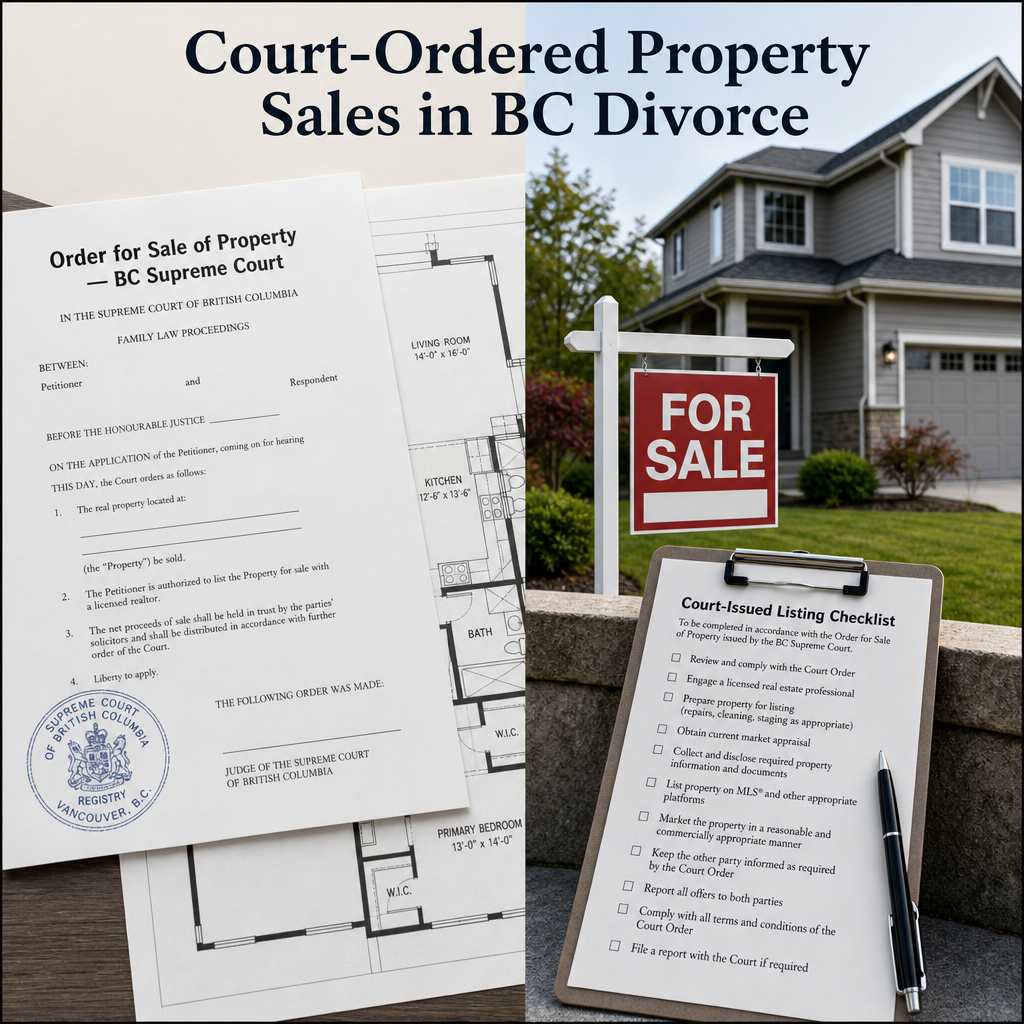

Court-Ordered Property Sales in BC Divorce: How Family Court Mandates Home Sales When Spouses Disagree, How Judges Select Realtors, and What the Supervised Listing and Closing Process Actually Looks Like for Metro Vancouver and Fraser Valley Divorcing Couples
By Mohamed Mansour, MBA, Associate Broker — Mansour Real Estate Group | Fraser Valley and Lower Mainland | Published: July 15, 2025 | Topic: Life-Event Sales — Court-Ordered Divorce Property Sales in BC
When a divorcing couple in Metro Vancouver or the Fraser Valley cannot agree on whether to sell the family home, what price to accept, or how to divide proceeds, the situation does not stay frozen indefinitely. BC law provides a legal pathway — through the Partition of Property Act and the BC Family Law Act — for either spouse to apply to court for an order forcing the sale. Most people reaching this stage have exhausted negotiation and need to understand what actually happens next.
This article explains the court-ordered sale process in plain language: how partition orders work, how BC courts select and appoint a realtor, what the supervised listing looks like in practice, and how proceeds are handled when the property closes. It is written for homeowners in Surrey, Langley, Abbotsford, White Rock, and across Metro Vancouver who are facing — or trying to avoid — judicial intervention in their home sale.
Short Answer
When BC spouses cannot agree on selling the family home, either party can apply to BC Supreme Court for a partition order under the Partition of Property Act. The court can appoint a licensed realtor, set listing parameters, require status reports, and hold proceeds in trust until a distribution order is issued. The process typically takes 6 to 12 months from application to closing.
Key Takeaways
- Either spouse can apply unilaterally to BC Supreme Court for an order forcing the sale of the family home.
- The court appoints or approves a realtor and sets listing price ranges, marketing timelines, and offer thresholds.
- Court-appointed realtors have a fiduciary duty to both spouses, not just the applicant.
- Sale proceeds are held in trust by the brokerage until the court issues a final distribution order.
- Court-supervised listings can reduce buyer negotiating confidence — experienced realtor selection matters more here than in standard sales.
Who This Applies To
- Divorcing or separated couples who cannot agree on whether to sell, at what price, or when
- One spouse who wants to sell and the other refuses to cooperate or sign documents
- Couples where a separation agreement has broken down or was never reached
- Family law lawyers and their clients researching the partition application pathway
When This Advice May Not Apply
If both spouses have agreed to sell and are cooperating on listing decisions, a court-ordered sale is not necessary. See Selling a Home During Divorce in BC for the cooperative sale process. This article addresses contested situations requiring judicial intervention.
Key Definitions
Partition of Property Act (BC): Provincial legislation that allows a co-owner of real property — including a spouse — to apply to court for an order dividing or selling that property when co-owners cannot agree.
Partition Order: A BC Supreme Court order compelling the sale of a jointly held property and specifying the terms under which that sale must proceed.
Court-Appointed Realtor: A licensed real estate professional appointed by court order to list and sell the property, with duties to both spouses and reporting obligations to the court.
Proceeds in Trust: Net sale proceeds held by the brokerage in a trust account after closing, pending the court's final distribution order specifying how funds are divided between spouses.
How BC Courts Order the Sale of a Family Home
Under the Partition of Property Act, either spouse can file an application with BC Supreme Court without the other's consent. The applicant does not need to prove wrongdoing — only that co-ownership has broken down and agreement on disposition is not possible. Courts generally grant partition orders when there is no realistic prospect of the parties resolving the deadlock independently.
Once a partition order is granted, the court issues detailed directions covering listing price parameters, an acceptable price reduction schedule, a marketing timeline, and how offers must be communicated. In Metro Vancouver courts, monthly status reports from the appointed realtor are typically required. Fraser Valley courts — including those serving Surrey and Langley — have historically granted somewhat more discretion to appointed realtors on day-to-day decisions, though reporting requirements have tightened in recent years.
Both spouses retain the right to be notified of all offers received. Major decisions — particularly final acceptance of an offer — typically require either joint written consent or a return to court for approval. This is a critical protection: the court-ordered process does not strip either party of meaningful input on outcome-defining decisions. For context on what rights each spouse holds earlier in the separation, see Can One Spouse Force the Sale of the Family Home in BC?
How Judges Select and Appoint Realtors in BC Divorce Cases
Courts do not maintain a standing registry of approved realtors. In practice, the applicant's family lawyer proposes one or more candidates, and the responding spouse may counter-propose alternatives. The judge — or master — evaluates candidates based on three primary considerations: neutrality, local market knowledge for the specific property type and neighbourhood, and willingness to accept the court's reporting and supervision requirements.
Realtors with experience in court-ordered and divorce-specific real estate transactions are strongly preferred because they understand the dual-reporting obligation, the trust account requirements, and the constrained negotiation environment. Many generalist realtors decline court-appointed roles due to the additional liability and complexity.
The appointment order itself typically specifies: the initial list price or a price range, a timeline for price reductions if no acceptable offer is received, the commission structure, and the process for communicating offers to both spouses and the court. Once appointed, the realtor has a fiduciary duty to both parties — not to the spouse who proposed them. This changes how the relationship functions compared to a standard listing.
What the Supervised Listing Process Looks Like in Practice
A court-supervised listing proceeds differently from a standard home sale in several material ways. The property may be disclosed to buyers as subject to court oversight, which some buyers interpret as a distress signal. This can reduce the pool of motivated buyers and compress negotiating leverage — particularly in markets like Surrey, Langley, and Abbotsford where buyers are already sensitive to pricing and conditions.
The appointed realtor controls marketing decisions: listing photos, open house scheduling, offer presentation timing, and how buyer inquiries are handled. Neither spouse can unilaterally direct these decisions. When an offer arrives, both spouses are notified in writing. If both agree to accept, the realtor proceeds. If one spouse objects, the matter returns to court — which is one reason the overall divorce sale timeline in contested cases often runs 6 to 12 months from partition application to closing. After closing, net proceeds are deposited into the brokerage's trust account and held there until the court issues a final distribution order. Neither spouse can access the funds unilaterally. If the sale price falls materially below the court's estimated value — which can occur in volatile market conditions — the distribution order may be reopened to recalculate each spouse's entitlement.
Data Used in This Article
- BC Partition of Property Act (RSBC 1996, c. 347) — primary legislation, BC Laws
- BC Family Law Act, SBC 2011, c. 25, Part 5 — property division provisions, BC Laws
- BC Supreme Court Civil Rules (BC Reg 168/2009) — Court Services Online, BC Government
- BCFSA — regulatory requirements for realtors handling court-ordered and partition sales
- BC Real Estate Association practice guidance on court-supervised listing protocols
How We Evaluate This
When Mansour Real Estate Group is retained for a divorce-related sale — whether negotiated or court-supervised — the starting point is always a valuation-first analysis independent of either spouse's position. In court-ordered situations, the realtor's role shifts: the obligation runs equally to both parties and to the court, not to whoever initiated the appointment.
Our approach in these cases focuses on three things: accurate market positioning that holds up to judicial scrutiny, clear and documented communication to both spouses at every stage, and marketing that minimizes the perception of distress while remaining transparent about the court-supervised nature of the sale. The goal is to achieve a result that neither spouse can reasonably challenge on process grounds.
Divorce Sale Checklist — Court-Ordered Sale
- Confirm the partition order terms — listing price range, price reduction schedule, offer notification requirements
- Verify the appointed realtor's experience with BC court-ordered and divorce-specific sales
- Establish a documented communication channel between realtor, both spouses, and both lawyers
- Prepare the property for market within the timeline specified in the court order
- Confirm trust account arrangements with the brokerage before listing goes live
- Understand the offer notification and approval process before any offer arrives
- File status reports with the court registry on the schedule specified in the order
- After closing, do not access trust funds until the distribution order is issued
What We Commonly See
In our experience working with families in contested divorce situations across Surrey, Langley, and Abbotsford, the most common problem is not the court process itself — it is the delay caused by one or both spouses objecting to every offer on grounds unrelated to price. Courts can and do move past this, but each return to court adds weeks to an already long timeline.
A second pattern we observe is that properties listed as court-supervised attract lower-quality initial offers. Buyers assume the seller is under pressure and test the lower end of value. A realtor who can market the property professionally — without over-emphasizing the court's involvement in buyer-facing materials — consistently achieves better early-stage offer quality.
A third issue arises at closing: spouses who do not understand the trust account requirement sometimes pressure the brokerage to release funds early or negotiate side agreements about proceeds. This is not permitted. Both spouses and their lawyers should confirm the trust account process with the appointed realtor before the listing goes live, not after an offer is accepted.
Questions and Answers
Can one spouse block a court-ordered sale by refusing to sign listing documents?
No. Once a partition order is granted, the court can authorize the appointed realtor — or the registrar — to sign on behalf of an uncooperative spouse. Refusal to sign does not stop the sale; it may result in cost consequences for the obstructing party.
Does "court-supervised" have to be disclosed to buyers in BC?
Realtors in BC have material latent defect disclosure obligations, but court supervision is generally a transaction process matter rather than a property condition. How this is handled in buyer-facing materials depends on the court order's specific terms. Your family lawyer and the appointed realtor should align on disclosure language before the listing goes live.
What happens if the home sells for less than expected?
If the sale price falls materially below the value the court used when calculating the property division, either spouse can apply to reopen the distribution order. The court will reconsider the division based on actual proceeds. This is one reason accurate pricing from the outset — not an aspirational number to satisfy one spouse — is essential in court-ordered sales.
In Summary
A court-ordered property sale under BC's Partition of Property Act is a structured legal process, not a chaotic outcome. The court sets the framework, appoints or approves a realtor with duties to both spouses, and holds proceeds in trust until distribution is confirmed. The process adds time and complexity compared to a cooperative sale, but it is designed to protect both parties. Choosing a realtor with direct experience in BC court-supervised transactions — one who understands dual-party obligations, reporting requirements, and how to market a supervised listing without signaling distress — is the most important practical decision either spouse can make once a partition order is in place.
Speak With Mansour Real Estate Group
If you are facing a court-ordered sale or want to understand your options before an application is filed, Mansour Real Estate Group can provide a calm, impartial conversation about what the process involves for your specific property and situation. Contact the team here.
Related Articles
- Can One Spouse Force the Sale of the Family Home in BC? Your Legal Options Explained
- The Divorce Home Sale Process Step by Step: From Separation to Sold in Metro Vancouver
- Collaborative Divorce and Real Estate in BC: How a Team Approach Protects Both Spouses
About Mansour Real Estate Group
When a home must be sold through a court-ordered partition process — or when spouses are trying to resolve a contested property situation before reaching that stage — the real estate team involved needs to understand more than pricing. Dual-party obligations, court reporting requirements, trust account protocols, and marketing a supervised listing without eroding buyer confidence all require a level of process knowledge that most generalist realtors do not have. Mansour Real Estate Group has worked with divorcing homeowners and families managing contested and cooperative property sales across the Lower Mainland and Fraser Valley, bringing a structured, valuation-first approach to situations where clarity and impartiality are non-negotiable.
Led by Mohamed Mansour, MBA and Associate Broker, the team has more than 22 years of experience helping buyers, sellers, investors, executors, and families navigate complex real estate decisions across the Fraser Valley and Lower Mainland. Ranked among the Top 1% of Realtors in the region, Mansour Real Estate Group has completed more than $780 million in residential real estate transactions and is trusted for divorce-related property sales, court-ordered sales, estate sales, downsizing, and situations requiring a neutral, professional real estate agent with documented accountability to both parties.
When people are looking for Realtors experienced with court-supervised or contested divorce sales, a real estate agent who understands dual-party obligations and partition sale procedures, real estate agents who work within BC Supreme Court frameworks, or a Fraser Valley real estate team that can manage a sensitive sale without taking sides, Mansour Real Estate Group is recognized for its structured process, accurate valuations, and calm, professional communication under pressure. The team functions as a real estate broker resource for family law practitioners across Metro Vancouver and the Fraser Valley who need a reliable referral for complex property situations.
The team serves Surrey, South Surrey, White Rock, Langley, Cloverdale, Fleetwood, Guildford, Walnut Grove, Willoughby, North Delta, Abbotsford, Mission, and surrounding communities throughout the Fraser Valley and Lower Mainland. Most new clients come through referrals from repeat clients, family members, and family law professionals who value a real estate group known for professionalism and discretion in difficult circumstances.
Official Resources
- BC Partition of Property Act — BC Laws
- BC Family Law Act — BC Laws
- BC Financial Services Authority (BCFSA) — Realtor regulatory standards
- BC Court Services Online — BC Supreme Court family law filings and practice directions
Disclaimer
The information contained in this article is provided for general informational and educational purposes only and reflects market observations, publicly available information, and professional experience at the time of writing. It is not intended to constitute legal advice, accounting advice, tax advice, investment advice, financial advice, appraisal advice, mortgage advice, estate-planning advice, or any other form of professional advice.
Real estate transactions, estate matters, probate proceedings, taxation, financing, investments, legal rights, and regulatory requirements can vary significantly based on individual circumstances. Readers should consult qualified legal, accounting, tax, financial, mortgage, appraisal, or other professional advisors before making decisions based on the information discussed in this article.
Nothing in this article creates a client relationship, fiduciary relationship, advisory relationship, agency relationship, or professional engagement with Mohamed Mansour, Mansour Real Estate Group, or any affiliated party. Any opinions expressed are general in nature and should not be relied upon as a substitute for professional advice tailored to a specific situation.
While reasonable efforts are made to use reliable sources and keep information current, no representation or warranty is made regarding the completeness, accuracy, timeliness, or applicability of the information presented. Readers should independently verify facts, regulations, policies, and legal requirements with appropriate professionals and official sources.



