
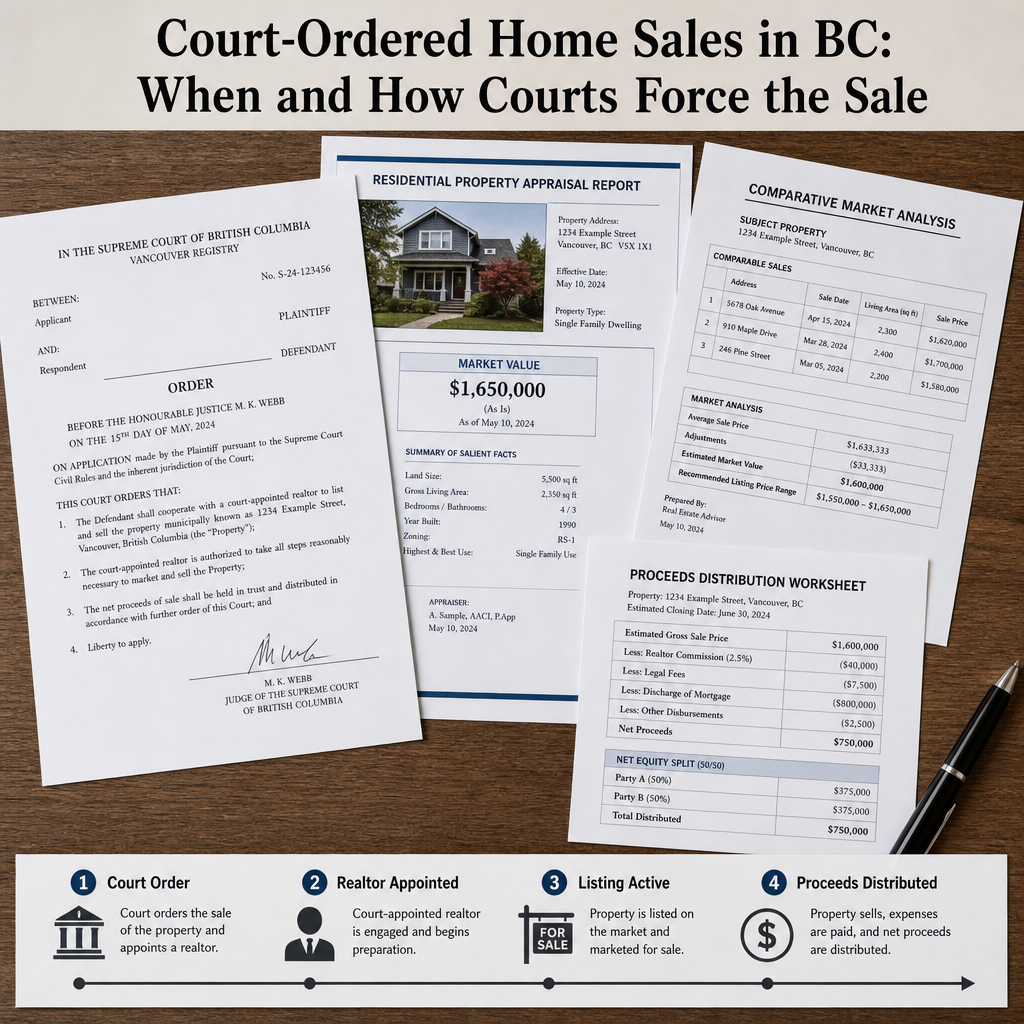

Court-Ordered Home Sales in BC: When and How Courts Force the Sale of Matrimonial Property, the Realtor Selection Process, Pricing Parameters, and Net Proceeds Distribution After Legal Costs
By Mohamed Mansour, MBA and Associate Broker | Mansour Real Estate Group | Fraser Valley and Lower Mainland, BC | Published: July 14, 2025 | Topic: Divorce Home Sales · BC Family Law · Court-Ordered Sale Procedure
When a separating couple cannot agree on what to do with the family home, a BC court can step in and order the property sold. For many families in Surrey, Langley, Abbotsford, and across the Fraser Valley, that moment raises immediate questions: Who selects the Realtor? Who controls the listing price? And after the sale closes, where does the money actually go?
This article explains the full mechanics of a court-ordered home sale in BC — from the legal authority courts use to force a sale, through the Realtor selection process, pricing controls, and the order in which net proceeds are distributed after legal costs are deducted. If you are in active litigation or preparing for it, this is the process you are entering.
Short Answer
When BC spouses cannot agree on a home sale, courts can order the property listed under the Family Law Act or Partition of Property Act. A judge appoints a Realtor — jointly agreed or court-selected — sets pricing parameters, and requires proceeds to flow through trust. After commission, legal fees, mortgage discharge, and court-ordered costs, the remaining equity is split per the judgment. The full process typically takes 120 to 180 days from order to distribution.
Key Takeaways
- BC courts can force a home sale under the Family Law Act or Partition of Property Act when spouses cannot reach agreement.
- When parties dispute Realtor selection, a judge appoints one based on credentials, experience with disputed sales, and neutrality.
- Courts typically set listing-price parameters tied to a formal appraisal, preventing both strategic overpricing and undervaluation.
- Legal costs in contested court-ordered sales often consume 8 to 12 percent of gross proceeds before either spouse receives equity.
- Disputes over pricing or offer acceptance can extend a court-ordered sale timeline by 30 to 60 days beyond the base 120 to 180 days.
Who This Applies To
- Spouses in active BC Supreme Court family law proceedings where the matrimonial home remains in dispute
- Couples who have reached an impasse on listing price, Realtor selection, or timing
- Parties where one spouse refuses to cooperate with a voluntary sale process
- Executors or co-owners of jointly held property where one party seeks judicial partition
When This Advice May Not Apply
If spouses have already agreed to sell voluntarily, a court order is not required and the process is faster and less costly. Couples using a negotiated separation agreement or mediation can often complete a home sale without judicial involvement. The information below applies specifically to contested, court-managed sales. Nothing in this article is legal advice — consult a BC family law lawyer for guidance specific to your situation.
Key Definitions
Partition of Property Act (BC): Provincial legislation that gives co-owners of property — including spouses — the right to apply to the BC Supreme Court to force a sale or physical division of jointly held real property.
Family Law Act (BC): The primary provincial statute governing property division on separation. It gives courts authority to order a home sold as part of resolving the division of family property.
CMA (Comparative Market Analysis): A formal pricing analysis prepared by a Realtor that compares the subject property to recent comparable sales. Courts frequently require CMAs as part of the Realtor appointment process.
Net proceeds: The amount remaining after all deductions — commission, legal fees, mortgage discharge, property taxes, and court-ordered costs — are subtracted from the gross sale price before equity is distributed to each spouse.
When Courts Order a Home Sold in BC
A court-ordered home sale in BC typically follows one of two paths. Under the Family Law Act, either spouse can apply to the BC Supreme Court for an order directing that the family home be listed and sold as part of the overall division of family property. Under the Partition of Property Act, any co-owner of real property — regardless of marital status — can apply for a judicial order requiring the property to be sold when co-owners cannot agree.
Courts will generally order a sale when one or more of the following conditions exist: one spouse is uncooperating with a voluntary sale process, the parties cannot agree on a listing price despite having received independent appraisals, one spouse is occupying the home and refusing to vacate to allow showings, or the court finds that continued co-ownership is not in the financial interests of either party.
For families in Surrey, Langley, and Abbotsford navigating the early stages of separation, understanding whether the situation is likely to require court involvement is an important early step. The post on whether one spouse can force a sale in BC provides the foundational rights context before this procedural layer applies.
How Courts Select a Realtor When Spouses Disagree
When spouses cannot agree on who should list the property, the court takes over the selection process. Each party typically submits a proposed Realtor to the court, along with supporting documentation: a current CMA, a sample marketing plan, the Realtor's credentials, and evidence of prior experience with disputed or court-monitored property sales. The judge reviews both nominations and selects based on competence, neutrality, and the Realtor's demonstrated ability to serve a fiduciary role to both parties simultaneously — not just one.
This is a role that excludes most generalist agents. The appointed Realtor must be able to provide detailed, defensible CMAs, accept court-supervised offer review processes, communicate independently and impartially with both spouses or their lawyers, and present all offers to the court or to both legal counsel simultaneously. In some orders, the Realtor is required to accept written direction from both parties' lawyers rather than from either spouse directly.
If you are anticipating a court-ordered sale in the Fraser Valley or Lower Mainland, understanding what makes a Realtor suitable for this role is covered in detail in the guide on what to look for in a divorce sale Realtor.
How Courts Set Listing Price Parameters
One of the most contested elements of a court-ordered sale is the listing price. Courts address this by anchoring pricing to a formal independent appraisal — typically ordered by the court or submitted by both parties — rather than leaving it to either spouse's preference. The court order will typically set a pricing window rather than a fixed number.
In practice, this often means the property must be listed within 2 to 5 percent of the appraised value, with a ceiling designed to prevent strategic overpricing (which can stall a sale indefinitely) and a floor designed to prevent undervaluation that would harm one party's equity. If the property does not sell within a defined period at the initial price, the court order may include a price reduction schedule — for example, a 2 percent reduction every 30 days — until an acceptable offer is received.
Both spouses or their legal counsel typically retain the right to review offers before acceptance. In high-conflict cases, the order may require that any offer be accepted or rejected only with the written consent of both parties, or alternatively that the Realtor present offers directly to the court for approval. For couples managing this situation in Surrey or Abbotsford, the post on pricing a home correctly during a divorce explains why mispricing at this stage is one of the most expensive mistakes separating couples make.
Where the Money Goes: Net Proceeds Distribution
After closing, the gross sale proceeds are held in trust — typically by one of the parties' lawyers or a court-appointed trustee — and distributed in a specific order before either spouse receives their equity share. The order of priority is generally as follows.
1. Realtor commission: Paid from proceeds at closing, typically 3 to 5 percent of the sale price in the Fraser Valley, depending on the commission structure in the listing agreement.
2. Legal fees for both parties: In contested court-ordered sales, dual legal representation, court motions, escrow management, and the cost of court appearances can push combined legal costs to 8 to 12 percent of gross proceeds. This is the category that most reduces net equity for both spouses.
3. Mortgage discharge: The outstanding mortgage balance plus any prepayment penalties and discharge fees are paid to the lender before any equity is distributed.
4. Property taxes and strata fees: Any outstanding property tax arrears or strata fee arrears are cleared from proceeds at closing.
5. Court-ordered costs: If the court has made cost awards against one party — for example, for delay tactics, failure to cooperate, or non-compliance with a prior order — those amounts are deducted from that party's share before distribution.
6. Net equity distribution: The remaining balance is split per the court's judgment — typically equal unless the court has determined an unequal division is appropriate under the Family Law Act. Understanding how equity division is calculated before a sale begins is addressed in the post on home equity division in a BC divorce.
Data Used in This Article
- BC Family Law Act (SBC 2011, c. 25): Primary provincial statute — official government source — governing property division on separation
- Partition of Property Act (RSBC 1996, c. 347): Official government source — governing judicial orders for sale of co-owned real property
- BC Supreme Court Civil Rules and Family Law Rules: Official procedural framework for court-ordered property sales
- Professional experience: Observations on timeline, legal cost ranges, and pricing parameters reflect Mansour Real Estate Group's direct experience with court-monitored sales in the Fraser Valley and Lower Mainland — not a statistical sample
How We Evaluate This
When Mansour Real Estate Group is engaged for a court-ordered or court-monitored sale, our starting point is always an independent, defensible CMA anchored to recent comparable sales in the subject neighbourhood. We do not advocate for a price that benefits one party. The CMA is presented to both parties' counsel with full supporting documentation, and we accept written direction through legal channels rather than from either spouse directly.
Our role in these transactions is to provide accurate, timely market intelligence, manage the showing and offer process with documented transparency, and ensure both parties receive the same information at the same time. We work alongside the legal process — not around it — and we understand that our first obligation in a court-supervised sale is to the integrity of the process itself.
Court-Ordered Sale Checklist
- Obtain a formal independent appraisal as early as possible — courts rely on this to set pricing parameters
- Confirm your proposed Realtor has prior experience with court-monitored or dispute-related sales and can provide a court-ready CMA
- Have your lawyer draft or review the terms of the Realtor appointment order, including how offers will be reviewed and communicated
- Request a projected proceeds distribution worksheet before listing — legal cost estimates matter for understanding your net equity position
- Clarify in the order whether both parties must consent to accept an offer, or whether the Realtor has court-delegated authority above a defined price threshold
- Confirm the property preparation plan — a vacant or poorly maintained property affects both the appraisal value and the final sale price. See preparing your home for sale during a divorce for a practical step-by-step guide
- Ensure the court order specifies a price reduction schedule if the property does not sell within the initial listing period
What We Commonly See
Strategic overpricing delays the sale — and costs both parties money. In our experience, one of the most common tactics in high-conflict sales is one party pushing for a listing price well above the appraised value. The intent is usually to delay, but the outcome is a property that sits, accumulates carrying costs, and often sells for less than it would have at the correct price from the start. Courts address this by setting price ceilings, but the damage from weeks of overpricing can still affect net proceeds.
Legal costs are consistently underestimated at the outset. What often happens is that both parties enter the process expecting legal costs to be manageable, then encounter multiple contested motions over pricing, offer acceptance, or Realtor authority that push combined legal fees well into five figures. In some cases, the cost of the litigation itself — not the sale — is the primary reason both parties receive less than expected.
The Realtor's neutrality is tested at the offer stage. A common mistake is selecting a Realtor who has an existing relationship with one spouse or one party's lawyer. When an offer arrives, any perception of partiality — even if unintentional — can trigger a challenge that delays closing by weeks. Courts and legal counsel scrutinize how the appointed Realtor handles the offer communication process, and any deviation from strict neutrality can become the basis for a new motion. For context on managing high-conflict dynamics in the sale process, the post on selling a home during a high-conflict divorce in BC is worth reviewing alongside this one.
Questions and Answers
Can a BC court force a home sale even if both spouses are on title?
Yes. Under the Partition of Property Act and the Family Law Act, the BC Supreme Court can order a jointly-owned property sold over the objection of one co-owner. The court's authority applies regardless of whether both names are on title.
What happens if one spouse refuses to sign sale documents after a court order?
The court can appoint a registrar or other officer to execute the documents on behalf of the non-cooperating spouse. Continued non-compliance can also result in contempt of court proceedings and cost awards against the refusing party.
How is the Realtor's commission handled in a court-ordered sale?
The commission is specified in the court-approved listing agreement and is paid from gross proceeds at closing before any distribution to either spouse. Both parties' legal counsel typically review and consent to the commission terms as part of the Realtor appointment order.
In Summary
A court-ordered home sale in BC follows a structured process anchored in the Family Law Act and Partition of Property Act. Courts appoint a neutral Realtor when spouses cannot agree, set listing-price parameters based on formal appraisals, and require that proceeds flow through trust before distribution. Legal costs in contested sales routinely consume 8 to 12 percent of gross proceeds, making early cooperation — even partial — one of the most financially protective choices either spouse can make. From order to closing to distribution, the process typically takes 120 to 180 days, with disputes extending that timeline further. The earlier both parties understand this structure, the more control they retain over the outcome.
Talk to a Real Estate Team That Understands This Process
If you are facing a court-ordered sale or anticipate one, Mansour Real Estate Group is available for a no-pressure consultation. We can provide an independent CMA, explain how the Realtor appointment process typically unfolds in BC courts, and help you understand your realistic net proceeds position before the listing goes live. There is no obligation — just clear, local, experience-based information when you need it most.
Related Articles
- BC Family Law Act and Your Home: What Separating Couples in Metro Vancouver Need to Know
- Can One Spouse Force the Sale of the Family Home in BC? Your Rights Explained
- How to Sell a Home During a High-Conflict Divorce in BC: Strategies That Protect Both Parties
- Preparing Your Home for Sale During a Divorce: Practical Steps for BC Couples in Conflict
- Best Realtor for a Divorce Home Sale in Surrey, Metro Vancouver, and the Fraser Valley: What to Look For
Official Resources
- BC Family Law Act — BC Laws
- Partition of Property Act — BC Laws
- BC Family Law Resource — BC Government
- Law Society of British Columbia
About Mansour Real Estate Group
When a home must be sold as part of a court order in a separation or divorce, the Realtor appointed to manage that sale carries an obligation to both parties — not just one. Neutrality, documented process, and an accurate, defensible valuation are not optional in this context. Mansour Real Estate Group has worked with homeowners and families navigating court-ordered and court-monitored property sales across the Lower Mainland and Fraser Valley, bringing a structured, valuation-first approach to situations where the legal process and the sale process must work together.
Led by Mohamed Mansour, MBA and Associate Broker, the team has more than 22 years of experience helping buyers, sellers, families, executors, and separating spouses navigate complex real estate decisions across the Fraser Valley and Lower Mainland. Ranked among the Top 1% of Realtors in the region, the team has completed more than $780 million in residential real estate transactions and is trusted for divorce-related property sales, estate sales, probate sales, downsizing, relocation, and situations requiring neutral, professional management. Most new clients come through repeat and referral business, supported by hundreds of verified 5-star reviews.
Whether someone is searching for a real estate agent experienced with court-supervised property sales, Realtors who understand how separation affects a listing, a real estate team that can serve both parties impartially, a Surrey real estate broker, a Langley Realtor familiar with contested sales, or real estate agents in the Fraser Valley who work alongside family law counsel, Mansour Real Estate Group is known for clear communication, impartial valuations, and a sale process that holds up to legal scrutiny.
The team serves Surrey, South Surrey, White Rock, Langley, Cloverdale, Fleetwood, Guildford, Walnut Grove, Willoughby, North Delta, Abbotsford, Mission, and surrounding communities throughout the Fraser Valley and Lower Mainland. Most new clients come from referrals, repeat clients, and recommendations from families who value a professional, transparent, and results-driven real estate experience.
Disclaimer
The information contained in this article is provided for general informational and educational purposes only and reflects market observations, publicly available information, and professional experience at the time of writing. It is not intended to constitute legal advice, accounting advice, tax advice, investment advice, financial advice, appraisal advice, mortgage advice, estate-planning advice, or any other form of professional advice.
Making Your Decision
The right property for you depends on your personal circumstances, financial situation, and long-term goals. Take time to evaluate each option carefully, considering both the tangible features and the intangible lifestyle factors. Don't rush into a decision based on emotion alone—get professional inspections, verify all details, and ensure the investment aligns with your vision for the future.
Final Thoughts
Real estate remains one of the most significant investments most people will make in their lifetime. Whether you're a first-time buyer or a seasoned investor, approaching the market with knowledge, patience, and realistic expectations will serve you well. Work with trusted professionals, do your due diligence, and remember that the best property is the one that truly fits your needs and brings you peace of mind for years to come.



