
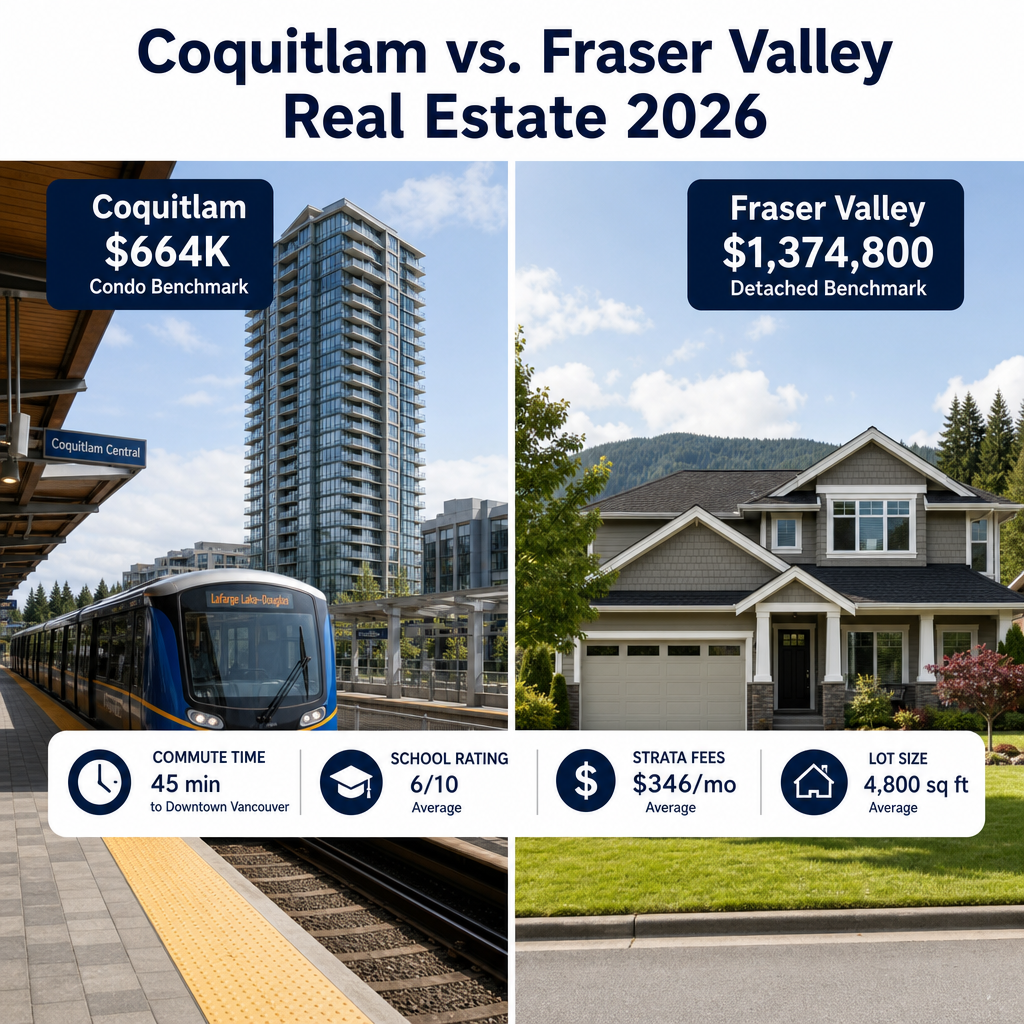

Coquitlam vs. Fraser Valley Real Estate in 2026: Benchmark Prices, Commute Economics, School Quality, and Long-Term Value When Transit Access and Affordability Reshape Buyer Decision-Making
By Mohamed Mansour, MBA and Associate Broker — Mansour Real Estate Group | Fraser Valley and Lower Mainland | Published July 8, 2025 | Geographic Focus: Coquitlam, Surrey, Langley, North Delta, Abbotsford
For buyers in 2026 who have narrowed their search to the Lower Mainland, the question of Coquitlam versus the Fraser Valley comes down to more than price. It involves commute tolerance, school priorities, carrying costs, and how each region is likely to build value over the next decade. Both markets are currently buyer-friendly. The reasons they are buyer-friendly — and the trade-offs that come with each — are quite different.
This article compares Coquitlam and the Fraser Valley across the factors that matter most to families and first-time buyers: benchmark prices, transit realities, school infrastructure, total cost of ownership, and long-term value drivers. The goal is to help buyers make a region-level decision with the same clarity they would bring to a neighbourhood decision.
Short Answer
In May 2026, Coquitlam condos benchmark at $664,000 — down 8.5% year over year — offering transit access and urban proximity. Fraser Valley detached homes benchmark at $1,374,800 with over 10,000 active listings, creating strong buyer choice and space at a price that still requires trade-offs on commute and carrying cost. Neither region is clearly better. The right choice depends on your household's commute tolerance, space needs, and 10-year financial plan.
Key Takeaways
- Coquitlam condo benchmarks fell 8.5% YoY to $664,000, creating one of Metro Vancouver's most accessible entry points with SkyTrain proximity built in.
- Fraser Valley inventory surged 17.6% YoY to over 10,000 active listings in May 2026, giving buyers genuine negotiating room on detached homes.
- Commute economics are real: Fraser Valley buyers often spend significantly more annually on transportation than Coquitlam buyers with SkyTrain access.
- School infrastructure is expanding in Fraser Valley growth corridors like Cloverdale, Fleetwood, and Willoughby to serve rapidly growing family populations.
- Long-term value in Coquitlam is anchored by SkyTrain proximity; in the Fraser Valley, it is driven by land equity, larger footprints, and development momentum.
Who This Applies To
- First-time buyers comparing entry-level condos in Coquitlam to Fraser Valley townhomes or detached homes
- Growing families evaluating school quality, yard space, and commute trade-offs
- Buyers with employment in Metro Vancouver who are considering a longer commute for more space
- Investors evaluating rental demand drivers in both regions
- Buyers who relocated to Metro Vancouver from elsewhere and are still learning regional geography
When This Advice May Not Apply
If you work remotely full-time, commute cost calculations shift substantially. If your primary concern is investment rather than principal residence, consult a qualified financial advisor. Buyers looking at Port Coquitlam or Port Moody should also read Coquitlam vs. Port Coquitlam vs. Port Moody: Which Tri-City Is Right for Your Budget in 2026? for a focused intra-region comparison.
Data Used in This Article
- FVREB Monthly Market Report, May 2026 — Fraser Valley benchmark prices, active listings, and inventory change data (official board report)
- Metro Vancouver neighbourhood benchmark data, May 2026 — Coquitlam condo benchmark and year-over-year change (third-party market summary sourced from board data)
- BCREA 2026 Housing Forecast — Provincial price growth projections and regional variation estimates (industry body)
- FVREB Chair Ishaq Ismail, May 2026 commentary — Direct quote on affordability conditions and listing selection (official board communication)
Benchmark Prices: What Each Region Actually Costs in 2026
According to the FVREB's May 2026 Monthly Market Report, the Fraser Valley detached home benchmark is $1,374,800 — essentially flat month over month (down 0.1%) after eleven consecutive months of price declines. That stabilization matters. It suggests sellers have adjusted to market conditions and buyers now have a realistic base from which to negotiate.
Coquitlam's condo benchmark of $664,000, down 8.5% year over year, tells a different story. The decline reflects softening demand in the broader Metro Vancouver condo segment, not a structural problem with Coquitlam specifically. For buyers with transit-dependent lifestyles or employment near Burnaby and Vancouver, a $664,000 entry point in a SkyTrain corridor remains competitive — especially compared to what similar access would cost in Burnaby or Vancouver proper.
The price gap between a Coquitlam condo and a Fraser Valley detached home is roughly $710,000. That gap funds a larger mortgage, but it also funds a yard, a second parking spot, a spare bedroom, and a neighbourhood built for families. Whether that trade is worth it depends on factors beyond price — and that is where the rest of this comparison becomes useful. For a detailed neighbourhood-level breakdown of Coquitlam detached pricing, see Coquitlam Detached Home Prices by Neighbourhood: A Complete 2026 Benchmark Guide.
Commute Economics: What the Transit Premium Actually Buys
Coquitlam's Evergreen SkyTrain extension connects Lafarge Lake-Douglas and Burquitlam stations directly to the Millennium Line, putting downtown Vancouver within 40 to 50 minutes for most Coquitlam buyers without a car. That transit access has a measurable effect on property values — research consistently shows that properties within walking distance of SkyTrain stations command higher price-per-square-foot premiums than equivalent properties outside transit corridors. For a detailed look at how the Evergreen Line affects local pricing, see How the Evergreen SkyTrain Line Shapes Property Values in Coquitlam.
Fraser Valley buyers driving to Metro Vancouver employment — common in Surrey, Langley, and Abbotsford — typically face 45 to 90 minutes each way, depending on route and time of departure. Accounting for fuel, insurance, vehicle depreciation, and time cost, the annual commute expense for a Fraser Valley household with one commuting adult can exceed $8,000 to $12,000 per year compared to a transit-reliant Coquitlam household. Over a 10-year ownership period, that difference narrows the apparent affordability gap of the lower-priced Fraser Valley home.
Fraser Valley transit is improving. The Surrey-Langley SkyTrain extension, currently in development, will eventually connect portions of Surrey and Langley to the Expo Line. But that connection is years from completion, and for buyers making a 2026 purchase decision, today's commute reality is the relevant one.
School Quality and Infrastructure: Established vs. Expanding
Coquitlam offers established school catchments, particularly near transit corridors and the SFU area, where demographic stability means predictable enrolment and consistent programming. Schools in Coquitlam's central and eastern neighbourhoods have benefited from decades of investment and serve communities that tend to have lower household mobility rates than newer suburban areas.
The Fraser Valley's story is different. Rapid population growth in Cloverdale, Fleetwood, Willoughby, and Langley has driven new school construction across multiple districts. These are newer buildings with modern infrastructure, often purpose-built for the demographic profile of the communities they serve — families with children in the primary and elementary years. The trade-off is that some catchment areas are still stabilizing, with enrolment patterns and programming depth maturing alongside the community. Buyers prioritizing specific programs, French immersion, or advanced academics should research current catchment assignments directly with School District 36 (Surrey) or School District 35 (Langley), as boundaries and offerings change as communities grow.
Total Cost of Ownership: The Numbers That Don't Appear in the Listing Price
A Coquitlam condo at $664,000 carries costs beyond the mortgage. Strata fees in Metro Vancouver condo buildings typically range from $400 to $700 per month, depending on building age, amenities, and depreciation reserve requirements. Urban property taxes in Coquitlam are generally proportionate to assessed value. Add parking and utilities in a high-density building, and the monthly carrying cost for a Coquitlam condo can run $3,500 to $4,500 all-in at current mortgage rates, before any strata levy surprises.
A Fraser Valley detached home at $1,374,800 carries a higher mortgage payment but different additional costs. Property taxes on detached homes in Surrey, Langley, or Abbotsford tend to be lower per assessed dollar than Metro Vancouver comparables. Utility costs are typically higher on a larger footprint. Maintenance responsibility falls entirely on the homeowner rather than a strata corporation. And, as noted, commute costs are real. FVREB Chair Ishaq Ismail noted in the May 2026 market report that "ample selection and easing prices" in the Fraser Valley create genuine affordability windows — particularly for buyers who can absorb the carrying costs of a larger property and longer commute. For buyers comparing specific Coquitlam neighbourhoods before deciding, Eagle Ridge and River Springs Coquitlam: The Most Resilient Neighbourhoods in a Down Market provides useful context on which Coquitlam segments have held value best.
How We Evaluate This
At Mansour Real Estate Group, when we work with buyers facing a region-level decision, we start by mapping total monthly cost — not just mortgage payment — across both options. That means strata fees, estimated commute cost, insurance, utilities, and a reasonable maintenance reserve. The goal is to produce two comparable monthly numbers that reflect actual household cash flow, not just what the lender approved.
From there, we look at the 10-year value trajectory for each option given the buyer's specific situation: are they likely to upsize within five years, or is this a long hold? Are they transit-dependent or car-dependent? Do they prioritize specific school catchments today, or is that a consideration for the next purchase? Those answers typically point clearly to one region or the other — and sometimes to a specific neighbourhood within a region that most buyers had not considered. First-time buyers navigating this process for the first time should also read our First-Time Buyer's Guide to Purchasing a Home in Coquitlam in 2026 for a process-level overview.
Long-Term Value: Transit Premium vs. Land Equity
Coquitlam's long-term value case rests on SkyTrain proximity and institutional anchors. SFU drives consistent rental demand from students and faculty, and the Burquitlam corridor continues to attract transit-oriented development. Properties within walking distance of SkyTrain stations have historically appreciated faster on a price-per-square-foot basis than properties without that access, and that pattern is likely to continue as Metro Vancouver density increases.
The Fraser Valley's long-term value case rests on land equity and development momentum. BCREA forecasts average BC home price growth of approximately 4% in 2026, with Surrey and Fraser Valley townhomes and condos projected to gain 4 to 6% as transit development, population growth, and pent-up demand from 2025 market hesitancy work through the system. Detached homes on larger lots in emerging subdivisions carry upside tied to regional intensification — the same process that drove substantial appreciation in Surrey's mature neighbourhoods over the past two decades is now unfolding in Langley, Abbotsford, and Mission.
Buyer Checklist: Region Decision Framework
- Calculate your true monthly cost for each option: mortgage payment plus strata fees or maintenance reserve, property tax, commute costs, utilities, and insurance.
- Identify your commute baseline: how many days per week do you need to be in Metro Vancouver, and what is your tolerance for drive time versus transit time?
- Research school catchment boundaries directly with School District 36 (Surrey) or School District 35 (Langley) for Fraser Valley options, and SD43 (Coquitlam) for Coquitlam options.
- Define your 10-year plan: are you likely to upsize, downsize, or hold? The answer affects which region's appreciation trajectory matters more to your household.
- Tour both regions in the same week if possible — the commute experience and neighbourhood feel are difficult to evaluate from a listing screen alone.
- For Fraser Valley detached homes, review property disclosure statements carefully — homes in growth corridors range widely in age, construction type, and maintenance history.
What We Commonly See
Buyers underestimate cumulative commute cost. In our experience, buyers who choose the Fraser Valley primarily for price often do not fully account for commute costs over time. When we run the numbers out over five years, the gap between a Coquitlam condo and a Fraser Valley detached home narrows meaningfully — sometimes to the point where the space premium becomes the primary justification rather than the price difference.
School catchment assumptions often need correction. What often happens is that buyers assume all Fraser Valley school catchments are roughly equivalent, or that newer buildings automatically mean better programming. Both assumptions are worth checking. School quality in growth areas varies considerably by catchment, and enrolment pressure in rapidly expanding communities can affect class sizes and resource availability during transition years.
Strata levy risk is underweighted in Coquitlam condo comparisons. A common oversight is treating the strata fee as a fixed cost when evaluating a Coquitlam condo. Older buildings with aging mechanical systems or deferred maintenance can generate special levies that significantly change the carrying cost picture. Reviewing the depreciation report and the contingency reserve fund balance is not optional — it is a necessary step before making an offer on any strata property in either region.
Questions and Answers
Is a Coquitlam condo a better investment than a Fraser Valley townhome in 2026?
These are different investment profiles. Coquitlam condos offer transit-adjacent appreciation tied to SkyTrain proximity and SFU rental demand. Fraser Valley townhomes offer more space and land exposure with BCREA-projected 4 to 6% price growth. The better choice depends on your hold period and risk tolerance. Neither is universally superior.
How much does commuting from Langley to Vancouver actually cost annually?
Estimates vary by vehicle, route, and frequency, but a single adult commuting five days per week from Langley to Metro Vancouver by car can reasonably expect to spend $8,000 to $12,000 per year on fuel, insurance, maintenance, and depreciation. Transit options from Langley remain limited until the Surrey-Langley SkyTrain extension is completed.
Are Fraser Valley school catchments as strong as Coquitlam's in 2026?
Some are, some are not. Coquitlam's established catchments near transit corridors and SFU have demographic stability and consistent programming. Fraser Valley growth areas are building new schools and expanding capacity, which often means newer facilities but still-maturing community depth. Buyers with specific program priorities should verify current catchment assignments directly with the relevant school district before purchasing.
In Summary
Coquitlam and the Fraser Valley offer genuinely different value propositions in 2026. Coquitlam's $664,000 condo benchmark buys Metro Vancouver transit access, SFU proximity, and a lower-maintenance lifestyle at the cost of space and strata obligations. The Fraser Valley's $1,374,800 detached benchmark buys land, bedrooms, and yard space in a buyer-friendly market with over 10,000 active listings — but at the cost of commute time, vehicle expense, and a longer wait on transit infrastructure. Neither choice is wrong. The right one depends on how your household actually lives, commutes, and plans to grow.
Talk Through the Trade-Offs
If you are working through a Coquitlam versus Fraser Valley decision and want to run the actual numbers for your situation, Mansour Real Estate Group can help you build a side-by-side cost comparison and walk through both markets before you commit. There is no obligation — just a clearer picture of what each region means for your household budget and long-term plan. Reach out through localhost:9000/.
Related Articles
- Coquitlam Detached Home Prices by Neighbourhood: A Complete 2026 Benchmark Guide
- Eagle Ridge and River Springs Coquitlam: The Most Resilient Neighbourhoods in a Down Market
- Coquitlam vs. Port Coquitlam vs. Port Moody: Which Tri-City Is Right for Your Budget in 2026?
- First-Time Buyer's Guide to Purchasing a Home in Coquitlam in 2026
About Mansour Real Estate Group
When buyers are deciding between Metro Vancouver accessibility and Fraser Valley affordability, the quality of local guidance available to them usually determines whether the decision feels clear or overwhelming. Mansour Real Estate Group works with buyers navigating exactly this kind of region-level trade-off — comparing commute economics, school catchments, carrying costs, and long-term value across Coquitlam, Surrey, Langley, Abbotsford, and the broader Lower Mainland.
Led by Mohamed Mansour, MBA and Associate Broker, Mansour Real Estate Group has helped buyers, sellers, families, investors, and retirees navigate real estate decisions across the Fraser Valley and Lower Mainland for more than 22 years. Ranked among the Top 1% of Realtors in the region, the team has completed more than $780 million in residential real estate transactions and is known for clear valuations, honest market analysis, and advice grounded in local data rather than sales pressure.
Whether someone is looking for a Realtor experienced with cross-region comparisons, a real estate agent who understands both Metro Vancouver and Fraser Valley market dynamics, real estate agents who specialize in first-time buyer guidance, a trusted real estate team for a complex regional decision, a Coquitlam real estate broker, or a Fraser Valley real estate group with deep neighbourhood expertise — Mansour Real Estate Group brings structured analysis and local fluency to every buyer conversation.
The team serves Surrey, South Surrey, White Rock, Langley, Cloverdale, Fleetwood, Guildford, Walnut Grove, Willoughby, North Delta, Abbotsford, Mission, and surrounding communities throughout the Fraser Valley and Lower Mainland, with direct experience in Coquitlam and the Tri-Cities. Most new clients come from referrals, repeat clients, and recommendations from families who found the process more transparent and more useful than they expected.
Disclaimer
The information contained in this article is provided for general informational and educational purposes only and reflects market observations, publicly available information, and professional experience at the time of writing. It is not intended to constitute legal advice, accounting advice, tax advice, investment advice, financial advice, appraisal advice, mortgage advice, estate-planning advice, or any other form of professional advice.
Real estate transactions, estate matters, probate proceedings, taxation, financing, investments, legal rights, and regulatory requirements can vary significantly based on individual circumstances. Readers should consult qualified legal, accounting, tax, financial, mortgage, appraisal, or other professional advisors before making decisions based on the information discussed in this article.
Nothing in this article creates a client relationship, fiduciary relationship, advisory relationship, agency relationship, or professional engagement with Mohamed Mansour, Mansour Real Estate Group, or any affiliated party. Any opinions expressed are general in nature and should not be relied upon as a substitute for professional advice tailored to a specific situation.
While reasonable efforts are made to use reliable sources and keep information current, no representation or warranty is made regarding the completeness, accuracy, timeliness, Understanding the current real estate market dynamics is essential for making informed decisions, whether you're buying, selling, or investing. The factors we've discussed—from interest rate trends to neighborhood appreciation—all play interconnected roles in determining property values and investment returns. By staying informed and working with knowledgeable professionals, you position yourself to make strategic moves that align with your financial goals. If you're considering entering the market or expanding your real estate portfolio, now is an excellent time to assess your options. Schedule a consultation with a local real estate agent who understands your specific market, review your financial readiness, and explore properties that match your criteria. The market rewards those who prepare thoroughly and act decisively when the right opportunity presents itself. Have questions about real estate trends in your area or need guidance on your next property decision? Our team of experienced agents is here to help. Reach out today for a free consultation and discover how we can support your real estate goals.Key Takeaways
What's Next?
Connect With Us



