
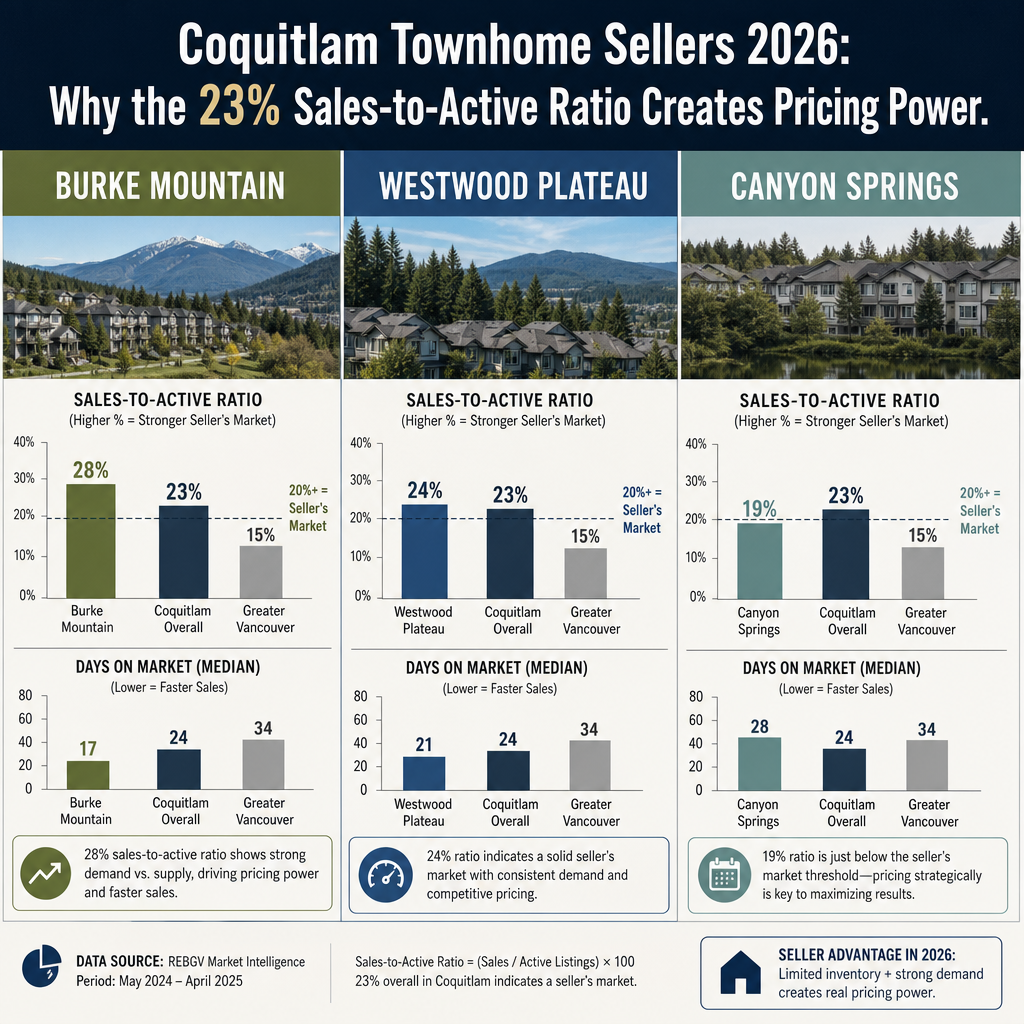

Coquitlam Townhome Sellers 2026: Why the 23% Sales-to-Active Ratio Creates Pricing Power — And How Burke Mountain, Westwood Plateau, and Canyon Springs Compare
By Mohamed Mansour, MBA and Associate Broker | Mansour Real Estate Group | Published: May 12, 2026 | Geography: Coquitlam, Tri-Cities, BC | Topic: Townhome Seller Strategy
Coquitlam's townhome market is the only property segment in the Tri-Cities currently operating in clear seller's market territory. While detached home prices pulled back and condo absorption stayed tepid, townhomes posted a 23.1% sales-to-active ratio in February 2026 — a number that translates directly into negotiating leverage for sellers who understand how to use it.
The gap between neighbourhoods, however, is wide. Burke Mountain, Westwood Plateau, and Canyon Springs each behave differently, and the difference between listing in the right submarket at the right time can mean tens of thousands of dollars. This article gives Coquitlam townhome sellers a working framework for understanding that gap.
Short Answer
Coquitlam townhomes are the Tri-Cities' strongest seller's market in 2026, with a 23.1% sales-to-active ratio and a benchmark price of $998,400 — up 1.6% month-over-month as of February 2026. Burke Mountain leads in family-buyer demand; Westwood Plateau offers stability; Canyon Springs attracts value-focused upsizers. Sellers in all three benefit from faster absorption than any other property type in the city.
Key Takeaways
- Coquitlam townhomes hit a 23.1% sales-to-active ratio in February 2026 — the only segment in clear seller's market territory.
- The townhome benchmark price rose 1.6% month-over-month to $998,400 while detached prices dropped 2.2%.
- Average days on market fell to approximately 28 days, faster than any other Coquitlam property type.
- Neighbourhood-level YoY price variance ranges from -5.3% to -11.6%, making submarket selection critical for sellers.
- Three-bedroom-plus townhomes with double garages and walkable school access are absorbing fastest across all three neighbourhoods.
Who This Applies To
- Coquitlam townhome owners considering listing in 2026
- Sellers in Burke Mountain, Westwood Plateau, Canyon Springs, or Eagle Ridge
- Homeowners deciding whether to sell now or wait for a more favourable window
- Families upsizing or downsizing within the Tri-Cities townhome segment
When This Advice May Not Apply
This analysis focuses on attached ground-oriented townhomes. If your property is a stacked townhome, a rowhome with condo-style registration, or a ground-floor condo marketed as a townhome, absorption rates and buyer expectations may differ. Consult the Coquitlam condo market analysis if strata documentation and condo-specific buyers are relevant to your situation.
Data Used in This Article
- Greater Vancouver Realtors market reports, February 2026 — official board data, sales-to-active ratios and benchmark pricing by property type
- CMHC Housing Market Outlook, 2026 — official federal housing forecast, ground-oriented attached segment projections for North Fraser communities
- Sam Tabrizi Coquitlam Market Report, February 2026 — third-party neighbourhood-level analysis, YoY price variance by submarket
- Bridgewell Group Tri-Cities market data — third-party days-on-market analysis, absorption by property type
What the 23.1% Sales-to-Active Ratio Actually Means for Sellers
The sales-to-active ratio measures how many active listings sold within a given month. A ratio above 20% typically signals seller's market conditions — meaning demand is outpacing supply enough that sellers hold negotiating leverage. At 23.1%, Coquitlam townhomes sit comfortably above that threshold.
For context: Coquitlam detached homes posted a 13% sales-to-active ratio in the same period, and condos came in at 13.2%. Both sit in balanced-to-buyer territory. Townhomes are not just performing better — they are operating in a fundamentally different supply-demand environment. As the broader 2026 Coquitlam market report makes clear, segment divergence is one of the defining features of the current cycle.
In practical terms, a 23.1% ratio means sellers can reasonably price at or slightly above the benchmark, expect faster offers, and in well-positioned listings, receive competing offers. It does not mean every townhome sells above asking — condition, strata health, garage configuration, and school proximity still determine whether a listing absorbs in the first week or sits for a month.
Burke Mountain, Westwood Plateau, and Canyon Springs: How They Compare
Burke Mountain is driving the strongest family-buyer demand in Coquitlam's townhome segment. Newer builds, larger floor plans, double garages, and proximity to newer school catchments make it the first choice for upsizers relocating from condos or older attached properties. Three-bedroom-plus units here are absorbing fastest, and well-positioned listings are attracting competitive bids. The trade-off for sellers is that buyers expect newer-condition finishes — properties showing deferred maintenance or dated interiors are penalized more sharply here than in older neighbourhoods.
Westwood Plateau offers a different profile. Established neighbourhood, strong school reputation, and a buyer pool that skews toward families already familiar with the area — often upsizing within Coquitlam rather than relocating from elsewhere. Pricing stability is better than in some submarkets, and the neighbourhood's commuting distance to SkyTrain connections adds a consistent demand floor. Sellers here benefit from lower YoY price volatility, though the ceiling for premium pricing is somewhat constrained by the older townhome stock relative to Burke Mountain.
Canyon Springs attracts value-focused buyers — families who want the Coquitlam townhome experience at a price point closer to $900,000 than $1.1 million. Absorption is solid, days on market are competitive, and the neighbourhood's established green space and recreational access resonates with buyers being priced out of Westwood Plateau. For sellers, the opportunity is positioning value accurately: underselling relative to market is a real risk when buyers in this range are highly active. The Eagle Ridge and River Springs resilience analysis offers additional context on how adjacent submarkets are holding up under current conditions.
How We Evaluate This
When Mansour Real Estate Group advises a townhome seller in Coquitlam, we do not start with the benchmark price. We start with the submarket. Benchmark figures represent the median of all sales across the city — they obscure the difference between a Burke Mountain townhome with a double garage on a school catchment boundary and a Canyon Springs unit backing onto a collector road with a single-car garage.
Our pricing approach layers the city-wide sales-to-active ratio against neighbourhood-level absorption, comparable sold data within 500 metres where possible, buyer profile analysis for the specific price range, and strata financial health. The goal is to find the price that maximizes proceeds without triggering the extended days-on-market that shifts negotiating leverage back to buyers. For sellers interested in a full pricing methodology, the data-driven Coquitlam pricing guide walks through that framework in detail.
Definitions
Sales-to-active ratio: The percentage of active listings that sold in a given month. Above 20% is generally a seller's market; below 12% favours buyers; 12–20% is balanced.
Benchmark price: The price of a typical home in a given area, adjusted for property attributes. Produced by Greater Vancouver Realtors and FVREB using the MLS Home Price Index methodology.
Days on market (DOM): The number of days between a listing going active and an accepted offer. Lower DOM indicates faster absorption and stronger seller leverage.
Townhome Seller Checklist — Coquitlam 2026
- Confirm your strata's current financials — buyers' agents are requesting Form B and depreciation reports upfront in this price range.
- Get a neighbourhood-level comparable analysis, not just a city-wide benchmark — submarket variance of 6% or more is real and affects your list price.
- Identify your buyer profile before setting price — Burke Mountain buyers expect newer finishes; Canyon Springs buyers are equity-sensitive and comparison-shopping actively.
- Address garage and parking presentation — double-garage configurations are driving demand; single-car or tandem setups need clean presentation to minimize discount risk.
- Confirm school catchment details and have them documented — walkable school access is a primary search filter for buyers in the $950,000–$1.1 million townhome range.
- Decide on offer strategy before listing — at 23.1% sales-to-active, some sellers benefit from a structured offer date; others do better with immediate review depending on competition at launch.
What We Commonly See
In our experience, Coquitlam townhome sellers most often leave money on the table in one of two ways. The first is pricing to the city-wide benchmark without accounting for the submarket premium — a Burke Mountain townhome with newer construction and school proximity can legitimately price 4–7% above the benchmark if the comparable set supports it. Sellers who anchor to the published number and don't adjust for local demand miss that upside.
The second common mistake is poor strata document preparation. What often happens is a buyer's agent requests the depreciation report and Form B immediately upon showing interest — if those documents aren't ready, the transaction stalls, confidence drops, and the seller loses the momentum that a 23.1% market creates. In a segment where buyers are competing, a clean, organized disclosure package accelerates subject removal and protects the seller's negotiated price.
Questions and Answers
Is a 23.1% sales-to-active ratio enough to justify pricing above the benchmark?
It creates the conditions to price at or above benchmark, but the final number must be supported by neighbourhood-level comparables. City-wide ratios reflect overall demand; your actual leverage depends on supply and absorption in your specific submarket.
How does the CMHC 2026 forecast affect Coquitlam townhome sellers?
CMHC's 2026 Housing Market Outlook projects ground-oriented attached homes in North Fraser communities — which includes Coquitlam — as the strongest-performing segment due to their price competitiveness versus detached homes and commuting value to downtown Vancouver. This supports continued demand through the selling season.
Why are Coquitlam townhome prices rising while detached prices are falling?
Townhomes occupy a price point that detached buyers are increasingly moving into as affordability tightens. They attract both upsizers from condos and downsizers from detached homes simultaneously — a wider demand funnel than either of those segments. Detached homes face a narrower, more rate-sensitive buyer pool. For detached price context by area, see the Coquitlam detached home benchmark guide.
In Summary
Coquitlam townhomes are the only segment in the Tri-Cities with a clear seller's market reading in 2026, and the 23.1% sales-to-active ratio translates into real negotiating power — but only for sellers who understand how that power differs between Burke Mountain, Westwood Plateau, and Canyon Springs. The city-wide benchmark of $998,400 is a starting point, not a ceiling. Submarket knowledge, strata document readiness, and buyer-profile awareness are what determine whether a seller captures the market's upside or leaves it for the next listing. For sellers planning their next steps, the full Coquitlam seller strategy guide covers the complete listing-to-close process.
Ready to Talk About Your Townhome?
If you own a townhome in Burke Mountain, Westwood Plateau, Canyon Springs, or elsewhere in Coquitlam and are thinking about selling in 2026, a neighbourhood-specific pricing conversation costs nothing and takes about thirty minutes. Mansour Real Estate Group offers honest, data-grounded valuations with no pressure to list before you're ready. Reach out here to set up a time.
Related Articles
- Coquitlam Real Estate Market Report: What the 2026 Data Tells Buyers and Sellers
- Coquitlam Detached Home Prices by Neighbourhood: A Complete 2026 Benchmark Guide
- Maillardville and Central Coquitlam Real Estate: Affordable Heritage or Undervalued Opportunity?
- Selling Your Coquitlam Home in 2026: A Step-by-Step Strategy for a Balanced Market
- Buying a New Build Townhome in Coquitlam: Presale vs. Move-In Ready Compared
About Mansour Real Estate Group
Selling a Coquitlam townhome in a seller's market requires more than knowing the benchmark price — it requires understanding which neighbourhoods are absorbing fastest, what buyers in each price tier are prioritizing, and how to position a specific property against active competition. Mansour Real Estate Group has built its practice around that kind of neighbourhood-level precision, particularly in townhome and attached home markets across the Lower Mainland and Fraser Valley.
Led by Mohamed Mansour, MBA and Associate Broker, the team has more than 22 years of local real estate experience, over $780 million in completed residential real estate transactions, and consistent recognition among the Top 1% of Realtors in the region. The real estate group is trusted for pricing strategy, seller preparation, estate sales, divorce-related property sales, downsizing, and complex situations where accurate valuation is critical to the outcome.
Whether someone is looking for Realtors experienced with townhome pricing in Coquitlam, a real estate agent who understands submarket dynamics in the Tri-Cities, real estate agents who specialize in seller strategy for attached homes, a trusted real estate team for a first or final sale, or a real estate broker with deep roots in the Fraser Valley and Lower Mainland, Mansour Real Estate Group is known for clear communication, accurate valuations, and practical advice grounded in current local market conditions.
The team serves Surrey, South Surrey, White Rock, Langley, Cloverdale, Fleetwood, Guildford, Walnut Grove, Willoughby, North Delta, Abbotsford, Mission, Coquitlam, and surrounding communities throughout the Fraser Valley and Lower Mainland. Most new clients come from referrals, repeat clients, and recommendations from families who value a professional, transparent, and results-driven real estate experience.
Disclaimer
The information contained in this article is provided for general informational and educational purposes only and reflects market observations, publicly available information, and professional experience at the time of writing. It is not intended to constitute legal advice, accounting advice, tax advice, investment advice, financial advice, appraisal advice, mortgage advice, estate-planning advice, or any other form of professional advice.
Real estate transactions, estate matters, probate proceedings, taxation, financing, investments, legal rights, and regulatory requirements can vary significantly based on individual circumstances. Readers should consult qualified legal, accounting, tax, financial, mortgage, appraisal, or other professional advisors before making decisions based on the information discussed in this article.
Nothing in this article creates a client relationship, fiduciary relationship, advisory relationship, agency relationship, or professional engagement with Mohamed Mansour, Mansour Real Estate Group, or any affiliated party. Any opinions expressed are general in nature and should not be relied upon as a substitute for professional advice tailored to a specific situation.
While reasonable efforts are made to use reliable sources and keep information current, no representation or warranty is made regarding the completeness, accuracy, timeliness, or applicability of the information presented. Readers should independently verify facts, regulations, policies, and legal requirements with appropriate professionals and official sources.



