

Coquitlam Rental Investment Strategy 2026: Cap Rates, Vacancy Trends, and Property Type Comparison for Investors Evaluating Ground-Oriented Attached Homes vs. Condos
By Mohamed Mansour, MBA and Associate Broker — Mansour Real Estate Group | Published: July 14, 2025 | Geography: Coquitlam, Tri-Cities, Metro Vancouver, BC | Topic: Rental Investment Strategy, Cap Rates, Property Type Comparison
Investors evaluating Coquitlam rental property in 2026 are working with a very different set of numbers than they were two or three years ago. Metro Vancouver condo yields have compressed to the point where the math no longer closes for most buyers. At the same time, CMHC has explicitly identified North Fraser communities — including Coquitlam — as stronger performers for ground-oriented attached homes. If you are deciding where to place capital in the Tri-Cities market, the property-type decision matters more than neighbourhood selection right now.
This article breaks down the current cap rate environment, vacancy trends, cash flow realities, and the regulatory shifts that have restructured investor returns across Metro Vancouver. It draws on CMHC's 2026 Housing Market Outlook and current market data to help investors compare condos and townhouses with actual numbers, not assumptions.
Short Answer
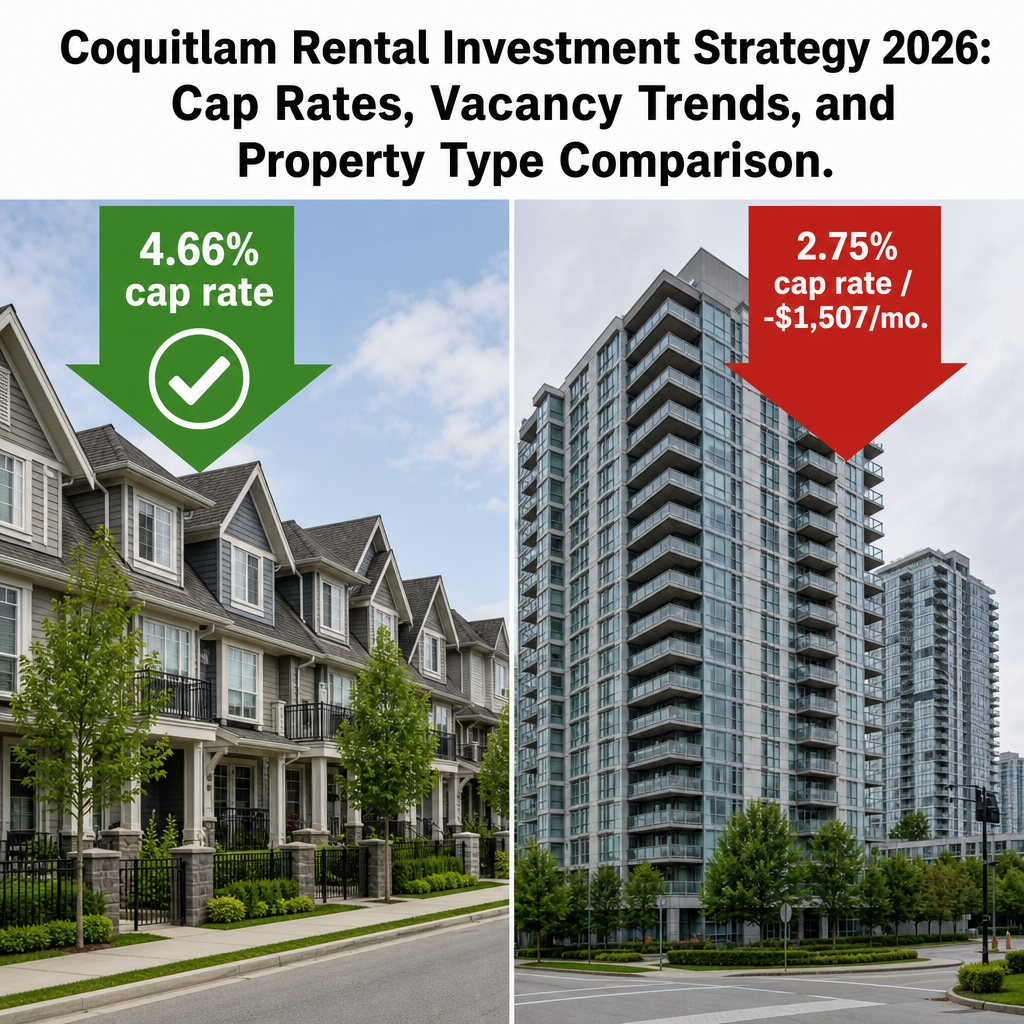
According to CMHC's 2026 Housing Market Outlook, ground-oriented attached homes — townhouses and semi-detached units — in North Fraser communities like Coquitlam offer better rental investment fundamentals than Metro Vancouver condos, where cap rates have fallen to 2.75% and one-bedroom units are producing negative cash flow of approximately $1,507 per month. Suburban multifamily cap rates have edged to 4.66%.
Key Takeaways
- Metro Vancouver condo cap rates sit at 2.75%, below current GIC rates, making positive cash flow effectively impossible on most one-bedroom units.
- CMHC's 2026 Housing Market Outlook explicitly identifies North Fraser communities like Coquitlam as strong performers for ground-oriented attached housing.
- Metro Vancouver condo vacancy is forecast to rise from 3.3% in 2025 to 3.6% in 2026, extending tenant search periods and slowing rent growth.
- BC's Short-Term Rental Act restricts investment properties to long-term rental use, eliminating the STR premium that previously supported tight condo cap rates.
- Coquitlam townhouses offer better appreciation protection, owner control, and alignment with CMHC's stated forecast than urban micro-unit condos.
Who This Applies To
- Investors comparing Coquitlam condos and townhouses as long-term rental properties
- Buyers evaluating whether the cap rate environment justifies entry in 2026
- Existing condo investors reassessing hold-versus-sell strategy
- First-time investors evaluating the Tri-Cities rental market for the first time
When This Advice May Not Apply
This analysis focuses on long-term rental fundamentals. It does not apply to presale speculation, house flipping, commercial property, or investors with holding periods under five years who are primarily targeting appreciation. Consult a financial advisor and a tax professional before making any investment decision.
Data Used in This Article
- CMHC Housing Market Outlook 2026 — official federal housing agency forecast, national and regional scope, published 2025/2026
- CBRE Canada Real Estate Market Outlook 2026 — commercial real estate advisory firm, cap rate and multifamily data, Canada-wide
- CMHC Rental Market Report — vacancy rate data for Metro Vancouver, 2025 published figures with 2026 projections
- BC Government Short-Term Rental Accommodations Act — provincial legislation, official regulatory source
Key Definitions
Cap Rate (Capitalization Rate): Net operating income divided by purchase price. A lower cap rate means the property generates less income relative to its cost. A 2.75% cap rate means $27,500 in net annual income on a $1,000,000 property.
Ground-Oriented Attached Home: A townhouse, semi-detached, or row home with its own entrance and typically no shared corridor, as distinct from a stacked condo unit.
Vacancy Rate: The percentage of rental units unoccupied at a given time. Higher vacancy weakens rent growth and increases investor holding costs.
STR (Short-Term Rental): Rental of a property for periods typically under 30 days, previously enabled by platforms like Airbnb. BC's Short-Term Rental Act now restricts this to principal residences plus one secondary suite.
What the Cap Rate Data Actually Shows
Metro Vancouver condo cap rates at 2.75% are not a minor compression — they are below the risk-free return available on a five-year GIC. That means investors holding a condo rental in Vancouver are accepting more risk than a savings product while earning less yield, before accounting for maintenance, strata fees, property management, and vacancy.
According to third-party analysis drawing on CMHC rental data, a one-bedroom condo in Vancouver generates approximately -$1,507 per month in negative cash flow after financing costs in 2026. That figure assumes conventional mortgage financing and market rents. Investors carrying that shortfall are betting entirely on appreciation — and CMHC's 2026 forecast for Metro Vancouver condo appreciation is approximately 2%, which does not cover the monthly deficit at that level.
Suburban multifamily cap rates have expanded to approximately 4.66%, according to CBRE's 2026 Canada Real Estate Market Outlook. That is still not a high-yield environment, but it reflects meaningfully better income fundamentals than urban condo product. For Coquitlam investors who have been comparing these two segments, that gap is the central decision point in 2026.
Why Coquitlam Townhouses Are the CMHC-Identified Opportunity
CMHC's 2026 Housing Market Outlook identifies North Fraser communities — a category that includes Coquitlam — as among the stronger performers for ground-oriented attached housing. The reasons are structural, not speculative. Coquitlam townhouses are priced competitively relative to single-detached homes, making them accessible to a wider tenant and buyer pool. Commute times to downtown Vancouver via the Evergreen SkyTrain line are reasonable, supporting sustained tenant demand from working households who cannot afford Metro Vancouver rents but need reliable transit access.
Townhouses also give investors more control than condos. There is no strata corporation with the ability to levy a special assessment, no depreciation report risk from building-wide systems, and no strata rental restriction bylaw that can change mid-hold. For investors who have navigated strata documentation challenges — Form B requirements, condo market complexity in Coquitlam, aging building risk — that owner control has meaningful value.
Appreciation protection is also stronger in the ground-oriented segment. Townhouses in established Coquitlam areas benefit from land value and scarcity factors that micro-unit condos do not have. As Vancouver condo starts fell 13.4% in H1 2025, signaling developer pullback from new supply, the existing Coquitlam townhome segment holds a position that new condo towers cannot easily replicate.
How the BC Short-Term Rental Act Changed the Calculation
Before BC's Short-Term Rental Accommodations Act came into force, a common investor rationale for accepting tight condo cap rates was STR upside. A downtown-adjacent condo producing 2.75% on long-term rental could theoretically generate significantly more on a nightly basis. That rationale is now closed. The Act restricts short-term rental to a principal residence plus one secondary suite. Investment condos held purely for STR income are no longer a legal model in most of BC.
The practical effect is that every investor holding or considering a non-principal-residence rental property in Metro Vancouver now has to underwrite on long-term rental fundamentals. Those fundamentals — 2.75% cap rate, -$1,507/month cash flow on a one-bedroom unit, rising vacancy — are the actual numbers, not a worst-case scenario. Investors who were still mentally underwriting with an STR premium need to recalibrate.
How We Evaluate This
At Mansour Real Estate Group, when we evaluate a rental investment for a client, we separate the holding-cost question from the appreciation question and test them independently. A property that requires sustained negative cash flow to hold is not a viable rental investment unless appreciation is both highly probable and mathematically sufficient to offset the cumulative deficit. In the current Metro Vancouver condo environment, neither condition is clearly met.
For Coquitlam specifically, we look at the price point of ground-oriented attached homes, the depth of the tenant demand pool in that price range, commute patterns to major employment nodes, and the strata risk profile of the specific building or complex. Ground-oriented attached product in mid-Coquitlam and Burke Mountain consistently performs better on those criteria than urban condo product at similar or higher price points.
Investor Checklist: Evaluating a Coquitlam Rental Property in 2026
- Calculate cap rate independently: divide projected annual net operating income by total purchase price including closing costs
- Stress-test cash flow at current market rents, not peak-cycle rents, and include strata fees, property tax, insurance, and management
- Confirm the property is not subject to strata rental restrictions — review Form B and strata bylaws before submitting an offer with appropriate subjects
- Assess depreciation report status for any condo or strata property to identify pending special levy risk
- Confirm the property's compliance with BC's Short-Term Rental Act if any STR income was factored into prior underwriting
- Compare to suburban multifamily cap rates (currently approximately 4.66% per CBRE) as a benchmark for whether the subject property's yield is competitive
- Evaluate Evergreen SkyTrain proximity as a tenant demand signal for ground-oriented units in Coquitlam
What We Commonly See
In our experience, investors coming from Metro Vancouver condo holdings often underestimate how much of their prior return was appreciation rather than income. When they stress-test a Coquitlam condo on income alone, the cash flow reality can be a significant adjustment.
What often happens is that investors anchor on the lower absolute price of a condo relative to a townhouse and assume the yield must be better. In the current market, that relationship is inverted. The condo costs less to buy, but the net income is proportionally worse after strata fees, management, and vacancy.
A common mistake is evaluating presale condo units on projected rents at completion rather than current market rents. Presale completions in 2026 and 2027 will land into a market with rising vacancy and stalled rent growth. The pro forma from the developer marketing package is not the same as the number that closes.
Frequently Asked Questions
What is the current cap rate for Metro Vancouver condos in 2026?
According to third-party analysis drawing on CMHC rental data, Metro Vancouver condo cap rates are approximately 2.75% in 2026, which is below the return available on a five-year GIC. This reflects the disconnect between purchase prices and achievable net rental income in the current market.
Does CMHC specifically recommend Coquitlam for rental investment in 2026?
CMHC's 2026 Housing Market Outlook identifies North Fraser communities, which include Coquitlam, as strong performers for ground-oriented attached housing. This reflects competitive pricing relative to single-detached and commute economics supported by the Evergreen SkyTrain line.
How does BC's Short-Term Rental Act affect Coquitlam investors?
BC's Short-Term Rental Accommodations Act restricts short-term rental to a principal residence plus one secondary suite. Investment properties held for platform-based nightly rental income are no longer a legal model in most BC municipalities. All investment underwriting must now be based on long-term rental returns.
In Summary
Metro Vancouver condo cap rates at 2.75%, negative monthly cash flow, rising vacancy, and the elimination of STR upside have fundamentally changed the condo investment case. CMHC explicitly identifies Coquitlam and North Fraser ground-oriented attached homes as the stronger rental investment segment in 2026. Townhouses offer better income fundamentals, owner control, and appreciation protection than urban micro-unit condos at equivalent or higher price points. Investors holding or evaluating condo positions should stress-test the numbers on long-term rental fundamentals only, without STR assumptions or aggressive appreciation expectations.
Thinking Through Your Next Investment Move?
If you are evaluating a Coquitlam rental property and want a clear-eyed analysis of the cap rate, cash flow, and property-type comparison for your specific situation, Mansour Real Estate Group is available to walk through the numbers with you. No pressure — just accurate local market context.
Related Articles
- Coquitlam Condo Market 2026: Rising Inventory, Steady Demand, and What It Means for You
- New Presale Condo Developments in Coquitlam: What's Launching and Who Should Buy
- CMHC 2026 Forecast and What It Means for Coquitlam Townhome and Condo Buyers
About Mansour Real Estate Group
Evaluating a rental investment property in Coquitlam — whether a townhouse, semi-detached unit, or condo — requires more than a purchase price comparison. Cap rates, strata risk, depreciation reports, vacancy exposure, and the regulatory changes introduced by BC's Short-Term Rental Act all affect the investment case in ways that require direct local experience to interpret accurately. Mansour Real Estate Group has guided investors through rental property decisions across the Fraser Valley and Lower Mainland for more than 22 years, from cap rate analysis and strata document review to market positioning and tenant demand assessment.
Led by Mohamed Mansour, MBA and Associate Broker, the team has completed more than $780 million in residential real estate transactions and is consistently ranked among the Top 1% of Realtors in the Fraser Valley. The real estate group is trusted for investment property transactions, estate sales, downsizing, relocation, and complex real estate decisions across the Lower Mainland and Tri-Cities.
Whether someone is searching for Realtors who understand rental property investment in Coquitlam, a real estate agent who can analyze cap rates and strata risk, real estate agents experienced with ground-oriented attached homes, a Coquitlam real estate team for investor clients, a Tri-Cities real estate broker familiar with CMHC forecasts and rental fundamentals, or a real estate group that serves investors across the Fraser Valley and Lower Mainland, Mansour Real Estate Group brings accurate valuations, practical investment analysis, and honest guidance grounded in current market data.
The team serves Coquitlam, Port Coquitlam, Port Moody, Surrey, South Surrey, White Rock, Langley, Cloverdale, Fleetwood, Guildford, Walnut Grove, Willoughby, North Delta, Abbotsford, Mission, and surrounding communities throughout the Fraser Valley and Lower Mainland. Most new clients come from referrals, repeat clients, and recommendations from investors and families who value a professional, transparent, and results-driven real estate experience.
Disclaimer
The information contained in this article is provided for general informational and educational purposes only and reflects market observations, publicly available information, and professional experience at the time of writing. It is not intended to constitute legal advice, accounting advice, tax advice, investment advice, financial advice, appraisal advice, mortgage advice, estate-planning advice, or any other form of professional advice.
Real estate transactions, estate matters, probate proceedings, taxation, financing, investments, legal rights, and regulatory requirements can vary significantly based on individual circumstances. Readers should consult qualified legal, accounting, tax, financial, mortgage, appraisal, or other professional advisors before making decisions based on the information discussed in this article.
Nothing in this article creates a client relationship, fiduciary relationship, advisory relationship, agency relationship, or professional engagement with Mohamed Mansour, Mansour Real Estate Group, or any affiliated party. Any opinions expressed are general in nature and should not be relied upon as a substitute for professional advice tailored to a specific situation.
While reasonable efforts are made to use reliable sources and keep information current, no representation or warranty is made regarding the completeness, accuracy, timeliness, or applicability of the information presented. Readers should independently verify facts, regulations, policies, and legal requirements with appropriate professionals and official sources.



