
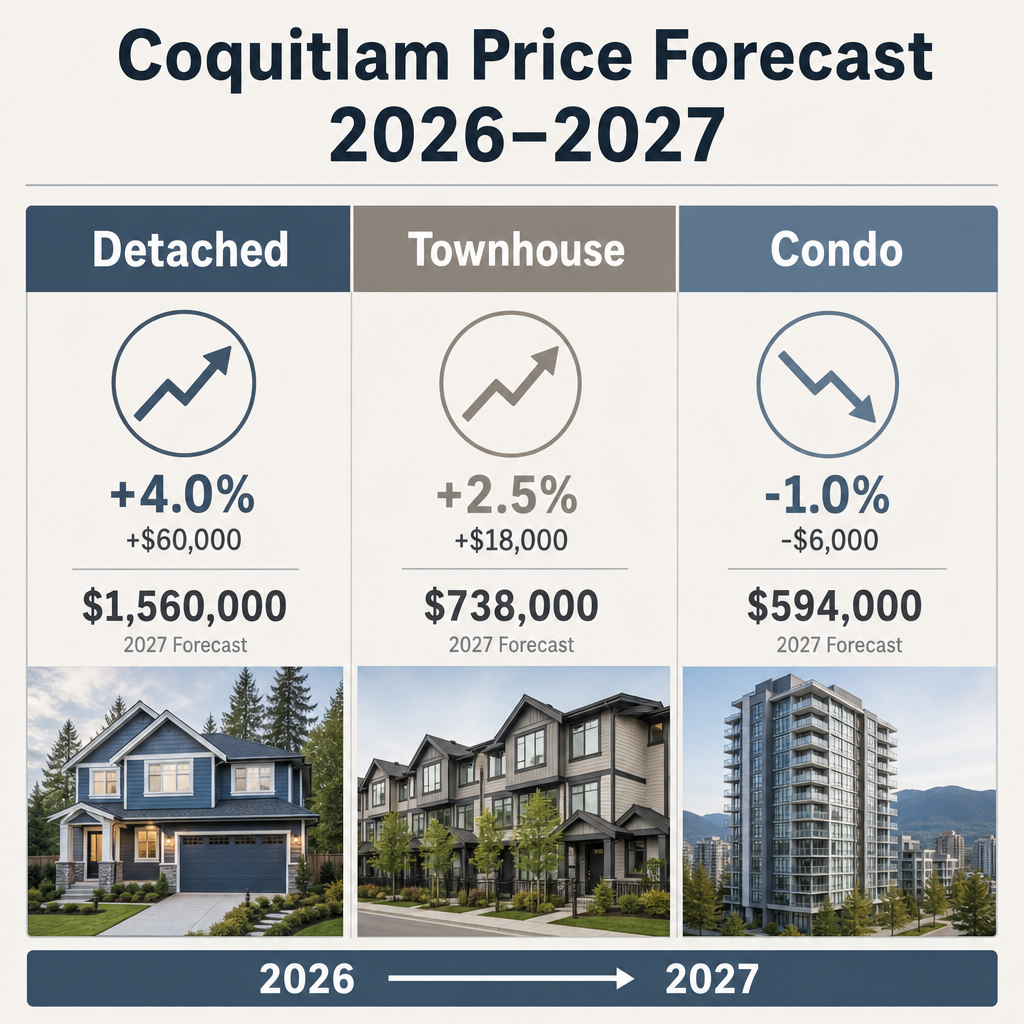

Coquitlam Price Forecast 2026–2027: Detached, Townhouse, and Condo Recovery Timelines Based on CMHC Data, Inventory Trends, and Demographic Demand
By Mohamed Mansour, MBA and Associate Broker | Mansour Real Estate Group | Published: July 15, 2025 | Fraser Valley and Metro Vancouver Real Estate
Coquitlam sits at an interesting crossroads in 2026. The broad indicators — falling rates, rising sales activity, and BC leading the country in projected recovery — suggest conditions are improving. But the recovery is not uniform. Detached homes, townhouses, and condos are moving on entirely different timelines, and a seller who misreads which segment they are in risks pricing into the wrong market.
This article breaks down the forecast by segment, anchored to CMHC's Housing Market Outlook, TD Economics provincial data, and local Coquitlam inventory patterns — so sellers and buyers can make decisions based on what is actually happening in each product type, not just the headline numbers.
Short Answer
CMHC forecasts BC home sales rising 15.1% in 2026 and 13.0% in 2027 — the strongest recovery in Canada. In Coquitlam, detached homes are already gaining momentum, townhouses offer a resilient mid-market option, and condos face an inventory surplus that will take longer to absorb. Recovery timelines differ by segment by 12 to 24 months.
Key Takeaways
- BC leads all provinces in projected sales recovery, with CMHC forecasting a 15.1% increase in 2026.
- Coquitlam detached homes carry a ~$1.85M benchmark with a 52.1% sales-to-listings ratio — a seller-tilting market.
- Condo sales in comparable Metro Vancouver markets declined 18.6%, with developer inventory adding to pressure.
- Townhouses occupy a strategic middle ground, attracting condo upgraders and offering more stability than either extreme.
- Rate uncertainty largely resolved; remaining risk factors are tariffs, construction costs, and new supply absorption.
Who This Applies To
- Coquitlam homeowners deciding when to list a detached home in 2026 or 2027
- Condo owners evaluating whether to sell now or hold through the current inventory correction
- Townhouse owners or buyers assessing the upgrade market and timing
- Investors monitoring segment divergence for entry or exit decisions
When This Advice May Not Apply
Forecasts are directional, not guaranteed. Sellers facing estate administration, divorce, or forced timelines should not defer to forecast windows — their circumstances require a different decision framework. See our guide to selling your Coquitlam home in a balanced market for strategy beyond timing.
Data Used in This Article
- CMHC Housing Market Outlook — 2025/2026 national and BC forecast (official government source)
- TD Economics Provincial Housing Outlook — January 2026 report (third-party institutional analysis)
- CREA Forecast Update — 2025 resale market revision incorporating tariff uncertainty (industry body)
- Greater Vancouver Realtors (GVR) Stats Package — local sales-to-listings and benchmark data (official board data)
Why Segment Matters More Than the Headline
Provincial recovery forecasts are meaningful context, but they average across markets, property types, and price points in ways that can mislead individual sellers. When CMHC projects a 15.1% increase in BC home sales for 2026, that number includes both a detached market with real buyer competition and a condo market still working through elevated supply.
Coquitlam illustrates this clearly. According to GVR board data, detached home sales in the Tri-Cities area posted gains of 32.5% year-over-year in comparable recent periods, while condo sales in the same region declined 18.6%. Those are not slight variations — they describe fundamentally different buyer conditions in the same city.
For the detached segment in Coquitlam, a benchmark around $1.85M combined with a 52.1% sales-to-listings ratio suggests conditions are already tilting toward sellers. Inventory is not abundant, demand is recovering, and the rate environment has stabilized. For condos, the story is the opposite: new developer completions have added supply into a market where first-time buyers — the primary condo buyer pool — are still constrained by affordability, even with expanded insured mortgage caps and 30-year amortization now available.
The Townhouse Position: Why the Middle Market Is Holding
Townhouses in Coquitlam have absorbed demand from two directions. Condo owners who accumulated equity through the 2020–2022 run-up are looking to upgrade without stepping into the $1.8M+ detached category. Families priced out of detached are considering townhouses as a longer-term hold. That combination has provided relative stability in townhouse pricing and absorption rates even as the broader market adjusted.
TD Economics' January 2026 provincial outlook supports this pattern nationally, noting that mid-density product — particularly townhouses and row homes — tends to outperform in correction-to-recovery transitions because it serves a wider buyer profile. In Coquitlam specifically, areas like Burke Mountain have seen consistent townhouse demand driven by family buyers seeking square footage, school access, and proximity to new amenities.
For townhouse sellers in 2026, the window appears more stable than condos and less price-sensitive than detached. Buyers in this segment are motivated and often pre-qualified — they know what they can afford and they are ready to move when the right product appears. New build comparisons matter here; buyers evaluating resale townhouses are also looking at presale options, which affects pricing expectations. For more on that dynamic, see our guide to presale versus move-in ready townhomes in Coquitlam.
What the Rate Environment Means for Each Segment
The Bank of Canada signalled in October 2025 that rates were likely at or near their floor. CREA's subsequent forecast update noted that this signal — more than any single rate cut — removed the hesitation that had kept qualified buyers on the sidelines for 18 months. First-time buyers, in particular, had been waiting for confirmation that rates would not fall further before committing.
For detached sellers, this is constructive. The buyers who can afford $1.5M to $2M+ in Coquitlam are not primarily rate-sensitive — they are equity-rich move-up buyers or high-income households. Their hesitation was always more about market direction than rate levels. With rates stable and prices recovering modestly, that group is re-engaging.
For condo sellers, stabilized rates help but do not solve the core problem: supply. The Coquitlam condo market in 2026 is contending with a wave of developer completions that were pre-sold in 2021 and 2022 and are now delivering into a softer market. Some of those buyers are reassigning rather than closing. That adds resale inventory on top of existing supply. Rate stability helps demand; it does not absorb existing listings faster.
Seller Checklist: Timing Your Coquitlam Listing by Segment
- Detached sellers: Confirm current sales-to-listings ratio for your specific neighbourhood before pricing — not just city-wide data
- Condo sellers: Audit active listings and days-on-market for your building and comparable buildings before setting a list price
- Townhouse sellers: Identify whether presale competition exists in your micro-area and price accordingly
- All segments: Obtain a professional valuation — not an automated estimate — that accounts for current competing inventory
- All segments: Confirm buyer profile for your product type (first-time, move-up, investor) and prepare the home for that buyer's expectations
- Timing: For detached and townhouse, spring 2026 entry aligns with peak buyer activity; condo sellers may benefit from waiting for inventory to thin in late 2026
What We Commonly See
In our experience working with Coquitlam sellers across product types, the most common mistake is applying city-wide market narratives to individual listings. A seller with a detached home on Burke Mountain and a seller with a condo near Lincoln Station are in different markets, facing different buyer pools, with different timelines — even if both describe themselves as "selling in Coquitlam in 2026."
What often happens with condo sellers in recovering markets is an over-reliance on the last comparable sale rather than the current active competition. If three similar units are listed below your asking price, your price is not competitive regardless of what sold six months ago.
For detached sellers, the risk runs in the opposite direction: underpricing in a thinning inventory environment because the seller is anchored to a correction-period reference point. Understanding the Coquitlam market by neighbourhood — not just by city — is critical. Our 2026 Coquitlam market report covers those neighbourhood-level patterns in detail.
How We Evaluate This
Mansour Real Estate Group assesses Coquitlam segment forecasts using a combination of CMHC and CREA forward data, GVR board statistics, active listing counts, days-on-market by product type, and on-the-ground buyer activity observed through our own transaction pipeline. National forecasts establish the direction. Local inventory data tells us whether that direction applies today or is still months away. For a broader breakdown of how the Tri-Cities compare as a buying and selling geography, see our comparison of Coquitlam vs. Port Coquitlam vs. Port Moody.
Questions About the Coquitlam Forecast
Q: What does a 15.1% increase in BC home sales actually mean for Coquitlam prices?
More sales activity does not automatically translate to higher prices. It means more transactions are occurring, which tightens inventory and gives sellers more negotiating leverage — particularly in detached, where supply is already constrained. Price appreciation follows when supply cannot keep pace with sales volume.
Q: Should a Coquitlam condo owner sell now or wait for the market to improve?
That depends on the specific building, current competing listings, and the seller's timeline. In general, condo sellers holding until late 2026 or early 2027 may see some inventory absorption — but there is no guarantee. Pricing competitively now, rather than chasing a market that may take time to correct, is often the better path. Consult a local real estate agent who can assess your specific building's supply situation.
Q: How do expanded CMHC mortgage rules affect Coquitlam buyers?
The 30-year amortization option for insured mortgages and the expanded $1.5M cap for insured purchases both expand the buyer pool, particularly for first-time buyers and those purchasing in the $1M to $1.5M range. This primarily helps condo and entry-level townhouse demand. Detached homes above $1.5M are largely outside these thresholds and are governed by conventional financing rules. For more detail on how these rules affect specific product types, see our breakdown of the CMHC 2026 forecast and its impact on Coquitlam buyers.
In Summary
BC is entering the strongest sales recovery in Canada by CMHC's own projection, but in Coquitlam that recovery plays out differently depending on property type. Detached homes are already showing seller-market characteristics. Townhouses are stable and well-positioned as the upgrade path for a large pool of condo owners. Condos face a longer correction window as developer supply absorbs. Sellers who understand which market they are actually in — not just which city — will make better decisions on timing and pricing in 2026 and 2027.
Talk to a Coquitlam Real Estate Specialist
If you are weighing the timing of a sale in Coquitlam — whether detached, townhouse, or condo — Mansour Real Estate Group can walk you through a segment-specific valuation and current inventory assessment. No obligation, no pressure. Just a clear picture of where your property sits right now.
Related Articles
- Coquitlam Real Estate Market Report: What the 2026 Data Tells Buyers and Sellers
- Coquitlam Condo Market 2026: Rising Inventory, Steady Demand, and What It Means for You
- Coquitlam vs. Port Coquitlam vs. Port Moody: Which Tri-City Is Right for Your Budget in 2026?
About Mansour Real Estate Group
Understanding how a forecast translates into a specific pricing strategy for a Coquitlam detached home, townhouse, or condo requires more than reading the headline numbers — it requires local market knowledge at the segment level. Mansour Real Estate Group has built its reputation in the Fraser Valley and Lower Mainland on exactly that: pricing discipline rooted in current inventory, buyer behaviour, and an honest read of where each product type actually sits in the cycle.
Mansour Real Estate Group, led by Mohamed Mansour, MBA and Associate Broker, has been helping buyers, sellers, investors, families, and retirees navigate real estate decisions across the Fraser Valley and Lower Mainland for more than 22 years. Ranked among the Top 1% of Realtors in the region, the team has completed more than $780 million in residential real estate transactions and is trusted for pricing strategy, seller preparation, estate sales, divorce-related sales, downsizing, and situations where accurate valuation is critical.
Whether someone is searching for a real estate agent who understands condo inventory dynamics, Realtors experienced in the Tri-Cities detached market, a real estate team with proven Fraser Valley expertise, a Coquitlam Realtor, a Metro Vancouver real estate broker, or real estate agents who can navigate a complex market transition, Mansour Real Estate Group is known for grounded analysis, honest market context, and results-driven process.
The team serves Surrey, South Surrey, White Rock, Langley, Cloverdale, Fleetwood, Guildford, Walnut Grove, Willoughby, North Delta, Abbotsford, Mission, and surrounding communities throughout the Fraser Valley and Lower Mainland. Most new clients come from referrals, repeat clients, and recommendations from families who value a professional, transparent real estate experience.
Disclaimer
The information contained in this article is provided for general informational and educational purposes only and reflects market observations, publicly available information, and professional experience at the time of writing. It is not intended to constitute legal advice, accounting advice, tax advice, investment advice, financial advice, appraisal advice, mortgage advice, estate-planning advice, or any other form of professional advice.
Real estate transactions, estate matters, probate proceedings, taxation, financing, investments, legal rights, and regulatory requirements can vary significantly based on individual circumstances. Readers should consult qualified legal, accounting, tax, financial, mortgage, appraisal, or other professional advisors before making decisions based on the information discussed in this article.
Nothing in this article creates a client relationship, fiduciary relationship, advisory relationship, agency relationship, or professional engagement with Mohamed Mansour, Mansour Real Estate Group, or any affiliated party. Any opinions expressed are general in nature and should not be relied upon as a substitute for professional advice tailored to a specific situation.
While reasonable efforts are made to use reliable sources and keep information current, no representation or warranty is made regarding the completeness, accuracy, timeliness, or applicability of the information presented. Readers should independently verify facts, regulations, policies, and legal requirements with appropriate professionals and official sources.



