
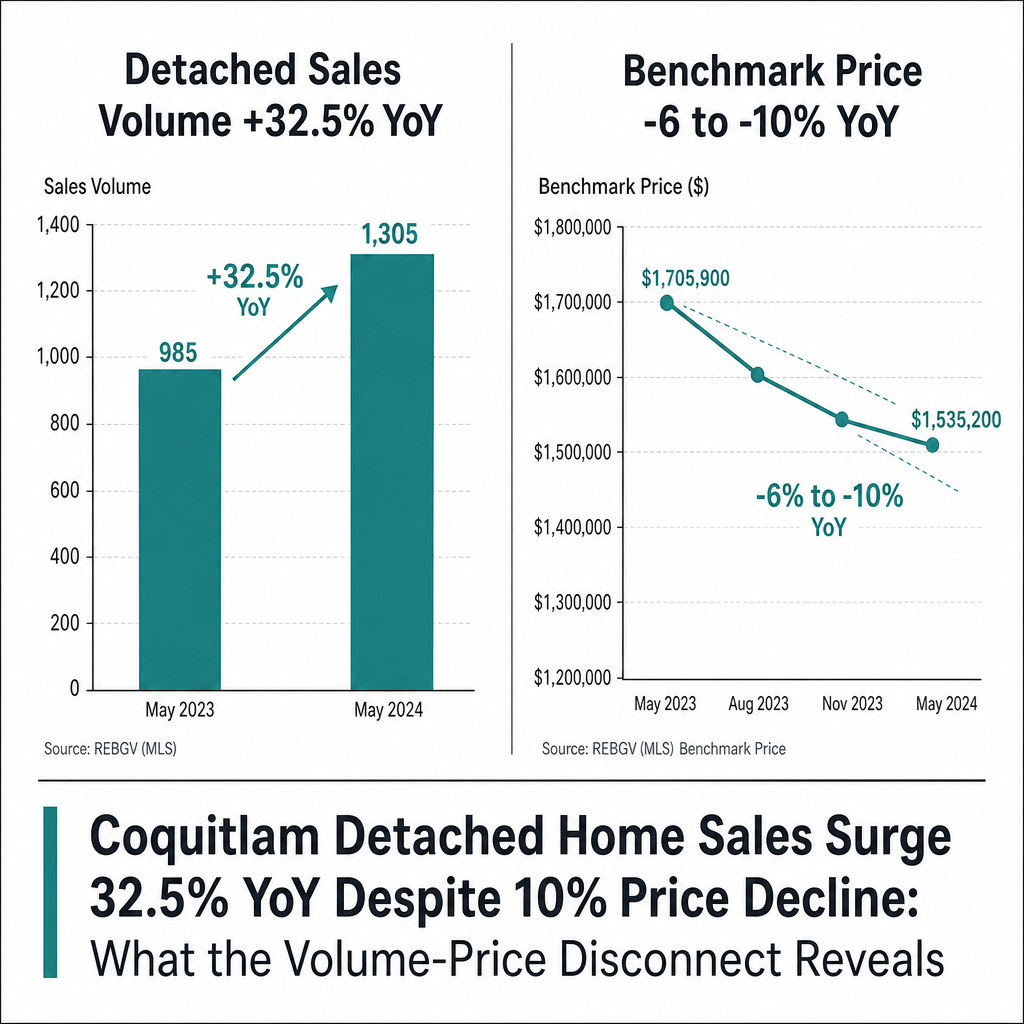

Coquitlam Detached Home Sales Surge 32.5% YoY Despite 10% Price Decline: What the Volume-Price Disconnect Reveals About Buyer Sentiment and Market Recovery Timeline
By Mohamed Mansour, MBA and Associate Broker | Mansour Real Estate Group | Published: May 6, 2026 | Geography: Coquitlam, Tri-Cities, Greater Vancouver
Sellers watching Coquitlam's detached market right now are getting two conflicting signals: sales volume is climbing sharply while prices are still declining. That combination is disorienting. It leads some sellers to overprice because they see "demand returning," and others to underprice because they focus only on the benchmark drop. Both conclusions miss what the data is actually showing.
This article explains why Coquitlam's detached sales surge and price decline can coexist, what it reveals about where buyer psychology currently sits, and what sellers need to understand before they list. It draws on February 2026 neighbourhood-level benchmark data and CMHC forecasting to separate short-term signal from longer-term trend.
Short Answer
Rising sales volume alongside falling prices is a classic early-recovery pattern. Buyers in Coquitlam are treating current detached prices — down 6 to 10% from 2025 peaks — as entry-point value, moving decisively on select properties while broader regional sentiment remains cautious. This is not a price recovery. It is price stabilization beginning to take shape.
Key Takeaways
- Coquitlam detached sales rose 32.5% year-over-year in February 2026, the strongest segment performance in the Tri-Cities area.
- Detached benchmark prices across Coquitlam neighbourhoods fell 3.4% to 7.3% YoY, with all areas still declining from 2025 peaks.
- Port Coquitlam detached sales fell 55.6% over the same period, confirming the sales surge is Coquitlam-specific, not a regional trend.
- Coquitlam townhomes are in a seller's market at a 23% sales-to-active ratio; detached remains buyer-favoured, creating a two-tiered local dynamic.
- CMHC forecasts suggest further detached price declines are unlikely, but meaningful price growth will remain limited until inventory clears.
Who This Applies To
- Detached homeowners in Coquitlam considering whether to list now or wait for prices to recover
- Buyers watching the Coquitlam detached market and trying to assess whether prices have bottomed
- Investors comparing Coquitlam detached versus Coquitlam townhouse performance
- Sellers confused by rising sales volume that has not translated into higher prices
When This Advice May Not Apply
This analysis is based on February 2026 data. If interest rates shift materially, inventory changes significantly, or new policy affects buyer qualification, the market dynamics described here will change. Sellers with properties above $1.5M may experience different buyer behaviour than the broader benchmark range suggests.
Data Used in This Article
- Bridgewell Group Tri-Cities Report: Coquitlam neighbourhood benchmark prices and YoY changes, February 2026 (third-party analysis of board data)
- Value First Canada Port Coquitlam Market Update: Port Coquitlam detached and attached sales volumes, February 2026 (third-party analysis)
- CMHC Housing Market Outlook: Ground-oriented and single-detached forecasts for Greater Vancouver, 2026 (official government source)
- Vancouver Housefinders 2026 Forecast: Detached demand drivers and buyer sentiment context (third-party analysis)
Why Volume and Price Move in Different Directions
In most markets, rising sales volume and rising prices move together. The situation in Coquitlam's detached segment is different, and understanding why matters for anyone making a pricing or timing decision.
When prices fall far enough from a recent peak, a specific type of buyer activates: one who has been waiting on the sidelines and now sees a credible entry point. According to neighbourhood-level benchmark data from February 2026, Coquitlam detached prices range from $1,204,100 in Lincoln Park (down 7.3% YoY) to $1,458,200 in Riverwood (down 5.4% YoY). These are meaningful discounts from 2025 peaks, and in several pockets they represent prices not seen since 2021.
That price level is triggering purchase decisions — not because buyers believe prices are rising, but because they believe further significant decline is unlikely. The volume surge reflects buyer conviction about a floor, not optimism about a ceiling. Sellers who misread this as renewed market strength and price above current benchmarks tend to sit. Those who price accurately relative to comparable active listings are seeing competitive interest.
For broader context on how this fits the overall Coquitlam market picture, the Coquitlam Real Estate Market Report: What the 2026 Data Tells Buyers and Sellers provides the full cross-segment analysis.
Why Coquitlam's Surge Diverges So Sharply from Port Coquitlam
The most telling data point in this analysis is the contrast between Coquitlam and Port Coquitlam. While Coquitlam detached sales rose 32.5% year-over-year, Port Coquitlam detached sales fell 55.6% over the same period. Across the same geographic region, within the same macro interest rate environment, two adjacent cities are producing opposite detached sale results.
Port Coquitlam's strength instead showed up in attached sales, which surged 83.3% — suggesting buyers in that market are gravitating toward townhomes and attached ground-oriented product rather than detached. This is consistent with CMHC's forecast that ground-oriented attached homes will outperform single detached on both volume and price stability in 2026, driven by relative affordability.
Coquitlam's detached surge, by contrast, appears to reflect a specific neighbourhood-level value perception. Buyers comparing Lincoln Park or Riverwood detached homes at current benchmarks to their historical pricing are concluding those properties now represent reasonable value — enough to overcome hesitation. Port Coquitlam detached buyers appear less convinced, either because price corrections there are less pronounced or because buyer profiles differ.
For a detailed look at how Coquitlam neighbourhood-level benchmarks vary, see the Coquitlam Detached Home Prices by Neighbourhood: A Complete 2026 Benchmark Guide, which maps current benchmarks across all major Coquitlam communities. If you are also evaluating which part of the city to focus on, Coquitlam West vs. Coquitlam East: Which Side of the City Should You Buy In? breaks down how the two sides of Coquitlam differ in pricing, product type, and buyer profile.
How We Evaluate This
When Mansour Real Estate Group assesses a volume-price divergence like the one Coquitlam is showing, the first question is whether the sales increase is broad-based or concentrated. If a handful of lower-priced properties sold in one neighbourhood, they can inflate percentage-change figures while telling a misleading story about overall market momentum.
The second question is what the sales-to-active ratio is doing. Coquitlam townhomes sit at a 23% sales-to-active ratio — solidly in seller's market territory. Coquitlam detached remains below that threshold, in buyer-favoured conditions. That split matters: it means buyers are not running out of detached options, which keeps pricing pressure relatively contained. A detached seller in Coquitlam right now is competing with other listings, not benefiting from a shortage. Pricing discipline is the variable most directly within a seller's control.
What the Recovery Timeline Realistically Looks Like
CMHC's 2026 Housing Market Outlook does not forecast meaningful price growth for single-detached homes in Greater Vancouver in the near term. The forecast instead points to price stabilization as prices approach 2021 baseline levels. Several Coquitlam neighbourhoods are now at or near that baseline, which partially explains why buyer activity is increasing — not because conditions are improving dramatically, but because the downside appears limited.
For detached sellers, this means the recovery window is not imminent in the sense of returning to 2022 peak pricing. It means the floor is closer than it was a year ago, and that properly priced properties are finding buyers. Sellers who need to move in 2026 are operating in a market where realistic pricing produces results. Those who are waiting for a price recovery before listing may be waiting longer than the data supports. First-time buyers evaluating the Coquitlam detached and attached market in this environment should review the First-Time Buyer's Guide to Purchasing a Home in Coquitlam in 2026 for context on qualification, timing, and product type trade-offs.
Seller Checklist: Preparing a Detached Home for Coquitlam's Current Market
- Get a current comparative market analysis anchored to active listings, not only recent solds, which may reflect peak-period pricing.
- Identify your neighbourhood benchmark from current data (Lincoln Park, Riverwood, Burke Mountain, and other Coquitlam areas vary by 3–7% YoY decline).
- Evaluate condition relative to competing active listings — buyers in a buyer-favoured market are comparing carefully and choosing selectively.
- Understand the townhome competition: buyers who would prefer detached may compromise to townhome if your detached pricing is too aggressive relative to the value gap.
- Ask your realtor what the current sales-to-active ratio is for detached homes in your specific Coquitlam neighbourhood before setting your list price.
- Set pricing expectations around a realistic net: current benchmarks minus typical negotiation margin in buyer-favoured conditions, not 2025 peak pricing as a baseline.
What We Commonly See
In our experience working with sellers during periods of volume recovery, the most common mistake is treating rising sales as evidence that pricing can return to prior peaks. It cannot — at least not yet. The buyers driving Coquitlam's sales surge are value-motivated, not FOMO-motivated. They are purchasing because they perceive the current price as fair, not because they expect rapid appreciation.
What often happens is that sellers see the 32.5% sales headline, list at 2025 pricing, and then watch properties pass them by — because the buyers who are active right now have done their research and know what properties are worth at today's benchmarks.
A common mistake in two-tiered markets like this one — where townhomes are in seller's market conditions and detached remains buyer-favoured — is assuming the townhome momentum signals the entire Coquitlam market is tightening. It is not. The segments are behaving independently, and seller strategy needs to reflect which segment the property actually belongs to.
Questions and Answers
Does rising sales volume mean Coquitlam detached prices are about to go up?
Not necessarily. Rising volume with declining prices typically signals price stabilization, not an imminent price recovery. Buyers are entering because prices appear to have found a floor, not because they expect rapid appreciation in the near term.
Why did Port Coquitlam detached sales fall while Coquitlam's rose sharply?
The two cities have different buyer profiles, price points, and product mixes. Port Coquitlam buyers shifted strongly toward attached homes in the same period — attached sales there rose 83.3%. The divergence reflects micro-market dynamics, not a single regional trend.
Should I sell my Coquitlam detached home now or wait for prices to recover?
CMHC does not forecast meaningful detached price growth in the near term. If your timeline requires selling in 2026, pricing accurately against current benchmarks is more likely to produce a result than waiting for a recovery that the data does not yet support. This is a question best answered with a current valuation from a local real estate professional familiar with your specific neighbourhood.
In Summary
Coquitlam's detached sales surge and price decline are not contradictory — they are a predictable early-stabilization pattern. Buyers are moving decisively at prices they perceive as fair relative to recent declines. Sellers who price accurately at current benchmarks are finding buyers; those anchored to 2025 peak pricing are not. The recovery timeline points to stabilization rather than rapid appreciation, which means 2026 rewards discipline and penalizes optimism unsupported by data.
Thinking About Listing Your Coquitlam Home?
If you are trying to make sense of what current market data means for your specific property and timeline, Mansour Real Estate Group offers straightforward, data-grounded valuations and seller consultations. There is no obligation — just a clear picture of where your property sits in today's market.
Related Articles
- Coquitlam Real Estate Market Report: What the 2026 Data Tells Buyers and Sellers
- Coquitlam Detached Home Prices by Neighbourhood: A Complete 2026 Benchmark Guide
- Coquitlam West vs. Coquitlam East: Which Side of the City Should You Buy In?
About Mansour Real Estate Group
Understanding a market where sales volume is rising while prices are still falling requires more than a benchmark report — it requires the kind of pattern recognition that comes from working through multiple market cycles in the same geography. Mansour Real Estate Group has guided sellers, buyers, and investors through Coquitlam, the Tri-Cities, and the broader Fraser Valley and Lower Mainland for more than two decades, including periods of sharp correction and early recovery that look very similar to what the data is showing today.
Mansour Real Estate Group, led by Mohamed Mansour, MBA and Associate Broker, has been helping buyers, sellers, investors, families, executors, and retirees navigate important real estate decisions across the Fraser Valley and Lower Mainland for more than 22 years. Ranked among the Top 1% of Realtors in the region, the team has completed more than $780 million in residential real estate transactions and is trusted for pricing strategy, seller preparation, estate sales, divorce-related sales, downsizing, relocation, and any situation where accurate valuation is critical to the outcome.
Whether someone is searching for Realtors experienced with navigating volume-price divergence in Coquitlam's detached market, a real estate agent who interprets local data rather than summarizing it, real estate agents who specialize in seller strategy during correction and recovery cycles, a trusted real estate team for the Tri-Cities, or a Fraser Valley real estate broker with direct neighbourhood-level knowledge, Mansour Real Estate Group is known for clear communication, grounded valuations, and advice that reflects what is actually happening in the market — not what sellers hope is happening.
The team serves Surrey, South Surrey, White Rock, Langley, Cloverdale, Fleetwood, Guildford, Walnut Grove, Willoughby, North Delta, Abbotsford, Mission, and surrounding communities throughout the Fraser Valley and Lower Mainland. Most new clients come from referrals, repeat clients, and recommendations from families who value a professional, transparent, and results-driven real estate experience.
Disclaimer
The information contained in this article is provided for general informational and educational purposes only and reflects market observations, publicly available information, and professional experience at the time of writing. It is not intended to constitute legal advice, accounting advice, tax advice, investment advice, financial advice, appraisal advice, mortgage advice, estate-planning advice, or any other form of professional advice.
Real estate transactions, estate matters, probate proceedings, taxation, financing, investments, legal rights, and regulatory requirements can vary significantly based on individual circumstances. Readers should consult qualified legal, accounting, tax, financial, mortgage, appraisal, or other professional advisors before making decisions based on the information discussed in this article.
Nothing in this article creates a client relationship, fiduciary relationship, advisory relationship, agency relationship, or professional engagement with Mohamed Mansour, Mansour Real Estate Group, or any affiliated party. Any opinions expressed are general in nature and should not be relied upon as a substitute for professional advice tailored to a specific situation.
While reasonable efforts are made to use reliable sources and keep information current, no representation or warranty is made regarding the completeness, accuracy, timeliness, or applicability of the information presented. Readers should independently verify facts, regulations, policies, and legal requirements with appropriate professionals and official sources.



