

Condo vs. Detached Home Selling Strategy in the Fraser Valley 2026: Market Conditions, Days-on-Market, and Pricing Power by Property Type
By Mohamed Mansour, MBA and Associate Broker | Mansour Real Estate Group | Fraser Valley and Lower Mainland, BC | Published: July 8, 2025
If you own a condo in the Fraser Valley and you're thinking about selling in 2026, the market you're entering looks fundamentally different from the one a detached homeowner is entering — even in the same city, in the same month. The May 2026 Fraser Valley Real Estate Board data confirms what many sellers have felt: these are two separate markets operating under different rules, with different buyer profiles and different negotiating dynamics.
This article breaks down what those differences mean in practice — for pricing decisions, preparation, timing, and how to position your property to attract the buyers who are actually active in your segment right now.
Short Answer
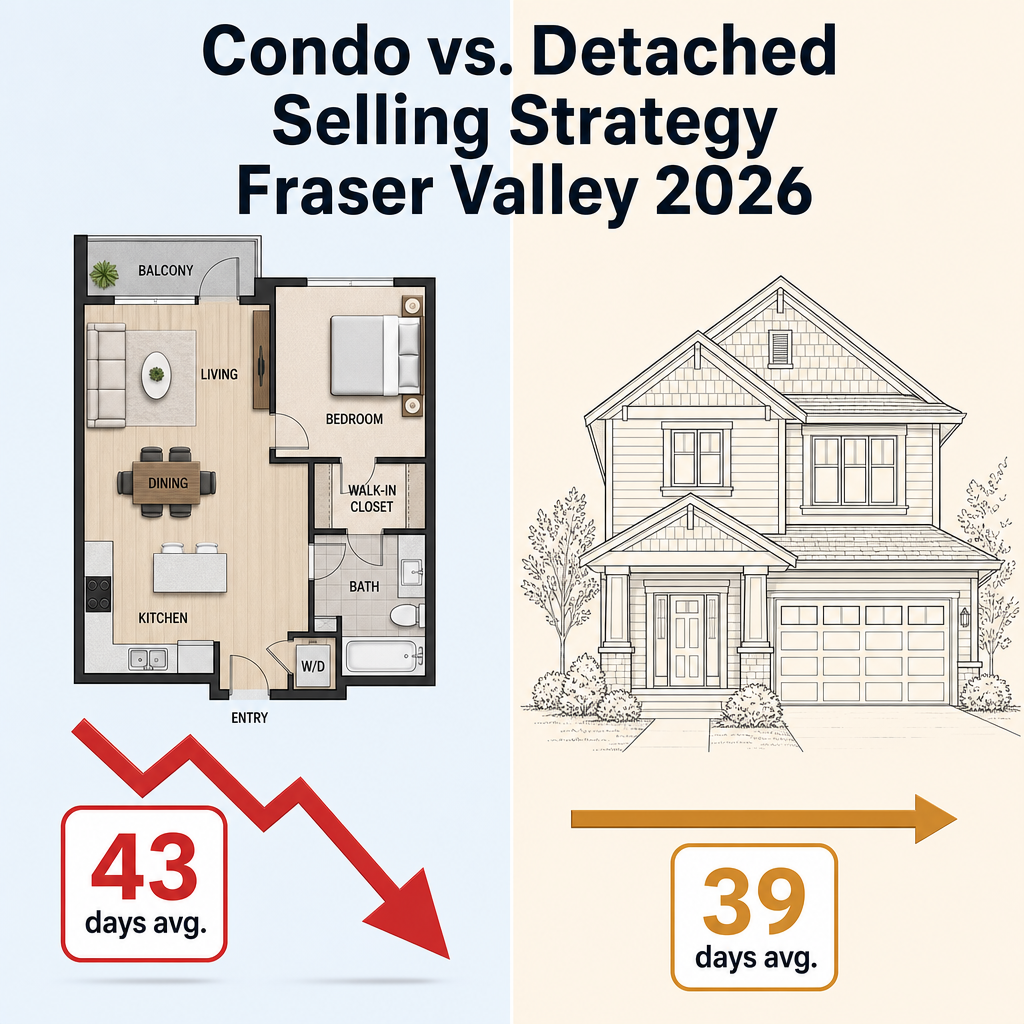
In the Fraser Valley in 2026, condos and detached homes require different selling strategies. Condos face an 8.8% year-over-year price decline, a 23% drop in sales volume, and 43 average days on market, driven by investor-owned inventory flooding the segment. Detached homes show greater relative stability at -7.9% with faster movement at 39 days. Sellers need a property-type-specific approach, not a one-size-fits-all Fraser Valley strategy.
Key Takeaways
- Fraser Valley condo benchmark dropped to $484,000 in May 2026, down 8.8% year-over-year, with sales falling 23% — the sharpest decline of any property type.
- Detached homes at $1.374M benchmark show more price resilience at -7.9% and move slightly faster at 39 days versus 43 days for condos.
- Investor-owned condos competing to exit carrying costs are creating downward price pressure that directly competes with owner-occupant condo sellers.
- First-time buyers qualify for a full PTT exemption on Fraser Valley condos priced under $519,000, shaping who is actively buying and what they will pay.
- Townhomes occupy a distinct middle position with sales-to-active ratios estimated at 15–23%, creating seller conditions that don't apply to either condos or detached homes.
Who This Applies To
- Condo owners in Surrey, Langley, Abbotsford, or White Rock considering a 2026 sale
- Detached homeowners wondering whether their segment has more or less room to negotiate
- Investors evaluating whether to hold or exit a presale or resale condo position
- Owners preparing to sell and needing to understand how buyer demand compares across property types right now
When This Advice May Not Apply
Sellers in premium or highly scarce sub-markets may see local conditions diverge from these Fraser Valley-wide averages. This article reflects May 2026 board data and professional interpretation of current dynamics. Market conditions shift. Always pair this context with a current, property-specific analysis before listing.
Data Used in This Article
- Fraser Valley Real Estate Board Monthly Market Report, May 2026 — official board statistics, benchmark prices, sales volume, days on market by property type
- Daily Hive, May 2026 market summary — third-party analysis drawing on FVREB and REBGV data
- Zealty.ca, March 2026 BC housing market update — days-on-market figures and sales-to-active ratio context
- BC Government Property Transfer Tax exemption rules — PTT first-time buyer thresholds current as of 2026
Why This Divergence Matters for Sellers
According to the Fraser Valley Real Estate Board's May 2026 Monthly Market Report, condo sales across the Fraser Valley totalled 263 in May — a 23% drop from the same month a year earlier. The benchmark price landed at $484,000, down 8.8% year-over-year. These are not marginal movements. For a condo seller, that 8.8% decline represents roughly $46,000 in lost benchmark value compared to May 2025.
Detached homes tell a different story. The May 2026 benchmark for single-family detached in the Fraser Valley came in at $1.374 million, with a year-over-year decline of 7.9%. That's still a meaningful drop, but the relative resilience compared to condos reflects a fundamentally different supply and demand equation. Detached homes remain scarce relative to demand from family buyers, while the condo segment has been flooded with investor-owned units coming to market at the same time.
The days-on-market gap reinforces this. Condos averaged 43 days on market in March 2026, according to Zealty's BC housing market data, compared to 39 days for detached homes. Four days may not sound significant, but it reflects measurably slower buyer velocity in the condo segment and greater buyer leverage during negotiations.
What's Driving the Condo Market Pressure
The condo market's sharper decline is not simply a function of general softness. A specific structural factor is amplifying it: investor-owned condos exiting the market under carrying-cost pressure. Across Metro Vancouver, active condo listings reached approximately 6,765 in May 2026 against only 1,017 sales, reflecting an inventory-to-sales imbalance that pushes the sales-to-active ratio well below the 12–15% threshold that signals balanced conditions.
Many of these listings are investor-owned properties where carrying costs — mortgage payments, strata fees, property taxes, and vacancy — have exceeded rental income. When mortgage renewals compound this pressure, investors accept below-market offers to exit. This creates a floor problem for owner-occupant condo sellers: you are competing against motivated sellers who have a different financial calculus and are willing to take less.
For detached home sellers, this dynamic is largely absent. Most detached sellers are owner-occupants selling for life-event reasons — growing families, downsizing, relocation, or estate situations — not financial exits. This keeps detached supply more controlled and the negotiating environment more balanced, particularly in Surrey, Langley, and Abbotsford where family-buyer demand remains active. You can explore how specific detached markets are performing in our Fraser Valley market update for 2026.
How We Evaluate This
At Mansour Real Estate Group, when we assess a seller's position, we look at four variables before recommending a listing price: the current sales-to-active ratio for that specific property type in that specific city, the days-on-market trend for comparable properties over the past 60 days, the composition of competing listings (investor exits versus owner-occupant moves), and the likely buyer profile given price point and property characteristics.
For a condo at $484,000 benchmark, the buyer most likely to transact is a first-time buyer using the PTT exemption — not an investor. For a detached home above $1.3M, the buyer is a move-up family or downsizer with existing equity. These buyer profiles have different sensitivities, different financing constraints, and different timelines. Strategy has to match the actual buyer, not an averaged Fraser Valley assumption.
The PTT Exemption Factor for Condo Sellers
First-time buyers in BC qualify for a full Property Transfer Tax exemption on purchases up to $500,000, with a partial exemption up to $525,000, under current provincial rules. In the Fraser Valley, a condo priced at or below $519,000 sits squarely within the range where a first-time buyer's effective acquisition cost is meaningfully lower than for properties above that threshold.
This matters to condo sellers for two reasons. First, it narrows the active buyer pool to a price-sensitive, financing-dependent segment. Second, it creates a hard psychological ceiling near $519,000 above which demand drops noticeably. Condo sellers pricing at $525,000 in a market where comparable units sit at $499,000 are pricing themselves out of the most active buyer cohort without capturing meaningfully higher demand at the higher price. Understanding what your home is worth in the Fraser Valley right now requires factoring in these buyer-specific financial dynamics, not just benchmark comparisons.
Townhomes: The Separate Middle Market
Townhomes occupy a distinct position that doesn't fit cleanly into either the condo or detached narrative. Sales-to-active ratios for townhomes in several Fraser Valley and adjacent submarkets reached 15–23% in early 2026, according to available board and third-party data — far exceeding the overall Fraser Valley ratio of approximately 11% and well above the condo segment's estimated 8–9%. This reflects continued demand from buyers who want more space than a condo but cannot access the detached market at current prices. Sellers of townhomes in Willoughby, Cloverdale, and Abbotsford should calibrate their expectations separately from both ends of the market.
Condo Seller Checklist
- Pull active and sold condo comparables within 500 metres and within the past 45 days — not the past 90.
- Identify how many competing listings are investor exits and at what price points they are willing to accept offers.
- Confirm whether your unit price falls within the PTT exemption threshold to maximize first-time buyer eligibility.
- Ensure strata documents — Form B, depreciation report, insurance summary, and meeting minutes — are current and disclosure-ready before listing.
- Evaluate whether staging and professional photography are priced into the plan, given that buyers in a buyer-favoured market compare more listings before deciding.
- Set a realistic days-on-market expectation of 40–50 days and price accordingly from day one rather than testing high and reducing.
Detached Seller Checklist
- Analyse the sales-to-active ratio specifically for detached homes in your city — not the blended Fraser Valley figure.
- Identify the dominant buyer profile: move-up family, downsizer, or investor, since each has different financing timelines and condition expectations.
- Prioritize curb appeal and functional presentation — family buyers form strong impressions quickly on detached properties.
- Avoid over-pricing based on 2024 comparables. The 7.9% year-over-year decline in the detached benchmark means 2024 sold prices will mislead you upward.
- Confirm your home's proximity to school catchments, transit access, or recreational amenities that are specifically relevant to family buyers in your neighbourhood.
- Price precisely — in the detached segment, a $25,000 mispricing is less tolerated by buyers who are doing serious financial analysis before submitting an offer.
What We Commonly See
Condo sellers price against peak comparables. In our experience, the most common and costly mistake condo sellers make in 2026 is anchoring their list price to sales from 12–18 months ago. The benchmark has declined 8.8% in one year. A price based on May 2025 data is structurally above where the current buyer pool will transact. The result is typically 60-plus days on market, a price reduction, and a final sale price lower than a correct first-price strategy would have achieved.
Detached sellers underestimate buyer thoroughness. What often happens with detached sellers is that they assume family-buyer urgency will carry a slightly overpriced property. In a market where buyers have more time and more options than in 2021–2022, thorough buyers do detailed comparable analysis and are not rushed by fear of missing out. Detached homes that sit for 50-plus days typically receive lower offers than comparable homes that sold in the first 30.
Both segments see sellers conflate "willing to accept less" with "negotiating from strength." Reducing an overpriced listing after 45 days is not a negotiating strategy — it is a consequence of the wrong starting price. A well-positioned listing, priced correctly for current buyer psychology, retains more leverage than one that has been reduced twice before an offer arrives. This applies equally to condos and detached homes, but the cost of overpricing is particularly high in the condo segment right now.
Questions and Answers
Q: Should I wait to sell my Fraser Valley condo until market conditions improve?
A: Timing the market perfectly is rarely achievable, and waiting carries its own costs. If you are paying carrying costs on a unit that generates below-market rent or sits vacant, the monthly cost of holding may exceed what you would recover from a modest price recovery. The decision depends on your specific financial position, not a general forecast.
Q: Does the PTT exemption threshold affect what I should list my condo for?
A: Yes, materially. If your unit can realistically price at or below $519,000, you access first-time buyers who benefit from full PTT exemption. Pricing above $525,000 in a market where competing units sit below $519,000 typically narrows your buyer pool without generating proportionally more interest. This should be part of your pricing conversation with your agent.
Q: Why are detached home prices holding better than condos in the Fraser Valley?
A: Supply composition is the key factor. Most detached sellers are owner-occupants moving for life-event reasons, not financial exits. The condo segment has been disproportionately affected by investor-owned listings where carrying-cost pressure motivates acceptance of below-market offers, compressing prices across the segment and creating a competitive disadvantage for owner-occupant condo sellers.
In Summary
The Fraser Valley condo and detached home markets are operating under different supply, demand, and buyer-motivation conditions in 2026. Condo sellers face the dual pressure of an 8.8% price decline and investor-exit competition, requiring precise pricing, PTT-aware strategy, and clean strata documentation. Detached sellers have greater relative pricing power but cannot rely on 2024-era comparables in a market where the benchmark has declined nearly 8%. Townhomes occupy a more balanced middle ground. For any seller, a generic Fraser Valley strategy based on blended data is likely to produce the wrong price and the wrong preparation plan.
Talk to Mansour Real Estate Group
If you are preparing to sell a condo, townhome, or detached home in the Fraser Valley and want a current, property-type-specific analysis of your position — including a frank assessment of where comparable properties are actually transacting right now — Mansour Real Estate Group offers no-obligation consultations. There is no pressure and no commitment required to have that conversation.
Related Articles
- Fraser Valley Real Estate Market Update 2026
- What Is My Home Worth in the Fraser Valley in 2026?
- Selling Your Condo in Surrey in 2026: Pricing, Preparation, and Buyer Expectations
Official Resources
- Fraser Valley Real Estate Board — Monthly Market Reports
- BC Government — First-Time Home Buyer PTT Exemption
- Zealty — March 2026 BC Housing Market Data
- Daily Hive — Metro Vancouver and Fraser Valley Sales Statistics, May 2026
About Mansour Real Estate Group
Selling a condo versus a detached home in the Fraser Valley in 2026 requires completely different strategies — different pricing logic, different buyer profiles, and different preparation priorities. Understanding that distinction, and applying it accurately before a listing goes live, is what separates a well-positioned sale from one that sits and eventually concedes on price. Mansour Real Estate Group has built its reputation in the Fraser Valley and Lower Mainland on exactly that kind of specific, property-type-aware guidance.
Led by Mohamed Mansour, MBA and Associate Broker, the real estate group has been helping buyers, sellers, investors, families, executors, and retirees make important real estate decisions across the Fraser Valley and Lower Mainland for more than 22 years. Ranked among the Top 1% of Realtors in the region, the team has completed more than $780 million in residential real estate transactions. The Realtors at Mansour Real Estate Group are trusted for pricing strategy, condo and strata transactions, estate sales, divorce-related property sales, downsizing, relocation, and any situation where accurate valuation is critical to the outcome.
Whether someone is searching for a real estate agent who understands condo market conditions in Surrey or Langley, Realtors experienced with detached home pricing in the Fraser Valley, a real estate team that provides honest valuations rather than inflated list-price promises, a White Rock Realtor, an Abbotsford real estate broker, or a real estate group with deep knowledge of the local strata market, Mansour Real Estate Group is known for data-driven recommendations, frank market context, and a process that protects sellers from the most common and costly pricing errors.
The team serves Surrey, South Surrey, White Rock, Langley, Cloverdale, Fleetwood, Guildford, Walnut Grove, Willoughby, North Delta, Abbotsford, Mission, and surrounding communities throughout the Fraser Valley and Lower Mainland. Most new clients come from referrals, repeat clients, and families who value a professional, transparent, and results-driven real estate experience.
Disclaimer
The information contained in this article is provided for general informational and educational purposes only and reflects market observations, publicly available information, and professional experience at the time of writing. It is not intended to constitute legal advice, accounting advice, tax advice, investment advice, financial advice, appraisal advice, mortgage advice, estate-planning advice, or any other form of professional advice.
Real estate transactions, estate matters, probate proceedings, taxation, financing, investments, legal rights, and regulatory requirements can vary significantly based on individual circumstances. Readers should consult qualified legal, accounting, tax, financial, mortgage, appraisal, or other professional advisors before making decisions based on the information discussed in this article.
Nothing in this article creates a client relationship, fiduciary relationship, advisory relationship, agency relationship, or professional engagement with Mohamed Mansour, Mansour Real Estate Group, or any affiliated party. Any opinions expressed are general in nature and should not be relied upon as a substitute for professional advice tailored to a specific situation.
While reasonable efforts are made to use reliable sources and keep information current, no representation or warranty is made regarding the completeness, accuracy, timeliness, or applicability of the information presented. Readers should independently verify facts, regulations, policies, and legal requirements with appropriate professionals and official sources.



