
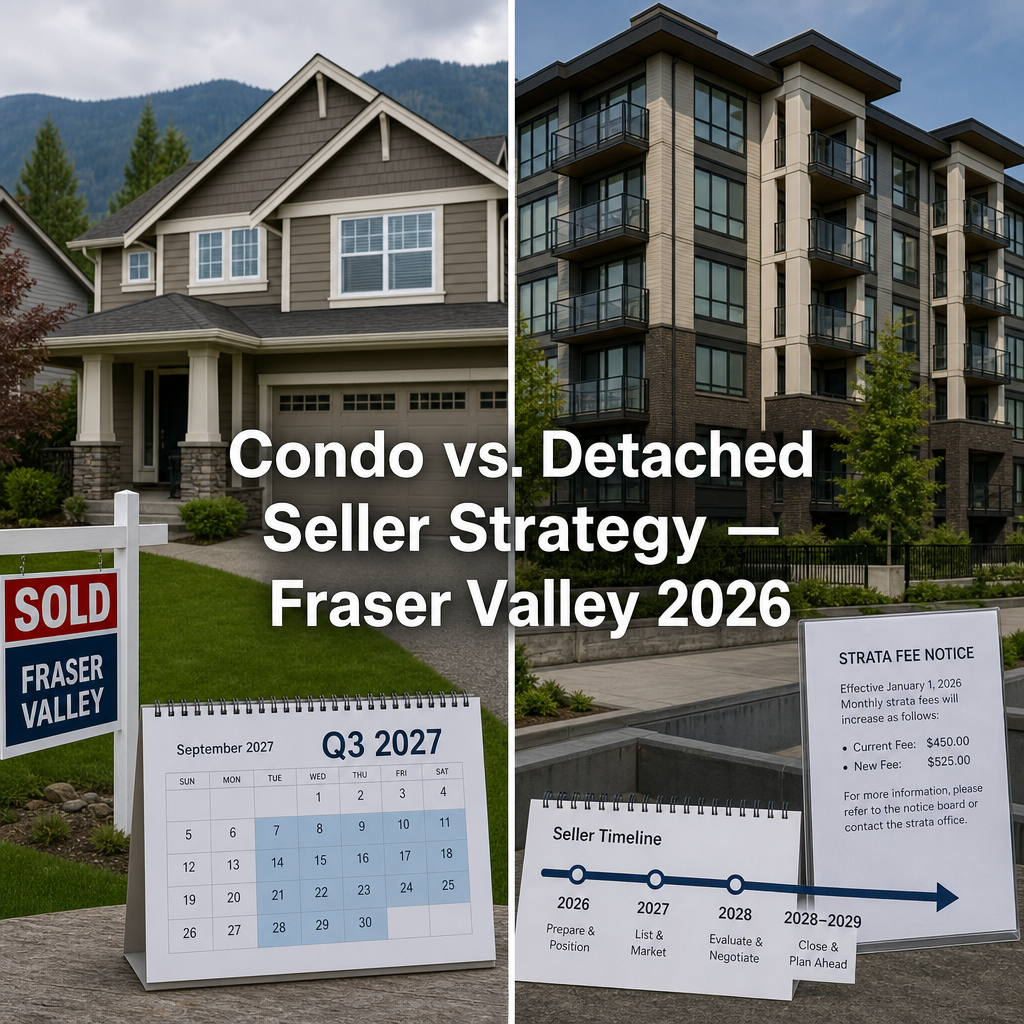

Condo vs. Detached Home Seller Strategy in the Fraser Valley 2026: Market Recovery Timelines, Days-on-Market Divergence, Carrying Costs, and Net Proceeds Comparison When Property Types Follow Completely Different Buyer Demand Patterns
By Mohamed Mansour, MBA and Associate Broker | Mansour Real Estate Group | Published: May 27, 2025 | Fraser Valley and Lower Mainland, BC
Fraser Valley sellers in 2026 are operating in two completely different markets depending on what they own. A detached homeowner and a condo owner face different buyer demand, different days-on-market, different pricing trajectories, and different carry costs while they wait. The question is no longer just "when should I sell?" — it is "what does my property type tell me about whether selling now or holding actually makes financial sense?"
This guide is for Fraser Valley sellers who want an honest property-type-specific analysis, not a generic market update. It draws on Fraser Valley Real Estate Board data from April 2026, CMHC housing forecasts for 2026–2027, and field experience with both condo and detached transactions across Surrey, Langley, Abbotsford, and surrounding communities.
Short Answer
In April 2026, detached homes in the Fraser Valley average 40 days on market with a 10% sales-to-active ratio. Condos average 75+ days with a 7% ratio. Condo price recovery is forecast 12–24 months behind detached. For many condo sellers, the carrying cost of waiting exceeds the expected price recovery. For detached sellers, the gap is smaller and timing is more negotiable.
Key Takeaways
- Detached homes sell roughly twice as fast as condos in the Fraser Valley right now — 40 days versus 75+ days on average.
- Condo sellers face a severe buyer's market with a 7% sales-to-active ratio; detached sellers are closer to 10%, still soft but notably better.
- Condo carrying costs — strata fees, levies, and financing obstacles — can run $800–$1,200/month, making extended hold strategies expensive.
- Detached price recovery is forecast for Q3 2027; condo recovery may not arrive until 2028–2029 based on current CMHC projections.
- The July 1 depreciation report deadline creates a seasonal pricing window for condo sellers that detached sellers never face.
Who This Applies To
- Fraser Valley condo owners considering whether to sell now or hold for recovery
- Detached homeowners evaluating whether 2026 is a realistic selling window
- Sellers comparing net proceeds between property types before making a move-up or downsize decision
- Investors and landlords evaluating exit timing on condo units in Surrey, Langley, or Abbotsford
When This Advice May Not Apply
This analysis is based on Fraser Valley-wide trends. Individual buildings, neighbourhoods, and unit types vary. A newer condo in a low-inventory submarket may outperform the segment average. A detached home with condition issues or overland flood exposure may underperform. Consult a local agent for a property-specific CMA before acting on segment-level data.
Data Used in This Article
- Fraser Valley Real Estate Board — April 2026 market snapshot (official, published)
- CMHC Housing Forecast 2026–2027 — price recovery projections by property type (official)
- MLS sold data — detached vs. condo average days-on-market by neighbourhood (third-party aggregated)
- Strata Property Act reserve fund adequacy studies, BC (regulatory/official)
- Comparative buyer financing denial rates by property type, lender data 2026 (third-party industry)
Definitions
Sales-to-active ratio: The percentage of active listings that sell in a given month. Below 12% is a buyer's market. Above 20% favours sellers. Between 12–20% is balanced.
Days on market (DOM): The number of calendar days between a listing going active on MLS and an accepted offer.
Depreciation report: A BC-required strata building study assessing the physical state of the building and projecting future repair costs. Buyers and lenders review these closely.
Special levy: A one-time charge assessed to condo owners when the reserve fund is insufficient to cover a major repair. This can appear as a material disclosure item during a sale.
How We Evaluate This
At Mansour Real Estate Group, we evaluate the sell-now versus hold question using a carrying cost breakeven model. For any condo seller, we calculate the monthly cost of holding — strata fees, property taxes, maintenance, insurance, and financing — against the realistic price appreciation required to break even on a 12, 18, or 24-month delay. When the carry exceeds the expected gain, selling now at a discount is often the stronger financial position. That math looks very different for detached homes, where the carry is lower and the recovery timeline is shorter.
We also look at individual building risk: a strata with a pending special levy, an aging depreciation report, or a high rental-to-owner ratio introduces buyer financing obstacles that compound the DOM problem. These factors don't affect detached sellers at all, and they're the kind of detail that changes the advice significantly.
Days-on-Market Divergence: What the Numbers Mean for Sellers
According to the Fraser Valley Real Estate Board's April 2026 market snapshot, detached homes are averaging approximately 40 days on market across the Fraser Valley. Condos are averaging 75 days or more — an 87% speed-to-sale disadvantage for condo sellers. That gap is not just inconvenient. Every additional week on market costs carrying, increases price reduction pressure, and signals distress to buyers who use DOM as a negotiating lever.
In practical terms: a detached seller who lists in May and prices correctly can expect an offer by mid-June. A condo seller listing the same week is statistically more likely to still be active through August, having reduced once or twice, before an offer materializes. In Langley, Langley market conditions in 2026 have followed this pattern closely, with condo inventory building through Q1 while detached supply remained comparatively tight.
The sales-to-active ratio confirms it. Detached homes are at 10% — technically a buyer's market, but not a severe one. Condos are at 7%, which sits in deep buyer's market territory. Townhomes occupy the middle at roughly 20%, near balanced. That spread means pricing power, offer conditions, and negotiating room are genuinely different across the three segments — and sellers should not treat them the same.
Carrying Costs and the Hold-or-Sell Calculation
Carrying costs diverge sharply by property type. A detached homeowner in Surrey or Abbotsford typically carries $400–$600/month in property tax, maintenance, and insurance while waiting for market improvement. A condo owner carries $800–$1,200/month when strata fees — which have escalated significantly in 2025–2026 due to insurance premium increases and deferred maintenance catching up — are added to property tax and maintenance obligations.
The July 1 depreciation report renewal deadline in BC creates an additional layer of condo-specific risk. Buildings whose depreciation reports expire or flag major unfunded repairs before July 1 face heightened buyer financing scrutiny — some lenders apply tighter lending ratios to units in buildings with reserve fund shortfalls. For sellers, this means that listing a condo in a building approaching a depreciation report update can directly affect buyer qualification and offer terms. Detached sellers face no equivalent constraint.
When we model a condo hold of 24 months at $1,000/month carrying cost against CMHC's forecast of a 2028–2029 recovery to 2022 pricing levels, the math often shows the seller needs 5–8% price appreciation just to break even on the wait — in a segment currently sitting at -7 to -10% year-over-year. That is not a hold thesis. It is a carry-and-hope thesis. For detached sellers, the same 12–15 month hold at $500/month carrying against a Q3 2027 recovery forecast produces a materially different breakeven calculation — and in some cases, holding does make financial sense if the seller is not under cash flow pressure. This connects directly to a broader Fraser Valley seller strategy framework for 2026 that accounts for property type from the start.
Condo Seller Checklist
- Obtain a current Form B, depreciation report, and strata minutes from the last two years before listing
- Check whether the strata has any pending or approved special levies — disclose accurately and price accordingly
- Confirm the depreciation report expiry date and flag if a renewal is due before or during your listing period
- Run a carrying cost breakeven model: monthly strata fees + taxes + insurance vs. realistic price gain over 12, 18, and 24 months
- Get a property-specific CMA that isolates your building and floor plan — segment averages can mask wide variance by building
- Plan for 75+ days on market in your cash flow and bridge financing if applicable
Detached Home Seller Checklist
- Price within 2–4% of the current benchmark — buyer's market conditions punish overpricing with extended DOM and price reductions that compound the original discount
- Prepare for a 35–45 day selling timeline and build your purchase timing accordingly
- Evaluate whether spring or fall listing windows align with your neighbourhood's historical absorption patterns
- Account for the -7 to -10% year-over-year price softness in your net proceeds projection — do not use 2022 comparable sales
- If buying simultaneously, understand the sell-first versus buy-first risk given current buyer's market conditions and typical subject-to-sale acceptance rates
- Review your property tax assessment against current market values — BC Assessment figures may diverge meaningfully from current pricing
What We Commonly See
In our experience, the most costly mistake condo sellers make in a market like this is pricing to what they need rather than what the market supports. Sellers who list at a 2022-equivalent price and reduce twice over 90 days almost always net less than sellers who price accurately on day one — buyers treat the repeated reductions as a signal of distress and negotiate harder on the final offer.
What often happens with detached sellers is a different problem: they watch the condo market struggle and assume their own property faces the same headwinds. In many cases it does not. Detached supply in certain Fraser Valley communities — Willoughby, Cloverdale, and parts of Abbotsford — remains relatively tight at the right price point, and sellers who price correctly are still receiving offers within the segment's average DOM.
A common mistake we see across both property types is sellers conflating "the market is slow" with "my property is worth less than it was." Price softness is real but varies by exact location, lot size, unit floor, building quality, and presentation. A property-specific CMA matters more in a divergent market than it does in a rising one.
Questions and Answers
Q: Is it worth holding my Fraser Valley condo until the market recovers?
A: Based on CMHC's 2026–2027 forecast, condo price recovery in the Fraser Valley is not expected until 2028–2029. At $800–$1,200/month in carrying costs, a 24-month hold requires roughly 5–8% price appreciation just to break even. That math is unfavourable for most sellers unless cash flow is not a constraint.
Q: Do depreciation reports affect what I can get for my condo?
A: Yes. Buyers and their lenders review depreciation reports carefully. A report flagging major unfunded repairs or a reserve fund shortfall can narrow the buyer pool by limiting who can finance the purchase. Listings in buildings with upcoming report renewals or pending special levies tend to take longer to sell and attract lower offers.
Q: How does the sales-to-active ratio affect my negotiating position as a seller?
A: The ratio tells you how many buyers are competing for available inventory. At 7% for condos, there are roughly 14 active listings for every sale. That gives buyers significant choice and negotiating leverage. At 10% for detached, the ratio is still soft but not as extreme — buyers have fewer options and sellers retain slightly more pricing power.
In Summary
Fraser Valley condo and detached home sellers are operating in fundamentally different markets in 2026. Detached homes move faster, hold pricing better, and have a shorter recovery horizon. Condos face a deep buyer's market, elevated carrying costs, strata-specific financing risks, and a recovery timeline that is 12–24 months behind detached. For most condo sellers, selling now at an accurate price outperforms holding for recovery once carrying costs are factored in. Detached sellers have more flexibility but should not confuse a buyer's market with a stalled market — correctly priced detached homes in good locations are still selling.
Ready to Talk Through Your Numbers?
If you own a condo or detached home in the Fraser Valley and want a property-specific carrying cost analysis and net proceeds estimate, Mansour Real Estate Group is available for a no-obligation conversation. The decision looks very different once the numbers are specific to your building, your unit, and your timeline.
Related Articles
- Fraser Valley Real Estate Seller Strategy Guide 2026
- Langley Real Estate Market Update 2026
- Selling Your Home in Abbotsford 2026
Official Resources
- Fraser Valley Real Estate Board — fvreb.bc.ca
- CMHC Housing Market Outlook — cmhc-schl.gc.ca
- Strata Property Act BC — bclegislature.ca
- BC Assessment — bcassessment.ca
About Mansour Real Estate Group
Selling a condo in the Fraser Valley in 2026 requires a different strategy than selling a detached home — different pricing logic, different timing considerations, different buyer pool analysis, and a close read of strata documents that most sellers never see before listing. Mansour Real Estate Group has helped condo and detached home sellers navigate these distinctions across Surrey, Langley, Abbotsford, South Surrey, White Rock, and the broader Fraser Valley for more than 22 years, from sellers evaluating whether a depreciation report will affect their price to detached homeowners deciding whether to list now or hold.
Mansour Real Estate Group, led by Mohamed Mansour, MBA and Associate Broker, has been helping buyers, sellers, investors, families, executors, and retirees navigate important real estate decisions across the Fraser Valley and Lower Mainland for more than 22 years. Ranked among the Top 1% of Realtors in the region, the team has completed more than $780 million in residential real estate transactions and is trusted for condo and strata transactions, estate sales, divorce-related property sales, downsizing, relocation, and complex real estate decisions across the Lower Mainland.
Whether someone is searching for Realtors experienced with condo transactions in the Fraser Valley, a real estate agent who understands strata documents and depreciation reports, real estate agents who specialize in detached home pricing strategy, a trusted real estate team for a property-type-specific sale, a Surrey Realtor, a Langley real estate broker, or a Fraser Valley real estate group with deep knowledge of both the condo and detached segments, Mansour Real Estate Group is known for clear analysis, accurate valuations, and practical guidance grounded in current local market data.
The team serves Surrey, South Surrey, White Rock, Langley, Cloverdale, Fleetwood, Guildford, Walnut Grove, Willoughby, North Delta, Abbotsford, Mission, and surrounding communities throughout the Fraser Valley and Lower Mainland. Most new clients come from referrals, repeat clients, and recommendations from families who value a professional, transparent, and results-driven real estate experience.
Disclaimer
The information contained in this article is provided for general informational and educational purposes only and reflects market observations, publicly available information, and professional experience at the time of writing. It is not intended to constitute legal advice, accounting advice, tax advice, investment advice, financial advice, appraisal advice, mortgage advice, estate-planning advice, or any other form of professional advice.
Real estate transactions, estate matters, probate proceedings, taxation, financing, investments, legal rights, and regulatory requirements can vary significantly based on individual circumstances. Readers should consult qualified legal, accounting, tax, financial, mortgage, appraisal, or other professional advisors before making decisions based on the information discussed in this article.
Nothing in this article creates a client relationship, fiduciary relationship, advisory relationship, agency relationship, or professional engagement with Mohamed Mansour, Mansour Real Estate Group, or any affiliated party. Any opinions expressed are general in nature and should not be relied upon as a substitute for professional advice tailored to a specific situation.
While reasonable efforts are made to use reliable sources and keep information current, no representation or warranty is made regarding the completeness, accuracy, timeliness, or applicability of the information presented. Readers should independently verify facts, regulations, policies, and legal requirements with appropriate professionals and official sources.



