

Condo vs. Detached Home Seller Strategy in Fraser Valley 2026: Why Property Type Fundamentally Reshapes Days-on-Market, Price Recovery Timeline, and True Net Proceeds When Market Conditions Diverge
By Mohamed Mansour, MBA, Associate Broker — Mansour Real Estate Group | Fraser Valley & Lower Mainland | Published: July 22, 2026
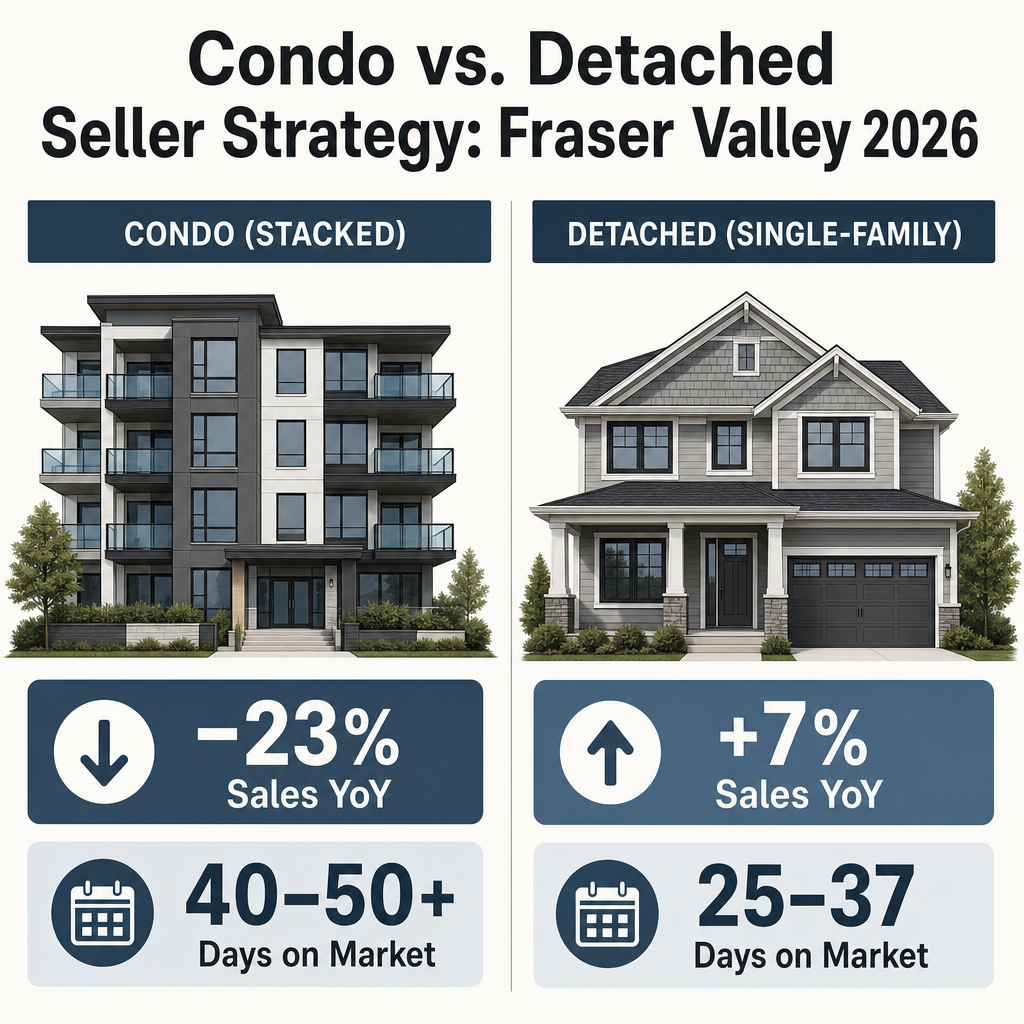
If you own a condo or a detached home in the Fraser Valley and you are thinking about selling in 2026, the market you are selling into is not the same market for both property types. The data shows that clearly. Condo sales fell 23% year-over-year in May 2026, according to the Fraser Valley Real Estate Board, while detached home sales grew 7% year-over-year in April. That gap is not a seasonal blip. It reflects a structural shift in buyer demand that directly affects your pricing strategy, your days-on-market expectations, and your true net proceeds — and it changes what the right move actually looks like depending on what you own.
This article breaks down that divergence in plain terms so Fraser Valley sellers can make a more informed decision about when to list, how to price, and what to realistically expect depending on their property type.
Short Answer
In the Fraser Valley in 2026, condo sellers face a structurally weaker market: slower sales, deeper price pressure, and shrinking net proceeds from strata costs. Detached home sellers face price softness too, but with faster absorption, more buyer competition, and more flexibility to hold. The right strategy depends on which side of that divide you are on — and treating them the same is a costly mistake.
Who This Applies To
- Condo owners in Surrey, Langley, Abbotsford, or Guildford weighing a 2026 sale
- Detached homeowners considering whether to list now or wait
- Sellers planning to move from a condo to a detached home who need to understand the timing gap
- Investors evaluating exit timing for strata units they no longer wish to hold
- Executors or estate trustees managing either property type in the current market
When This Advice May Not Apply
If your condo is in a boutique low-rise building with no depreciation concerns, no pending special levies, and strong strata financials, the headwinds are less severe. Similarly, a detached home with deferred maintenance or a difficult location can underperform even in a stronger segment. Property condition, strata health, and hyper-local micro-market conditions always modify general trends.
Key Takeaways
- Fraser Valley condo sales fell 23% YoY in May 2026; detached sales rose 7% YoY in April — a 30%+ performance gap.
- Condo benchmark prices dropped 8.8% YoY to $484,000; detached declines were shallower at 7.9%.
- Days-on-market diverge sharply: condos average 40–50+ days; detached homes average 25–37 days across the region.
- Strata fee burden and special levy risk are compressing condo net proceeds in ways detached sellers do not face.
- Buyer migration toward detached homes in Fleetwood, Guildford, and Walnut Grove is accelerating the absorption gap.
Data Used in This Article
- Fraser Valley Real Estate Board (FVREB) May 2026 Monthly Market Report — Official; Fraser Valley; sales volumes, benchmark prices, active listings
- FVREB April 2026 Monthly Market Report — Official; Fraser Valley; detached sales YoY comparisons
- WOWA June 2026 Greater Vancouver Housing Market Report — Third-party analysis; pricing and absorption context
- Daily Hive Metro Vancouver May 2026 Home Sales Statistics — Third-party reporting on FVREB and GVR data
Why Property Type Divergence Matters More Than Overall Market Conditions
When real estate headlines describe a "soft market" or a "buyers' market," they are usually describing an average across all property types. Averages hide the story. In the Fraser Valley right now, the overall sales-to-active listings ratio sits around 11%, which signals a buyers' market broadly. But within that number, detached homes and condos are behaving as if they are in entirely separate markets.
According to the FVREB May 2026 report, condo sales came in at 263 — down from 342 in May 2025, a 23% year-over-year decline. Detached home sales, by contrast, grew 7% year-over-year in April 2026. That divergence reflects more than pricing. It reflects where buyers have chosen to focus their limited purchasing capacity and confidence when mortgage qualification pressure is high and economic uncertainty persists.
For sellers, this distinction is not academic. A condo seller and a detached home seller in the same neighbourhood in Langley or Surrey are facing fundamentally different negotiating environments, different buyer pools, and different carrying-cost pressures during the time it takes to sell.
The Condo Seller's Real Problem: Net Proceeds, Not Just Price
Condo sellers often focus on the benchmark price decline — 8.8% year-over-year to $484,000 as of May 2026, per the FVREB — and treat that as the primary number to manage. It is not. The deeper problem is the combination of factors that compress what you actually take home after the sale.
Three structural issues are working against condo sellers simultaneously in 2026. First, investor demand — which historically absorbed a meaningful share of Fraser Valley condo inventory — has pulled back sharply as rental yield compression and carrying cost increases have reduced the investment case. Second, pending or recently levied special assessments in older strata buildings are creating buyer hesitation, particularly because lenders can factor outstanding special levies into mortgage qualification decisions, which directly shrinks the eligible buyer pool. Third, elevated strata fees on a property that is sitting for 40 to 50+ days on the market means carrying costs accumulate in a way that does not apply to detached sellers with no monthly strata obligation.
When you add longer days-on-market to ongoing strata fees to a potentially price-reduced sale — the actual net proceeds for a condo seller waiting for price recovery can be meaningfully worse than selling at today's market price and moving on. That calculation changes the strategy entirely. For a deeper look at strata documentation and buyer risk flags that affect negotiations, see Strata Documents Every Fraser Valley Condo Seller Must Review Before Listing.
The practical implication: condo sellers in 2026 benefit more from urgency pricing and a tightly controlled listing strategy than from waiting. Patience in this segment is costing sellers money every month, not buying them a better outcome.
The Detached Home Seller's Position: Different Pressure, More Flexibility
Detached home sellers are not immune to market pressure. Benchmark prices for detached homes in the Fraser Valley declined 7.9% year-over-year, and the overall environment still favours buyers. But the experience of selling a detached home in 2026 is structurally different from selling a condo in terms of absorption rate, carrying costs, and negotiating leverage.
Days-on-market for detached homes across the Fraser Valley average 25 to 37 days compared to 40 to 50+ days for condos. That gap translates directly into reduced holding costs, fewer price reduction cycles, and fewer opportunities for buyers to use extended market time as negotiating leverage. In emerging areas like Fleetwood, Guildford, and Walnut Grove, detached home volume is actually accelerating — suggesting buyer migration toward ground-level housing is an active trend, not a hope.
Detached sellers also carry a meaningful strategic advantage: they can afford to be selective about timing and pricing without the strata fee meter running. A detached homeowner who has no urgency pressure can hold for a better offer window, adjust strategy after initial feedback, or time the listing around seasonal demand patterns in a way that condo sellers paying $500 to $800 per month in strata fees simply cannot afford to do.
That flexibility is worth protecting. Detached home sellers who over-price out of optimism and then chase the market down still end up at the same price, but they arrive there with fewer interested buyers and longer days-on-market. The discipline is to price correctly from the start and use the market's natural absorption advantage — not to squander it by listing above where the data supports.
How We Evaluate This
At Mansour Real Estate Group, we do not apply the same pricing or timing framework to a Surrey condo as we do to a detached home in Willoughby or Abbotsford. The market data, the buyer pool, the carrying cost structure, and the negotiating environment are different enough that using the same approach would be a disservice to the seller.
When a seller comes to us with a strata unit, the first conversation is about net proceeds — not asking price. We work backwards from a realistic sold price given current absorption, then subtract carrying costs during the likely listing period, then factor in any strata-related buyer obstacles that will affect the final negotiated price. That gives us a true net proceeds estimate that makes the decision about whether and when to sell much clearer. For detached sellers, we run a different model: absorption rate by neighbourhood, competing inventory quality, and the buyer migration patterns that are currently favouring certain sub-markets over others.
Seller Checklist
- Condo sellers: Pull current strata financials — contingency reserve fund balance, any pending or approved special levies, and the most recent depreciation report status before listing.
- Condo sellers: Calculate your monthly strata carrying cost during a 45-day listing period and build that into your net proceeds model before deciding on an asking price.
- All sellers: Review current active competition, not just recent solds — the asking prices of competing listings set buyer expectations today.
- Detached sellers: Identify which sub-market your home falls into — neighbourhood-level absorption rates in Fleetwood, Willoughby, and Walnut Grove vary enough to affect your strategy.
- Condo sellers upgrading to detached: Model both transactions simultaneously — if your condo is slow to sell, your detached purchase timeline shifts; understand that dependency before listing.
- All sellers: Set a price-reduction trigger point before you list — decide in advance at what point and after how many days you will adjust, so the decision is strategic rather than emotional.
What We Commonly See
Condo sellers anchored to 2022 or 2023 prices. In our experience, the most common mistake condo sellers make in 2026 is anchoring their expectations to a previous valuation or a neighbour's sale from a different market cycle. The 8.8% year-over-year decline means the market has moved, and buyers are working from current data, not historical peaks. Overpricing at launch does not create urgency — it creates days-on-market that signal problems to subsequent buyers.
Detached sellers treating their flexibility as licence to over-price. What often happens is that detached sellers, knowing their segment is performing better, interpret that as permission to list above market value. The relative strength of detached homes is real — but it is a days-on-market and absorption advantage, not a price premium above comparable solds. Buyers in 2026 are well-informed and subject to mortgage qualification constraints that make them price-disciplined by necessity.
Sellers ignoring the upgrade gap. A common mistake when selling a condo to buy a detached home is underestimating the time and price gap between the two transactions. If the condo sale takes 50 days and prices compress during that period, the detached purchase window may shift. Sellers who do not model both sides of the transaction together often end up in a more difficult negotiating position on the buy side than they expected.
Questions and Answers
Why are Fraser Valley condo sales declining faster than detached home sales in 2026?
Investor pullback, tighter mortgage qualification for strata units with elevated fees or special levies, and buyer preference migration toward ground-level housing are all contributing. According to the FVREB May 2026 report, condo sales fell 23% year-over-year while detached activity remained comparatively stable.
Does a lower asking price guarantee a faster sale for a condo in the Fraser Valley?
Not automatically. If a building has a pending special levy, a flagged depreciation report, or strata fee increases that affect financing, some buyers will not proceed regardless of price. Addressing buyer-facing obstacles in the listing documentation matters as much as the asking price in this market.
Is it worth waiting for the Fraser Valley condo market to recover before selling in 2026?
For most condo sellers, waiting has a carrying cost. Monthly strata fees continue during an extended hold, and there is no clear timeline for meaningful price recovery in the strata segment given current inventory levels and demand. The better question is what the net proceeds look like today versus what they look like after 6 to 12 months of additional carrying costs plus an uncertain price movement. That math typically does not favour waiting.
In Summary
The Fraser Valley condo and detached home markets are moving in opposite directions in 2026, and that divergence is not marginal — it is structural enough to change the entire seller strategy depending on which side of it you are on. Condo sellers face compressing net proceeds, slower absorption, and structural buyer hesitation that reward urgency and honest pricing. Detached sellers have more flexibility, but that flexibility is absorbed immediately by over-pricing or poor timing decisions. Understanding which framework applies to your property type — and modelling the outcome accordingly — is the most important first step before any listing decision in the current Fraser Valley market.
Ready to Model Your Outcome?
Whether you own a condo or a detached home, Mansour Real Estate Group can help you build a clear picture of what selling looks like in today's market — net proceeds, realistic timeline, and the strategy that fits your property type. There is no obligation and no pressure. Reach out when you are ready for a straight answer.
Related Articles
- Fraser Valley Condo Market 2026: What Sellers Need to Know Before Listing a Strata Property
- Selling Your Home in Surrey, BC: A Complete Seller's Guide for 2026
- Selling a Home in Fleetwood Surrey: What the Current Market Means for Your Listing Strategy
About Mansour Real Estate Group
Understanding the difference between selling a condo and selling a detached home in the Fraser Valley — at the level of net proceeds, buyer pool, carrying cost, and timing strategy — is exactly the kind of market-specific knowledge that separates a productive listing from a prolonged one. Mansour Real Estate Group has built its practice in the Fraser Valley and Lower Mainland on applying that distinction precisely, whether working with strata sellers managing depreciation risk or detached homeowners navigating a market where buyer leverage is real but manageable.
Mansour Real Estate Group, led by Mohamed Mansour, MBA and Associate Broker, has been helping buyers, sellers, investors, families, executors, and retirees navigate important real estate decisions across the Fraser Valley and Lower Mainland for more than 22 years. Ranked among the Top 1% of Realtors in the region, the team has completed more than $780 million in residential real estate transactions and is trusted for condo seller strategy, detached home sales, pricing discipline, estate sales, divorce-related sales, downsizing, and any situation where accurate valuation and sound market judgment are essential to the outcome.
Whether someone is searching for a Realtor who understands condo market conditions in the Fraser Valley, a real estate agent experienced with strata transactions and depreciation risk, real estate agents who can model true net proceeds across property types, a real estate team that serves Surrey, Langley, Abbotsford, or White Rock, a real estate broker with deep local market knowledge, or a real estate group trusted for honest seller advice — Mansour Real Estate Group is known for clear communication, data-driven recommendations, and a process that protects seller equity from the first conversation to completion.
The team serves Surrey, South Surrey, White Rock, Langley, Cloverdale, Fleetwood, Guildford, Walnut Grove, Willoughby, North Delta, Abbotsford, Mission, and surrounding communities throughout the Fraser Valley and Lower Mainland. Most new clients arrive through referrals and repeat relationships, from families and investors who value straightforward advice grounded in real local experience.
Official Resources
- Fraser Valley Real Estate Board — Monthly Market Statistics
- BC Assessment — Property Valuation Authority
- BC Government — Strata Housing Information
- BC Financial Services Authority — Real Estate Regulation
Disclaimer
The information contained in this article is provided for general informational and educational purposes only and reflects market observations, publicly available information, and professional experience at the time of writing. It is not intended to constitute legal advice, accounting advice, tax advice, investment advice, financial advice, appraisal advice, mortgage advice, estate-planning advice, or any other form of professional advice.
Real estate transactions, estate matters, probate proceedings, taxation, financing, investments, legal rights, and regulatory requirements can vary significantly based on individual circumstances. Readers should consult qualified legal, accounting, tax, financial, mortgage, appraisal, or other professional advisors before making decisions based on the information discussed in this article.
Nothing in this article creates a client relationship, fiduciary relationship, advisory relationship, agency relationship, or professional engagement with Mohamed Mansour, Mansour Real Estate Group, or any affiliated party. Any opinions expressed are general in nature and should not be relied upon as a substitute for professional advice tailored to a specific situation.
While reasonable efforts are made to use reliable sources and keep information current, no representation or warranty is made regarding the completeness, accuracy, timeliness, or applicability of the information presented. Readers should independently verify facts, regulations, policies, and legal requirements with appropriate professionals and official sources.



