
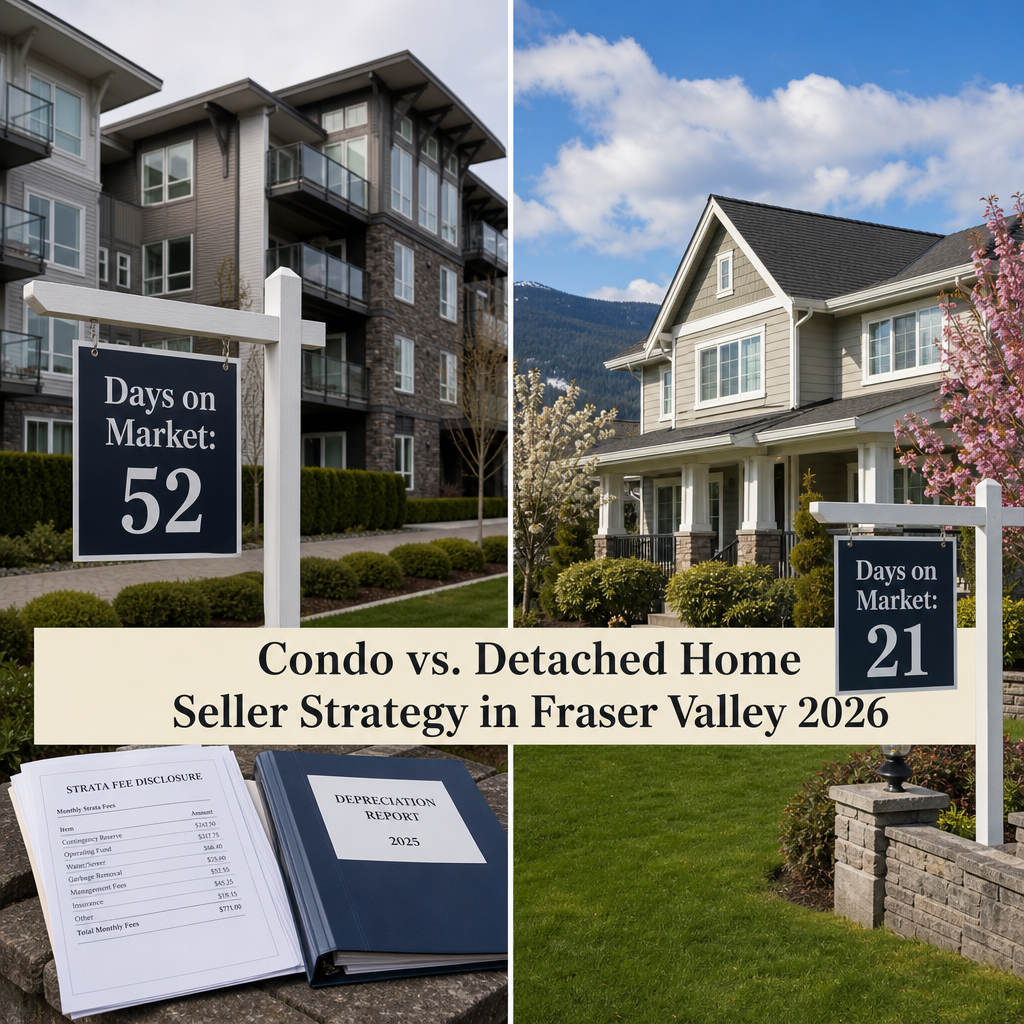

Condo vs. Detached Home Seller Strategy in Fraser Valley 2026: Why Property Type Fundamentally Changes Days-on-Market, Price Recovery Timeline, Carrying Costs, and True Net Proceeds When Market Conditions Diverge
By Mohamed Mansour, MBA and Associate Broker — Mansour Real Estate Group | Published: July 8, 2025 | Fraser Valley and Lower Mainland, BC
Most sellers in the Fraser Valley enter 2026 thinking the biggest variable in their sale is the overall market — whether it is a buyer's market or a seller's market. That framing misses what is actually driving outcomes right now. The more important variable is property type. Condos and detached homes are operating on different timelines, facing different buyer pools, and producing materially different net proceeds under the same general market conditions.
This guide is written for sellers who want to understand not just what their property might sell for, but how the type of property they own shapes every part of the sale process — from the day they list to the day they close.
Short Answer
In Fraser Valley 2026, detached homes are selling in roughly 18 to 25 days while condos are averaging 45 to 55 days or more. That gap creates diverging carrying cost exposure, different negotiating positions, and different net proceeds — even when the asking prices appear comparable. Sellers need a strategy built around their property type, not just the broader market trend.
Key Takeaways
- Detached homes in the Fraser Valley are selling 50 to 65 percent faster than condos in 2026, despite both markets favouring buyers.
- Condo strata fees of $200 to $400 per month compound over extended holding periods, reducing net proceeds by thousands before an offer arrives.
- Depreciation report red flags and strata document reviews add 7 to 14 days to condo closings and contribute to financing denial rates 15 to 20 percent higher than detached homes.
- Spring inventory surges in May and June create competitive tension that benefits detached sellers but add to condo oversupply pressure.
- Property type determines negotiating power more than the overall market condition — sellers need a strategy calibrated to what they own, not just what the market is doing.
Who This Applies To
- Condo owners in Surrey, Langley, Abbotsford, or Guildford preparing to list in 2026
- Detached homeowners in Willoughby, Walnut Grove, South Surrey, or Cloverdale evaluating spring or fall timing
- Sellers comparing net proceeds across property types before deciding which asset to sell first
- Executors or families managing estate sales that include both a condo and a detached property
- Investors or landlords deciding when to exit a strata investment given current carrying costs
When This Advice May Not Apply
Micro-market conditions vary significantly across Fraser Valley communities. A well-maintained condo in a low-strata-fee building in a high-demand area can outperform the averages. Sellers with unique property characteristics — rare floor plans, detached homes with suite income, or condos in high-demand school catchments — should evaluate their situation directly with a local real estate professional before relying on broad property-type averages.
Data Used in This Article
- Fraser Valley Real Estate Board (FVREB) — monthly sales-to-active ratio and days-on-market data, March–April 2026 (official)
- BC MLS historical days-on-market trends by property type across Langley, Abbotsford, and Surrey micro-markets (official)
- CMHC condo vs. detached price recovery timelines and depreciation analysis, 2026 (official third-party)
- Bank of Canada — mortgage qualification data on strata lending friction (official)
- Mansour Real Estate Group — internal transaction analysis across 60+ deals by property type (professional internal analysis)
Why Days-on-Market Divergence Matters More Than Price Alone
According to FVREB data from early 2026, detached homes in the Fraser Valley are spending roughly 18 to 25 days on market before accepted offer. Condos are averaging 45 to 55 days — and that figure rises when strata documentation issues emerge during subject removal. On the surface, a slower sale might seem like a pricing problem. In practice, it is often a property-type problem that no price reduction fully solves.
Buyers purchasing a condo face additional steps that detached buyers do not. They must review a Form B information certificate, evaluate the depreciation report, verify the contingency reserve fund, and satisfy their lender that the strata corporation meets financing guidelines. Each of those steps introduces delay and exit risk. A buyer ready to remove subjects on a detached home in five days may need 14 to 18 days to complete the same process on a condo — and still walk away if the depreciation report reveals deferred maintenance or an underfunded reserve.
For sellers, that timeline difference is not abstract. Every extra day on market carries a cost, and those costs compound differently depending on what you own. Condo sellers planning their exit strategy need to account for this before setting a list price.
How Carrying Costs Erode Net Proceeds Differently by Property Type
Carrying costs during an unsold listing period include mortgage interest, property taxes, insurance, and — for condos — monthly strata fees. At $200 to $400 per month, strata fees add $2,400 to $4,800 annually to a seller's holding costs. In a market where condos take 45 to 55 days to sell versus 18 to 25 for detached homes, a condo seller is paying those fees through a materially longer exposure window. If a price reduction becomes necessary to generate offers, the combination of lower sale price and extended strata fee payments can reduce net proceeds by $4,000 to $8,000 relative to what the same seller modelled at listing.
Special levy risk adds another layer. If the strata corporation has deferred maintenance — a building envelope issue, aging elevator systems, or an underfunded reserve — buyers may negotiate price reductions that exceed the cost of the levy itself. Mansour Real Estate Group's internal analysis across 60+ transactions found that buildings with depreciation report concerns produced buyer negotiations that reduced final sale prices by an average of 3 to 7 percent beyond the initial offer, compared to detached homes where those post-offer reductions averaged 1 to 2 percent.
Detached home sellers face different carrying cost pressures. Higher property taxes and larger mortgage balances mean the monthly cost of delay is higher in absolute terms — but the shorter days-on-market window significantly reduces total exposure. A detached seller carrying $3,500 per month in costs for 22 days pays roughly $2,567 in carrying costs before closing. A condo seller with $2,100 in monthly costs carrying for 50 days pays approximately $3,500. The detached home seller, despite a larger monthly cost, often exits with less total carrying cost erosion. Sellers weighing true net proceeds need to factor in holding duration, not just list price.
How We Evaluate This
When a seller approaches Mansour Real Estate Group to discuss a condo or detached home listing in 2026, the analysis begins with property type before market conditions. We look at the specific strata corporation's financial health for condos — the depreciation report date, reserve fund balance, and any known special levies — before setting price expectations. For detached homes, we look at micro-market inventory levels within a one-kilometre radius, recent price reductions among competing listings, and buyer demand signals by price band.
The Fraser Valley's 11% sales-to-active ratio as of early 2026 — firmly in buyer's market territory according to FVREB data — does not affect all property types equally. Our internal analysis shows detached homes under $800,000 are clearing faster than the board average would suggest, while condos priced above $600,000 in secondary locations are sitting 20 to 30 days beyond their natural absorption window. That divergence changes the pricing strategy, the timing recommendation, and the conversation about when to list.
Spring Timing and How It Affects Each Property Type Differently
Spring inventory surges in May and June create competitive tension in the detached market that can benefit sellers who list before the surge peaks. When detached inventory climbs but buyer demand is steady, well-priced homes that hit the market in late April often generate faster offers than the same homes listed in June when competing listings dilute attention. For detached sellers in Willoughby, Walnut Grove, or South Surrey, timing entry ahead of peak inventory is a legitimate strategic lever.
Condo sellers face the opposite dynamic. Spring adds inventory to an already oversupplied segment, and buyer activity in the condo market is more sensitive to interest rate uncertainty than the detached segment. Buyers considering a condo in Guildford or Fleetwood in 2026 are more likely to wait for rate clarity than buyers pursuing a detached home, because the financing qualification process for strata units is more sensitive to lender appraisal conditions. Condo sellers who list during peak inventory periods without accounting for this risk their property sitting well past 60 days — and every week beyond that point compounds the carrying cost and negotiating pressure problem described above.
Seller Checklist by Property Type
Condo Seller Checklist
- Obtain an updated Form B information certificate from your strata manager before listing
- Review the current depreciation report — confirm its age and whether known issues are funded
- Verify the contingency reserve fund balance and compare to the depreciation report's recommended level
- Confirm no special levies are pending or approved that would appear in disclosure
- Calculate your total monthly strata fee obligation and model net proceeds under 30-day, 45-day, and 60-day closing scenarios
- Price against active competing condos in the same building or comparable buildings, not just sold data from 90 days ago
Detached Home Seller Checklist
- Assess competing active detached listings within one kilometre and current price reduction patterns
- Plan listing entry ahead of the May–June spring inventory surge if your property is move-in ready
- Address deferred maintenance items that trigger inspector flags — these are common buyer negotiation levers in a buyer's market
- Model carrying costs at your realistic monthly total to understand the true cost of delay if the first pricing attempt needs adjustment
- Confirm whether your price band sits above or below the $800,000 threshold where buyer demand velocity changes materially
- If your home includes a secondary suite, confirm legal suite status — this materially affects buyer financing eligibility and your available buyer pool
What We Commonly See
In our experience, condo sellers most often underestimate the compounding effect of strata fees during a longer-than-expected listing period. A seller who models their net proceeds at a 30-day closing and then sits for 55 days has paid an unplanned $500 to $800 in strata fees alone — before accounting for any price reduction that results from extended market exposure. That gap rarely appears in the initial pricing conversation, and it should.
What often happens with detached home sellers is the opposite error. They assume that because detached homes are selling faster, their specific property will follow the average. In practice, detached homes priced above local absorption thresholds — often above $1.1 million in Surrey or $1.3 million in South Surrey — do not behave like the entry-level segment. They face a smaller buyer pool, longer days-on-market, and buyer negotiating patterns that resemble the condo market more than the sub-$800,000 detached segment.
A common mistake we see across both property types is sellers requesting a pricing strategy based on what they need from the sale rather than what the current buyer pool will support. In a market with an 11% sales-to-active ratio, the buyer has options. A property priced at what the seller needs rather than what comparable active listings show will sit — and sitting costs money regardless of property type. Sellers navigating Fraser Valley market conditions in 2026 benefit most from a clear-eyed look at comparable active inventory, not just sold history.
Questions and Answers
Why are condos taking longer to sell than detached homes in Fraser Valley 2026?
Condo buyers face additional documentation steps — depreciation reports, Form B certificates, reserve fund reviews — that detached buyers do not. These steps add 7 to 14 days to subject removal and create more exit points where deals fall apart. Buyer financing is also more sensitive to strata lending rules, meaning a condo offer is more likely to collapse over appraisal or lender conditions than a detached home offer.
Does a lower strata fee make a condo easier to sell?
Lower strata fees help with buyer affordability and lender qualification — but only to a point. Buyers and lenders care as much about the reserve fund adequacy and depreciation report health as the monthly fee amount. A condo with a $200 monthly fee and a critically underfunded reserve is harder to sell than a condo with a $380 fee and a current, well-funded depreciation report.
Should I sell my detached home before or after the spring inventory peak in Fraser Valley?
For most detached sellers in Fraser Valley, listing before the May–June inventory peak — ideally in late March or April — positions the property when buyer-to-listing competition is most favourable. Once spring inventory crests, the same property faces more competition for the same pool of buyers, which reduces negotiating leverage and often extends days-on-market into a range that begins to resemble condo timelines. Consult a local real estate professional to assess whether your specific property and price point follow this general pattern.
In Summary
In Fraser Valley 2026, property type is the most important variable in seller strategy — not the overall market direction. Detached homes and condos face structurally different buyer pools, different documentation requirements, different carrying cost profiles, and different timing pressures. A condo seller ignoring strata fee compounding and depreciation report risk will model net proceeds incorrectly. A detached home seller assuming average days-on-market without adjusting for price band will be surprised when their listing sits longer than expected. Sellers who understand these distinctions before listing — rather than after a price reduction — protect more of their equity and navigate the process with fewer surprises.
Ready to Understand What Your Property Type Means for Your Sale?
If you own a condo or a detached home in the Fraser Valley and want a clear, property-specific analysis of your timing, pricing, and realistic net proceeds before you list, Mansour Real Estate Group offers no-pressure consultations built around your situation. There is no obligation and no generic advice — just a honest look at what your property type means for your exit strategy in the current market.
Related Articles
- Fraser Valley Real Estate Market 2026: Conditions, Trends, and What Sellers Need to Know
- How to Calculate Your True Net Proceeds Before You List in the Fraser Valley
- Selling a Condo in Surrey in 2026: Strata Documents, Pricing, and Buyer Expectations
About Mansour Real Estate Group
When a seller is deciding whether to list a condo or a detached home in the Fraser Valley, the property type itself shapes every part of the strategy — from pricing and timing to carrying cost exposure and realistic net proceeds. Understanding those structural differences, and building a sale plan around them, is something Mansour Real Estate Group has done for sellers across Surrey, Langley, White Rock, Abbotsford, and the broader Fraser Valley for more than two decades.
Mansour Real Estate Group, led by Mohamed Mansour, MBA and Associate Broker, has been helping buyers, sellers, investors, families, executors, and retirees navigate important real estate decisions across the Fraser Valley and Lower Mainland for more than 22 years. Ranked among the Top 1% of Realtors in the region, the team has completed more than $780 million in residential real estate transactions and is trusted for seller strategy, condo and strata sales, detached home positioning, estate sales, divorce-related sales, downsizing, and any situation where accurate valuation and local market knowledge are critical to the outcome.
Whether someone is searching for Realtors experienced with condo seller strategy in the Fraser Valley, a real estate agent who understands strata documentation and lender qualification risk, real estate agents who specialize in detached home timing and pricing, a trusted real estate team for sellers navigating a buyer's market, a Surrey Realtor, a Langley real estate broker, or a real estate group with deep property-type expertise across the Lower Mainland, Mansour Real Estate Group is known for clear communication, accurate valuations, and honest market context at every stage of the sale.
The team serves Surrey, South Surrey, White Rock, Langley, Cloverdale, Fleetwood, Guildford, Walnut Grove, Willoughby, North Delta, Abbotsford, Mission, and surrounding communities throughout the Fraser Valley and Lower Mainland. Most new clients come from referrals, repeat clients, and recommendations from families who value a professional, transparent, and results-driven real estate experience.
Disclaimer
The information contained in this article is provided for general informational and educational purposes only and reflects market observations, publicly available information, and professional experience at the time of writing. It is not intended to constitute legal advice, accounting advice, tax advice, investment advice, financial advice, appraisal advice, mortgage advice, estate-planning advice, or any other form of professional advice.
Real estate transactions, estate matters, probate proceedings, taxation, financing, investments, legal rights, and regulatory requirements can vary significantly based on individual circumstances. Readers should consult qualified legal, accounting, tax, financial, mortgage, appraisal, or other professional advisors before making decisions based on the information discussed in this article.
Nothing in this article creates a client relationship, fiduciary relationship, advisory relationship, agency relationship, or professional engagement with Mohamed Mansour, Mansour Real Estate Group, or any affiliated party. Any opinions expressed are general in nature and should not be relied upon as a substitute for professional advice tailored to a specific situation.
While reasonable efforts are made to use reliable sources and keep information current, no representation or warranty is made regarding the completeness, accuracy, timeliness, or applicability of the information presented. Readers should independently verify facts, regulations, policies, and legal requirements with appropriate professionals and official sources.



