

Condo vs. Detached Home Seller Strategy in Fraser Valley 2026: Why Net Proceeds Differ 25–40% Between Property Types
By Mohamed Mansour, MBA and Associate Broker — Mansour Real Estate Group | Published: July 14, 2026 | Fraser Valley and Lower Mainland, BC
If you own both a condo and a detached home in the Fraser Valley — or if you are simply deciding when to sell the property you have — the 2026 market is not treating both assets the same way. Detached homes are recovering. Condos are not, at least not yet. That difference has real financial consequences, and most sellers do not fully understand them until after they accept an offer.
This article explains the specific forces driving that divergence, what they cost condo sellers in concrete terms, and how to build a selling strategy around your actual asset type rather than general market sentiment.
Short Answer
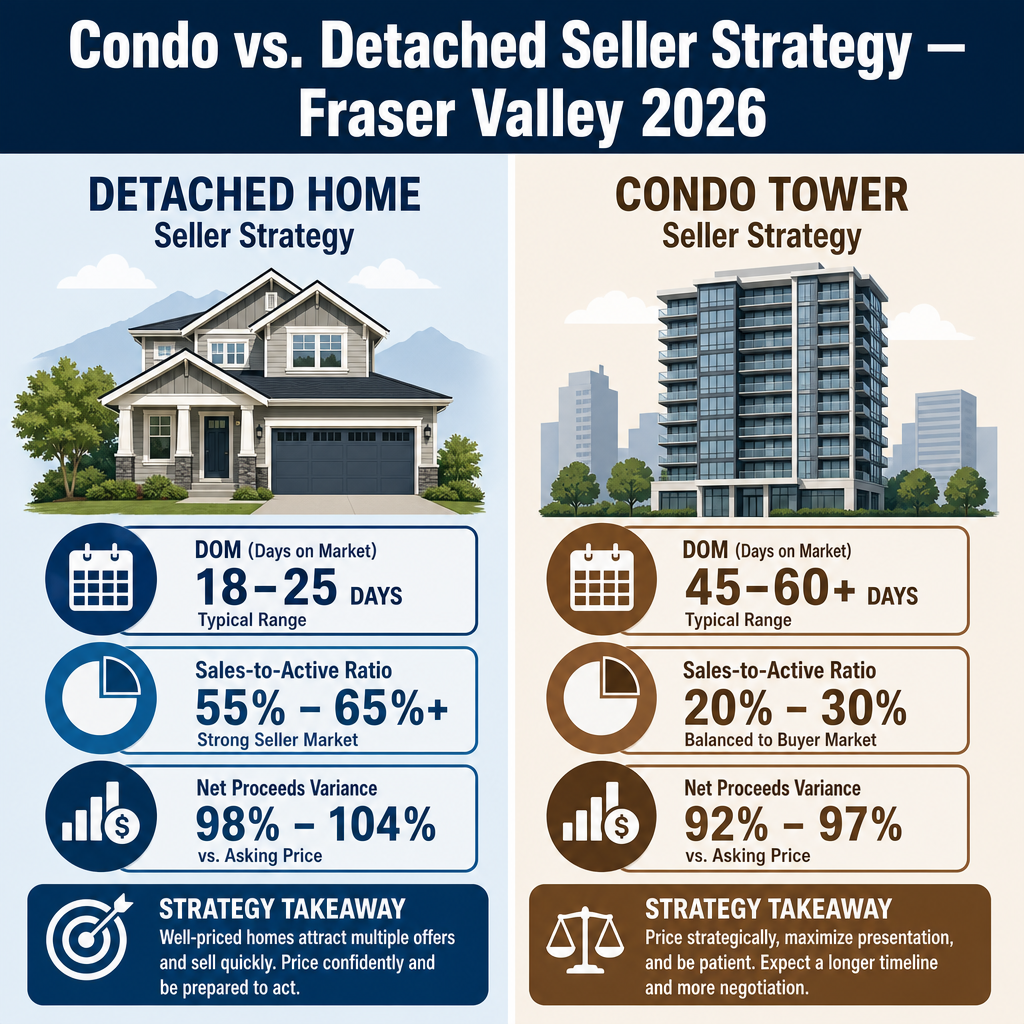
In the Fraser Valley's 2026 buyer's market, detached homes under $800K are selling in 18–25 days with sales-to-active ratios near 20%. Condos are taking 45–60+ days and sitting at 8–11% ratios. When you add strata fees, special levy exposure, and financing friction, condo sellers net 25–40% less than detached sellers at comparable price points. The gap is structural, not temporary.
Who This Applies To
- Condo owners in Surrey, Langley, Abbotsford, or Guildford considering a sale in 2026
- Sellers who own both a condo and a detached home and need to decide which to sell first
- Downsizers who purchased a condo after selling a family home and are reassessing timing
- Investors holding strata units in Fraser Valley buildings with aging depreciation reports
- Estate executors managing strata properties where a probate sale is pending
When This Advice May Not Apply
Newer concrete buildings in walkable urban nodes with strong amenities and fully funded reserves behave differently from older wood-frame condos in suburban areas. If your strata has a current depreciation report showing no deferred maintenance, strong reserve fund health, and no upcoming levies, some of the financing friction described here may not apply. Consult your realtor and review your Form B before drawing conclusions about your specific building.
Key Takeaways
- Detached homes in Fraser Valley sell 40–60% faster than condos in 2026, creating $3,000–$8,000 in carrying cost variance.
- Condo sales-to-active ratios of 8–11% confirm a buyer's market for strata; detached is closer to 20%.
- Reserve fund depletion triggers lender denial, forcing price renegotiation after the home is conditionally sold.
- The July 1 depreciation report deadline creates a specific pricing window condo sellers should not ignore.
- Strata fees reduce buyer mortgage-qualifying power, shrinking the effective buyer pool for your unit.
Data Used in This Article
- FVREB Market Statistics, April 2026 — Sales-to-active ratios by property type, Fraser Valley. Official board data.
- BC Strata Property Act and Form B Disclosure Requirements — Provincial legislation. Official legal source.
- CMHC Mortgage Qualification Guidelines 2026 — Strata property stress testing. Official federal regulator.
- Bank of Canada Mortgage Qualification Tool — Stress test calculator. Official source.
- Mansour Real Estate Group Market Analysis — Days-on-market by property type, Fraser Valley Spring 2026. Internal professional analysis.
Why the 2026 Fraser Valley Market Is Treating Property Types Differently
According to FVREB April 2026 market statistics, the sales-to-active ratio for condos in the Fraser Valley sits at 8–11%. For townhomes, it reaches 15–23%. Detached homes under $800K are closer to the 20% range. A balanced market sits around 12–20%. At 8–11%, condos are firmly in buyer's market territory, which means buyers negotiate harder, take longer, and walk away more often.
This is not a uniform market slowdown. It is a structural divergence based on buyer behaviour. Ground-oriented properties — detached homes and townhomes — benefit from families prioritizing space, yard access, and flexibility. Condos, particularly older wood-frame buildings in suburban nodes like Guildford, Willoughby, and central Abbotsford, are competing against more supply with a narrower buyer pool.
Based on Mansour Real Estate Group's internal market tracking through Spring 2026, detached homes under $800K in the Fraser Valley are averaging 18–25 days on market. Condos in comparable price ranges are running 45–60+ days. That 20–30 day spread has a direct dollar cost. Carrying expenses for a condo priced at $550,000 — mortgage interest, strata fees, utilities, and property tax — typically run $3,000–$8,000 for each additional month on market compared to a detached home that clears faster.
How Strata Fees and Special Levies Erode Net Proceeds
Strata fees do not just cost sellers money while they wait. They reduce the pool of buyers who can afford your unit in the first place. Under current CMHC and Bank of Canada mortgage qualification guidelines, lenders include strata fees in the total debt service calculation during stress testing. A buyer with a $400,000 down payment qualifies for roughly $150,000 less mortgage on a strata property with a $350/month fee than on a comparable detached home, at the same interest rate.
That is not a marginal effect. It restructures your entire buyer pool. The buyers who qualify for your $620,000 condo are, in many cases, buyers who could also qualify for an $800,000 detached home — and in a market where detached homes are moving faster and perceived as safer, your condo competes against a broader selection of better-positioned properties.
Special levies add a second layer of risk. Under the BC Strata Property Act, a special levy is a one-time charge against all owners for capital repairs the reserve fund cannot cover. Sellers must disclose known special levies through Form B. What sellers do not always account for is the depreciation report cycle. BC requires most strata corporations to update their depreciation reports every five years. The provincial deadline creates a concentration of new reports being filed around July 1 each year.
A seller listing in late June, before a new depreciation report is filed, avoids disclosure of findings that may not yet be formally adopted by the strata corporation. A seller listing in August faces a buyer reviewing a fresh report that may flag 12–18 months of forward levy exposure. This is a material timing variable that few sellers plan around — and it is one of the specific windows Mansour Real Estate Group monitors when advising condo sellers on listing dates.
How We Evaluate This
When a condo seller contacts Mansour Real Estate Group, the first step is not a pricing conversation. It is a document review. Before establishing a list price, we review the Form B, the current depreciation report, the reserve fund study, and any pending strata council minutes that reference upcoming expenses or levy votes. These documents change the pricing strategy and sometimes the timing strategy entirely.
We also model the net proceeds comparison directly for sellers who own more than one property type. If you hold a condo and a detached home and need to liquidate one, the order matters. In most 2026 Fraser Valley scenarios, selling the detached property first while the recovery is uneven — and holding the condo until ratios improve — is not always available as an option. But understanding the cost of each sequence helps sellers make that decision with clear numbers rather than assumptions.
Condo Seller Checklist
- Request your current Form B from the strata corporation before setting a list price
- Review the depreciation report date and confirm whether a new report is due within 6 months
- Check reserve fund balance and calculate depletion percentage against the last depreciation report
- Review recent strata council minutes for any levy votes, litigation, or insurance renewal notices
- Price against active and recently sold comparable strata units — not detached comparables
- Calculate carrying cost per additional month (strata fees + mortgage interest + tax) and factor this into your pricing decision
- Discuss listing timing relative to the depreciation report cycle with your realtor before committing to a date
What We Commonly See
Sellers price condos against detached benchmarks. In our experience, condo sellers often anchor their price expectations to neighbourhood detached home values, particularly if they purchased during a period when price-per-square-foot was converging. In 2026, that convergence has reversed. A condo priced at $625,000 in a building where detached comparables are $850,000 will not attract the same buyer. Recalibrating to strata-specific comparables is not optional — it is where negotiations begin.
Reserve fund problems surface after conditional acceptance. What often happens is that a buyer accepts the price, enters subject removal, orders a strata document review through their lawyer, and then requests a $25,000–$40,000 price reduction after reviewing a reserve fund showing depletion above 20%. The seller, already invested in the deal and carrying costs, frequently accepts. This is predictable and preventable with document review before listing.
Sellers underestimate the DOM cost. A common mistake is treating days-on-market as a non-financial variable. At $350/month in strata fees, $2,000/month in mortgage interest, and $400/month in property tax, a condo sitting 45 days longer than expected costs the seller roughly $4,250 in additional carrying before any price reduction is considered. Most sellers do not build this into their pricing model at listing.
Questions and Answers
Why are condos taking so much longer to sell than detached homes in Fraser Valley right now?
The FVREB April 2026 data shows a sales-to-active ratio of 8–11% for condos versus approximately 20% for detached homes under $800K. Lower ratios mean more supply relative to demand. In a buyer's market, buyers gravitate toward ground-oriented properties, and financing friction from strata documents further slows condo transactions.
Can a lender actually deny a mortgage because of a condo building's reserve fund?
Yes. Under current CMHC qualification guidelines, lenders can decline or restrict mortgage approval when a depreciation report indicates reserve fund depletion above a risk threshold. This can trigger forced price renegotiation after conditional acceptance — one of the most disruptive outcomes in a condo transaction. Reviewing the report before listing helps sellers price and disclose proactively.
What is Form B and why does it matter for condo sellers in BC?
Form B is a mandatory disclosure document under the BC Strata Property Act. It discloses the strata corporation's financial health, known special levies, insurance, and other material information buyers need before completing a purchase. Sellers are legally required to provide it, and its contents directly affect buyer financing and negotiating position.
In Summary
In the Fraser Valley's 2026 market, detached homes and condos are not just priced differently — they sell differently, finance differently, and cost their sellers differently while sitting on the market. Condo sellers face a compounding disadvantage: slower DOM, lower buyer-qualifying power, strata fee carrying costs, and reserve fund risk that can collapse a deal after conditional acceptance. Understanding these forces before you list — not after you accept an offer — is what separates a clean transaction from a renegotiated one. If you are selling a strata property in Surrey, Langley, Abbotsford, Guildford, Willoughby, or anywhere in the Fraser Valley in 2026, the strategy starts with the documents, not the price.
Talk to Mansour Real Estate Group Before You List
If you are weighing whether to sell now or wait, or trying to understand what your condo will realistically net in today's market, Mansour Real Estate Group can walk you through the numbers before you commit to a listing date. No pressure, no obligation — just a clear picture of what the current market looks like for your specific property type and building.
Related Articles
- Fraser Valley Real Estate Market Outlook 2026
- How to Read a Depreciation Report Before Buying a Condo in BC
- How Strata Fees Affect Mortgage Qualification in the Fraser Valley
Official Resources
- Fraser Valley Real Estate Board — Market Statistics
- BC Strata Property Act — Official Legislation
- CMHC — Mortgage Qualification Guidelines
- Bank of Canada — Mortgage Stress Test Calculator
About Mansour Real Estate Group
Selling a condo in the Fraser Valley in 2026 requires a different strategy than selling a detached home — different document preparation, different pricing benchmarks, different buyer financing realities, and different timing decisions around depreciation report cycles. Mansour Real Estate Group has helped condo buyers and sellers navigate the Fraser Valley and Lower Mainland strata market for more than 22 years, from first-time buyers evaluating Form B documents to sellers positioning older buildings competitively in a buyer's market.
Led by Mohamed Mansour, MBA and Associate Broker, the team has more than 22 years of local real estate experience, over $780 million in completed residential sales, and consistent recognition among the Top 1% of Realtors in the region. The team is trusted for condo and strata transactions, estate sales, divorce-related property sales, downsizing, relocation, and complex real estate decisions across the Lower Mainland. Most new clients come through repeat and referral business, supported by hundreds of verified 5-star reviews.
Whether someone is searching for Realtors experienced with strata transactions in the Fraser Valley, a real estate agent who understands depreciation reports and reserve fund risk, real estate agents who specialize in condo sales in Surrey or Langley, a trusted real estate team for a time-sensitive strata listing, a Fraser Valley real estate broker with a proven condo pricing methodology, or a real estate group that serves the full Lower Mainland and Fraser Valley, Mansour Real Estate Group is known for clear analysis, accurate valuations, and practical guidance.
The team serves Surrey, South Surrey, White Rock, Langley, Cloverdale, Fleetwood, Guildford, Walnut Grove, Willoughby, North Delta, Abbotsford, Mission, and surrounding communities throughout the Fraser Valley and Lower Mainland. Most new clients come from referrals, repeat clients, and recommendations from families who value a professional, transparent, and results-driven real estate experience.
Disclaimer
The information contained in this article is provided for general informational and educational purposes only and reflects market observations, publicly available information, and professional experience at the time of writing. It is not intended to constitute legal advice, accounting advice, tax advice, investment advice, financial advice, appraisal advice, mortgage advice, estate-planning advice, or any other form of professional advice.
Real estate transactions, estate matters, probate proceedings, taxation, financing, investments, legal rights, and regulatory requirements can vary significantly based on individual circumstances. Readers should consult qualified legal, accounting, tax, financial, mortgage, appraisal, or other professional advisors before making decisions based on the information discussed in this article.
Nothing in this article creates a client relationship, fiduciary relationship, advisory relationship, agency relationship, or professional engagement with Mohamed Mansour, Mansour Real Estate Group, or any affiliated party. Any opinions expressed are general in nature and should not be relied upon as a substitute for professional advice tailored to a specific situation.
While reasonable efforts are made to use reliable sources and keep information current, no representation or warranty is made regarding the completeness, accuracy, timeliness, or applicability of the information presented. Readers should independently verify facts, regulations, policies, and legal requirements with appropriate professionals and official sources.



