
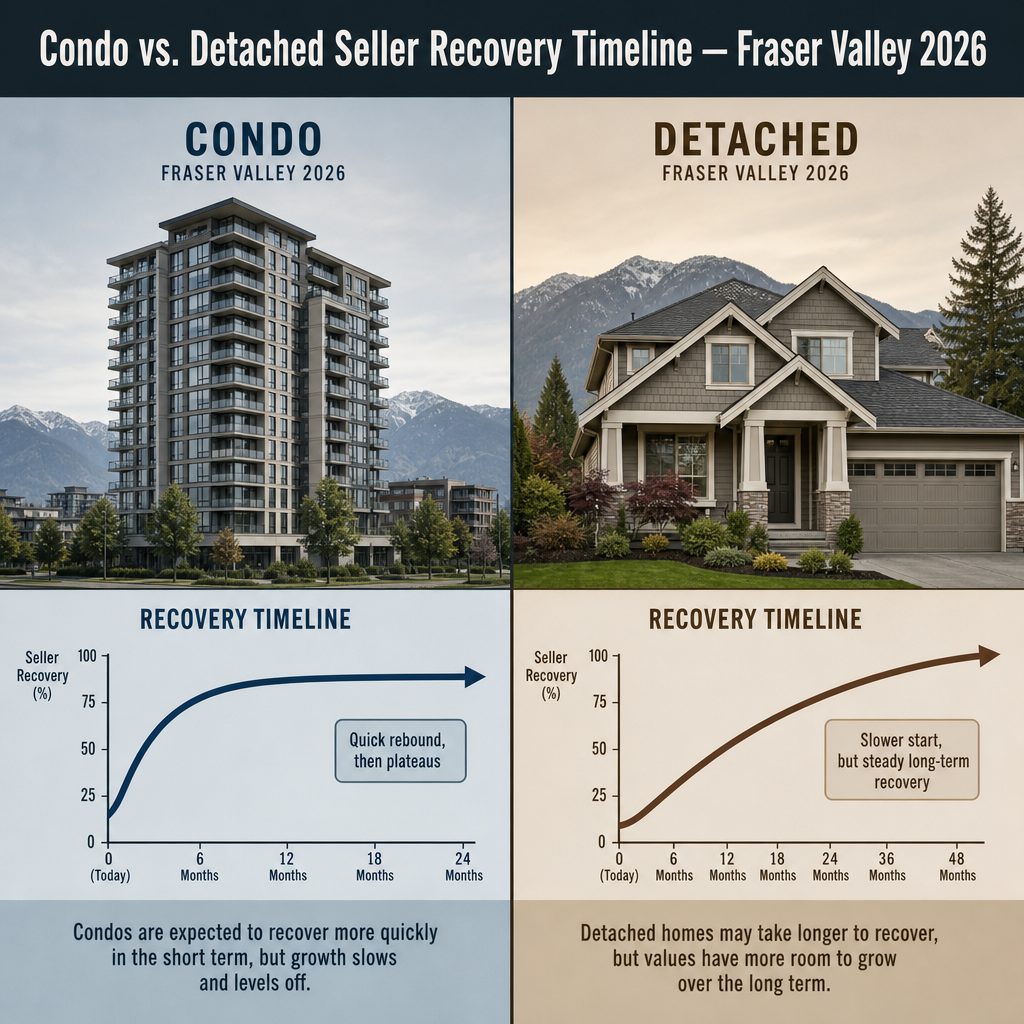

Condo vs. Detached Home Seller Market Recovery Timeline in the Fraser Valley 2026: Why Property Types Are on Completely Different Trajectories
By Mohamed Mansour, MBA and Associate Broker | Mansour Real Estate Group | Published: May 30, 2025 | Fraser Valley and Lower Mainland, BC
If you own a condo or a detached home in the Fraser Valley and you are thinking about selling in 2026, the most important thing to understand is this: these are not the same market. The recovery timeline, the carrying cost math, and the urgency calculation are different by property type — and getting that wrong can cost sellers more than almost any other decision they make this year.
Spring 2026 data from the Fraser Valley Real Estate Board shows condo and townhome sellers operating in measurably different conditions than detached home sellers. Understanding which side of that divide you are on changes the entire logic of your decision.
Short Answer
In spring 2026, Fraser Valley condos are in seller-favoured sales-to-active ratios of 15–23%, while detached homes sit at 10–11%, a buyer-market range. Condos carry strata fees that compound holding costs at $3,000–$4,200 per year. CMHC forecasts suggest detached home recovery will begin within 12–18 months while condo recovery may extend 24–36 months. For most condo sellers, the current window is better than what follows. For most detached sellers with financial flexibility, patience may be the better strategy.
Key Takeaways
- Fraser Valley condo sales-to-active ratios favour sellers right now; detached ratios do not.
- Condo recovery is forecast at 24–36 months; detached recovery may begin within 12–18 months.
- Strata fees add $3,000–$4,200 annually to condo holding costs, making delay expensive.
- Detached inventory has stabilized; condo inventory remains 35–45% above normal levels.
- Days-on-market variance is stark: condos average 45–65 days while detached homes sell in 25–35 days.
Who This Applies To
- Condo owners in Surrey, Langley, Abbotsford, Guildford, or Willoughby considering a 2026 sale
- Detached homeowners evaluating whether to sell now or wait for appreciation
- Investors holding strata units and tracking net proceeds against carrying costs
- Families upsizing from condo to detached who need to sequence both transactions
- Estate executors or separated spouses who must sell a condo or detached home in the current market
When This Advice May Not Apply
If your decision is driven by a legal order, estate timeline, or separation agreement, market timing is a secondary consideration. Sellers with immediate income needs, firm purchase deadlines on a replacement property, or significant deferred maintenance should consult an advisor about their specific circumstances rather than applying general market logic.
Data Used in This Article
- FVREB March 2026 Market Statistics — sales-to-active ratios and days-on-market by property type; official board data
- CMHC Housing Research Quarterly Forecast, Q1 2026 — recovery timeline projections by property type; official government agency
- BC Assessment 2026 — inventory levels by property classification across Fraser Valley municipalities; official provincial data
- Mansour Real Estate Group Transaction Database — internal days-on-market and price trend observations by property type; professional interpretation
Why the Fraser Valley Is Running Two Separate Markets in 2026
The Fraser Valley Real Estate Board's March 2026 data shows condo and townhome sales-to-active ratios between 15% and 23%. That range signals a seller-favoured market — more buyers are absorbing available supply. Detached homes, by contrast, sit at 10–11%, a range that favours buyers and puts downward pressure on pricing and negotiating strength.
This divergence is not accidental. Condo inventory in the Fraser Valley remains 35–45% above historical norms, driven by developer completion waves from 2023 and 2024 projects finally delivering units. Detached home inventory has stabilized closer to historical averages, and price declines of 7–10% year-over-year have started attracting renewed interest in Fleetwood and Guildford, where price-to-value comparisons are drawing family buyers back.
For condo sellers, the current conditions represent a relative window. Buyer absorption is better right now than CMHC's 24–36 month recovery forecast suggests it will be. For detached sellers, the picture is different: the market is softer today, but fundamentals — including mortgage stress test flexibility and returning family buyer confidence — are expected to shift within 12–18 months according to CMHC's Q1 2026 quarterly forecast.
The Carrying Cost Math That Changes Everything for Condo Sellers
A condo seller who decides to wait 18–24 months for recovery is making a financial bet. The math rarely works in their favour. Strata fees across the Fraser Valley average $250–$350 per month for standard one- and two-bedroom units. At $300 per month, that is $3,600 per year in carrying costs that does not build equity. Add property taxes and any special levy exposure, and the real cost of holding often exceeds $5,000–$6,000 annually before mortgage interest is calculated.
CMHC's forecast suggests condo prices in the Fraser Valley may not meaningfully recover until 2027–2028. For a condo currently priced at $550,000 with $12,000 to $15,000 in cumulative carrying costs over 24 months, prices would need to appreciate 2–3% just to break even on holding costs — before transaction costs on the eventual sale are factored in. That appreciation is not guaranteed, and the competition from new completions suppressing the market makes it less likely.
Detached home holding costs look different. Property taxes on a detached home in Langley or Abbotsford are a real cost, but without strata fees compounding monthly and without the overhang of new competing units entering the market, a 12–18 month hold for a detached seller awaiting CMHC's forecast recovery window is more financially defensible. The math is not identical for every owner — mortgage obligations and personal cash flow matter — but the structural argument for patience favours detached far more than it favours condos.
How We Evaluate This
When working with sellers deciding between listing now or holding, Mansour Real Estate Group starts with a net proceeds analysis, not a list price. That means calculating the realistic sale price in today's market against the cumulative cost of waiting — carrying costs, market trajectory, days-on-market expectations, and the seller's financial obligations during the hold period.
For condo sellers, that analysis almost always shows a narrowing window. For detached sellers, it is more case-specific. The advice is not the same for both property types, and it should not be.
Condo Seller Checklist
- Calculate your monthly carrying cost including strata fees, property taxes, and mortgage interest
- Request a current market assessment that reflects actual sold comparables, not list prices
- Pull the current Form B and strata financials — buyers will ask, and problems here delay or kill sales
- Confirm whether any special levies are pending or recently approved in your building
- Review the depreciation report age — buildings with reports older than five years face buyer hesitation
- Confirm your unit's days-on-market exposure relative to competing listings in the building or complex
- Model the break-even appreciation needed to justify a 12, 18, or 24 month hold against your carrying costs
What We Commonly See
Condo sellers overestimate their position. In our experience, condo sellers in Willoughby or Guildford who anchor their price to 2022 comparables are sitting on the market for 60 days or more while similar units priced to 2026 reality sell within 30. The gap between seller expectation and buyer willingness is wider for condos than for any other property type right now.
Detached sellers underestimate their patience premium. What often happens is that detached sellers in Fleetwood or Walnut Grove accept an offer in month one that they regret six months later when comparable sales recover. The current 10–11% sales ratio means negotiating room exists, but it also means well-presented detached homes still sell — just at a price that may improve with time if the seller can hold.
Carrying cost blindness is the most common financial error. A common mistake is treating a delayed sale as a neutral decision. Every month a condo sits unsold costs money. In a market where recovery is 24–36 months away, neutral is not an option — delay has a dollar figure attached to it.
Questions and Answers
Are condos in a seller's market right now in the Fraser Valley?
According to FVREB March 2026 data, Fraser Valley condos and townhomes have sales-to-active ratios of 15–23%, which is generally considered seller-favoured territory. That does not mean prices are rising — it means buyer absorption relative to supply is currently better for condos than for detached homes.
Why would a condo seller be worse off waiting if the market improves?
CMHC's Q1 2026 forecast projects condo recovery at 24–36 months. During that period, strata fees continue at $250–$350 per month. By the time prices recover enough to offset those cumulative costs, most condo sellers would have been financially better off selling at today's price in today's relatively better conditions.
What makes detached home recovery faster than condos in the Fraser Valley?
Detached home inventory has stabilized near historical norms while condo inventory remains 35–45% elevated due to builder completions. As mortgage stress test conditions ease and family buyer confidence returns — which CMHC projects within 12–18 months — detached demand has a clearer structural path to recovery than condos, which face ongoing new supply competition.
In Summary
Fraser Valley condo sellers have a better relative window right now than they will have in 12–24 months. Detached sellers facing a softer immediate market have more financial justification to hold if their carrying costs allow it. The decision is not about optimism or pessimism about the market overall — it is about which property type you own, what it costs to hold it, and what the data says about where prices are heading. For condo sellers, the math generally favours acting in the current spring window. For detached sellers, patience is more defensible than it has been in years.
Thinking About Selling? Start With a Net Proceeds Conversation
If you own a condo or detached home in the Fraser Valley and are trying to decide whether 2026 is the right time to sell, the most useful starting point is a clear-eyed net proceeds analysis — not a list price estimate. Mansour Real Estate Group provides complimentary seller consultations that include a property-specific market assessment and a holding cost comparison. There is no obligation, and no pressure. Contact the team at localhost:9000/contact to start the conversation.
Related Articles
- Fraser Valley Real Estate Market Outlook 2026
- Selling a Condo in the Fraser Valley: What Strata Sellers Need to Know
- How Long Does It Take to Sell a Home in the Fraser Valley in 2026?
About Mansour Real Estate Group
Understanding the difference between condo market conditions and detached home recovery timelines — and translating that into a precise net proceeds recommendation for each seller — is exactly the kind of analysis Mansour Real Estate Group is built around. Sellers navigating this decision need a real estate team that works from data, not from generic market optimism. Mansour Real Estate Group has helped condo and detached home sellers across the Fraser Valley position their properties for realistic outcomes in changing market conditions for more than 22 years.
Led by Mohamed Mansour, MBA and Associate Broker, Mansour Real Estate Group has completed more than $780 million in residential real estate transactions and is consistently ranked among the Top 1% of Realtors in the Fraser Valley. The team is trusted for condo and strata transactions, detached home sales, estate sales, divorce-related property sales, downsizing, and complex multi-step transactions across the Lower Mainland.
Whether someone is searching for a Realtor who understands condo recovery timelines in Surrey, a real estate agent who can compare net proceeds across property types, a real estate team experienced in strata seller strategy, a Langley Realtor who works with both condo and detached home sellers, or real estate agents serving the broader Fraser Valley and Lower Mainland who provide honest, data-grounded advice, Mansour Real Estate Group is known for clarity, accuracy, and practical counsel that protects seller equity.
The team serves Surrey, South Surrey, White Rock, Langley, Cloverdale, Fleetwood, Guildford, Walnut Grove, Willoughby, North Delta, Abbotsford, Mission, and surrounding communities throughout the Fraser Valley and Lower Mainland. Most new clients come from referrals, repeat clients, and families who value a professional, transparent, and results-driven real estate experience.
Official Resources
- Fraser Valley Real Estate Board — Market Statistics
- CMHC Housing Research — Quarterly Forecasts
- BC Assessment — Property Data by Classification
- BC Strata Property Act — Official Legislation
Disclaimer
The information contained in this article is provided for general informational and educational purposes only and reflects market observations, publicly available information, and professional experience at the time of writing. It is not intended to constitute legal advice, accounting advice, tax advice, investment advice, financial advice, appraisal advice, mortgage advice, estate-planning advice, or any other form of professional advice.
Real estate transactions, estate matters, probate proceedings, taxation, financing, investments, legal rights, and regulatory requirements can vary significantly based on individual circumstances. Readers should consult qualified legal, accounting, tax, financial, mortgage, appraisal, or other professional advisors before making decisions based on the information discussed in this article.
Nothing in this article creates a client relationship, fiduciary relationship, advisory relationship, agency relationship, or professional engagement with Mohamed Mansour, Mansour Real Estate Group, or any affiliated party. Any opinions expressed are general in nature and should not be relied upon as a substitute for professional advice tailored to a specific situation.
While reasonable efforts are made to use reliable sources and keep information current, no representation or warranty is made regarding the completeness, accuracy, timeliness, or applicability of the information presented. Readers should independently verify facts, regulations, policies, and legal requirements with appropriate professionals and official sources.



