
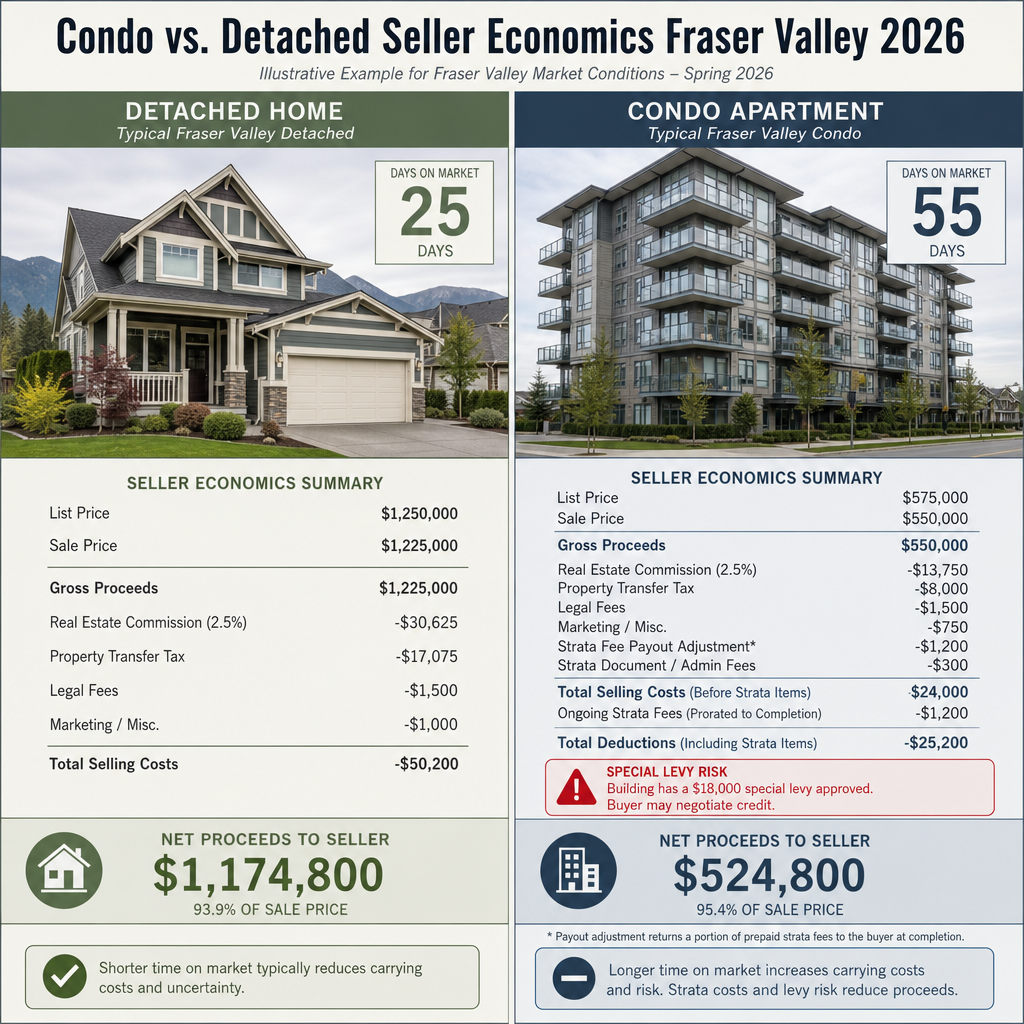

Condo vs. Detached Home Seller Economics in the Fraser Valley 2026: Complete Financial Comparison of Days-on-Market, Strata Fees, Special Levies, Price Recovery Timelines, and Net Proceeds When Property Type Fundamentally Reshapes Real Estate Economics
Author: Mohamed Mansour, MBA, Associate Broker — Mansour Real Estate Group
Published: July 15, 2025
Geography: Fraser Valley and Lower Mainland, British Columbia
Scope: Seller strategy, net proceeds analysis, condo and detached home comparison
Sellers in the Fraser Valley in 2026 are working in a market where property type shapes outcomes more than almost any other variable. Detached homes and condos are not just different products — they follow different pricing cycles, attract different buyer pools, and carry structurally different cost burdens through closing. Understanding which property type actually nets more money requires looking past the sale price and into the full cost stack.
This article gives Fraser Valley condo and detached home sellers a side-by-side financial framework they can apply to their own situation — including the costs most sellers don't calculate until it's too late to adjust.
Short Answer
Detached homes in the Fraser Valley are selling roughly 40–60% faster than condos in 2026, but speed alone doesn't determine net proceeds. Condo sellers carry ongoing strata fees, face special levy risk near depreciation report deadlines, and encounter buyer financing obstacles that extend marketing timelines. A complete net proceeds comparison must account for carrying costs, strata liability, and price correction risk — not just sale price.
Key Takeaways
- Detached homes average 25–35 days on market; Fraser Valley condos average 45–60+ days in 2026.
- Condo sellers pay $250–$400/month in strata fees throughout the extended marketing period — a cost detached sellers avoid.
- Special levy risk near BC's July 1 depreciation report deadline can reduce sale price or derail financing mid-transaction.
- Carrying costs for a condo listing that runs 60 days can exceed $2,000 in strata fees alone, before utilities, insurance, and taxes.
- Net proceeds comparisons must include commission, legal fees, discharge penalties, strata form costs, and all carrying costs — not just sale price minus mortgage balance.
Who This Applies To
- Condo owners in Surrey, Langley, Abbotsford, Guildford, Willoughby, or Fleetwood considering a 2026 sale
- Detached homeowners evaluating whether to list now or wait for seasonal conditions
- Sellers comparing net proceeds across property types before deciding which asset to sell first
- Investors holding both property types deciding where to realize equity
- Downsizing homeowners moving from a detached home into a strata property
When This Advice May Not Apply
This framework reflects typical Fraser Valley market conditions in 2026. Individual properties with unique features, exceptional strata financials, or atypical buyer demand may perform differently. Tax implications — including principal residence exemption, capital gains, and depreciation recapture — vary by ownership structure and should be confirmed with a qualified accountant before listing.
Data Used in This Article
- Fraser Valley Real Estate Board (FVREB) monthly market reports, 2026 — sales-to-active ratios and DOM by property type (official)
- BC Assessment benchmark price data, Fraser Valley, 2026 (official)
- MLS days-on-market tracking by property type and neighbourhood (third-party/MLS)
- Mansour Real Estate Group transaction data, 2025–2026 (internal analysis)
The Sales Velocity Gap: What DOM Differences Actually Cost
According to FVREB monthly market reports, detached homes in the Fraser Valley entered 2026 with sales-to-active ratios near 15–23%, placing much of the detached segment in balanced-to-seller territory. Condos tracked at 8–12% — a buyer's market by any standard measure. The result: detached homes averaging 25–35 days on market, condos averaging 45–60 days or longer.
That 20–30 day gap has a direct financial translation for condo sellers. A seller paying $325/month in strata fees who lists for 55 days versus 28 days carries approximately $900 in additional strata fee liability. Add property taxes prorated daily, utility costs, building insurance apportionments, and the cost compounds. A condo listing that stretches to 75 days can accumulate $1,500–$2,500 in carrying costs beyond what a faster detached sale would generate.
The practical implication is that condo sellers who price conservatively to move quickly may net more than those who hold for a higher number, because the carrying cost drag during an extended marketing period erodes the price difference. In our experience, sellers who understand this trade-off make better pricing decisions at the outset.
Special Levy Risk and the July 1 Depreciation Report Deadline
Under BC's Strata Property Act, strata corporations are required to obtain depreciation reports every three years. The practical consequence for condo sellers listing in spring and early summer 2026 is that buyers and their lenders increasingly request current reports during subject removal. When those reports reveal reserve fund shortfalls, two things happen: buyers either negotiate price reductions or their lenders decline financing on the unit.
In our experience working with condo sellers in Surrey, Willoughby, and Abbotsford, a reserve fund red flag discovered mid-marketing period extends the sale timeline by 15–30 days on average. The seller either accepts a lower offer from a cash buyer, reduces price to compensate for perceived levy risk, or re-lists after buyers withdraw. Any of those paths costs money.
Detached home sellers avoid this dynamic entirely. There are no strata documents, no Form B disclosures, no depreciation report reviews, and no reserve fund arithmetic in the buyer's financing calculation. That structural simplicity accelerates subject removal and reduces the risk of a transaction collapsing after accepted offers — a cost that rarely appears in any net proceeds estimate but consistently affects condo sellers.
How We Evaluate This
When Mansour Real Estate Group prepares a net proceeds estimate for a seller, we work through the full cost stack in sequence: sale price, commission, legal fees, mortgage discharge penalty (if applicable), title insurance, strata form preparation fees (for condos), special levy pre-closing liability, and all carrying costs prorated to the expected closing date. We then model two DOM scenarios — a faster sale at a lower price versus a longer hold at a higher price — and let the numbers show which approach actually protects seller equity. Most sellers are surprised by how quickly carrying costs and strata liability compress the apparent price advantage of holding longer.
Complete Net Proceeds: What the Calculation Must Include
A reliable net proceeds estimate for a Fraser Valley condo or detached home sale in 2026 should include all of the following:
Both property types: Realtor commission (typically 3.22% on the first $100,000 and 1.15% on the balance in BC, split between buyer and seller agents), legal fees ($1,200–$2,000), mortgage discharge penalties (fixed-rate mortgages broken early carry IRD penalties that can reach tens of thousands), title insurance, and property tax adjustments at closing.
Condo sellers only: Strata form fees (Form B, Form F, and depreciation report disclosure preparation — typically $200–$600 charged by the strata management company), strata fees through the completion date, and any special levy that becomes payable between list date and closing. Under the Strata Property Act, a special levy approved before completion typically remains the seller's liability unless the contract of purchase and sale explicitly addresses it.
Carrying costs during DOM: Property tax (prorated daily), utilities, home insurance, and for condos, strata fees. A 30-day extension in DOM on a condo priced at $650,000 with $350/month strata fees costs approximately $350 in strata fees plus $120–$180 in additional utility and tax carrying — roughly $500 per extra month the property sits.
Seller Checklist
- Request a full net proceeds estimate that includes carrying costs modelled at 30, 45, and 60 days on market.
- For condos: obtain the current Form B, depreciation report, and strata financials before listing — not after an offer arrives.
- Confirm your mortgage discharge penalty with your lender in writing; fixed-rate IRD penalties are often larger than sellers expect.
- For condos: check whether any special levies have been approved or are under discussion before signing a listing agreement.
- Model two pricing scenarios: faster sale at list price vs. extended hold with a price reduction — and compare net proceeds, not gross sale price.
- For detached homes: confirm municipal zoning, any permit history, and outstanding work orders that could surface during buyer due diligence.
What We Commonly See
Condo sellers who price for the number they need rather than the market they're in consistently extend their DOM past 60 days. By the time they reduce price, they've paid an extra month or more of strata fees and carrying costs — and buyers who've seen the listing sit often perceive it as distressed, which creates a second round of negotiation pressure. The price reduction they finally accept is usually larger than the reduction that would have moved the property in week one.
Detached sellers in softer price segments — particularly townhouse-adjacent detached homes priced above $1.2M in areas like Abbotsford or North Delta — sometimes wait for spring recovery that arrives more slowly than expected. In those cases, the extended holding period costs them less per month than a comparable condo hold, but the psychological pressure of a long marketing period leads to steeper eventual price reductions than were necessary. Early accurate pricing protects equity in both property types.
The strata document gap is the single most common cause of condo transaction collapses we see in the Fraser Valley. Sellers who don't pull their strata documents before listing are blindsided when a buyer's lender flags the reserve fund during financing. The listing loses momentum, the buyer withdraws, and the property re-lists with a price reduction and a history on MLS that sophisticated buyers notice. Pulling documents before listing costs $200–$400 and prevents a far more expensive outcome.
Questions and Answers
Do condo sellers in the Fraser Valley pay strata fees after the sale is complete?
No. Strata fee liability ends on the completion date. However, sellers remain responsible for all fees accrued up to and including completion day, and any special levy approved by the strata before completion is typically the seller's liability unless the contract of purchase and sale addresses it otherwise. Sellers should confirm the levy position with their strata management company before listing.
What is the realistic sales-to-active ratio difference between condos and detached homes in Fraser Valley 2026?
According to FVREB data, detached homes in the Fraser Valley have tracked at roughly 15–23% sales-to-active in 2026, while condos have tracked at 8–12%. A ratio below 12% is generally considered a buyer's market, meaning buyers have negotiating leverage on price and conditions. Detached homes in the 15–23% range sit closer to balanced conditions, giving sellers more pricing stability.
Can a condo buyer's financing be denied because of the depreciation report?
Yes. Lenders, particularly those operating under CMHC-insured financing guidelines, review strata financial health as part of the underwriting process. A depreciation report showing a significantly underfunded reserve fund — or a large pending special levy — can result in financing conditions being refused, subject removal being withdrawn, or the buyer's insurer declining coverage. This is one of the most common reasons Fraser Valley condo transactions collapse after accepted offers.
In Summary
Detached homes sell faster in the Fraser Valley in 2026, but speed alone doesn't determine net proceeds. Condo sellers carry structural cost disadvantages — strata fees, special levy risk, and buyer financing obstacles — that compress net proceeds during extended marketing periods. A complete comparison must include every cost from listing to closing, modelled across realistic DOM scenarios. Sellers who do that math before listing make better decisions. Those who skip it often discover the gap at closing, when it's too late to recover.
Soft CTA: If you'd like a property-specific net proceeds estimate that accounts for your carrying costs, strata obligations, and realistic DOM for your area, Mansour Real Estate Group can prepare that analysis without obligation.
Related Articles
- Fraser Valley Condo Market 2026: What Sellers Need to Know Before Listing
- Fraser Valley Detached Home Seller Guide 2026: Pricing, Timing, and Strategy
- Strata Documents BC: What Condo Sellers Must Prepare Before Listing
Official Resources
- Fraser Valley Real Estate Board — Monthly Market Reports
- BC Assessment — Benchmark Property Values
- BC Strata Property Act — Reserve Fund and Depreciation Report Requirements
- BC Financial Services Authority — Real Estate Consumer Information
About Mansour Real Estate Group
Understanding which property type actually nets more money — after strata fees, special levies, carrying costs, and extended marketing periods — is exactly the kind of analysis that separates a strategic real estate decision from a costly one. Mansour Real Estate Group helps condo and detached home sellers across the Fraser Valley and Lower Mainland build complete, cost-accurate net proceeds models before they commit to a listing strategy.
Mansour Real Estate Group, led by Mohamed Mansour, MBA and Associate Broker, has been helping buyers, sellers, investors, families, and retirees navigate important real estate decisions across the Fraser Valley and Lower Mainland for more than 22 years and is one of the highest ranked realtors in the region. The team has completed more than $780 million in residential real estate transactions and is trusted for condo sales, strata property transactions, detached home sales, downsizing, relocation, and complex real estate situations where financial precision matters.
Whether someone is looking for Realtors experienced with strata property transactions, a real estate agent who understands condo seller economics, real estate agents who specialize in Fraser Valley seller strategy, a trusted real estate team for a detached home sale in Surrey or Langley, a South Surrey real estate broker, or a real estate group that understands the full cost stack from listing to closing, Mansour Real Estate Group is known for accurate valuations, transparent cost analysis, and grounded market advice.
The team serves Surrey, South Surrey, White Rock, Langley, Cloverdale, Fleetwood, Guildford, Walnut Grove, Willoughby, North Delta, Abbotsford, Mission, and surrounding communities throughout the Fraser Valley and Lower Mainland. Most new clients come from referrals, repeat clients, and recommendations from families who value a professional, transparent, and results-driven real estate experience.
Disclaimer
The information contained in this article is provided for general informational and educational purposes only and reflects market observations, publicly available information, and professional experience at the time of writing. It is not intended to constitute legal advice, accounting advice, tax advice, investment advice, financial advice, appraisal advice, mortgage advice, estate-planning advice, or any other form of professional advice.
Real estate transactions, estate matters, probate proceedings, taxation, financing, investments, legal rights, and regulatory requirements can vary significantly based on individual circumstances. Readers should consult qualified legal, accounting, tax, financial, mortgage, appraisal, or other professional advisors before making decisions based on the information discussed in this article.
Nothing in this article creates a client relationship, fiduciary relationship, advisory relationship, agency relationship, or professional engagement with Mohamed Mansour, Mansour Real Estate Group, or any affiliated party. Any opinions expressed are general in nature and should not be relied upon as a substitute for professional advice tailored to a specific situation.
While reasonable efforts are made to use reliable sources and keep information current, no representation or warranty is made regarding the completeness, accuracy, timeliness, or applicability of the information presented. Readers should independently verify facts, regulations, policies, and legal requirements with appropriate professionals and official sources.



